
Systems and Workflows
Grok 4.7 API Setup: Pricing, Caching and Agent Controls
Configure Grok 4.7 API requests with the 200k context price boundary, cache and compaction behavior, tool permissions, budgets, and safe stops in view.
On this page
- First choose the surface you actually need
- Read the context price boundary before sending a large prompt
- Design requests to reuse stable context
- Keep long tasks compact without losing the work state
- Choose reasoning effort as an experiment
- Keep tools behind an application-owned permission boundary
- Treat failures and retries as billable behavior
- An implementation checklist for a first deployment
- Calculate the cost you will actually monitor
- Roll out in stages, with a way back
- Questions teams should settle before enabling it
- Does 500,000 tokens mean I should send the whole project?
- Can I use Grok 4.7 Fast through the xAI API?
- Does prompt caching guarantee that later calls cost less?
- Does compaction preserve all details needed for an agent task?
- Is this an independent coding benchmark or a deployment guarantee?
- The implementation choice is really about control
This planning guide is based on xAI documentation checked October 3, 2026. It does not report a Rise integration or API load test.
If you are wiring Grok 4.7 into a coding or knowledge-work agent, begin with the request shape and the boundary conditions, not the headline token price. The API guide lists a 500,000-token context window, multiple reasoning-effort settings, and access to tools such as function calling and code execution. But the effective price changes when a request crosses 200,000 prompt tokens, cached input has its own rate, and Grok 4.7 Fast is not available on the public xAI API. Those details affect which surface you choose and how you manage a long-running loop. For a broader comparison of current model rates and the difference between token spend and completed-work cost, see Rise’s AI task cost comparison. This guide focuses on what an xAI API implementation needs to handle.
A sensible setup separates four decisions: where the model runs, how much context the task needs, what information persists between turns, and which actions the agent may take without a human. Keep those decisions explicit and the integration is easier to debug when a task gets expensive or stops behaving as expected.
First choose the surface you actually need
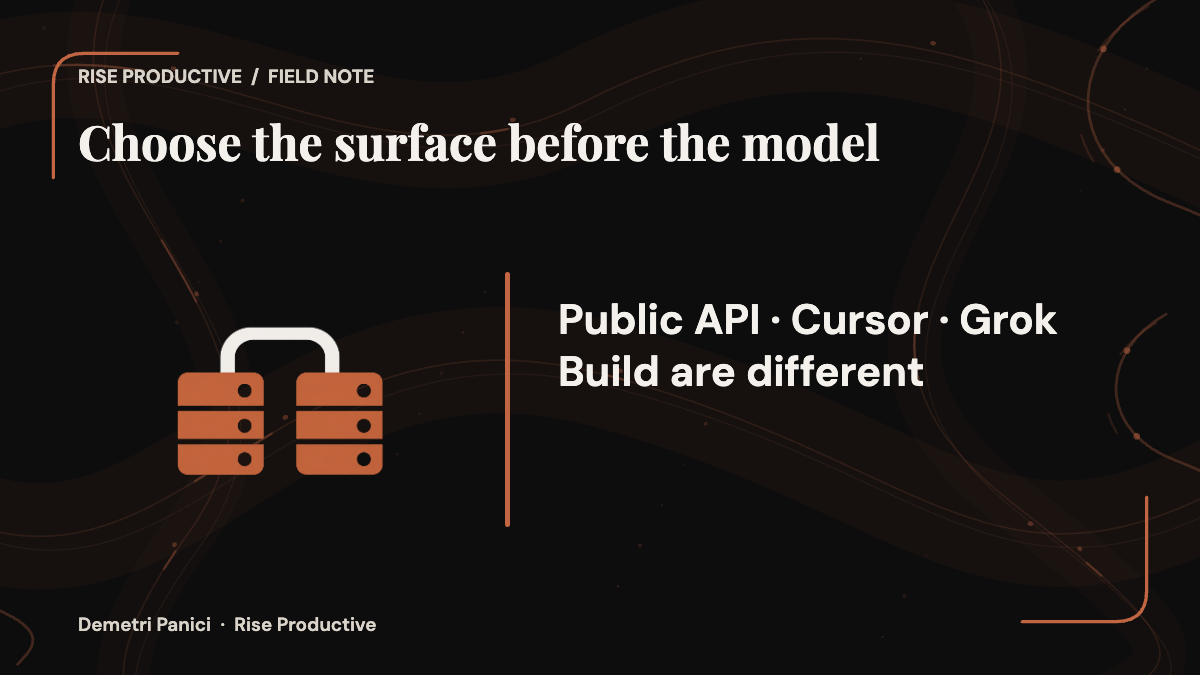
The public xAI API exposes the model as grok-4.7. The developer guide shows the Responses API, Chat Completions and xAI SDK examples, with standard request capabilities including function calling, web search, X search and code execution. The exact option depends on your existing stack and the interface features you need. Use the model guide and the API reference for the call shape you will ship, then pin it in your service and test it with the same SDK version used by your application.
Grok 4.7 is also listed in Cursor and Grok Build. The Fast variant is a separate deployment choice: xAI describes it as the same model on faster infrastructure, with higher rates. The docs say Fast is available in Cursor and Grok Build, billed through those plans, and not available through the public xAI API. If your architecture depends on an API call from your own service, do not design around the assumption that you can request grok-4.7-fast from that API. The name and surface matter as much as the model family.
This is a product boundary, not a minor configuration switch. A developer choosing an editor subscription can evaluate the included product experience. A team integrating a service needs the documented public API, its per-token billing, account limits and logging. The code can look similar while the ownership of history, tools, spend and policy differs. Document who hosts each step, who can inspect its inputs, and where an operator can stop a run.
 View image detail
Read the context price boundary before sending a large prompt
Grok 4.7 API context is the combined amount of input and generated output processed in one request, up to the published 500,000-token window. That maximum is not a recommended prompt size. A large window can help with a real task that needs a lot of repository state. It is not a reason to put every file, old conversation and tool result into every request. More context can add processing cost, increase the chance that irrelevant detail competes with the current task, and make a run harder to audit.
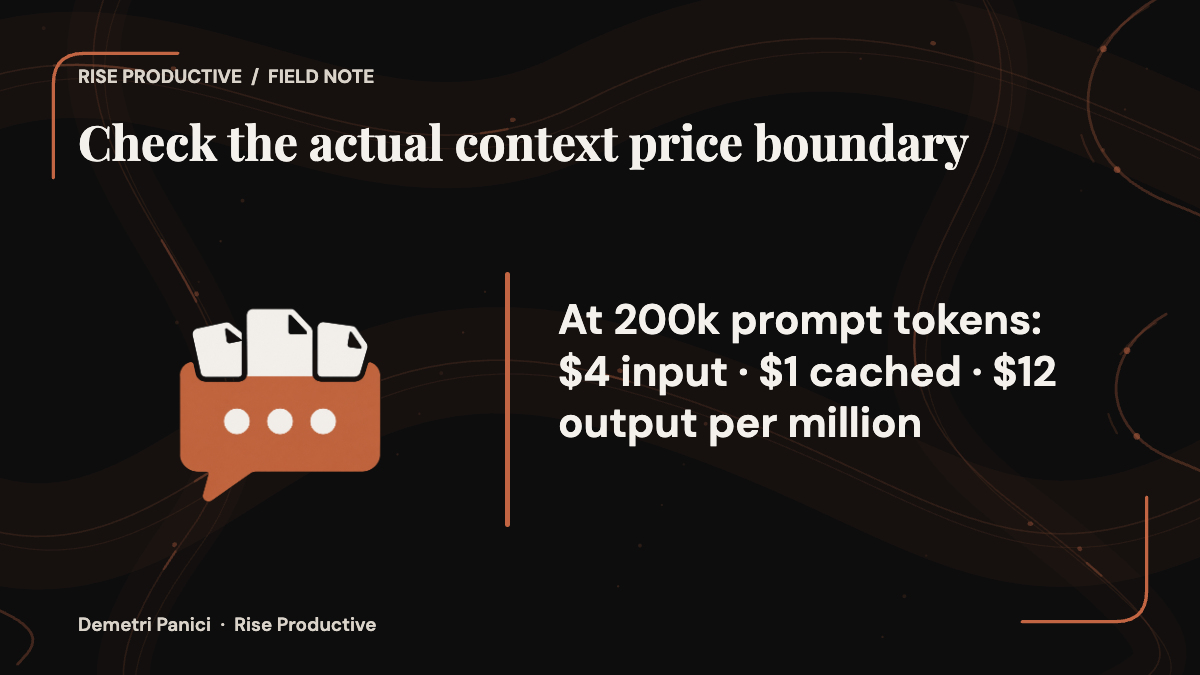
xAI's pricing page sets a long-context threshold at 200,000 prompt tokens. Below that threshold, the Grok 4.7 public API rates are $2 per million input tokens, $0.50 per million cached input tokens, and $6 per million output tokens. Once the prompt reaches 200,000 tokens, the listed long-context rates are $4, $1 and $12 respectively. xAI says requests that meet the threshold use the long-context rates for all tokens in that request. That means you should estimate the rendered prompt, including prior conversation, instructions, attached content and tool outputs, before assuming the lower rates apply.
A simple hypothetical example shows why this needs to be monitored. Suppose a request stays below the threshold and includes 120,000 uncached input tokens, 40,000 cached input tokens, and 20,000 output tokens. At the published rates, the token portion would be $0.24 + $0.02 + $0.12, or $0.38. These quantities are chosen only to illustrate the arithmetic. They are not a measured Grok 4.7 task, and your cache split and generated output could be very different.
Now consider a hypothetical 250,000-token prompt and 40,000 output tokens with no cache. Because the prompt crosses the threshold, the listed long-context prices imply $1.00 for input and $0.48 for output, or $1.48 total token cost for that request. The price difference is not a “large context penalty” on an identical input: the scenario has both a longer prompt and a different tier. It simply shows the consequence of crossing the documented boundary. If a real request approaches that size, calculate it using the actual token counts returned by the API and the applicable cache and output rates.
 View image detail
For each model call, log the model ID, prompt-token count, cached-token count, output-token count, reasoning effort, response status, tool calls, request ID, time and billed amount. Do not estimate a bill from the visible answer length. Tool loops can create several requests, and reasoning or hidden state may contribute tokens not visible as prose. Use the response usage and account billing record as the source of truth. Compare the expected calculation with actual account data before setting an automatic cap.
Design requests to reuse stable context
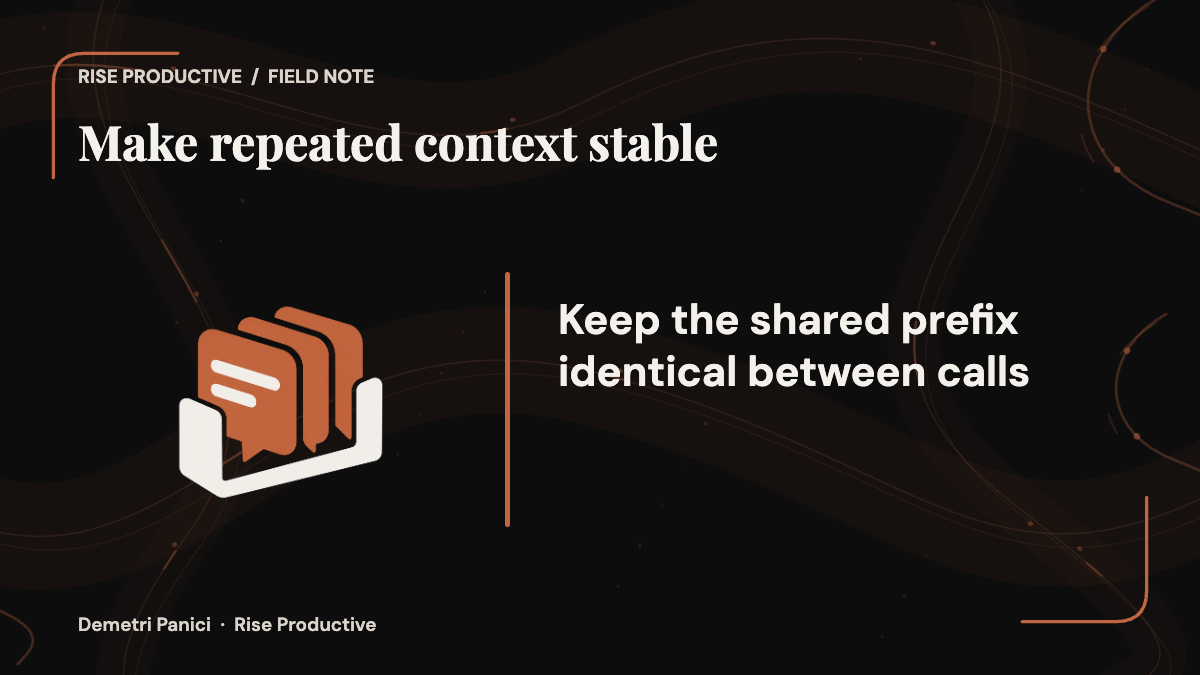
Prompt caching lets matching starting message prefixes in consecutive xAI API requests reuse cached input, according to its documentation. When consecutive requests share the exact same starting messages, matching initial messages can be served from cache. xAI recommends setting the x-grok-conv-id header to maximize cache-hit rate. Its Responses API guide also recommends prompt_cache_key. Treat these as tools to test, not magic flags that guarantee a discount.
Long-running coding agents often have a stable system instruction, repository conventions and tool descriptions, followed by task-specific content and the recent loop. Put the content that is genuinely stable at the beginning, preserve the exact prefix across calls, and put changing user input later. Avoid moving timestamps, request IDs, random values or freshly generated summaries into the front of the prompt. If those messages alter the initial sequence, they can prevent an otherwise reusable prefix from matching. Keep a conversation identifier consistent for the same ongoing conversation where the documentation recommends it. Keep the cache identity separate across tenants or tasks when their contexts should not be shared.
Inspect returned usage to confirm whether tokens were served from cache. If the reported cached-token count stays at zero, debug the request sequence before expecting savings. Look for reordered messages, changed system text, a different conversation ID, non-deterministic content in the prefix, or a switch to a provider that handles caching differently. Caching is a billing behavior, not proof that the right data was reused or that the agent remembered the right project state.
You also have to account for correctness and privacy. A cached prefix might contain internal instructions or repository conventions. Do not place tenant-specific secrets or data in shared prefixes. Keep authentication secrets out of prompts and tool outputs. Review retention and data policy for the surface you use; an API call, editor surface and third-party gateway can have different operating terms. Route only the data approved for that provider and account.
 View image detail
Keep long tasks compact without losing the work state
A multi-step agent cannot assume its entire transcript will remain a useful memory. Tool output grows, old hypotheses become stale, and past instructions may no longer describe the current task. Context compaction is xAI’s documented way to reduce a longer conversation into a compact item that can be passed back into a later request. It says the result preserves salient context while dropping verbose back-and-forth and tool output. The returned encrypted content is opaque and should be passed back unchanged rather than parsed or modified.
Compaction is not a substitute for durable application state. It is a smaller conversational continuation. Store the facts your workflow must recover independently: current task and acceptance criteria, branch or document identifiers, completed actions, test results, unresolved issues, tool permissions, budget, and the exact next action. The application should own these records. The model can summarize; it should not be the only copy of the state needed to recover from a timeout or process restart.
One pattern is to compact after a measured threshold rather than at an arbitrary fixed turn count. Track context size and the cost of resending prior messages. When the input begins to consume too much budget or the tool trace becomes mostly noise, ask whether the next request needs the full history. If the answer is no, create a concise current-state record. If a detail may determine whether a code change is safe, retain its source or a path back to it rather than asking a summary to stand in for the original evidence.
After compaction, run a continuity check. Give the agent the next task and ask it to identify the goal, completed checks, current branch or working file, constraints and stop condition before allowing an external action. Compare that answer with the durable state. A compact transcript can lose a critical qualification even if the model returns a confident recap. For risky steps, the host should require an explicit human review rather than rely on memory quality.
 View image detail
Choose reasoning effort as an experiment
The Grok 4.7 API guide lists low, medium, high and xhigh reasoning effort, with high as the default. This is a control to test on the task types you care about. It is not a guarantee that a higher setting will improve every output, and token use or latency may change with the task and configuration.
Start by defining the error consequence. A low-risk classification or a narrow transformation with a deterministic check may not need the same reasoning budget as a multi-file change with difficult constraints. For each representative task, record the model and effort setting along with the full harness. Compare completion quality, review time, output and reasoning token use, latency, retries and accepted result. If you change the effort after seeing one output, rerun the same task under comparable settings before claiming an improvement.
Avoid treating the highest setting as “production quality” by definition. A stronger attempt can still make a wrong assumption, use an incorrect tool, or produce a patch that passes a partial test. The host needs independent checks. A production policy should distinguish what the model may propose from what the application may execute.
 View image detail
Keep tools behind an application-owned permission boundary
Function calling lets a model request that your application run a function. The model does not itself grant the function permission or make the result safe. Your service should validate the tool name, arguments, identity, scope and state before executing it. Return only the information the model needs to continue, and audit what actually happened.
A coding agent can have a read-only exploration phase, a patch proposal phase and a human-approved write or merge phase. Rise Productive’s guide to where review should stay in unattended coding gives a related permission-envelope framework. Give the first phase only repository operations it needs, such as reading selected files, searching, or running safe tests. If it can edit a working tree, keep the changes in an isolated workspace. Avoid credentials that can alter production, publish packages, access unrelated client repositories or transmit data externally. The application should decide whether a tool call is allowed for the current user, task and environment; the prompt should not be the only access control.
Use the same principle for web search, X search and code execution. A model can request a search or calculation, but the host decides whether it is enabled, whether the result can be trusted, and whether the input contains sensitive material. Treat web pages, repository comments and tool output as untrusted content. They can contain instructions that try to redirect the agent. Keep the system's actual policy outside of content supplied by the user, a third party or a repository file.
OWASP's AI Agent Security Cheat Sheet offers general guidance on least-privilege tool access, untrusted inputs and checks for high-impact actions; it is not an evaluation of Grok 4.7.
For a task that can modify files, make the human decision visible: show the diff, tests, relevant tool trace and known limitations before approval. Require a person to approve merges, deployments, billing changes, customer data writes, access changes and other high-impact operations. A model that can work for longer still needs a well-defined point where it must stop.
 View image detail
Treat failures and retries as billable behavior
Long tasks fail in ways that a single successful response does not reveal. The network can time out after the provider received a request. A tool may return malformed data. The model may repeat a search or test without using the result. A run can hit a rate limit or spend cap. Your integration needs a distinct status for provider error, tool error, timeout, invalid model output, validation failure, user cancellation and budget exhaustion.
Before retrying, decide whether the previous action already took effect. A request to a read-only tool is usually easier to repeat than a function that writes a file or submits a payment. Use idempotency controls where the provider and tool support them. For a non-idempotent action, query the resulting state before deciding whether to retry. Do not let a timeout cause the same side effect to be executed twice.
Retry only when the error is eligible and the budget allows it. Use a bounded number of attempts with backoff, and preserve the original request and provider response ID for diagnosis. If the task is looping on the same failed check, stop and return the evidence to a human instead of paying for another version of the same mistake. Track repair calls and their tokens against the task's total cost. “The final answer succeeded” can otherwise hide five expensive retries.
A good user-facing status is specific: “The patch was generated, but the integration test did not pass, so no write or merge occurred.” It should identify what happened and what is waiting. Avoid reporting “done” when the agent produced code but the validation boundary failed.
 View image detail
An implementation checklist for a first deployment
Before enabling requests, record the exact model ID, SDK/API surface, account and rate limits, short- and long-context pricing, cache behavior and data rules. Decide whether the global endpoint is acceptable or whether a regional endpoint is required. The xAI pricing page says the US regional endpoint uses a 1.1 multiplier on token rates for Grok 4.7. That is a dated provider statement about its regional product; verify the current endpoint scope and terms against the documentation before making a data-location commitment.
For every job, persist the normalized task ID, source revision, acceptance criteria, model settings, current step and durable task state outside the conversation. Keep only the user-request details needed to resume. Protect logs and stored state as carefully as the source repository, and avoid retaining secrets or unnecessary private content.
Then exercise the request protocol with a small test set: normal completion, invalid arguments, provider timeout, tool failure, rate limit, context compaction, long-context price tier, cache hit and cache miss. Confirm that each response is parsed correctly and the application can recover its task state. Test destructive or non-idempotent tools separately with mocks before exposing them to an agent.
 View image detail
Calculate the cost you will actually monitor
Use request-level usage and the current price table to estimate tokens. Then compare that estimate with account billing after a real test. The account bill is the authority for what was charged. A model answer's visible word count is not enough: each call can include a prompt history, hidden reasoning, cached prefix and tool-result content. A multi-step workflow may make several model requests for one user-visible task.
For a long-running agent, group logs by a stable task ID. The summary should include total input, cache-hit and output tokens across every request, along with any platform or tool fees. Keep one row for the proposed token calculation and another for the actual charge. If they differ, investigate whether the prompt crossed 200k, caching worked as expected, a retry repeated an operation, or your calculation omitted a request. That discrepancy is not an accounting nuisance. It tells you something about how your application is using the model.
If a router, cloud partner or gateway sits in the path, verify whose price and data terms apply. A model-level rate table is not necessarily the price on every surface.
Set a per-task spend limit from the expected workload and an account-level alert for aggregate use. If a run reaches its limit, stop and preserve state instead of quietly switching to a more expensive model or a broader tool. Log any approved fallback as a separate route with its own measured cost.
 View image detail
Roll out in stages, with a way back
An implementation can be technically correct and still be a poor operating choice. Start in a sandbox with representative tasks and fake or resettable data. Test the API call shape, tool arguments, usage extraction and stop logic without granting access to a live customer system. Make one person responsible for reviewing the log and the patch.
Then shadow the existing workflow. The agent can produce a proposed answer or diff while the normal route remains in control. Compare outputs against the written acceptance rule and keep the current process as the fallback. Shadow mode should not send customer-facing messages, change billing records, alter permissions, publish content or merge code.
Move to a limited pilot only if shadow results support it. Name the eligible task class, users and approved data, then evaluate a full workflow against the acceptance rule. Record defects and correction effort, and distinguish work completed by the reviewer from work completed by the model.
Keep the pilot easy to turn off. Record how to revoke the model key, disable its tool functions, return to the previous route and recover active tasks. Preserve a queue of incomplete work and mark whether each task is waiting on a provider, a test or a person. Reliability includes the handoff when the agent cannot complete the work. A graceful stop is a better outcome than a confident answer attached to an unknown state.
 View image detail
Questions teams should settle before enabling it
Does 500,000 tokens mean I should send the whole project?
No. It is the stated maximum context, not an instruction to include every file. Select only the repository facts and files needed for the current task. Large requests have a different price tier after 200,000 prompt tokens, and unnecessary material can make the run less focused. Track the rendered prompt and response usage.
Can I use Grok 4.7 Fast through the xAI API?
The current xAI documentation says no. It lists Fast on Cursor and Grok Build, where it is billed through those plans. Check current product documentation before implementation because availability can change. Keep API and subscription-product assumptions separate in your architecture.
Does prompt caching guarantee that later calls cost less?
No. xAI says caching is automatic when consecutive requests share identical starting messages and recommends conversation identifiers for cache hits. Inspect reported cached tokens and actual billing. Changed prefixes or different request behavior can reduce cache reuse.
Does compaction preserve all details needed for an agent task?
The provider describes compaction as preserving salient conversation state, but a workflow should not depend on the model summary as its only record. Keep important task state in the host application, pass the returned compaction item back as documented, and verify continuation before allowing a high-impact action.
Is this an independent coding benchmark or a deployment guarantee?
No. The Grok 4.7 API guide describes the model and API. It does not guarantee the results of your application, security configuration, latency or task cost. Use a bounded evaluation with your own acceptance conditions to make those decisions.
The implementation choice is really about control
Grok 4.7's API is a fit only if the exact public API surface, context tier and host controls match the job. The long-context threshold can change the rate for the whole request, so use measured request and billing records before estimating spend. Rise’s rate-card analysis explains why a lower token price alone cannot settle a workflow decision. Keep the article's proposed test separate from a result: no Rise integration or Grok 4.7 pilot has been run here.
Checked for this article
Sources
Keep going
Related notes.

Systems and Workflows
Perplexity Agent API Connectors: What Can Shared Agents Access?
A project administrator can configure a connector once, but every application sharing that Project needs to understand the access boundary.
Read the article
Systems and Workflows
How to Set Safe Budgets for Exa Agent Ultra Research
Set an Exa Agent Ultra budget, duration and review gate with this practical preflight for safe handling of partial research results.
Read the article
Systems and Workflows
Base44 Base Code Security: GitHub Access and Shared Secrets
Before inviting collaborators, map Base Code workspace access, GitHub permissions, branch protections, shared secrets and merge authority.
Read the article