
Systems and Workflows
How to Govern AI Music Assets: Licensing, Stems, and Ownership
Deploying generative music in commercial campaigns creates serious legal exposure. Here is how to govern licensing tiers, stem copyright, and voice likeness risks.
On this page
- Commercial Licensing Tiers and Contractual Rights
- Free vs. Paid Generation Ownership
- The Critical Gap: Enterprise Indemnification
- Stem Ownership and Derivative Works: The Multi-Track Conundrum
- Copyrightability of Hybrid Audio
- Securing Chain of Title for Multitrack Assets
- Rights of Publicity and Vocal Likeness Risks
- Statutory Landscape: State and Federal Voice Protection Laws
- Proactive Guardrails Against Voice Infringement
- International Compliance and Regulatory Mandates
- EU AI Act Transparency Requirements
- Collective Bargaining and Guild Considerations
- The Enterprise AI Audio Governance Framework
- Stage 1: Centralized Intake and Account Consolidation
- Stage 2: Automated Legal and Technical Verification
- Stage 3: Clear Labeling and Disclaimers
- Stage 4: Long-Term Vault Archiving
- Insurance Underwriting: Mitigating AI Intellectual Property Liabilities
- Performing Rights Organizations and Royalty Administration
- The Problem of Mechanical and Performance Royalties
- Multi-Jurisdictional Cross-Border Enforcement
- Automated Audio Fingerprinting and Plagiarism Screening
- Algorithmic Royalties and Collective Management Organizations
- Legal Checklist for Corporate Counsel and Risk Officers
- Conclusion: Balancing Creative Velocity with Legal Security
- Sources
The rapid adoption of generative music platforms such as Suno v6 across advertising agencies, game development studios, film production companies, and corporate marketing teams has outpaced existing legal and compliance frameworks. In traditional audio production, copyright ownership, publishing royalties, synchronization licenses, and master recording rights follow century-old legal precedents governed by clear contractual chains of title.
When an artificial intelligence model synthesizes an original, commercial-grade musical track in sixty seconds, that traditional legal clarity vanishes. Who owns the underlying copyright: the platform vendor, the enterprise subscriber, or the public domain? How do commercial licensing tiers distinguish between social media background music and broadcast television advertising? What liabilities arise when an enterprise exports multitrack stems, isolates synthetic vocals, or mixes AI audio with human-performed tracks?
Furthermore, high-profile lawsuits brought by major record labels against generative audio companies create operational exposure for enterprise users. Without rigorous governance protocols, companies risk publishing marketing assets that could face copyright infringement claims, takedown notices, or catastrophic brand embarrassment.
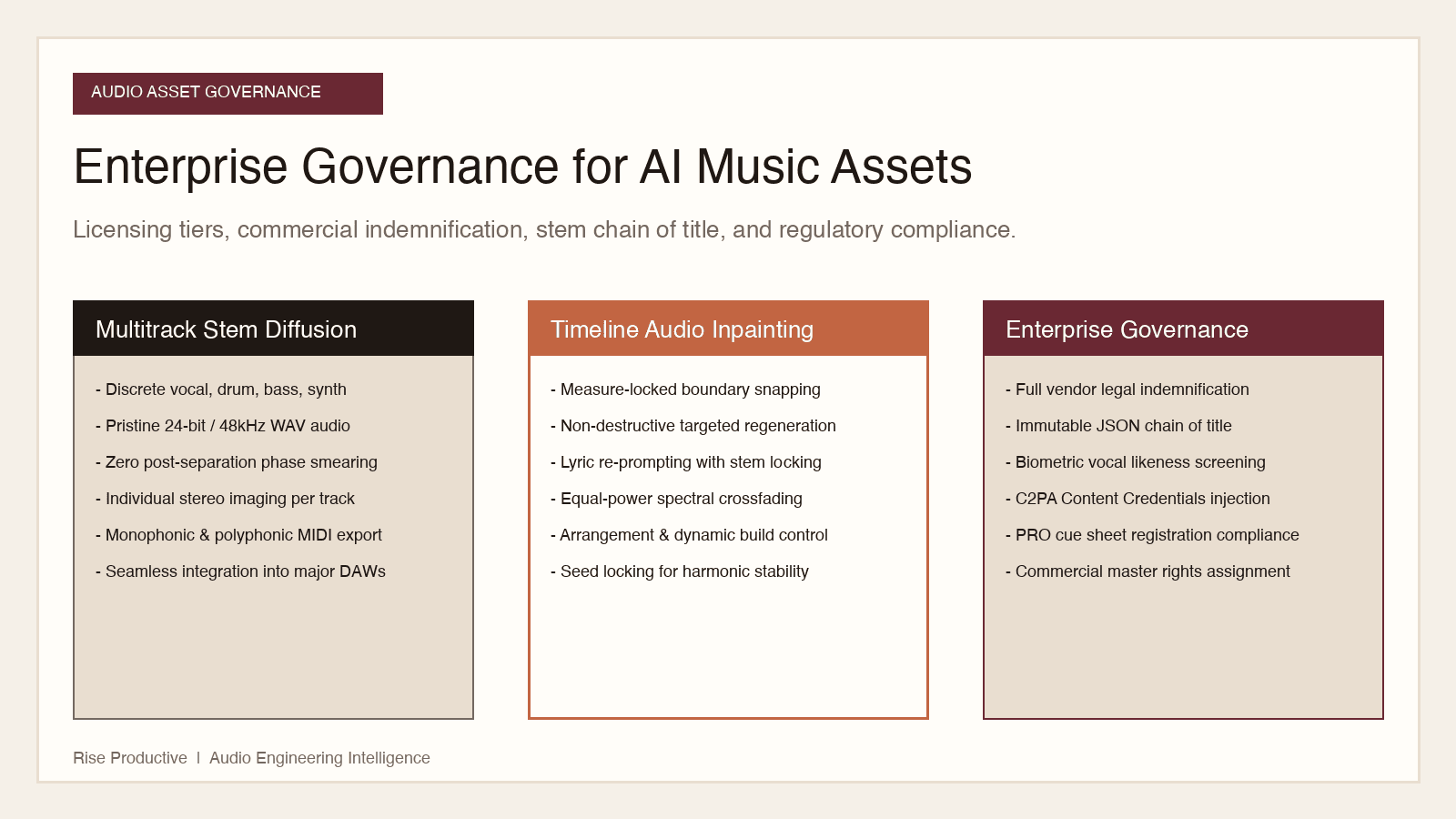
This comprehensive guide provides an enterprise governance framework for evaluating, licensing, managing, and auditing AI-generated music assets. We examine commercial subscription rights, training data indemnification clauses, stem ownership, chain-of-title documentation, and automated compliance tracking.
 View image detail
Commercial Licensing Tiers and Contractual Rights
The first line of defense in governing AI music is understanding the explicit terms of service of generative audio platforms. Most vendors operate multi-tier licensing structures where intellectual property rights depend entirely on the subscription tier active at the exact moment of generation.
 View image detail
Free vs. Paid Generation Ownership
Across major generative music providers, including Suno, the fundamental ownership split operates as follows:
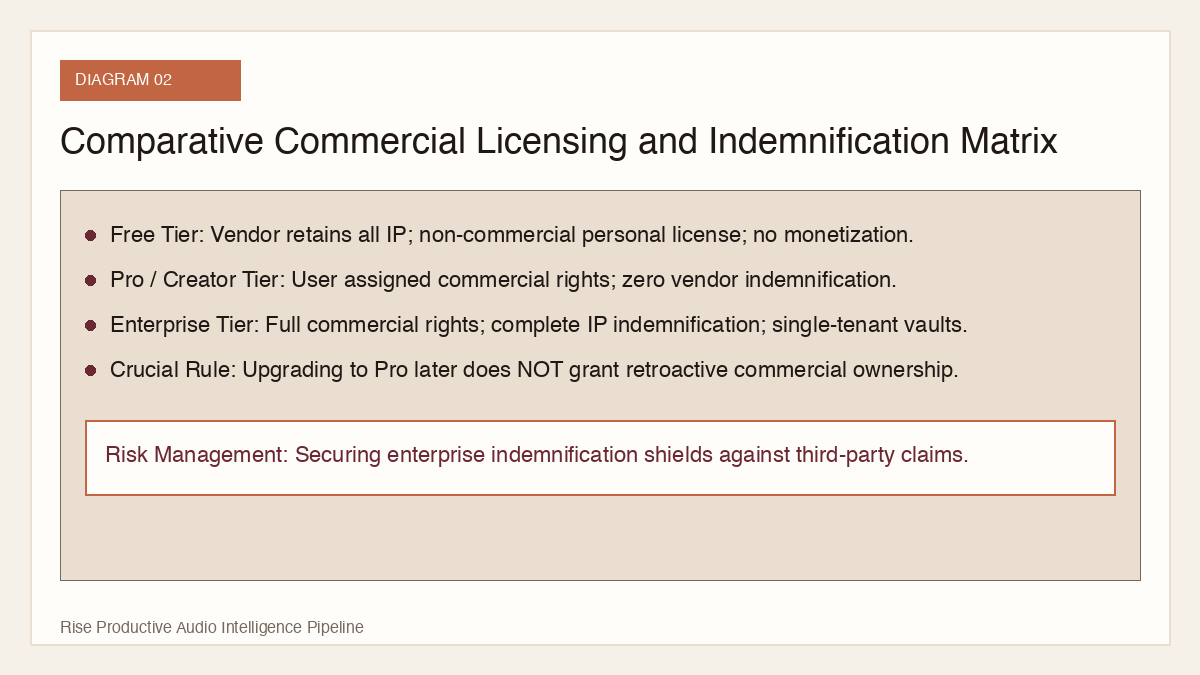
- Free Tier Generations: The vendor retains full copyright and commercial ownership of all musical tracks generated on free accounts. Free-tier users are granted a non-commercial, revocable license to share tracks for personal enjoyment or social non-monetized streaming. Crucially, upgrading to a paid tier later does not retroactively grant commercial rights to tracks created while on a free plan.
- Paid Tier Generations (Pro and Premier): Subscribers on paid plans are granted commercial ownership of the output recordings, allowing them to monetize tracks on streaming platforms (Spotify, Apple Music), license music for YouTube videos, and incorporate audio into commercial software.
The Critical Gap: Enterprise Indemnification
While standard Pro tiers grant commercial rights, they lack corporate indemnification. In the event that a third-party copyright holder claims an AI-generated song infringes on an existing musical composition or vocal performance, standard paid subscribers bear full legal liability.
Enterprise organizations must require:
- Complete Intellectual Property Indemnification: The platform vendor must defend, indemnify, and hold harmless the enterprise client against all claims, damages, and legal fees arising from allegations that the generated audio infringes third-party copyrights, trademarks, or rights of publicity.
- Representation of Non-Infringing Training Data: Explicit contractual warranties that the model training pipeline respected statutory copyright law, licensing agreements, or valid fair-use boundaries.
- Private Model Instances: Assurances that corporate prompts, imported proprietary audio stems, and internal marketing briefs are never incorporated into public training datasets or accessible to other platform users.
Key commercial and enterprise licensing tier distinctions:
- Free Tier: Commercial exploitation is strictly prohibited; vendor retains all master rights; zero indemnification; watermarked audio output only; public workspace feed.
- Pro / Creator Tier: Commercial exploitation permitted; master rights assigned to creator; no indemnification (creator assumes liability); stem export included; semi-private workspace.
- Enterprise Tier: Full commercial exploitation; comprehensive master rights assignment; full vendor hold-harmless indemnification; dedicated stem asset vault; isolated single-tenant private workspace.
 View image detail
Stem Ownership and Derivative Works: The Multi-Track Conundrum
With platforms like Suno v6 enabling the export of discrete multitrack stems (vocals, drums, bass, instruments), governance complexity multiplies. When an internal audio team takes an AI drum stem, combines it with an original human guitar riff, and hires a session vocalist to sing new lyrics, the resulting audio is a hybrid derivative work.
Copyrightability of Hybrid Audio
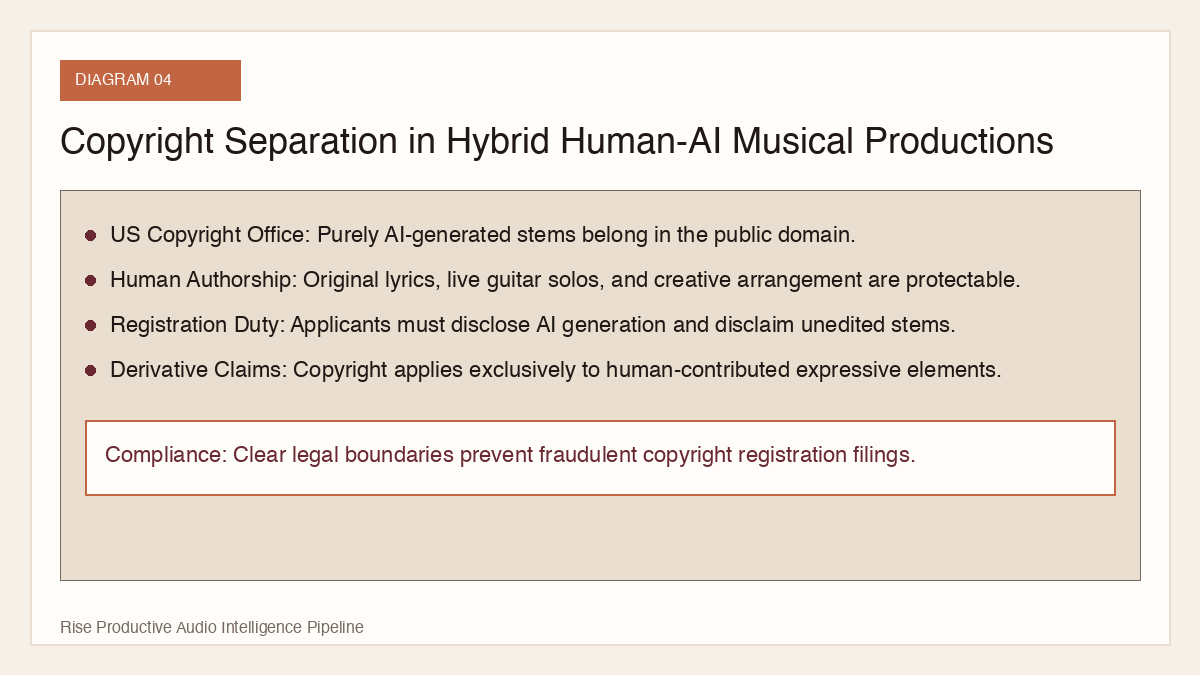
Under current guidelines established by the United States Copyright Office (USCO), purely AI-generated content devoid of human creative intervention is ineligible for statutory copyright protection. A complete song generated from a simple prompt like Upbeat electronic corporate pop belongs to the public domain in the eyes of statutory copyright law, even if the vendor's contract assigns you commercial ownership.
However, human creative arrangement and substantial modification remain copyrightable:
- Pure AI Stems: An isolated AI synth stem cannot be copyrighted as an independent musical composition.
- Human Contribution: Original human lyrics, human vocal performance, live guitar tracks, and creative arrangement decisions constitute human authorship and can be copyrighted.
- The Derivative Registration Requirement: When registering a hybrid work with the Copyright Office, the applicant has a legal duty to disclose the presence of AI-generated material and disclaim ownership of the unedited AI stems, claiming copyright exclusively over the human-authored components and original arrangement.
 View image detail
Securing Chain of Title for Multitrack Assets
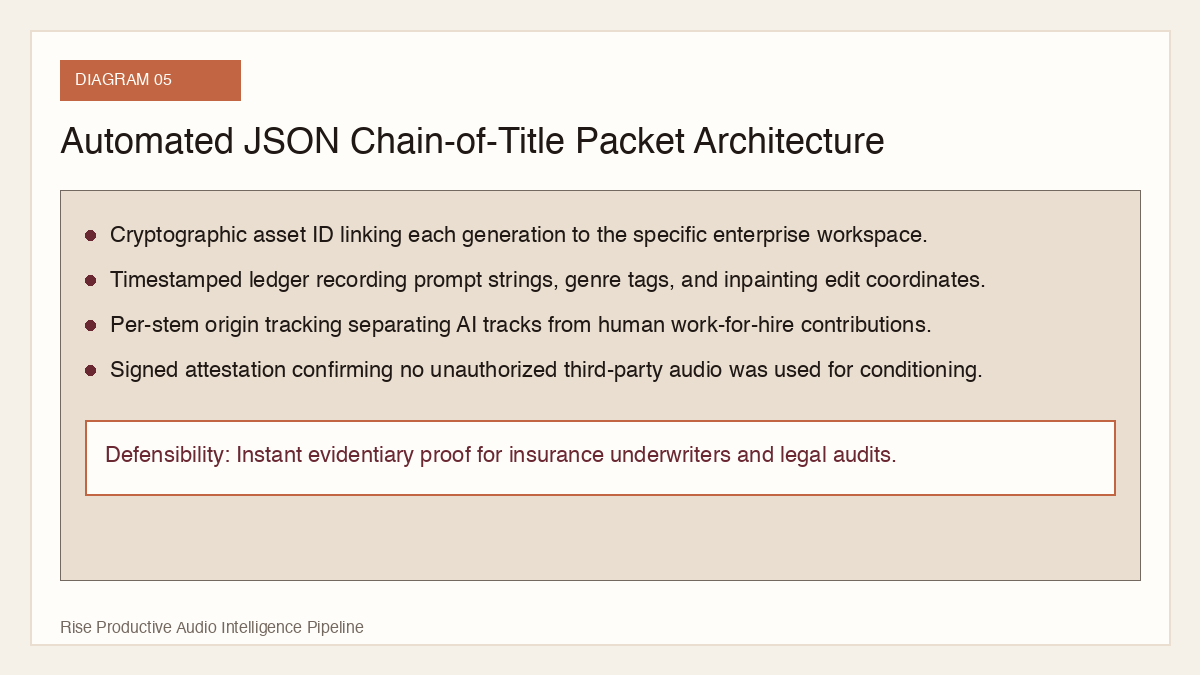
To maintain clean title across commercial productions, creative organizations must establish strict chain-of-title documentation for every stem track used in a project.
A production metadata packet must record:
- Asset Generation ID: The unique database hash generated by the AI platform.
- Account Credentials: The specific enterprise account and subscription plan active during creation.
- Complete Prompt History: The text prompt, genre tags, and lyrical input used to generate the audio.
- Inpainting Ledger: An audit log of all time-sliced inpainting passes, recording exactly which bars were regenerated and which remained original.
- External Sample Clearances: Documentation proving that any reference audio imported into the model for conditioning was 100 percent original or legally licensed.
```json
{
"chainOfTitle": {
"project": "Autumn Campaign 2026",
"trackTitle": "Horizon Shift",
"internalAssetId": "AUD_2026_9941",
"generationPlatform": "Suno v6 Enterprise",
"generationTimestamp": "2026-09-12T14:32:00Z",
"commercialLicenseType": "Enterprise Indemnified Tier",
"components": [
{
"stem": "drums",
"origin": "AI Generated (Suno v6)",
"hash": "sha256_99bba14e",
"humanModified": true,
"modifications": "Quantized, transient shaped, layered with acoustic shaker"
},
{
"stem": "vocals",
"origin": "Human Performer",
"performerName": "Jane Doe",
"contract": "Work-for-Hire Master Agreement #4410",
"aiAssisted": false
},
{
"stem": "bass",
"origin": "AI Generated (Suno v6)",
"hash": "sha256_88cca21f",
"humanModified": false,
"modifications": "Direct stem export with EQ notch at 120Hz"
}
]
}
}
```
 View image detail
Rights of Publicity and Vocal Likeness Risks
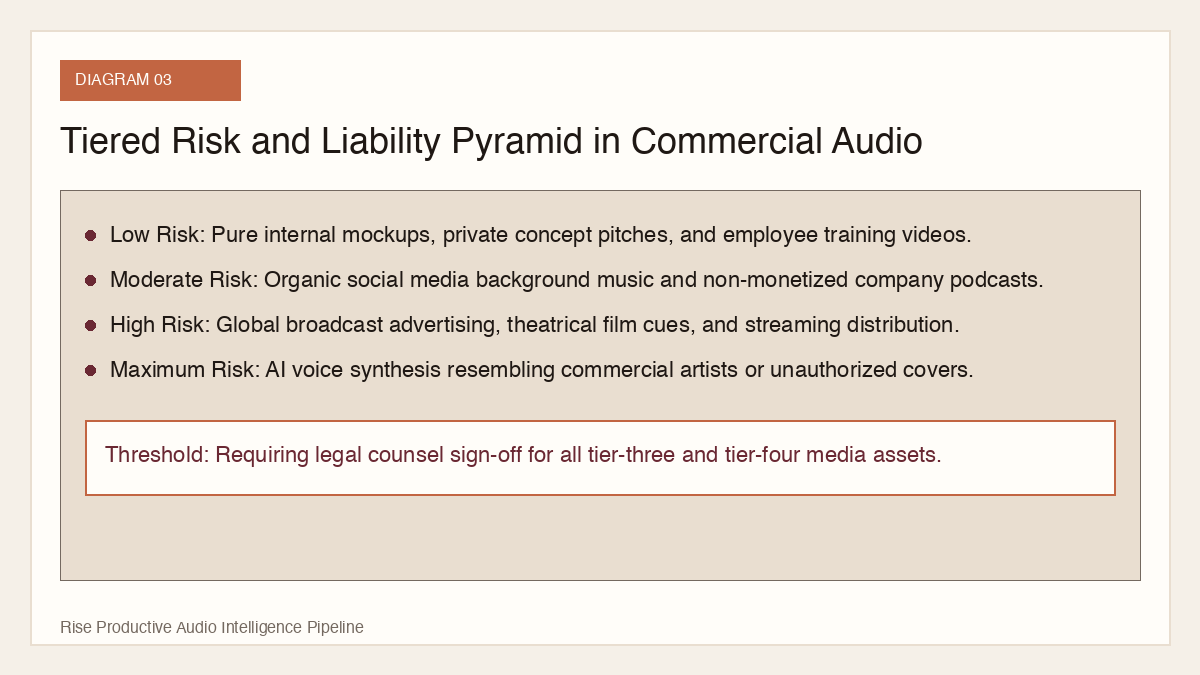
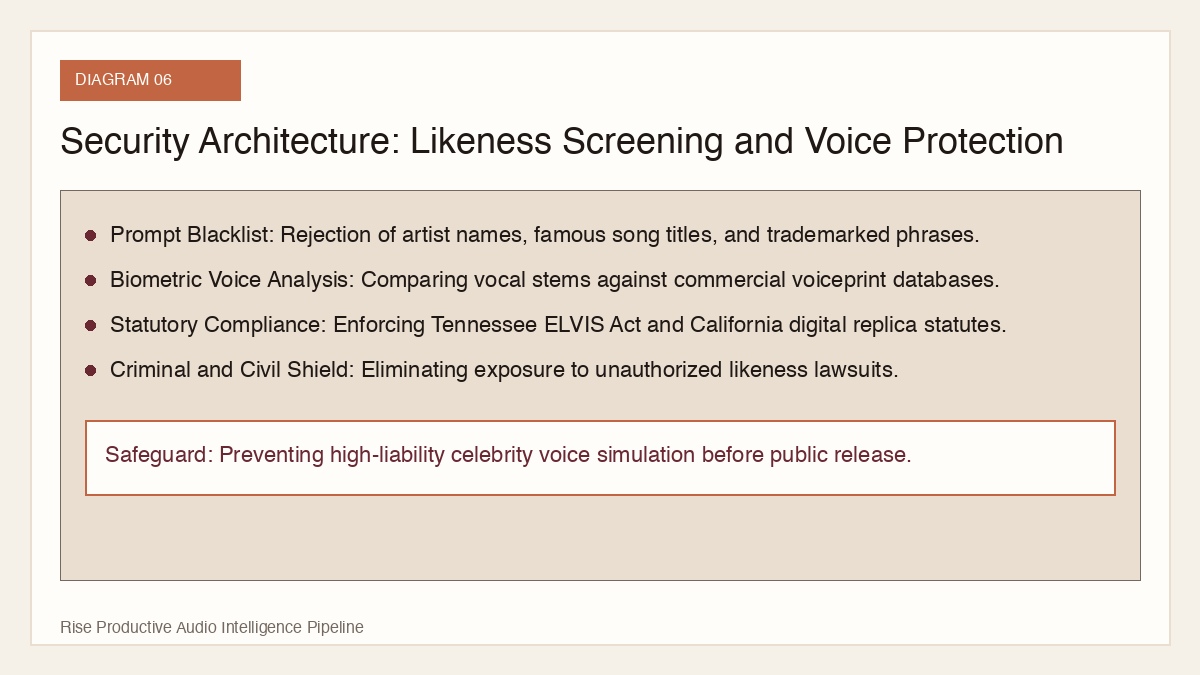
One of the most dangerous legal liabilities in AI music governance involves voice cloning and likeness infringement. Under emerging state and federal legislation (such as the ELVIS Act in Tennessee and federal right-of-publicity statutes), generating music that mimics the distinct vocal timbre, cadence, or artistic style of a recognizable commercial artist without consent creates severe civil and criminal liability.
Statutory Landscape: State and Federal Voice Protection Laws
The legal framework protecting personal voice and artistic identity has expanded dramatically:
- The Tennessee ELVIS Act (Ensuring Likeness Voice and Image Security): Explicitly extends property rights to an individual voice, making unauthorized commercial voice simulation a Class A misdemeanor and exposing advertisers to statutory damages.
- California AB 2602 and AB 1836: Restricts the use of digital voice replicas in entertainment contracts without informed, represented consent, and protects deceased performers likeness rights for 70 years following death.
- Federal NO FAKES Act Proposals: Federal statutory frameworks establishing an exclusive federal intellectual property right in human voice and visual likeness, enforceable against unauthorized commercial generative audio.
Proactive Guardrails Against Voice Infringement
Enterprise production pipelines must enforce strict guardrails at both the prompt level and the audio analysis level:
- Negative Prompting and Blacklists: Automated prompt filtering that rejects any input containing names of living or deceased artists, band names, famous song titles, or trademarked phrases (for example, rejecting
In the style of Taylor SwiftorDrake vocal cadence). - Acoustic Biometric Screening: Before an AI track is approved for commercial broadcast, run the isolated vocal stem through an acoustic fingerprinting service to verify that the voice does not match known commercial artists within a statistical similarity threshold.
- Synthetic Voice Attestation: Require internal creators to sign a legal attestation verifying that they did not upload unauthorized voice recordings of third parties to condition the model.
 View image detail
International Compliance and Regulatory Mandates
Operating global marketing campaigns requires complying with international artificial intelligence directives, most notably the European Union Artificial Intelligence Act (EU AI Act).
EU AI Act Transparency Requirements
Under Title IV of the EU AI Act, providers and deployers of generative AI audio systems must adhere to strict transparency mandates:
- Mandatory Watermarking and Machine-Readable Disclosure: Synthetic audio files made available to the public must be labeled in a machine-readable format that discloses the artificial nature of the content.
- Cryptographic Provenance Standards: Broadcasters and streaming platforms increasingly require Content Credentials (C2PA) metadata embedded directly into audio container files (WAV, FLAC, MP3). These credentials record cryptographic signatures verifying the tool used, generation timestamp, and editing history.
- Takedown Liabilities on Social Platforms: Platforms like YouTube, Meta, and TikTok now require creators to disclose generative audio during upload. Failure to disclose AI music can result in automated demonetization, algorithmic suppression, or account suspension.
Collective Bargaining and Guild Considerations
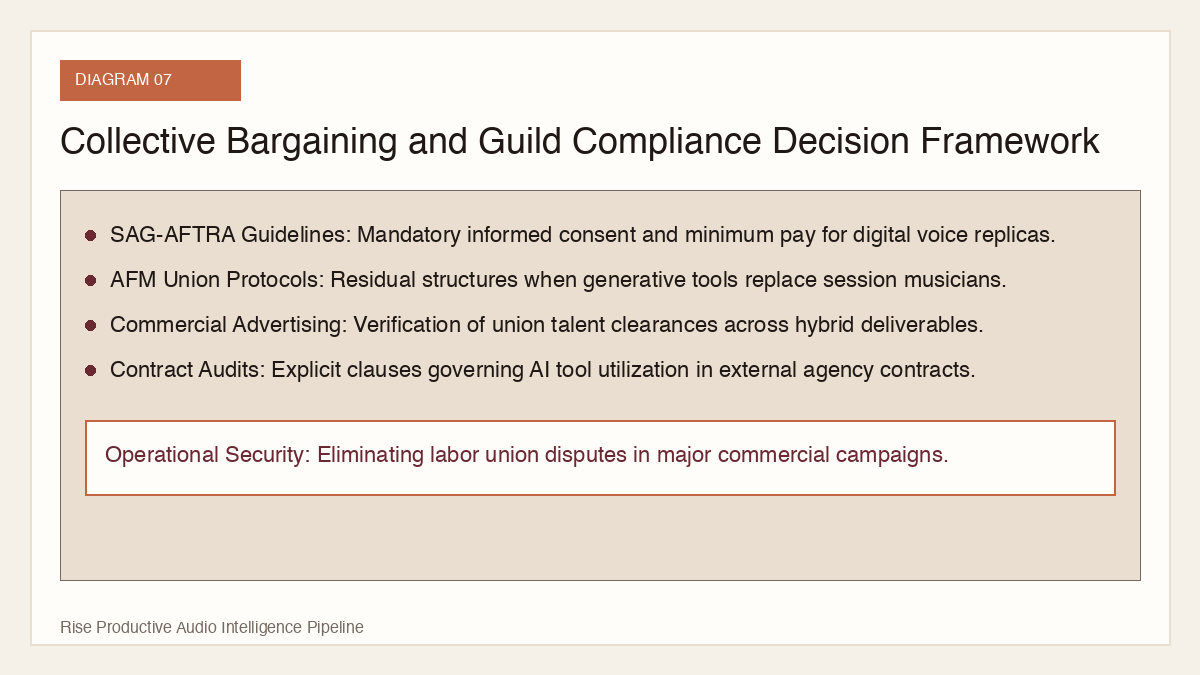
When enterprises operate in entertainment, film, gaming, or high-tier advertising, AI music workflows must navigate collective bargaining agreements:
- SAG-AFTRA Interactive Media Agreement: Sets clear guardrails requiring explicit consent, minimum compensation, and specific usage descriptions whenever generative tools are used to create or alter voice performances in video games.
- American Federation of Musicians (AFM) Agreements: Requires production studios to consult with union representatives and pay established residual formulas when generative audio tools replace human session musicians in theatrical films or television series.
 View image detail
The Enterprise AI Audio Governance Framework
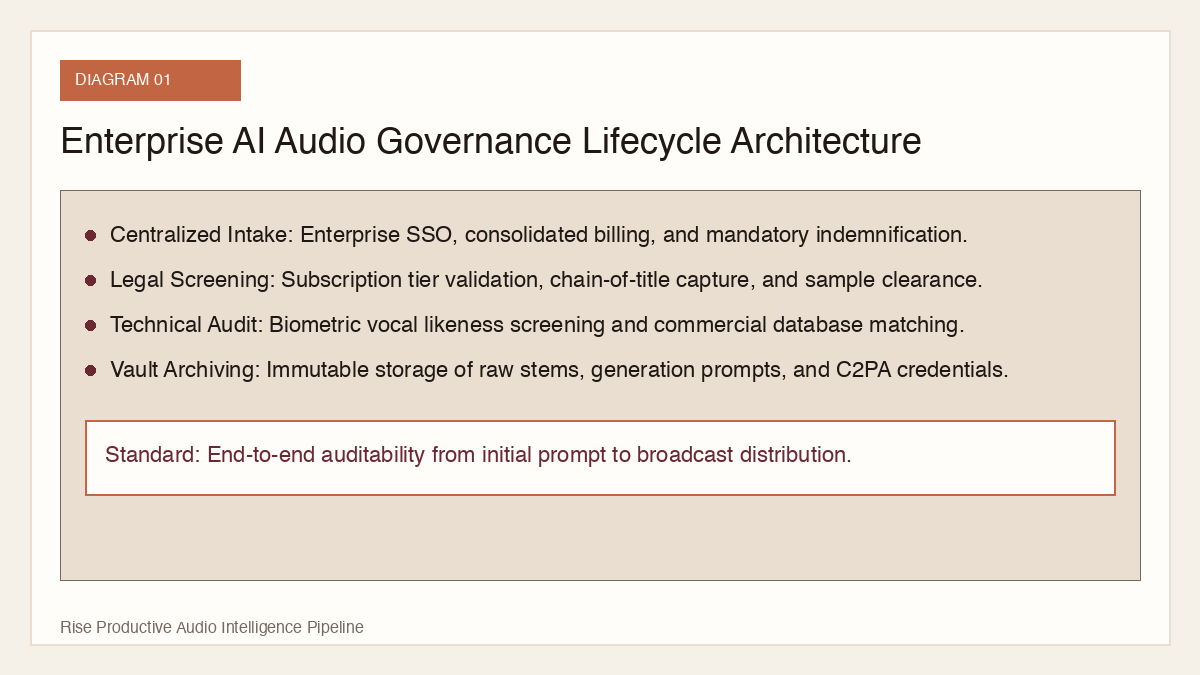
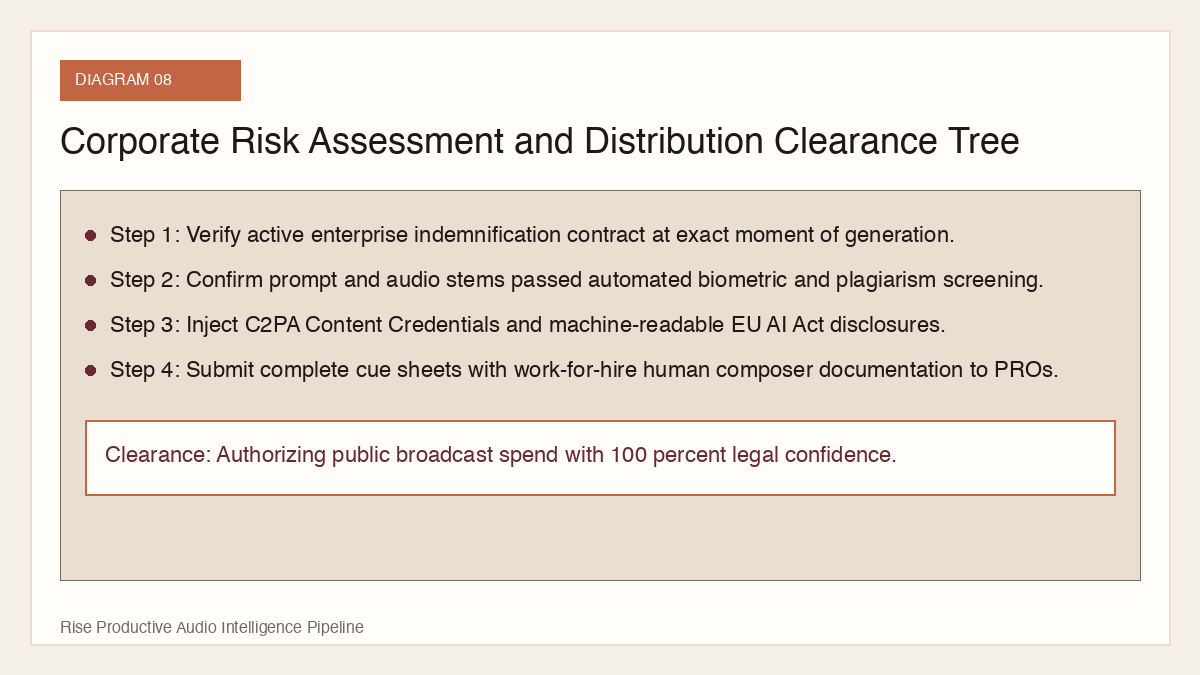
To operationalize these principles across marketing, product, and creative departments, organizations should implement a four-stage governance framework:
Stage 1: Centralized Intake and Account Consolidation
Eliminate shadow AI generation across decentralized personal accounts. All generative audio production must occur within managed enterprise accounts with centralized single sign-on (SSO), role-based access control (RBAC), and mandatory indemnification terms. Personal subscriptions must never be reimbursed for commercial deliverables.
Stage 2: Automated Legal and Technical Verification
Every completed audio track must pass an automated clearance checklist before entering video editing or broadcast workflows:
- License Verification: Confirm active enterprise subscription status at time of generation.
- Likeness Clearance: Pass vocal stems through biometric similarity scanners.
- Originality Check: Run the composition through digital fingerprinting databases (such as Audible Magic or Shazam) to ensure no accidental melodic plagiarism occurred.
Stage 3: Clear Labeling and Disclaimers
Adhere to emerging regulatory requirements regarding AI content transparency. In broadcast, streaming, and European Union markets, audio assets generated primarily through AI systems must carry appropriate metadata tags (such as C2PA Content Credentials or digital watermarks) declaring the use of generative synthesis.
Stage 4: Long-Term Vault Archiving
Store all raw stem files, prompt histories, generation seeds, and chain-of-title JSON records in an immutable enterprise digital asset management (DAM) vault. If an infringement claim arises three years after a campaign launch, having the complete cryptographic audit trail ensures that the enterprise can invoke vendor indemnification and defend its commercial chain of title.
 View image detail
Insurance Underwriting: Mitigating AI Intellectual Property Liabilities
As intellectual property risks proliferate, enterprise risk management teams are actively incorporating AI liabilities into corporate insurance policies:
- Media Liability and Errors and Omissions (E&O): Ensure your commercial general liability or specialized media liability policies explicitly cover claims arising from generative artificial intelligence outputs.
- Vendor Representations in Policy Riders: Insurers frequently demand warranties that the enterprise utilizes licensed vendor tools with indemnification clauses and maintains immutable chain-of-title documentation for all generated assets.
Performing Rights Organizations and Royalty Administration
A frequently overlooked operational risk in enterprise audio governance is navigating the rules of Performing Rights Organizations (PROs) such as ASCAP, BMI, and SESAC in the United States, or PRS for Music and SACEM in Europe.
The Problem of Mechanical and Performance Royalties
When commercial advertising campaigns air on television, radio, or digital streaming platforms, networks automatically generate cue sheets that log all musical cues. These cue sheets are submitted to PROs to distribute performance royalties to registered composers and publishers.
If a production team submits a cue sheet naming an AI tool as the composer or author, PRO registration systems reject the filing. Current PRO rules require human natural persons to be registered as songwriters and copyright claimants.
Enterprise governance must enforce standard operating procedures for cue sheet filings:
- Work-for-Hire Composer Attachment: When hybrid tracks are created (combining human arrangement with AI stems), the internal sound designer or staff composer must be credited as the arranger and author of the derivative work.
- Production Music Library Agreements: If enterprise teams license AI tracks from commercial platforms, ensure the license terms include a 100 percent buyout of public performance rights, eliminating secondary claims from third-party collecting societies.
- Accurate Cue Sheet Categorization: Mark AI background beds as non-dramatic background music (BI) rather than feature vocal performances (VF) on standard cue sheet submissions.
Multi-Jurisdictional Cross-Border Enforcement
For multinational enterprises distributing media campaigns across global markets, governance must account for conflicting international legal doctrines:
- United States: The Copyright Office strictly enforces the human authorship requirement, refusing copyright registration to unedited AI tracks while permitting copyright over human arrangements.
- European Union: Under the EU AI Act and national copyright laws, transparency disclosures are legally binding. Furthermore, individual member states like Germany and France enforce strict moral rights (Droit Moral) that cannot be waived by contract.
- United Kingdom: The UK Copyright, Designs and Patents Act 1988 (Section 9(3)) contains unique provisions granting copyright protection to computer-generated works, designating the author as the person by whom the arrangements necessary for the creation of the work are undertaken.
When clearing global advertising campaigns, creative counsel must verify that audio assets comply with the most restrictive jurisdiction in the distribution footprint.
Automated Audio Fingerprinting and Plagiarism Screening
Before any generated audio asset is cleared for enterprise deployment, it must pass through an automated technical screening gauntlet:
- Acoustic Waveform Hashing: Generate Chromaprint and AcoustID acoustic fingerprints across both the full stereo master and isolated stems.
- Commercial Database Cross-Matching: Query enterprise digital fingerprinting databases (such as Audible Magic, Shazam, and YouTube Content ID) to verify that the generated composition does not accidentally reproduce copyrighted melodies, riffs, or protected sound recordings.
- Neural Embedding Similarity: Compute deep latent audio embedding distances against known commercial pop repertoires. If cosine similarity between a generated vocal melody and an existing commercial hit exceeds 0.82, flag the track for manual review by an independent musicologist.
Algorithmic Royalties and Collective Management Organizations
As generative audio proliferates across digital streaming platforms, collective management organizations and mechanical licensing collectives are deploying real-time acoustic recognition systems to identify automated track submissions. Media enterprises that rely on background music beds for branded video campaigns must navigate complex mechanical royalty clearance protocols.
When registering hybrid productions with rights organizations such as ASCAP, BMI, or PRS for Music, production leads must ensure that documentation clearly differentiates between synthetic stem layers and human compositional contributions. Falsely attributing 100 percent human songwriting credits to purely generative stems can result in account suspension, statutory copyright fraud claims, or retroactive royalty clawbacks. Establishing an immutable internal registry of production session logs, prompt histories, and stem export receipts guarantees that corporate legal teams can substantiate all registered metadata during automated audit sweeps.
Legal Checklist for Corporate Counsel and Risk Officers
Before clearing any generative audio asset for public distribution or paid media spend, corporate counsel should confirm:
- The commercial agreement contains explicit intellectual property indemnification and warranties of non-infringing training data.
- The chain of title explicitly disclaims pure AI generation and identifies the specific human authorial contributions in hybrid works.
- Vocal stems have passed automated acoustic biometric fingerprinting to prevent likeness claims under state voice protection statutes.
- C2PA Content Credentials or digital watermarks have been embedded in compliance with EU AI Act Title IV transparency mandates.
- All cue sheets submitted to Performing Rights Organizations clearly identify human composers or list tracks as buyout production beds.
Conclusion: Balancing Creative Velocity with Legal Security
Generative audio models like Suno v6 offer unprecedented speed and flexibility for modern content production. However, commercial velocity without governance is an unacceptable business risk.
By establishing clear licensing guidelines, securing vendor indemnification, documenting stem-level chain of title, and screening against rights-of-publicity violations, enterprises can harness the creative power of AI music while ensuring their brand, assets, and bottom line remain completely protected.
Sources
- Suno Official Release Notes: Introducing Suno v6: Multimodal Song Creation and Targeted Audio Editing
- Suno Creator Blog: Stem Separation, Audio Inpainting, and Timeline Control in Suno v6
Checked for this article
Sources
Keep going
Related notes.
Systems and Workflows
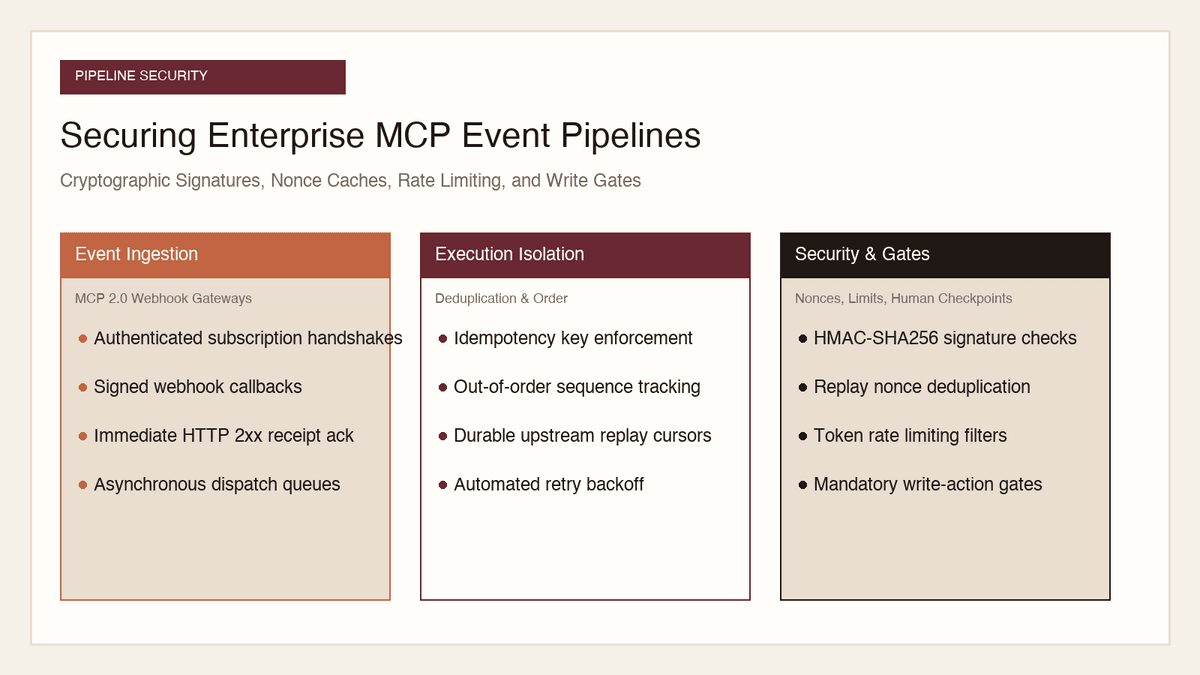
How to Secure MCP Event Pipelines: Signatures, Nonces, Rate Limits
Opening inbound webhook ingress to autonomous AI agents creates severe attack surfaces. Here is how to secure MCP event pipelines with signatures, nonces, and gates.
Read the article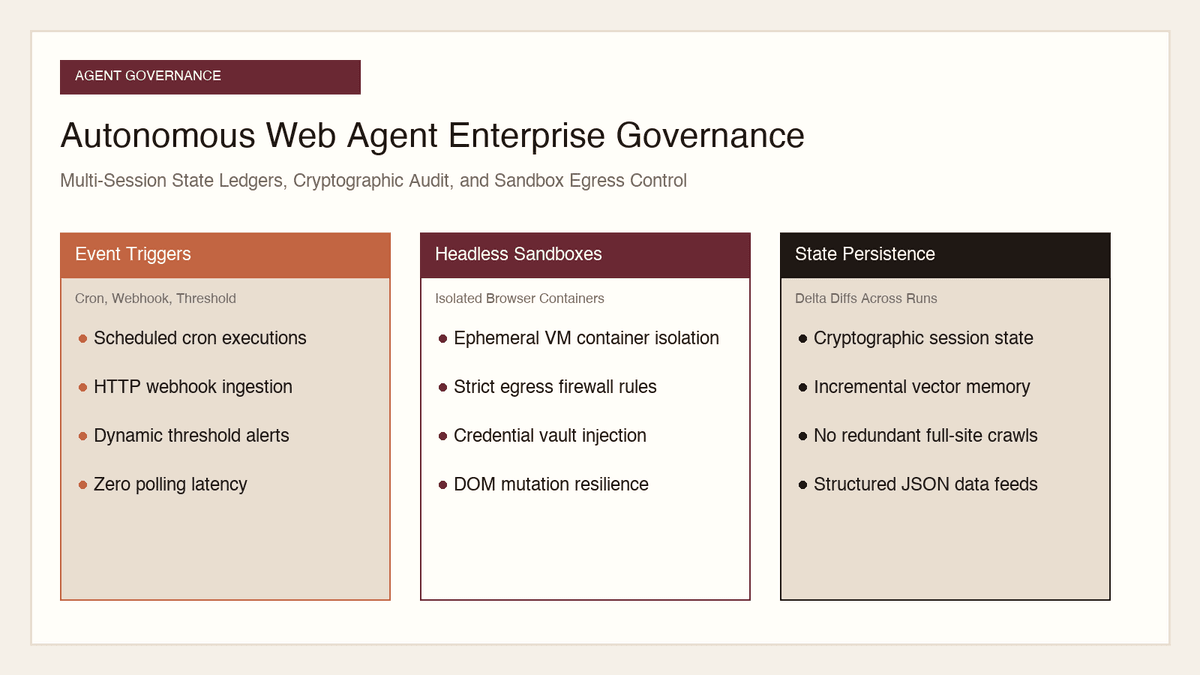
Systems and Workflows
How to Govern Autonomous Web Agents: Session State, Audit, Security
Allowing autonomous browser agents to navigate the open internet creates severe liability. Here is how to govern multi-session state, audit logs, and egress security.
Read the article
Systems and Workflows
ChatGPT Team Tasks Permissions: Who Owns Connections and Runs?
A shared task needs more than a creator. Map who owns its connections, who reviews its run, and who resolves access or source failures before the team depends on it.
Read the article