
Systems and Workflows
How to Secure MCP Event Pipelines: Signatures, Nonces, Rate Limits
Opening inbound webhook ingress to autonomous AI agents creates severe attack surfaces. Here is how to secure MCP event pipelines with signatures, nonces, and gates.
On this page
- The Four Pillars of MCP Event Pipeline Security
- Cryptographic Signature Verification
- Structure of the X-MCP-Signature Header
- Timestamp Freshness Validation
- Constant-Time Digest Comparison
- Replay Attack Mitigation and Distributed Nonce Architectures
- The Replay Threat Vector
- Distributed Nonce Deduplication with Redis
- Multi-Region Nonce Synchronization
- Two-Stage Human Authorization Gates for Sensitive Mutations
- Classifying Tool Permissions
- The Proposal-Approval-Execution Workflow
- Token Rate Limiting and Denial-of-Service Defense
- Multi-Tiered Throttling Architecture
- Implementing the Token Bucket Algorithm
- Secret Rotation and Key Lifecycle Management
- The Dual-Verification Protocol
- Threat Vector Analysis and Mitigation Controls
- Security Incident Response Playbook for Compromised Webhooks
- Scenario 1: Signature Verification Failure Spike
- Scenario 2: Suspected Secret Key Exposure
- Scenario 3: Indirect Prompt Injection Detection
- Enterprise Production Readiness Checklist
- Conclusion: Defense-in-Depth for Event-Driven AI
- Sources
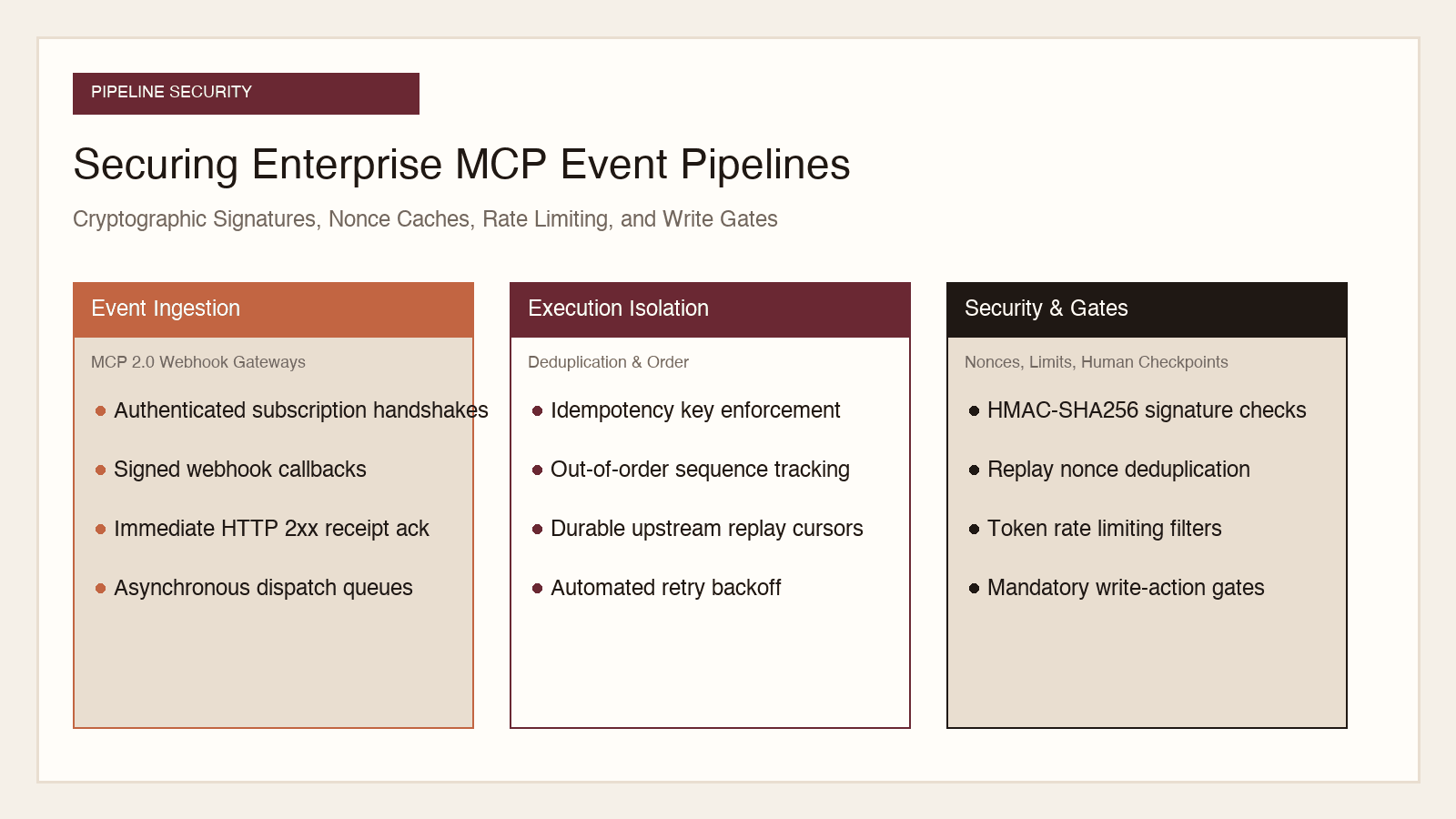
Connecting autonomous AI models to enterprise infrastructure unlocks unprecedented automation, but introducing event-triggered webhooks creates substantial attack surfaces. When an agent can inspect telemetry, query databases, or execute administrative workflows based on inbound event triggers, an unsecured event pipeline becomes an open door for payload tampering, replay attacks, resource exhaustion, and indirect prompt injection.
Securing Model Context Protocol (MCP) event pipelines requires moving far beyond simple API keys. Engineering teams must implement a comprehensive defense-in-depth framework that safeguards every stage of the event lifecycle, spanning transport encryption, cryptographic payload signing, distributed replay suppression, multi-tenant rate limiting, and strict human authorization gates.
This guide provides an end-to-end security architecture for engineering teams deploying MCP Events in production. We examine cryptographic signature verification, replay protection using distributed nonces, token bucket rate limiting algorithms, zero-downtime secret rotation, and operational readiness checklists.
 View image detail
The Four Pillars of MCP Event Pipeline Security
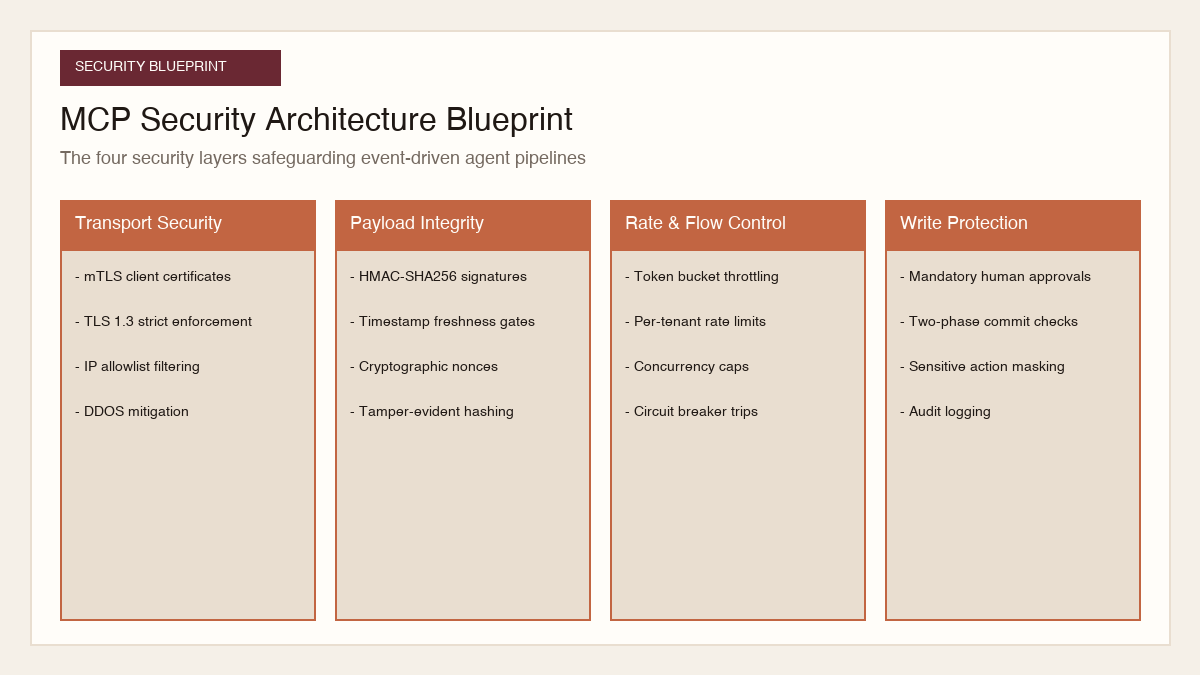
To protect autonomous agent environments against malicious manipulation and systemic failure, security leads must enforce four synchronized defensive layers:
- Transport and Network Hardening: Enforces strict TLS 1.3 encryption across all communication links, mandates mutual TLS (mTLS) for private enterprise gateways, and restricts ingress traffic through IP allowlists and Cloudflare Web Application Firewall (WAF) filtering.
- Cryptographic Payload Integrity: Utilizes HMAC-SHA256 signatures with timestamp binding and constant-time digest comparison to guarantee that event payloads cannot be forged, intercepted, or tampered with in transit.
- Ingress Flow and Concurrency Control: Implements token bucket and sliding window rate limiters at both global and per-tenant layers to neutralize denial-of-service floods and prevent upstream broker queue exhaustion.
- Execution Isolation and Write Governance: Restricts AI tool execution to safe read-only queries by default, while requiring signed human approval tokens before executing any state-modifying database write or cloud mutation.
Implementing these four pillars ensures that even if an attacker bypasses perimeter network defenses, internal cryptographic verification and execution guardrails prevent unauthorized agent actions.
 View image detail
Cryptographic Signature Verification
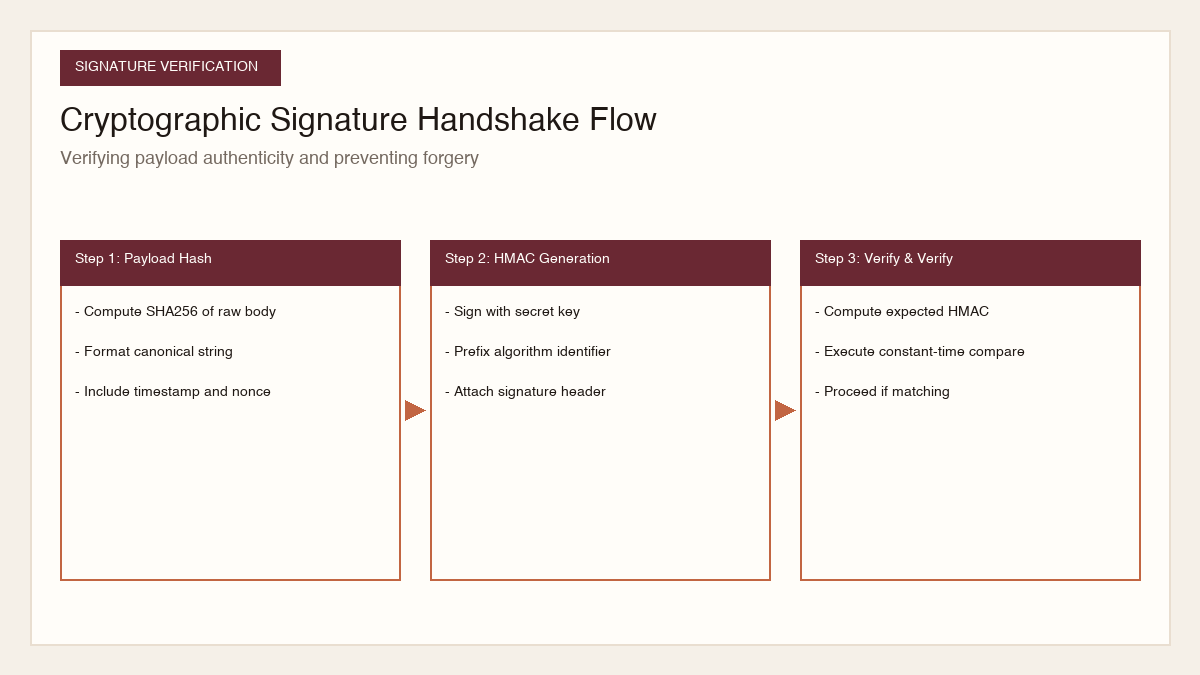
Every incoming MCP event must be treated as untrusted until its cryptographic signature is verified against a pre-shared enterprise secret.
Structure of the X-MCP-Signature Header
The sending application constructs the X-MCP-Signature header adhering to the Model Context Protocol 2.0 specification:
```
X-MCP-Signature: t=1727635335,v1=9f8a3c2e1b4d5f6a7b8c9d0e1f2a3b4c5d6e7f8a9b0c1d2e3f4a5b6c7d8e9f0a
```
Where:
- t: The UNIX timestamp (in seconds) representing when the event payload was signed by the upstream source.
- v1: The hexadecimal HMAC-SHA256 digest computed over the concatenation of the timestamp, a delimiter, and the raw, unparsed request body string.
Timestamp Freshness Validation
Before evaluating the cryptographic signature, the receiving gateway must inspect the timestamp parameter to prevent delayed replay attacks.
The verification service computes the difference between current server time and the timestamp header:
- If the timestamp is older than 300 seconds (5 minutes), the event is rejected immediately with HTTP 400 Bad Request.
- If the timestamp is in the future by more than 30 seconds (accounting for acceptable NTP clock drift), the event is similarly rejected.
This temporal freshness window limits the window of opportunity for intercepted payloads to be re-transmitted by an adversary.
Constant-Time Digest Comparison
A critical implementation pitfall in webhook verification is the use of standard equality operators (such as JavaScript === or Python ==). Standard string equality checks evaluate characters sequentially and terminate at the first non-matching byte, leaking execution time discrepancies that attackers can exploit via timing attacks to iteratively guess valid signatures.
Verification gateways must always employ constant-time comparison algorithms:
```typescript
import { createHmac, timingSafeEqual } from 'crypto';
import { Request, Response, NextFunction } from 'express';
export function verifyMcpSignatureMiddleware(secret: string) {
return (req: Request, res: Response, next: NextFunction) => {
const signatureHeader = req.headers['x-mcp-signature'] as string;
if (!signatureHeader) {
return res.status(401).json({ error: 'Missing signature header' });
}
const headerParts = Object.fromEntries(
signatureHeader.split(',').map(entry => entry.split('='))
);
const timestamp = headerParts.t;
const receivedDigest = headerParts.v1;
if (!timestamp || !receivedDigest) {
return res.status(400).json({ error: 'Malformed signature header' });
}
// Enforce 300-second freshness window
const now = Math.floor(Date.now() / 1000);
const eventTime = parseInt(timestamp, 10);
if (Math.abs(now - eventTime) > 300) {
return res.status(400).json({ error: 'Timestamp out of acceptable bounds' });
}
// Compute expected HMAC-SHA256
const rawBody = (req as any).rawBody;
if (!rawBody) {
return res.status(500).json({ error: 'Raw body missing from request context' });
}
const hmac = createHmac('sha256', secret);
hmac.update(timestamp + '.' + rawBody);
const expectedDigest = hmac.digest('hex');
// Constant-time comparison
const receivedBuffer = Buffer.from(receivedDigest, 'utf8');
const expectedBuffer = Buffer.from(expectedDigest, 'utf8');
if (receivedBuffer.length !== expectedBuffer.length || !timingSafeEqual(receivedBuffer, expectedBuffer)) {
return res.status(403).json({ error: 'Signature verification failed' });
}
return next();
};
}
```
Notice that the raw body buffer must be extracted before body-parser or JSON middlewares modify formatting, indentation, or character escaping.
Replay Attack Mitigation and Distributed Nonce Architectures
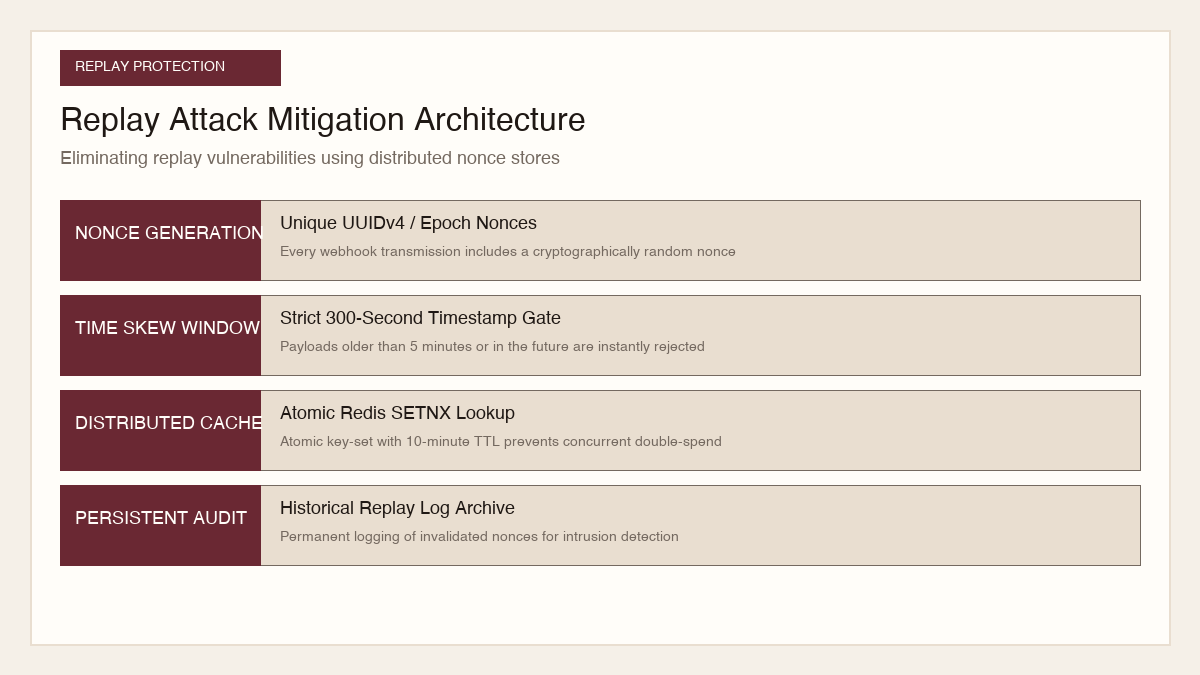
Even with valid HMAC signatures and 300-second freshness windows, an attacker who intercepts a legitimate webhook transmission within that 5-minute window could theoretically replay the packet multiple times, causing repeated agent actions or resource exhaustion.
 View image detail
The Replay Threat Vector
Consider an automated billing event that triggers an agent to issue a refund or a deployment event that restarts a microservice cluster. If an adversary captures the signed webhook and replays it 50 times within 180 seconds, the signature remains mathematically valid unless explicit nonce deduplication is enforced.
Distributed Nonce Deduplication with Redis
To eliminate replay risks, every MCP event payload includes a unique nonce or event ID attribute. The verification gateway tracks seen nonces in a distributed in-memory cache (such as Redis) using atomic operations.
```typescript
import { Redis } from 'ioredis';
export async function validateAndStoreNonce(
redisClient: Redis,
nonce: string,
ttlSeconds: number = 600
): Promise<boolean> {
const nonceKey = 'mcp:nonce:' + nonce;
// Atomic SET if Not Exists with Expiration
const result = await redisClient.set(nonceKey, '1', 'EX', ttlSeconds, 'NX');
// If result is null, the key already existed, indicating a replay attempt
return result === 'OK';
}
```
By setting the nonce TTL to 600 seconds (twice the 300-second timestamp freshness window), the gateway guarantees that once an event timestamp expires, any delayed replay is rejected by the freshness gate, while any rapid replay within the window is rejected by the atomic Redis nonce check.
Multi-Region Nonce Synchronization
For globally distributed enterprise deployments operating across multiple AWS regions or cloud providers:
- Regional Nonce Replicas: Local Redis instances process incoming requests with sub-millisecond latency.
- Global Conflict Resolution: Nonce writes are asynchronously broadcast across regions using Redis Enterprise Active-Active or Amazon DynamoDB global tables.
- Clock Drift Compensation: NTP synchronization across all cluster nodes must be maintained within 50 milliseconds using AWS Time Sync Service or Google Cloud NTP.
Two-Stage Human Authorization Gates for Sensitive Mutations
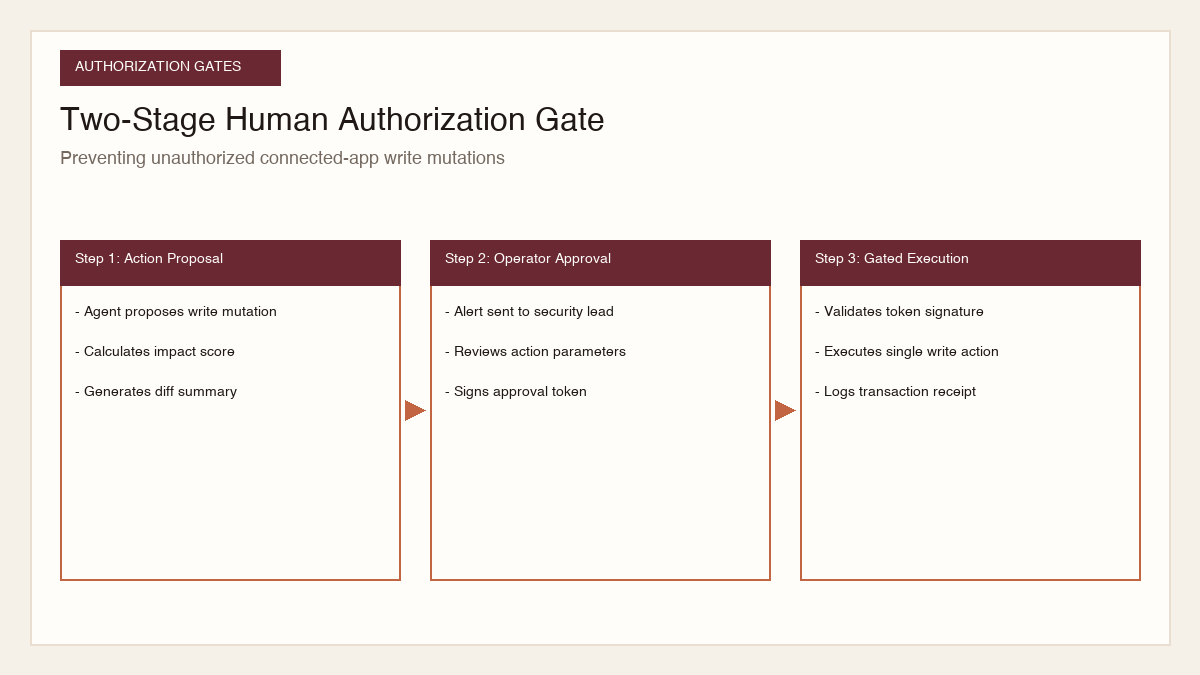
Autonomous agents excel at retrieving information, synthesizing logs, and generating root-cause analyses. However, granting agents unconstrained permission to modify production databases, alter firewall rules, or delete customer data introduces catastrophic operational risk.
 View image detail
Classifying Tool Permissions
Every MCP tool exposed to ChatGPT must be categorized into one of two operational tiers:
- Tier 1: Read-Only Query Tools:
- Examples:
get_system_metrics,query_audit_logs,search_knowledge_base,fetch_ticket_status. - Security Profile: Autonomous execution permitted without human intervention.
- Tier 2: Write Mutation Tools:
- Examples:
restart_database_cluster,update_firewall_rule,issue_customer_refund,drop_database_table. - Security Profile: Autonomous execution prohibited. Requires a cryptographically signed human authorization token.
The Proposal-Approval-Execution Workflow
When an agent concludes that a write mutation is required to resolve an event:
- Proposal Generation: The agent formulates the requested tool call, including exact parameters, expected outcome, and rollback instructions.
- Token Creation: The plugin backend packages the proposal into an approval ticket, computes a cryptographic approval hash, and dispatches an alert to the engineering team via Slack, Teams, or PagerDuty.
- Human Review: An authorized operator inspects the proposed action, reviews the diff, and clicks Approve or Reject.
- Signed Token Verification: The operator approval signs an authorization token with a 15-minute lease duration. The agent receives the signed token and submits it to execute the tool.
- Execution and Audit: The tool gateway validates the human signature and executes the mutation, recording the transaction in an immutable audit ledger.
```typescript
export interface HumanApprovalToken {
ticketId: string;
proposedTool: string;
toolParametersHash: string;
approverId: string;
expiresAt: number;
approverSignature: string;
}
export function verifyHumanApproval(
token: HumanApprovalToken,
actualTool: string,
actualParams: any,
publicVerificationKey: string
): boolean {
// Check token expiration
const now = Math.floor(Date.now() / 1000);
if (now > token.expiresAt) {
return false;
}
// Verify tool name match
if (token.proposedTool !== actualTool) {
return false;
}
// Verify parameter integrity hash
const computedHash = createHmac('sha256', 'salt')
.update(JSON.stringify(actualParams))
.digest('hex');
if (computedHash !== token.toolParametersHash) {
return false;
}
// Verify cryptographic signature
return verifyDigitalSignature(token, publicVerificationKey);
}
```
This two-stage gate guarantees that human operators retain ultimate control over enterprise state changes while allowing agents to autonomously perform the heavy lifting of diagnostic research.
Token Rate Limiting and Denial-of-Service Defense
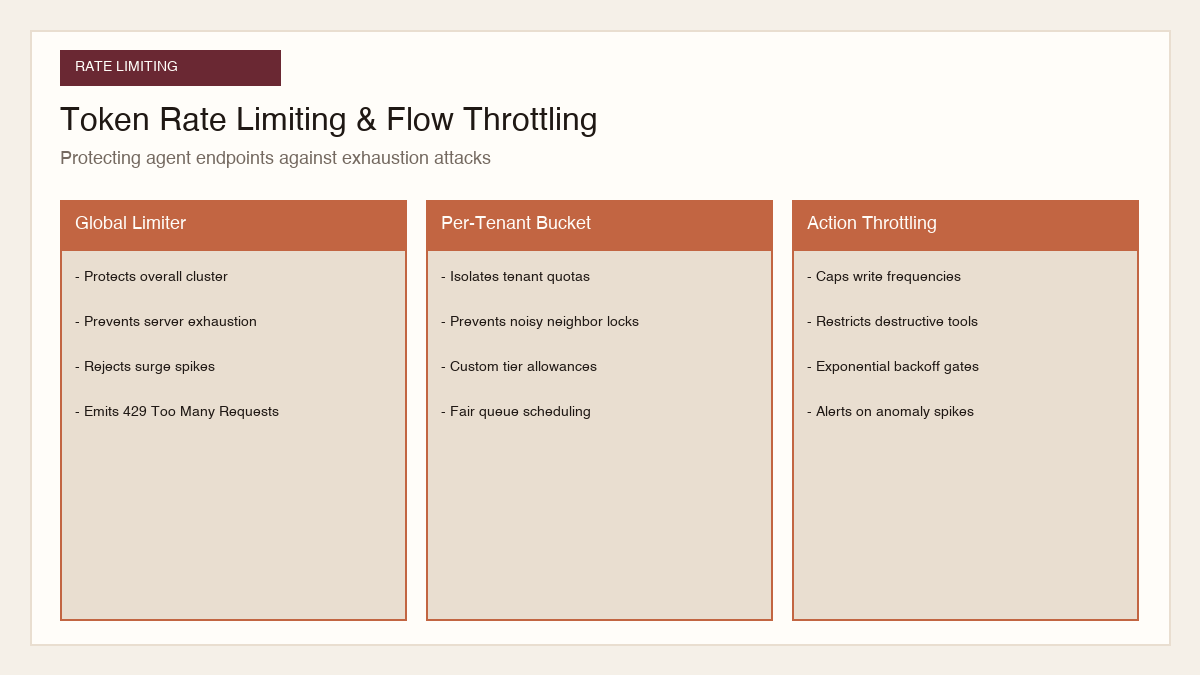
Because webhooks trigger downstream LLM inference and database queries, unsecured webhook receivers are prime targets for resource exhaustion attacks. Flooding an endpoint with hundreds of forged or repetitive events can rapidly exhaust OpenAI API budgets and crash worker pools.
 View image detail
Multi-Tiered Throttling Architecture
Resilient MCP architectures enforce rate limiting across three distinct layers:
- Edge Layer: Network-level DDoS mitigation managed by Cloudflare or AWS Shield, dropping malicious volumetric traffic before it reaches application servers.
- Ingress Gateway Layer: Global rate limiting applied across the entire webhook receiver cluster to protect downstream message queues from memory exhaustion.
- Tenant Layer: Granular token bucket limits enforced per subscription ID or tenant key, ensuring that a single misconfigured or compromised client cannot degrade service for other tenants.
Implementing the Token Bucket Algorithm
The token bucket algorithm provides the ideal balance between handling legitimate burst traffic and enforcing strict sustained throughput limits:
```typescript
export class TokenBucketLimiter {
private redis: Redis;
constructor(redisClient: Redis) {
this.redis = redisClient;
}
async checkLimit(
tenantId: string,
capacity: number,
refillRatePerSec: number
): Promise<{ allowed: boolean; remainingTokens: number }> {
const key = 'ratelimit:' + tenantId;
const now = Date.now();
const luaScript = `
local key = KEYS[1]
local capacity = tonumber(ARGV[1])
local refillRate = tonumber(ARGV[2])
local now = tonumber(ARGV[3])
local data = redis.call('HMGET', key, 'tokens', 'lastRefill')
local tokens = tonumber(data[1])
local lastRefill = tonumber(data[2])
if not tokens then
tokens = capacity
lastRefill = now
else
local elapsed = (now - lastRefill) / 1000
tokens = math.min(capacity, tokens + elapsed * refillRate)
lastRefill = now
end
if tokens >= 1 then
tokens = tokens - 1
redis.call('HMSET', key, 'tokens', tokens, 'lastRefill', lastRefill)
redis.call('EXPIRE', key, 3600)
return {1, math.floor(tokens)}
else
redis.call('HMSET', key, 'tokens', tokens, 'lastRefill', lastRefill)
redis.call('EXPIRE', key, 3600)
return {0, 0}
end
`;
const result = await this.redis.eval(luaScript, 1, key, capacity, refillRatePerSec, now) as [number, number];
return {
allowed: result[0] === 1,
remainingTokens: result[1]
};
}
}
```
When an event exceeds rate limits, the gateway returns an HTTP 429 Too Many Requests response with standard RFC 7807 problem details and a Retry-After header indicating when the client may retry.
Secret Rotation and Key Lifecycle Management
Static secrets inevitably leak or degrade over time. Enterprise compliance frameworks (such as SOC 2 Type II and ISO 27001) mandate regular cryptographic key rotation without incurring application downtime.
 View image detail
The Dual-Verification Protocol
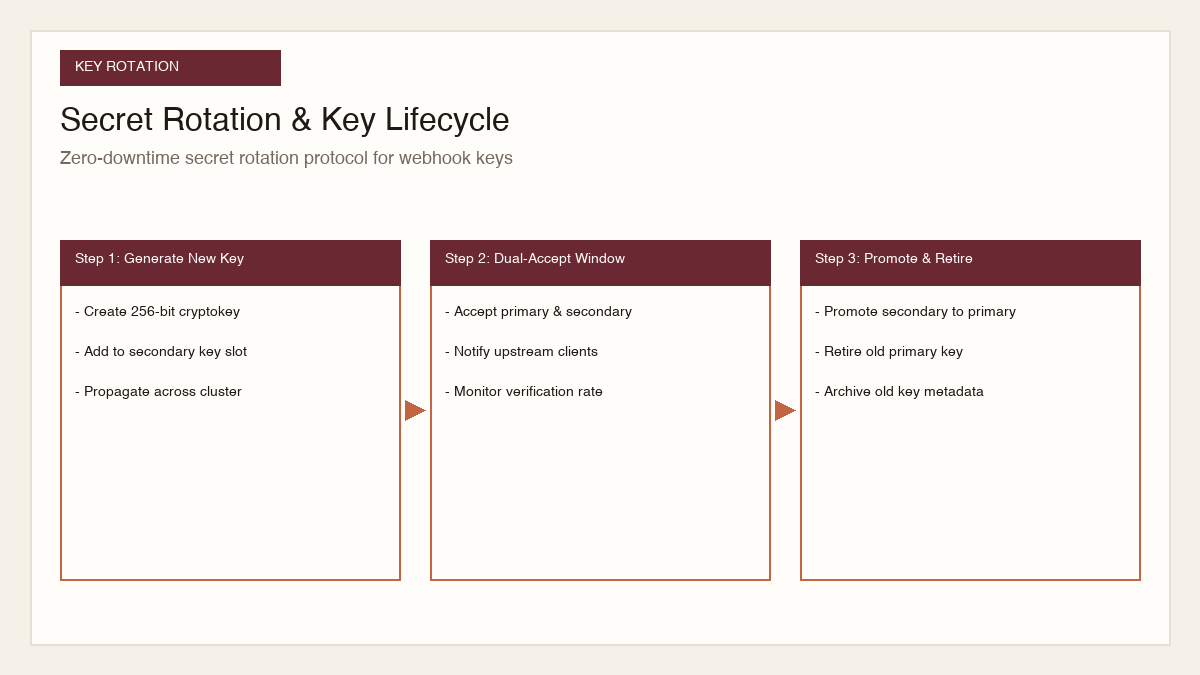
To rotate webhook secrets without dropping valid in-flight event transmissions, the verification gateway supports a dual-key evaluation window:
- Primary and Secondary Key Slots: The verification gateway maintains two active keys: KEY_PRIMARY and KEY_SECONDARY.
- Rotation Window Activation: When a rotation is initiated, a new 256-bit cryptokey is generated and placed in the KEY_SECONDARY slot.
- Dual-Verification Evaluation: The gateway attempts verification against KEY_PRIMARY first. If verification fails, it immediately attempts verification against KEY_SECONDARY.
- Client Propagation: The upstream sending application is updated with the new key.
- Promotion and Retirement: Once telemetry confirms that 100 percent of inbound requests are successfully validating against the new key, KEY_SECONDARY is promoted to KEY_PRIMARY, and the old key is permanently revoked and archived.
This zero-downtime rotation protocol ensures that enterprise systems can rotate secrets every 90 days or immediately following suspected compromises without disrupting continuous operational monitoring.
Threat Vector Analysis and Mitigation Controls
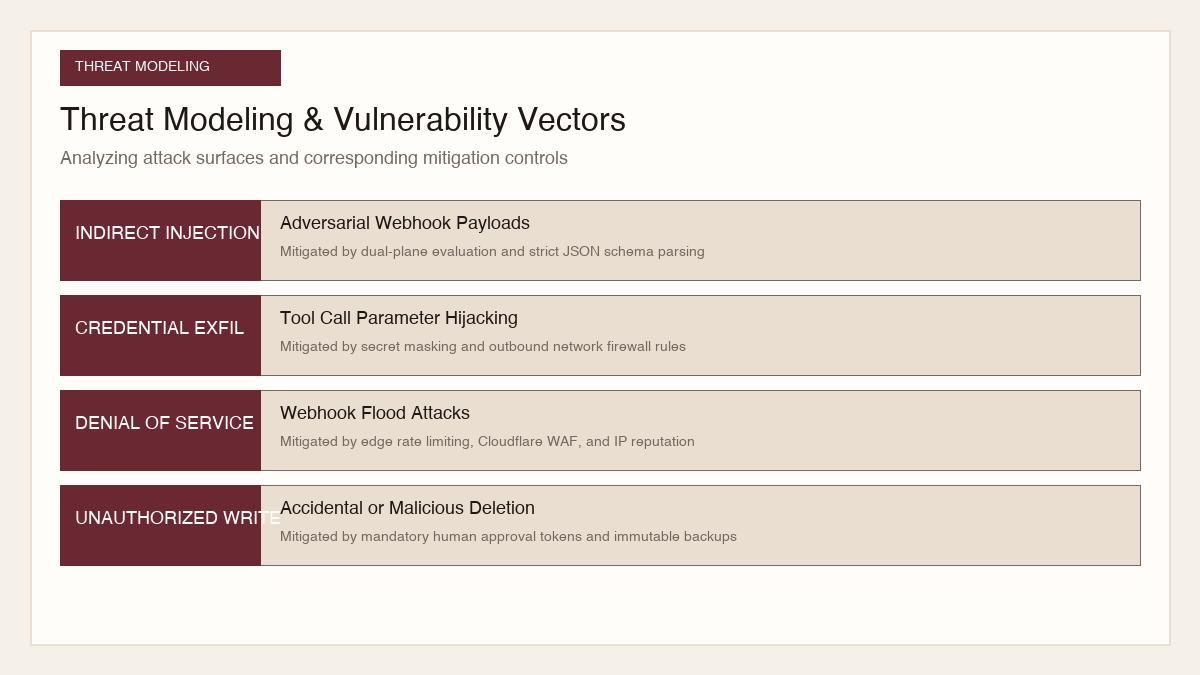
To validate the robustness of your MCP event pipeline, benchmark your security posture against the following threat matrix:
 View image detail
- Threat: Forged Webhook Payloads
- Severity: Critical
- Attack Vector: Adversary sends synthetic webhook requests to trigger unauthorized agent actions.
- Mitigation Control: Enforce HMAC-SHA256 signature verification with constant-time comparison on every request.
- Threat: Replay Attacks
- Severity: High
- Attack Vector: Intercepted legitimate payloads are retransmitted to trigger duplicate workflows.
- Mitigation Control: Enforce 300-second timestamp freshness windows paired with atomic Redis nonce deduplication caches.
- Threat: Ingress Denial of Service
- Severity: High
- Attack Vector: High-frequency webhook floods saturate receiver CPU and memory, crashing workers.
- Mitigation Control: Deploy multi-tiered token bucket rate limiting at the network edge with Cloudflare WAF protection.
- Threat: Indirect Prompt Injection
- Severity: Critical
- Attack Vector: Adversary injects adversarial prompt text inside webhook data fields (such as ticket titles or error logs) to hijack agent reasoning.
- Mitigation Control: Isolate incoming event context in strict JSON schema blocks; screen proposed tool calls through hardened secondary evaluation models.
- Threat: Unauthorized Data Mutations
- Severity: Critical
- Attack Vector: Hallucinated or compromised agent invokes destructive database deletion tools.
- Mitigation Control: Require signed human approval tokens for all tools classified as WRITE_MUTATION.
Security Incident Response Playbook for Compromised Webhooks
Even with defense-in-depth measures, enterprise operations must maintain a battle-tested incident response playbook for potential webhook compromise scenarios:
Scenario 1: Signature Verification Failure Spike
When telemetry detects a sudden surge in HTTP 403 Signature Verification Failed responses exceeding 5 percent of total traffic:
- Automated Circuit Breaking: Ingress gateways automatically engage rate-limiting throttles on the affected endpoint to prevent CPU exhaustion from cryptographic hashing.
- Payload Forensics: Security operations engineers inspect raw payloads in the dead-letter quarantine buffer to analyze whether the mismatch stems from an upstream key rotation desynchronization, character encoding alterations in an intermediary reverse proxy, or an active forgery attack.
- Upstream Alignment: If caused by key desynchronization, engineers initiate the secondary key evaluation window to gracefully restore valid traffic without dropping legitimate enterprise events.
Scenario 2: Suspected Secret Key Exposure
If an enterprise client secret is accidentally committed to source control or exposed in server logs:
- Immediate Secondary Slot Activation: Generate a new 256-bit cryptokey and deploy it immediately into the KEY_SECONDARY slot across all verification nodes.
- Notification Dispatch: Transmit an automated key rotation alert to upstream webhook publishers with a mandatory 4-hour migration window.
- Dual-Verification Monitoring: Observe real-time verification ratios in Datadog or Prometheus. As soon as upstream traffic transitions fully to the secondary key, promote it to primary and permanently revoke the compromised secret.
- Audit Trail Scrutiny: Execute an immediate forensic query across the immutable audit log for all events processed using the compromised secret over the preceding 72 hours, verifying that no unauthorized mutations were performed.
Scenario 3: Indirect Prompt Injection Detection
If an incoming event payload contains adversarial delimiter sequences or prompt injection markers designed to hijack agent reasoning:
- Payload Sanitization Quarantine: The ingress gateway flags the payload using regex boundary detectors and isolates the event from the primary execution queue.
- Secondary Model Evaluation: Route the suspicious payload to an isolated, unprivileged evaluator model tasked with extracting raw data entities into a strict typed JSON schema.
- Threat Intelligence Ingestion: Extract adversarial strings, originating IP ranges, and client IDs, populating edge WAF blocklists to neutralize future injection campaigns.
Enterprise Production Readiness Checklist
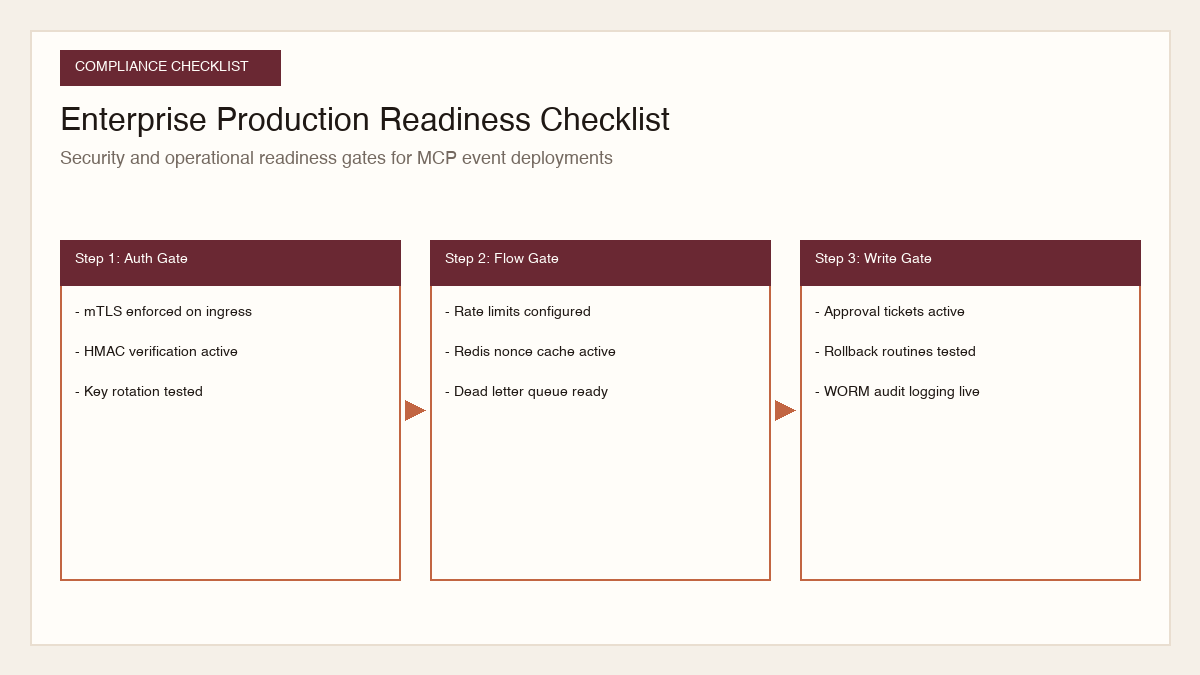
Before transitioning an MCP event pipeline into enterprise production, security leads must verify completion of this operational readiness checklist:
 View image detail
- Transport and Authentication:
- HTTPS enforced with TLS 1.3 and modern cipher suites across all endpoints.
- Mutual TLS (mTLS) client certificate verification enabled on high-security ingress gateways.
- HMAC-SHA256 signature verification active with zero tolerance for unsigned payloads.
- Replay and Rate Limiting:
- Strict 300-second timestamp freshness gates active.
- Distributed Redis nonce deduplication store verified with 600-second TTL.
- Per-subscription token bucket rate limits configured with automated 429 throttling.
- Write Protection and Audit:
- All tools classified into READ_ONLY and WRITE_MUTATION tiers.
- Mandatory human authorization gates active for all state-modifying actions.
- Full audit logging enabled with immutable WORM storage retention.
- Operational Resilience:
- Dual-key zero-downtime secret rotation protocol tested end-to-end.
- Dead-letter queues configured for dropped or failed event deliveries.
- Real-time intrusion detection alerting active for repeated signature or nonce failures.
Conclusion: Defense-in-Depth for Event-Driven AI
Event-driven agent architectures unlock transformative productivity, but enterprise adoption demands uncompromising security discipline. Treating webhooks with the same rigorous cryptographic controls, rate-limiting boundaries, and human authorization checkpoints as primary transaction systems is non-negotiable.
By deploying robust HMAC-SHA256 signatures, distributed replay nonce caches, multi-tiered token bucket limiters, zero-downtime key rotation, and mandatory human write gates, enterprise security teams can confidently empower autonomous agents while ensuring corporate infrastructure remains completely impenetrable.
Sources
- OpenAI DevDay 2026 Announcement: DevDay 2026 Recap
- OpenAI Developer Documentation: MCP Events for ChatGPT Plugins: Architecture and Webhook Implementation
- Model Context Protocol Project: Experimental Extension: Triggers and Events Proposal
Checked for this article
Sources
Keep going
Related notes.
Systems and Workflows
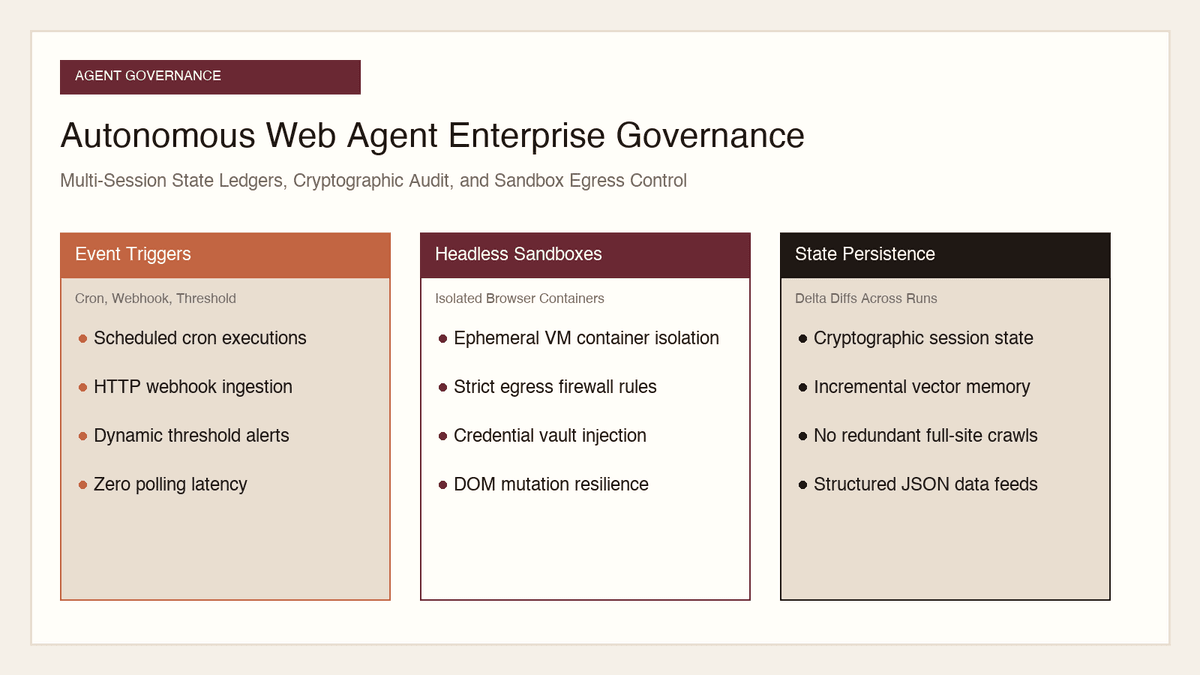
How to Govern Autonomous Web Agents: Session State, Audit, Security
Allowing autonomous browser agents to navigate the open internet creates severe liability. Here is how to govern multi-session state, audit logs, and egress security.
Read the article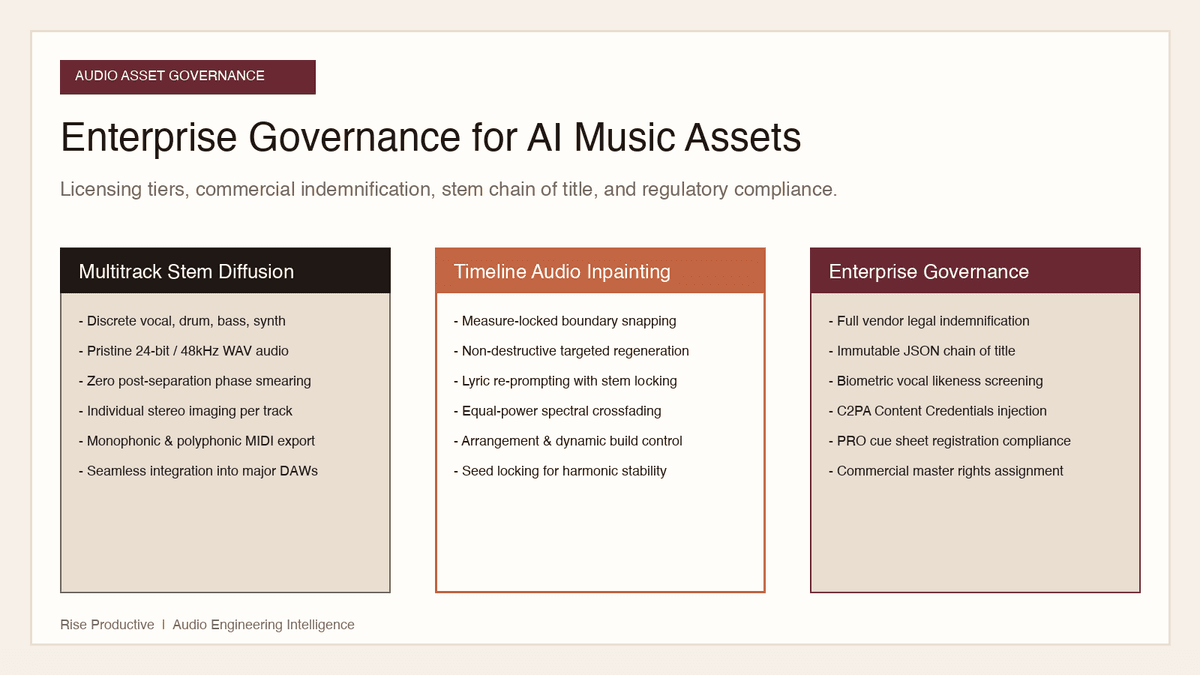
Systems and Workflows
How to Govern AI Music Assets: Licensing, Stems, and Ownership
Deploying generative music in commercial campaigns creates serious legal exposure. Here is how to govern licensing tiers, stem copyright, and voice likeness risks.
Read the article
Systems and Workflows
ChatGPT Team Tasks Permissions: Who Owns Connections and Runs?
A shared task needs more than a creator. Map who owns its connections, who reviews its run, and who resolves access or source failures before the team depends on it.
Read the article