
Automation and Agents
How to Govern Real-Time AI Avatars: Allowlisting, Identity, and Audit
Deploying an interactive AI avatar is an organizational identity decision. Here is how to govern synthetic faces, permissions, and audit trails.
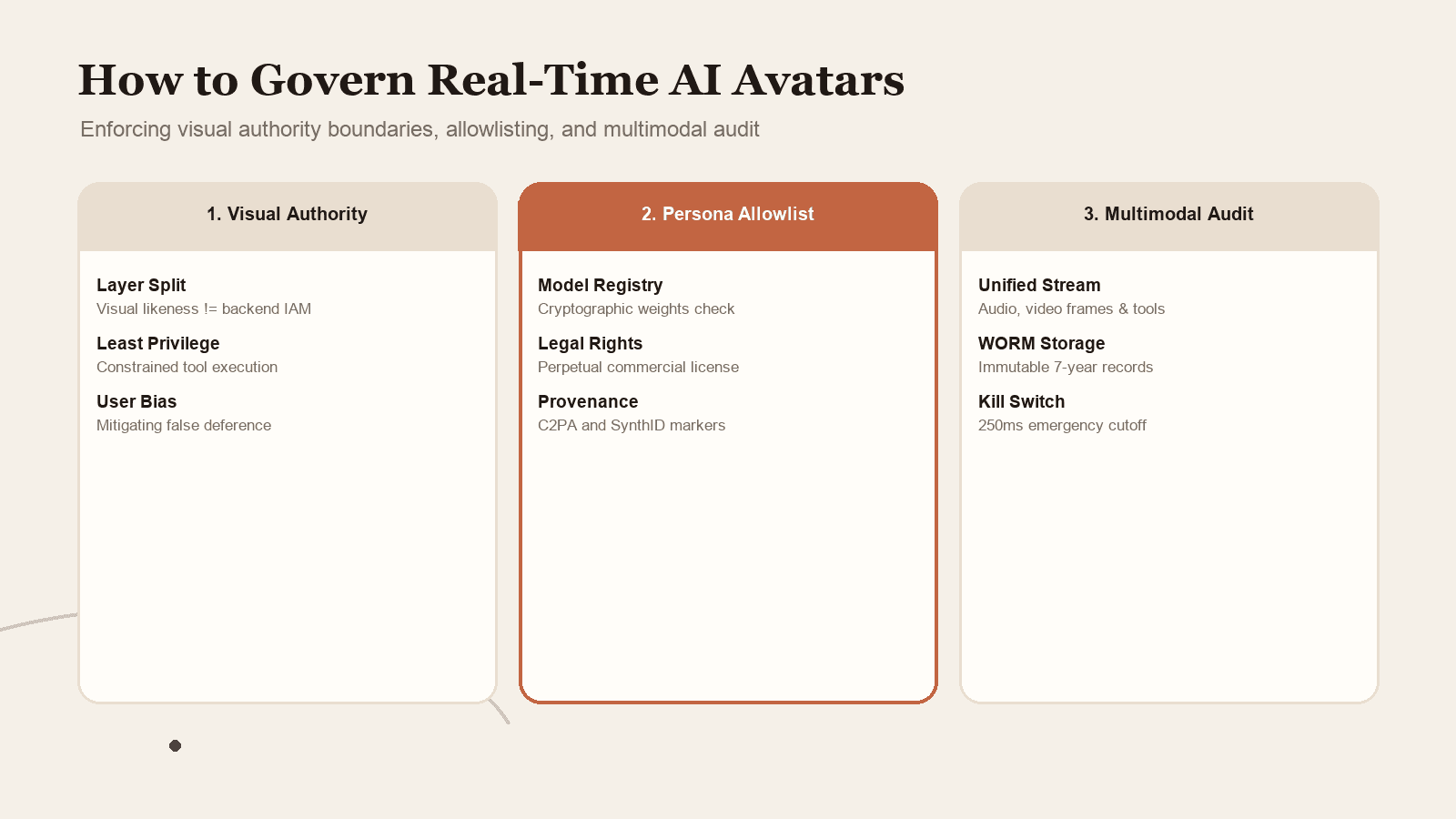
On this page
- The Illusion of Authority: Why Visual Agents Require Separate Governance
- Likeness Protection and Persona Allowlisting
- 1. Mandatory Identity and Consent Verification
- 2. Cryptographic Allowlisting on Vertex AI
- 3. Watermarking and Synthetic Media Disclosures
- Structuring the Multimodal Audit Trail
- Immutable Storage and Retention Policies
- Live Session Circuit Breakers and Human Handoff
- Automated Trigger Conditions
- Execution of the Graceful Interruption
- Compliance and Privacy Boundaries for Multimodal Sessions
- 1. Inbound User Camera and Biometric Consent
- 2. European Union AI Act Compliance
- 3. Training Data Boundaries and Cloud Privacy Guarantees
- Brand Fidelity and Emotional Appropriateness
- Evaluating Emotional Congruence
- Establishing the Brand Safety Style Guide
- The Enterprise Governance Lifecycle
- Phase 1: Provisioning and Allowlisting
- Phase 2: Continuous Real-Time Monitoring
- Phase 3: Periodic Multimodal Auditing
- Phase 4: Emergency Revocation and Decommissioning
- Operational Postmortem Protocol for Avatar Incidents
- Conclusion and Executive Checklist
Deploying an interactive AI avatar is an organizational identity decision before it is a software integration. When an enterprise deploys Google Cloud Gemini 3.8 Live with Live Avatar, it is not merely providing a text box that returns advice. It is launching a synthetic human likeness that speaks with an authorized corporate voice, presents facial expressions, makes representations to customers, and executes live system tools in real time.
That visual presence changes the corporate risk landscape fundamentally. If a text chatbot returns a faulty sentence, the error is an inconvenient operational bug. If a photorealistic visual avatar bearing your corporate badge smiles while misstating financial terms, hallucinates legal commitments on video, or has its likeness cloned by an adversary, the consequences involve brand reputational damage, regulatory scrutiny, and severe liability.
Enterprise deployment requires comprehensive governance before the first external user connects to an avatar stream. Organizations must establish clear visual authority boundaries, enforce cryptographic allowlists on approved synthetic likenesses, build tamper-proof multimodal audit trails, and maintain emergency kill switches that enable immediate human intervention.
This guide provides an enterprise governance framework for real-time visual voice agents, built from Google Cloud Vertex AI security documentation, NIST AI Risk Management principles, and corporate access control best practices.
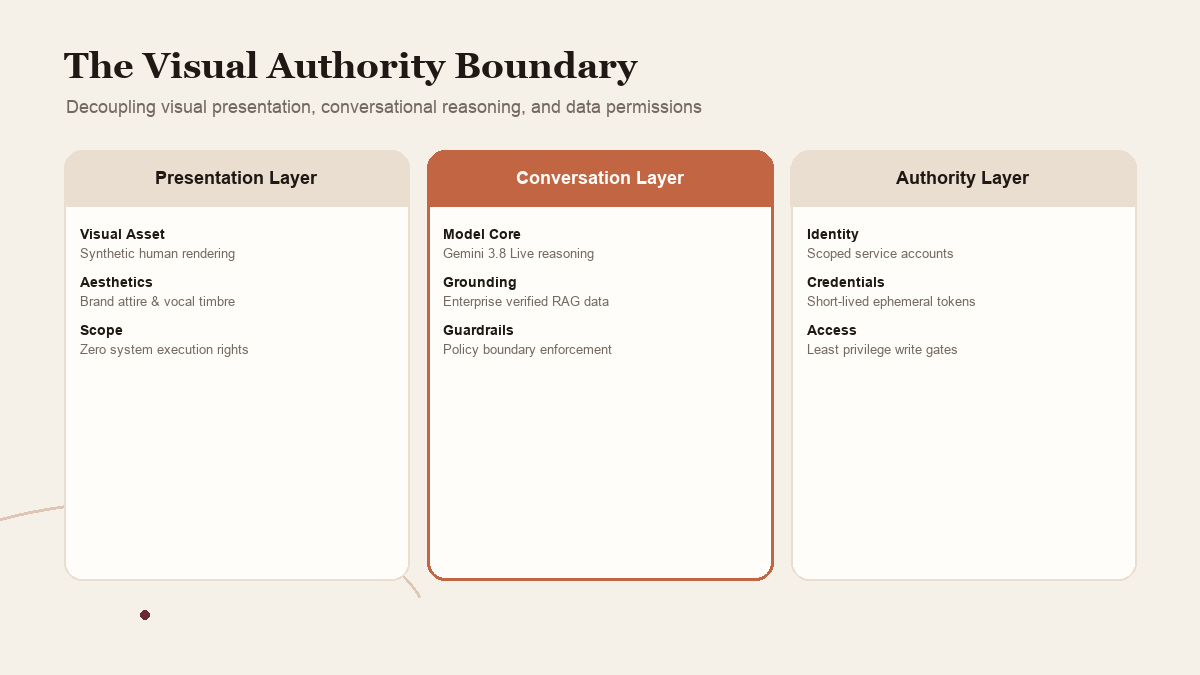 View image detail
Separating presentation identity, conversational authority, and underlying data permissions in an avatar architecture.
The Illusion of Authority: Why Visual Agents Require Separate Governance
Human psychology is hardwired to trust face-to-face communication far more than written text. When people interact with a visually articulate avatar that looks them in the eye, nods in response to their concerns, and speaks fluently, they instinctively attribute higher competence, authority, and trustworthiness to the system.
This psychological effect creates the primary operational hazard of synthetic avatars: unwarranted user deference. Customers and internal employees assume the visual agent possesses the authority to make binding commitments, grant policy exceptions, or certify compliance simply because it looks like an official company representative.
To prevent dangerous misunderstandings, an enterprise governance framework must separate three distinct architectural layers:
- The Presentation Layer (Visual Likeness): The visual model, clothing, gender presentation, voice timbre, and non-verbal mannerisms displayed to the user.
- The Conversational Layer (Reasoning and Knowledge): The system prompts, grounded enterprise knowledge bases, retrieval-augmented generation sources, and conversational guardrails governing what the agent may say.
- The Authority Layer (Tools and Execution Permissions): The specific service accounts, API tokens, and transactional boundaries defining what the agent may actually modify in corporate databases.
Under no circumstances should the presentation layer dictate the authority layer. Just because an avatar wears the digital uniform of an executive concierge does not mean its backend service account should possess write permissions to customer financial records. Least privilege must govern every operational step.
Likeness Protection and Persona Allowlisting
When deploying Gemini 3.8 Live on Google Cloud Vertex AI, enterprises can choose between Google's pre-configured stock personas or custom-trained enterprise avatars representing specific brand personalities or actual executives.
Deploying custom likenesses introduces intellectual property, privacy, and impersonation risks that require rigorous administrative controls:
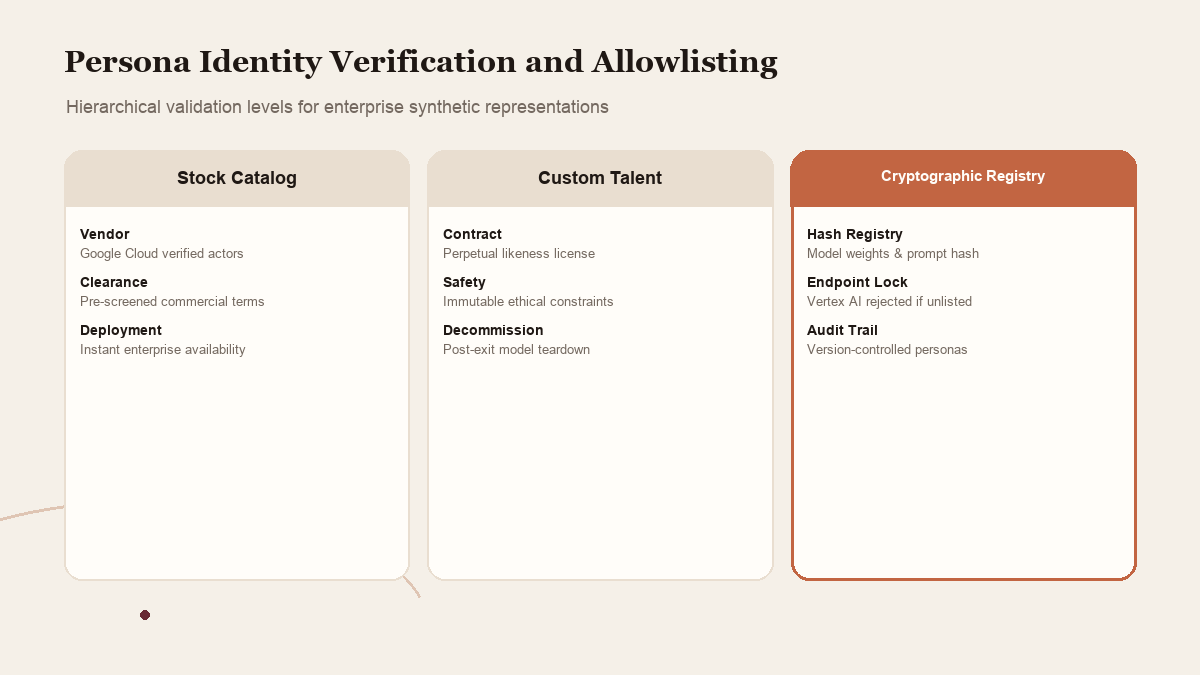 View image detail
Four levels of persona allowlisting: stock catalog, licensed commercial actor, executive digital twin, and customer-facing agent.
1. Mandatory Identity and Consent Verification
If an enterprise trains a custom avatar on an actual employee, founder, or hired talent, legal counsel must secure explicit, perpetual, and strictly bounded synthetic media likeness rights. The legal agreement must define:
- Permitted domains and brand contexts where the likeness may be generated.
- Strict prohibitions against modifying the persona's core ethical guardrails.
- Clear post-termination provisions specifying how models, training weights, and source footage are permanently decommissioned if the individual leaves the company.
2. Cryptographic Allowlisting on Vertex AI
Every authorized avatar persona deployed within your Google Cloud project must be registered on an internal cryptographic allowlist. Vertex AI service endpoints must reject any session request that specifies an unapproved persona ID or unverified model hash. This prevents rogue development teams or compromised API keys from spinning up unauthorized digital representatives under corporate credentials.
3. Watermarking and Synthetic Media Disclosures
Regulatory frameworks worldwide, including the European Union AI Act and emerging United States federal guidelines, mandate clear transparency regarding synthetic interactive media. Every enterprise avatar session must incorporate:
- Visual Disclosures: A persistent, unobtrusive visual indicator on screen stating that the user is interacting with an AI-generated digital avatar.
- Conversational Attribution: Clear introductory speech during session initialization, such as: "Hello, I am the automated virtual assistant for Acme Services."
- Cryptographic Watermarking: Embed digital provenance metadata (such as C2PA standards or Google SynthID) into outgoing video frames to certify authenticity and prove whether controversial video clips originated from authorized corporate endpoints.
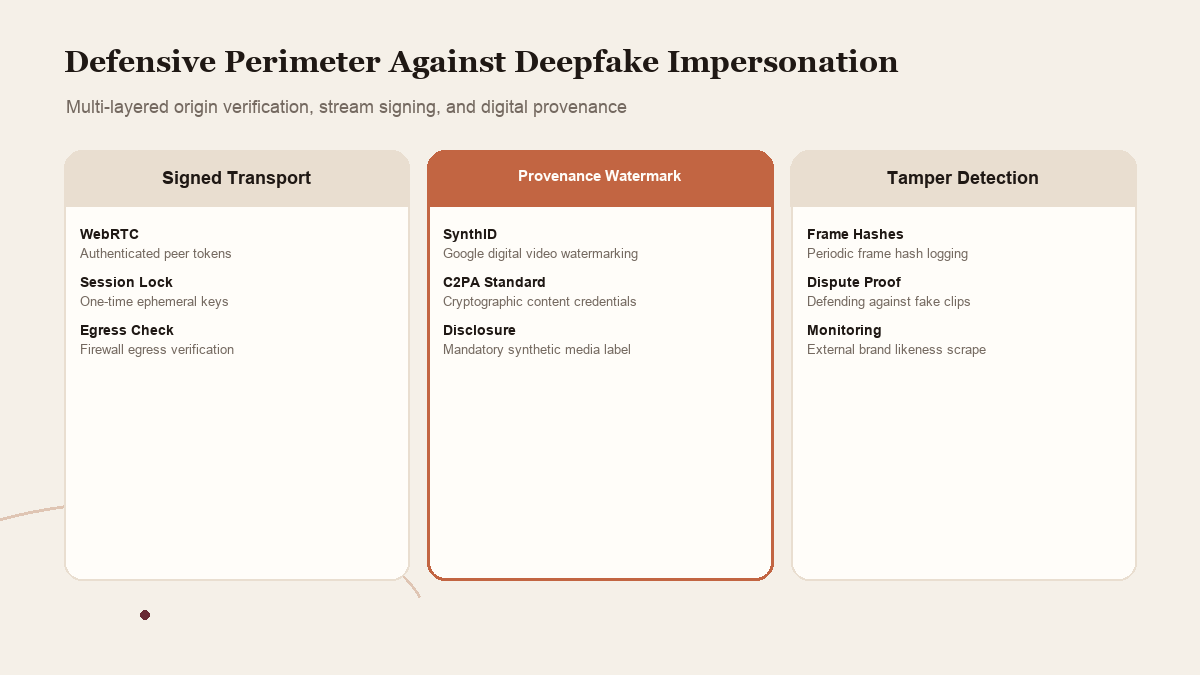 View image detail
Defensive perimeter against impersonation: signed stream transport, origin verification, and visual tamper detection.
Structuring the Multimodal Audit Trail
Conventional AI audit logs record text prompts and text completions. For real-time visual voice agents, a text-only log is completely inadequate for legal defense, compliance verification, or post-incident analysis.
If a customer claims that your avatar promised an unauthorized commercial discount, made a discriminatory gesture, or verbally agreed to an unapproved contract clause, reviewing a text transcript fails to prove what the user actually saw and heard. Facial expressions, vocal inflection, and visual presentation convey legally significant meaning in court and regulatory inquiries.
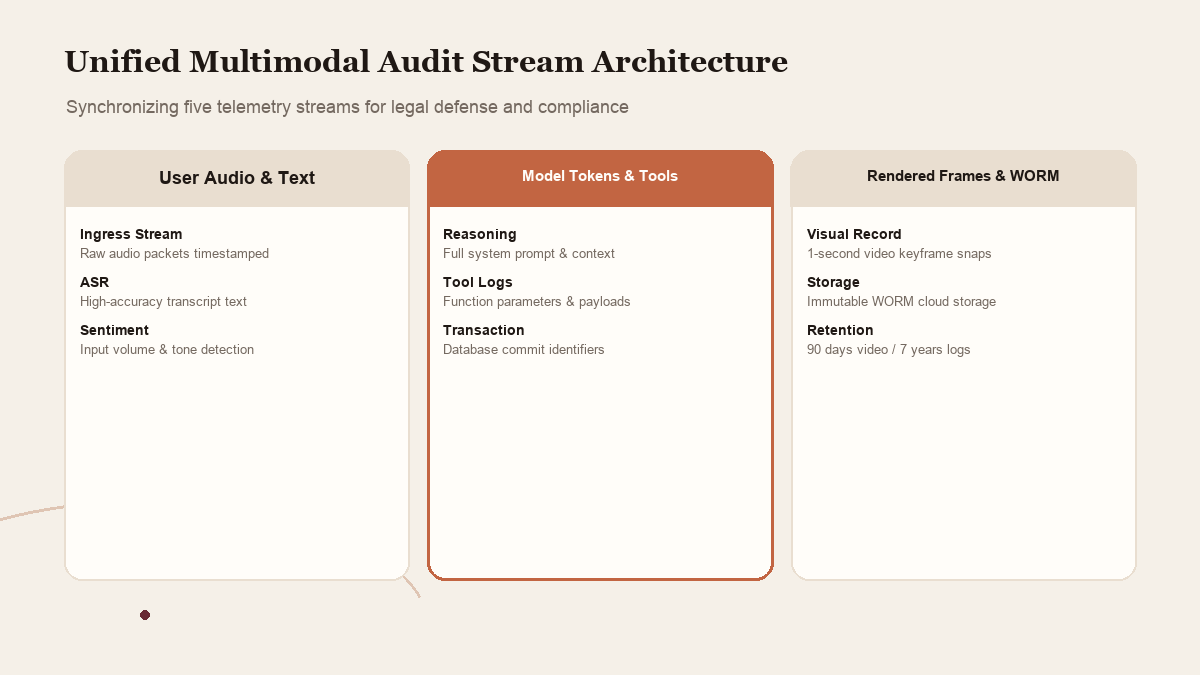
An enterprise multimodal audit record must synchronize five synchronized telemetry streams:
 View image detail
Unified audit stream architecture: synchronizing audio input, model reasoning tokens, tool calls, and rendered video keyframes.
- Ingress User Audio and Transcripts: Raw user audio packets alongside high-fidelity automatic speech recognition transcripts, timestamped to the millisecond.
- Model Reasoning and Intermediate Tokens: The exact prompt context, system instructions, retrieval-augmented snippets, and output tokens generated by Gemini 3.8 Live during the interaction.
- Tool Execution Logs: Detailed records of every backend function call triggered during the session, including input arguments, execution timestamps, return payloads, and database transaction IDs.
- Rendered Video Keyframes: Periodic video snapshots (captured at 1-second intervals or key conversational transitions) alongside synthesized voice audio tracks, stored in immutable object storage.
- Session Telemetry and Quality Metrics: WebRTC network performance data, including packet loss, round-trip latency, frame rate drops, and user interruption events.
Immutable Storage and Retention Policies
Store multimodal audit records in write-once-read-many (WORM) cloud storage buckets protected by Google Cloud VPC Service Controls and customer-managed encryption keys (CMEK). Enforce strict data retention schedules: retain high-resolution video keyframes for ninety days for customer support dispute resolution, and retain compressed audio and structured metadata logs for seven years to satisfy statutory compliance mandates.
Live Session Circuit Breakers and Human Handoff
Autonomous agents operating in real time will occasionally encounter scenarios that exceed their capabilities, trigger safety violations, or generate erratic visual behavior. Without a dependable intervention mechanism, an erratic avatar remains live in front of the customer, compounding brand damage with every passing second.
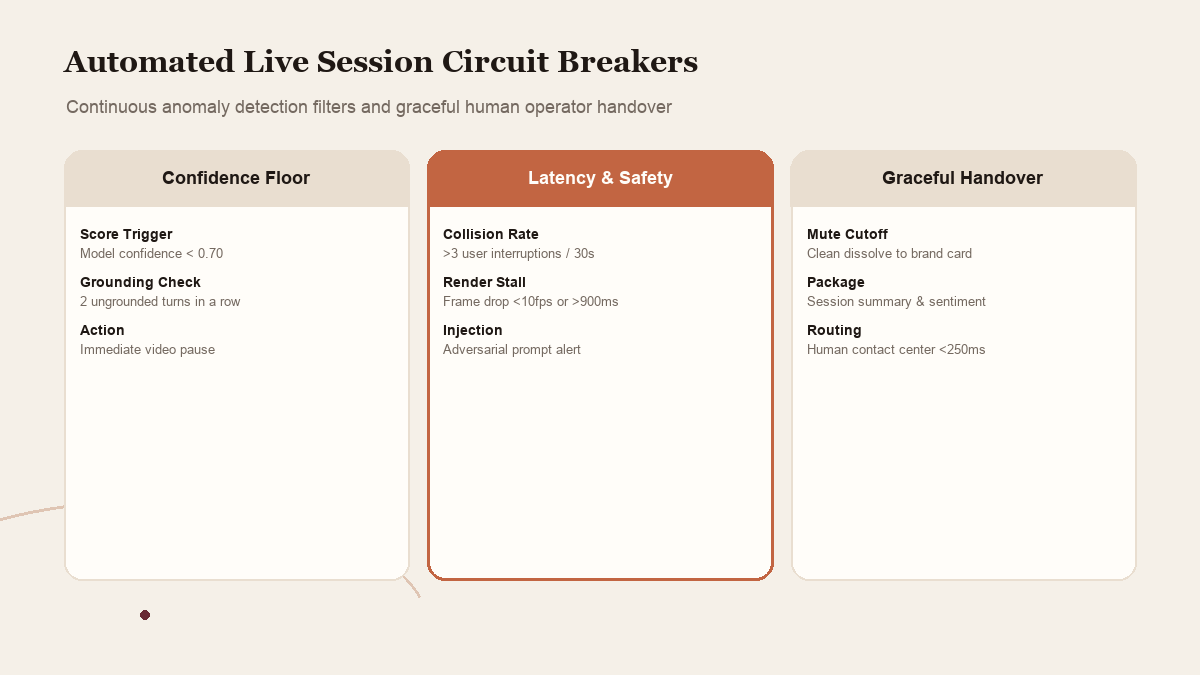
Enterprises must deploy an automated session circuit breaker system capable of halting an avatar stream and transferring the user to a human operator or graceful text fallback within 250 milliseconds.
 View image detail
Circuit breaker architecture: automated anomaly detection filters, instantaneous video cutoffs, and seamless human operator takeover.
Automated Trigger Conditions
The circuit breaker monitoring service continuously inspects the live WebRTC stream and model telemetry for five critical anomaly patterns:
- Confidence and Grounding Collapse: If the Gemini 3.8 Live internal confidence score drops below 0.70 or retrieval-augmented generation sources fail to return grounding evidence for two consecutive turns.
- Safety and Policy Violations: If internal safety filters detect user prompt injection attempts, aggressive adversarial probing, or model policy boundary violations.
- Excessive Conversational Collisions: If the user interrupts the avatar more than three times within a thirty-second window, indicating acute conversational breakdown or severe latency desynchronization.
- Visual Rendering Degradation: If WebRTC metrics indicate that client frame rates dropped below 10 frames per second or neural rendering latency exceeded 900 milliseconds.
- High-Risk Transactional Triggers: If the conversation transitions into legally sensitive territory, such as customer account closure threats, formal regulatory complaints, or allegations of fraudulent charges.
Execution of the Graceful Interruption
When a circuit breaker condition triggers, the system executes an automated three-step transition:
- Instantaneous Stream Transition: The video feed cleanly dissolves from the animated avatar to a neutral, branded corporate standby screen within 100 milliseconds, accompanied by a polite closing or transfer phrase.
- Context Package Assembly: The system compiles a structured summary of the interaction, including the conversation history, user sentiment, and the specific trigger reason.
- Human Agent Routing: The session routes directly into the enterprise contact center platform (such as Genesys, Salesforce Service Cloud, or Google Contact Center AI), where a qualified human specialist accepts the call with full conversational context.
Compliance and Privacy Boundaries for Multimodal Sessions
Deploying real-time video avatars introduces complex regulatory obligations regarding biometric data capture, camera surveillance, and consumer transparency.
 View image detail
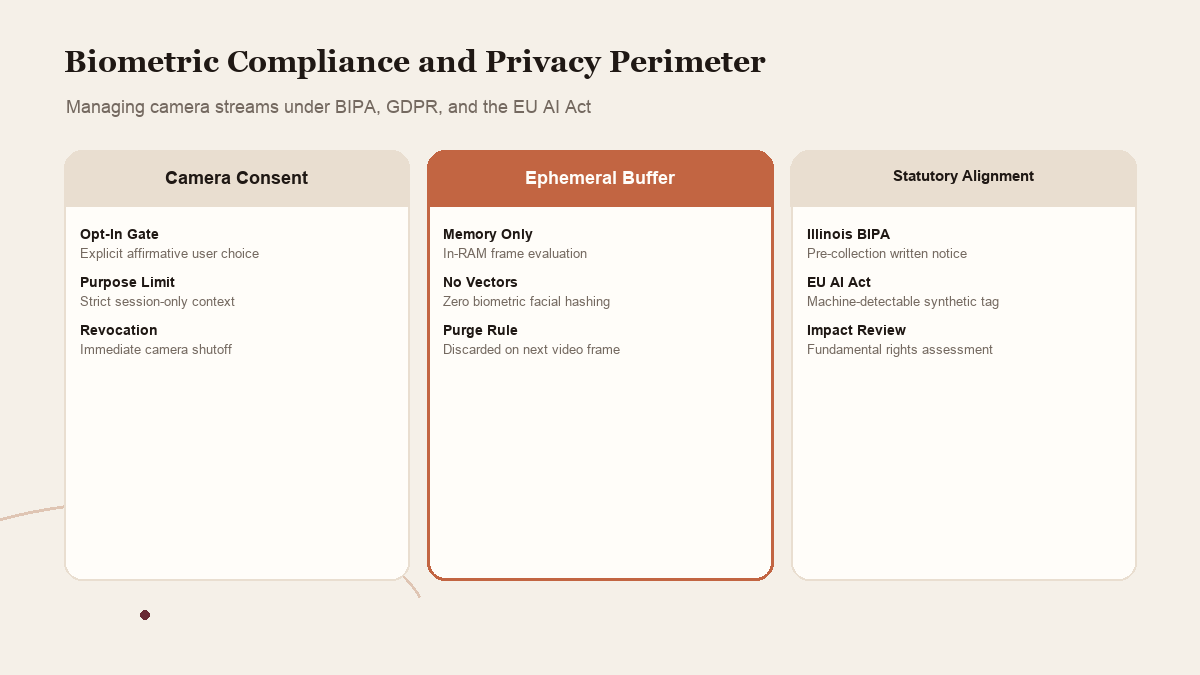
Data privacy boundaries: user audio/video ingest boundaries, biometric hashing restrictions, and consent compliance layers.
1. Inbound User Camera and Biometric Consent
While Gemini 3.8 Live Avatar is primarily deployed to synthesize an outgoing avatar face, advanced multimodal setups allow users to share their own camera feed to show physical items or environments. If your application accepts user camera feeds, you enter the scope of strict biometric privacy regulations, including the Illinois Biometric Information Privacy Act (BIPA), the Texas Capture or Use of Biometric Identifier Act (CUBI), and the EU General Data Protection Regulation (GDPR).
To remain fully compliant:
- Secure explicit, affirmative opt-in consent before initializing user camera streams.
- Never extract, process, or store facial geometry vectors, eye-tracking metrics, or emotional state estimates from user video feeds unless specifically required and authorized by legal counsel.
- Enforce ephemeral video buffer processing: process incoming frames in memory for immediate object recognition and purge them from server RAM immediately without writing to persistent disk.
2. European Union AI Act Compliance
Under the EU AI Act, interactive synthetic avatars interacting with consumers fall under specific transparency classifications. Deployers must ensure that:
- Users are notified unequivocally that they are conversing with an artificial intelligence system prior to the commencement of dialogue.
- Synthetic audio and video content is machine-detectable through standardized provenance metadata.
- High-risk deployment scenarios (such as employment evaluations, educational admissions, or credit eligibility interviews) undergo formal fundamental rights impact assessments before launch.
3. Training Data Boundaries and Cloud Privacy Guarantees
A persistent concern for enterprise risk committees is whether real-time multimodal inputs, specifically customer facial expressions, vocal inflections, and spoken proprietary details, might be ingested into vendor training corpora. When negotiating commercial agreements for Gemini 3.8 Live on Vertex AI:
- Contractual Zero-Retention Guarantees: Verify that your enterprise Master Cloud Agreement (MCA) explicitly includes zero-retention terms for generative AI inference. By default on Vertex AI commercial tiers, Google does not use customer prompts, audio streams, or generated video frames to train foundation models.
- VPC Service Controls Enforcement: Place Vertex AI live avatar inference endpoints inside a strictly defined Service Perimeter. This prevents data exfiltration even if an internal credential is compromised, ensuring that user audio and video packets cannot traverse unauthorized public networks.
- Customer-Managed Encryption Keys (CMEK): Enforce CMEK encryption across all ephemeral storage, temporary audio buffers, and audit log repositories. If a security incident requires freezing data access, revoking the customer key renders all stored session materials instantaneously unreadable.
Brand Fidelity and Emotional Appropriateness
Brand reputation is built over decades and can be damaged in seconds by an inappropriate visual gesture or an unfeeling facial expression during a sensitive conversation.
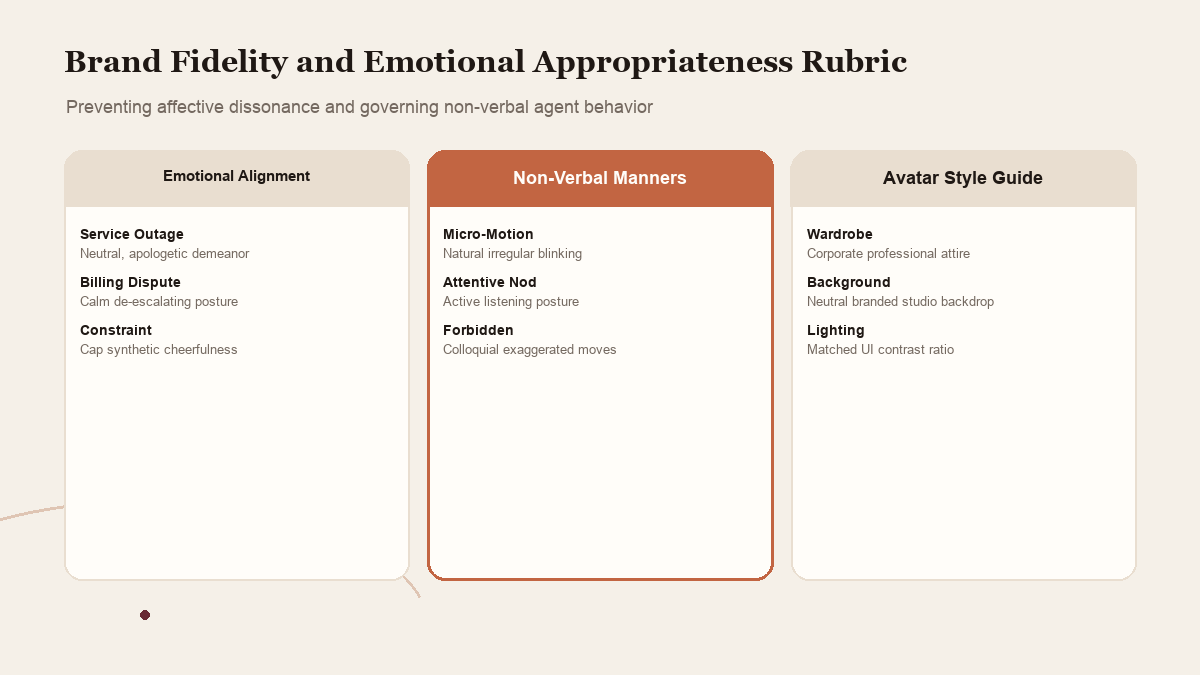
In traditional human customer service, representatives undergo extensive training in emotional intelligence, tone modulation, and de-escalation. Synthetic avatars require an equivalent operational framework: the Brand Fidelity and Emotional Appropriateness Rubric.
 View image detail
Brand governance rubric: evaluating facial expression congruence, vocal modulation, attire compliance, and cultural sensitivity.
Evaluating Emotional Congruence
A major failure mode in synthetic video agents is affective dissonance: displaying a smiling, cheerful visual expression while delivering somber or unfortunate news.
- Scenario A: Flight Cancellation or Service Disruption
- Unacceptable behavior: Avatar maintains a perky smile while explaining that a customer's international connection has been cancelled.
- Required behavior: Avatar transitions facial demeanor to neutral, attentive, and apologetic, lowering vocal pitch and reducing upbeat inflection.
- Scenario B: Disputed Billing Inquiries
- Unacceptable behavior: Avatar displays dismissive or impatient micro-expressions when a customer expresses anger.
- Required behavior: Avatar maintains calm, non-defensive posture, nods slowly to acknowledge customer frustration, and prioritizes concise factual verification.
Establishing the Brand Safety Style Guide
Create an authoritative Avatar Style Guide that defines precise operational boundaries for engineering and prompt design teams:
- Approved facial expression ranges (capping maximum cheerfulness and preventing excessive synthetic enthusiasm).
- Acceptable wardrobe configurations, background environments, and virtual corporate settings.
- Explicit non-verbal boundaries: prohibiting exaggerated hand gestures, informal colloquial body language, or political/religious symbols.
The Enterprise Governance Lifecycle
Enterprise AI governance is not a one-time pre-deployment review. It is an ongoing operational lifecycle that spans procurement, deployment, continuous monitoring, and safe decommissioning.
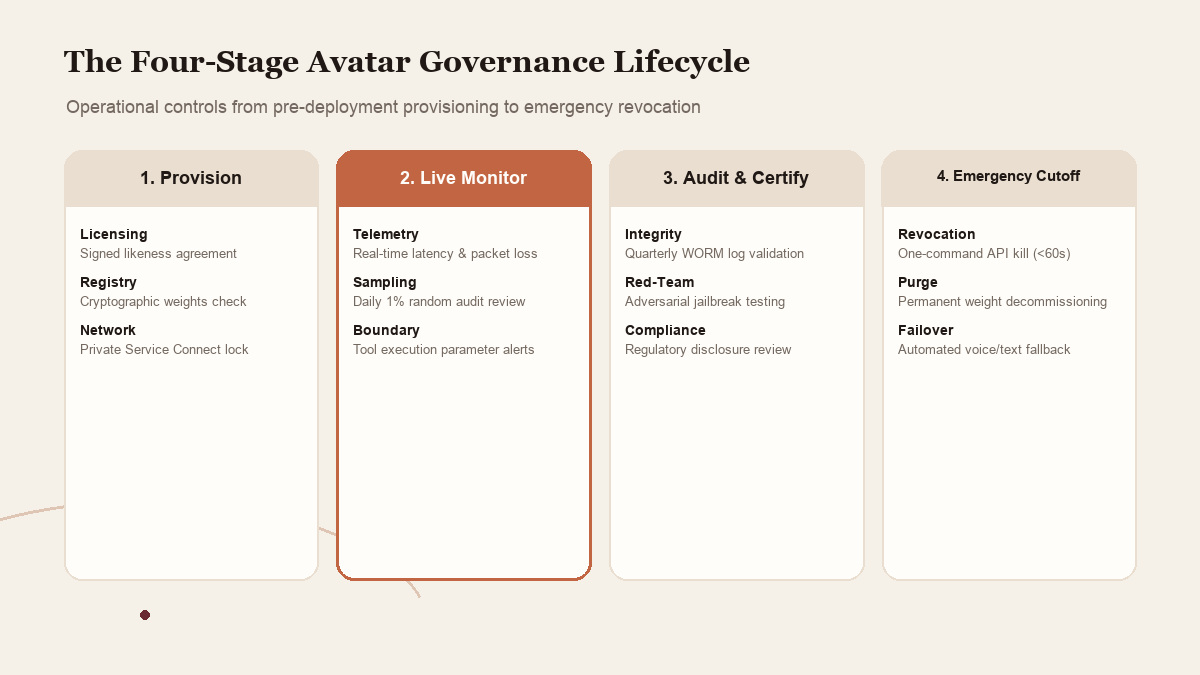 View image detail
The four lifecycle phases: provisioning and allowlisting, continuous real-time monitoring, multimodal compliance auditing, and emergency revocation.
Phase 1: Provisioning and Allowlisting
- Conduct legal identity and likeness verification for all proposed avatar models.
- Generate cryptographic hashes for approved model weights, system prompts, and tool interfaces.
- Register endpoints within Google Cloud VPC Service Controls and configure Private Service Connect routing.
Phase 2: Continuous Real-Time Monitoring
- Deploy automated telemetry collectors tracking latency, WebRTC packet health, and circuit breaker activations.
- Implement random sampling pipelines where compliance officers review 1% of anonymized sessions daily for brand fidelity and tone appropriateness.
- Monitor tool invocation boundaries to ensure the agent executes only authorized backend procedures.
Phase 3: Periodic Multimodal Auditing
- Conduct quarterly compliance audits reviewing multimodal WORM storage integrity.
- Re-certify third-party licenses, commercial actor likeness agreements, and synthetic media transparency disclosures.
- Execute simulated red-team attacks attempting to induce prompt injections, visual jailbreaks, or unauthorized tool executions.
Phase 4: Emergency Revocation and Decommissioning
- Maintain an automated, one-command revocation mechanism capable of invalidating API keys and shutting down avatar endpoints within 60 seconds of a confirmed security breach.
- Establish verified procedures for permanently purging model weights and training datasets upon contract expiration or talent departure.
- Ensure automated DNS and load balancer failover routes customer traffic immediately to pre-tested voice or text fallback services.
Operational Postmortem Protocol for Avatar Incidents
When an avatar failure occurs, compliance teams must not rely on subjective user recollections. Instead, initiate a formal postmortem within twenty-four hours using the synchronized audit trail:
- Frame-by-Frame Visual Replay: Reconstruct the exact video frames displayed to the user at the moment of failure. Evaluate whether neural rendering artifacts or anomalous facial expressions contributed to miscommunication.
- Deterministic Token Re-evaluation: Feed the identical user prompt and system context into Gemini 3.8 Live in an isolated sandbox environment. Determine whether the output was non-deterministic drift or caused by flawed system prompt constraints.
- Tool Invocation Audit: Verify whether backend tool execution parameters conformed to expected schema constraints or if an unvalidated payload caused downstream processing errors.
- Corrective Action Cataloging: Document remediation steps, such as updating system prompt guardrails, tightening circuit breaker latency thresholds, or retraining custom persona video weights.
Conclusion and Executive Checklist
Deploying Google Cloud Gemini 3.8 Live Avatar gives enterprises an unprecedented capability to deliver human-like, real-time visual service at scale. However, the power of a photorealistic visual presence comes with an equal responsibility to protect organizational identity, customer trust, and corporate liability.
By implementing strict visual authority boundaries, cryptographic persona allowlisting, multimodal WORM audit logging, automated circuit breakers, and ongoing brand governance, enterprises can harness the engagement of synthetic video without exposing their business to catastrophic operational failures.
Checked for this article
Sources
Keep going
Related notes.
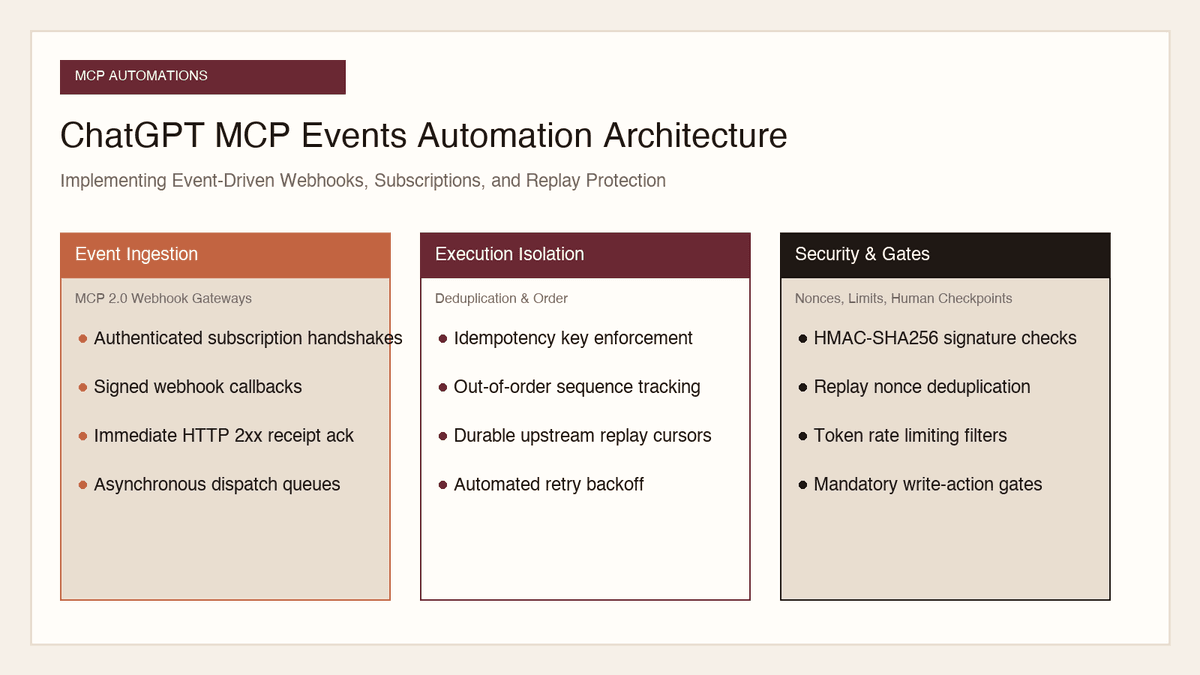
Automation and Agents
How to Implement MCP Events in ChatGPT: Event-Triggered Automations
Autonomous conversational agents no longer need to rely on wasteful polling loops. Here is how to implement event-triggered automations using ChatGPT MCP Events.
Read the article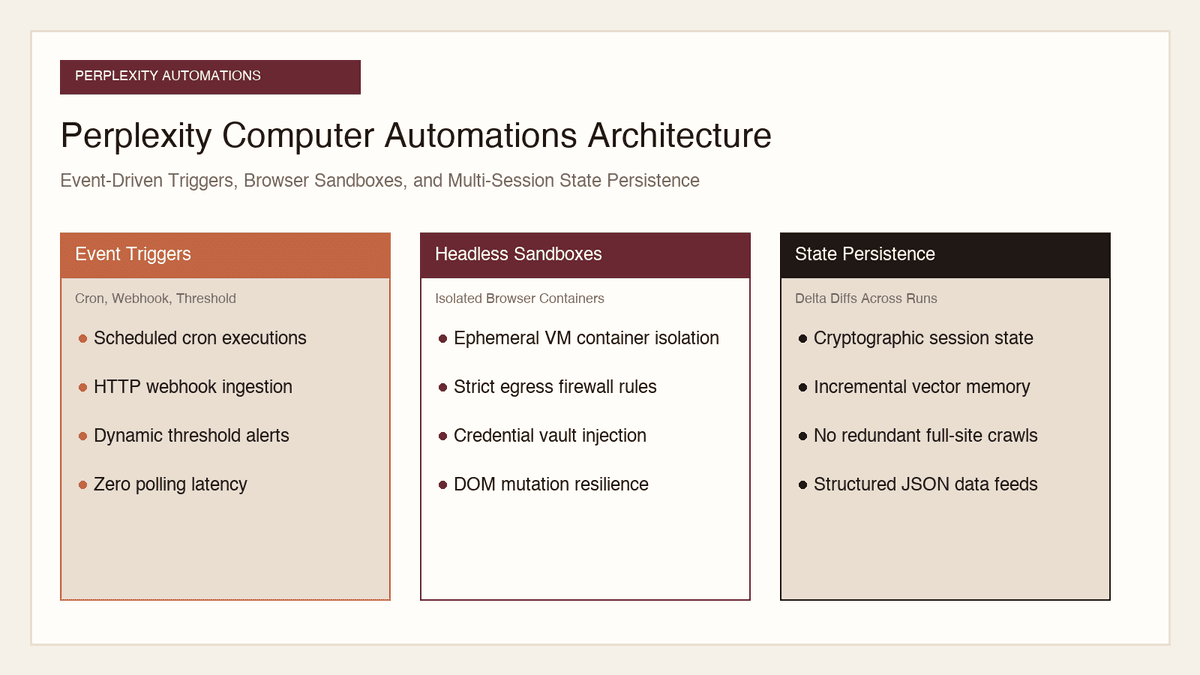
Automation and Agents
How to Build Recurring Web Automations with Perplexity Computer
Web scraping scripts break whenever a layout shifts. Here is how to build durable, recurring web automations using Perplexity Computer and persistent state.
Read the article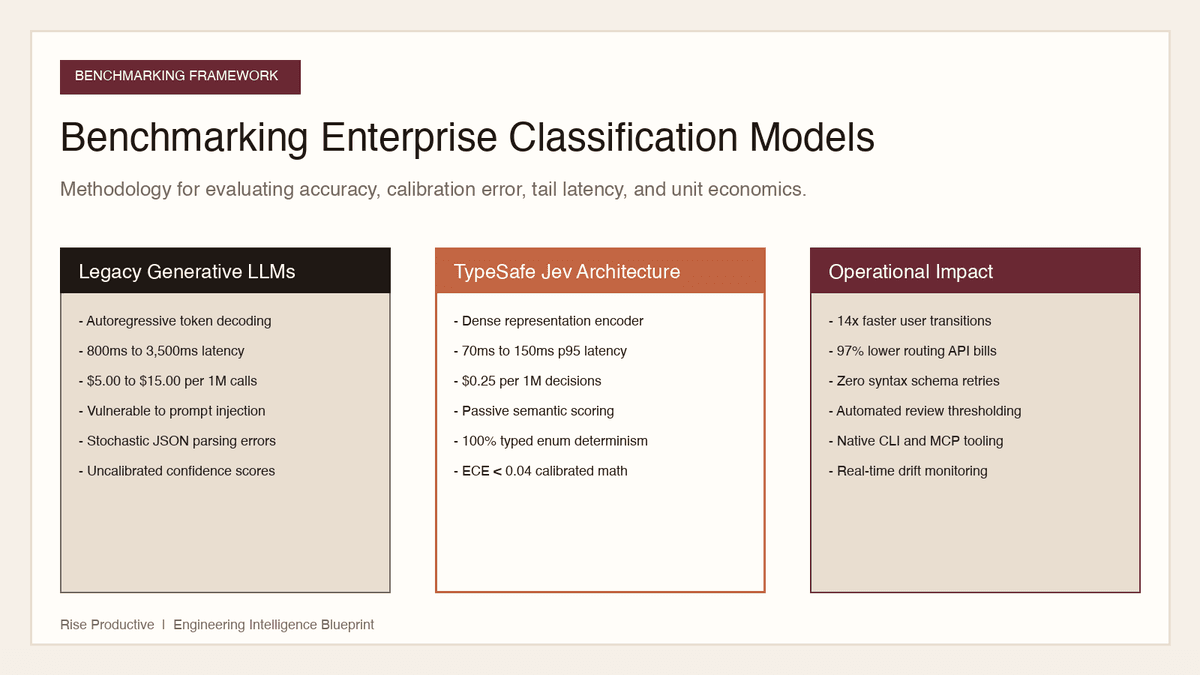
Automation and Agents
How to Benchmark Classifier Models: Latency, Cost, Determinism
Evaluating AI classifiers requires looking beyond static accuracy. Here is how to benchmark probability calibration, latency percentiles, and unit economics.
Read the article