
Automation and Agents
How to Pilot Astra for Law: A Lawyer-Supervised Evaluation Framework
OpenAI reported 54% correctness on legal research benchmarks, but client matters require zero unverified errors. Here is how to evaluate Astra for Law.
On this page
- What OpenAI Announced and How Astra for Law Differs
- Evaluating the 54% Correctness Claim: Vendor Benchmarks Versus Legal Reality
- 1. The Composition of the Evaluation Set
- 2. The 46% Error and Incompleteness Margin
- 3. The Nature of Real-World Firm Research
- The Citation Verification Rubric: Spotting Hallucinations and Bad Law
- Checkpoint 1: Existence and Reporter Verification
- Checkpoint 2: Direct Quotation Fidelity
- Checkpoint 3: Substantive Proposition Support
- Checkpoint 4: Negative Treatment and Subsequent History (Shepardizing / KeyCiting)
- Economic Modeling: Associate Hours, Research Costs, and Value Billing
- Baseline Practice Scenario: Complex Commercial Motion to Dismiss
- Strategic Billing Implications
- The Practice Evaluation Scorecard: Assessing Model Quality
- Dimension 1: Jurisdictional Precision
- Dimension 2: Statutory and Regulatory Hierarchy
- Dimension 3: Procedural Context Sensitivity
- Dimension 4: Depth and Counter-Argument Anticipation
- Technical Architecture: Trusted Access and Document Retrieval
- Architectural Components
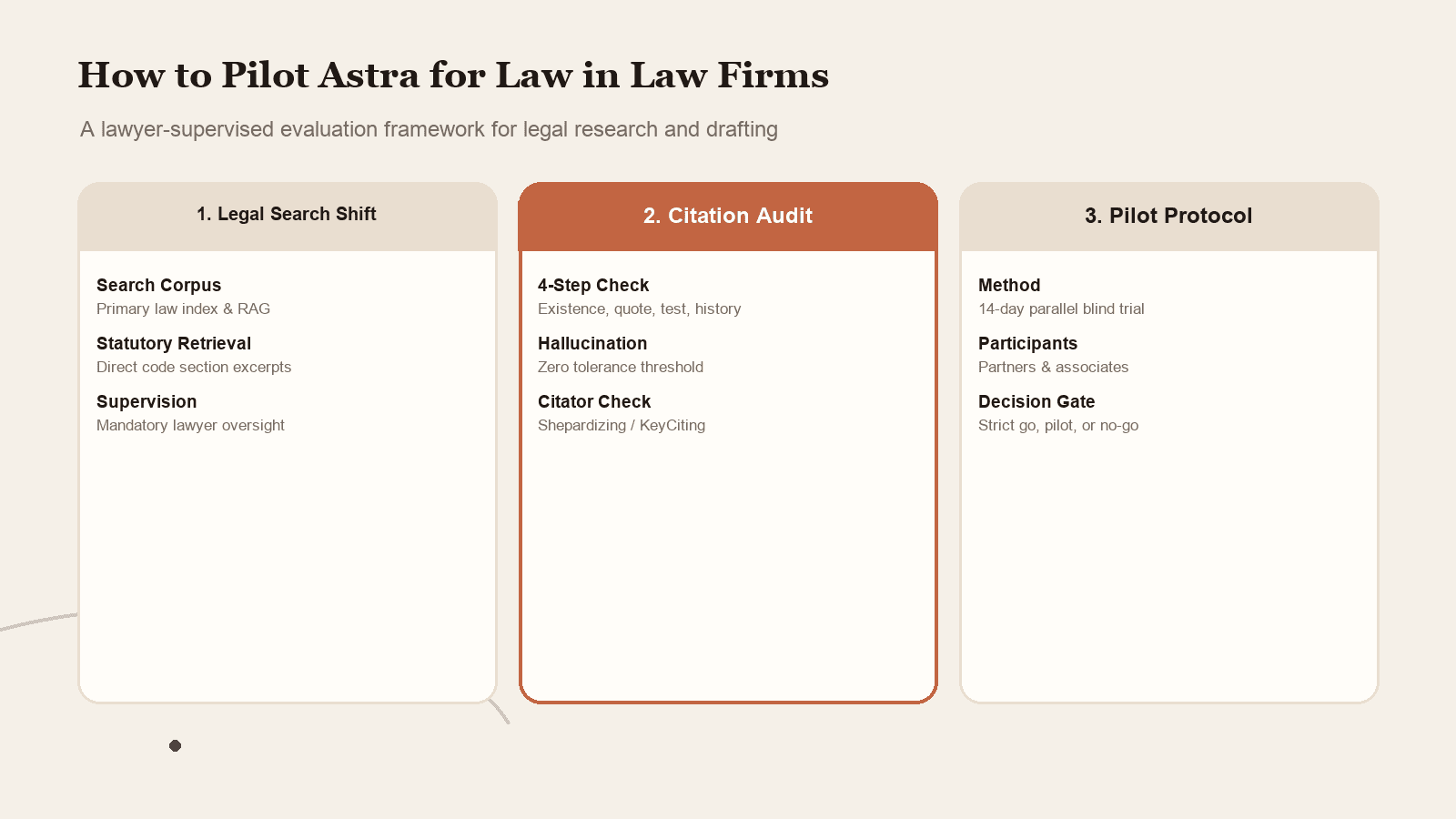
- The Two-Week Law Firm Pilot Protocol
- Phase 1: Setup and Ethical Guardrails (Days 1 to 3)
- Phase 2: Parallel Blind Research (Days 4 to 8)
- Phase 3: Blind Partner Quality Review (Days 9 to 12)
- Phase 4: Economics and Strategic Committee Review (Days 13 to 14)
- Law Firm Decision Matrix: Deploy, Pilot, or Reject
- Scenario A: Enterprise Rollout (Go)
- Scenario B: Specialized Practice Group Pilot (Constrained Adoption)
- Scenario C: Rejection and Delay (No-Go)
- Conclusion and Strategic Recommendations
Legal research is an exacting discipline where a single misattributed citation, an overlooked jurisdictional exception, or an uncited negative treatment can compromise an entire client matter. When OpenAI announced Astra for Law on September 17, 2026, it marked the company's first model configuration explicitly engineered for legal analysis, statutory retrieval, and draft brief synthesis. According to OpenAI's launch documentation, Astra for Law integrates specialized legal retrieval across federal and state primary law with firm-specific tool integrations, delivered through a Trusted Access deployment tier in ChatGPT Enterprise and Codex.
For managing partners, practice group leaders, and legal innovation directors, the central challenge is cutting through marketing claims to evaluate real-world practice impact. OpenAI reported a 54.0% versus 38.7% correctness improvement over baseline models on an internal 200-question evaluation set adapted from legal research benchmarks. However, private vendor validation runs on standardized questions do not guarantee dependable performance on complex, fact-intensive client disputes.
Deploying generative AI in legal practice carries strict ethical and professional responsibilities under ABA Model Rule 1.1 (Competence) and Model Rule 5.3 (Supervision of Non-Lawyer Assistance). Law firms cannot treat legal AI models as autonomous research assistants. Instead, firms must implement structured, lawyer-supervised pilot frameworks to test model performance against established incumbents like Westlaw and LexisNexis, quantify hallucination risk, verify citation validity, and measure true time savings.
This guide provides an operational evaluation methodology for law firms testing Astra for Law. We examine the architectural shift from keyword searching to semantic legal reasoning, construct a rigorous citation verification rubric, analyze practice economics, and outline a two-week pilot protocol with clear go or no-go criteria.
 View image detail
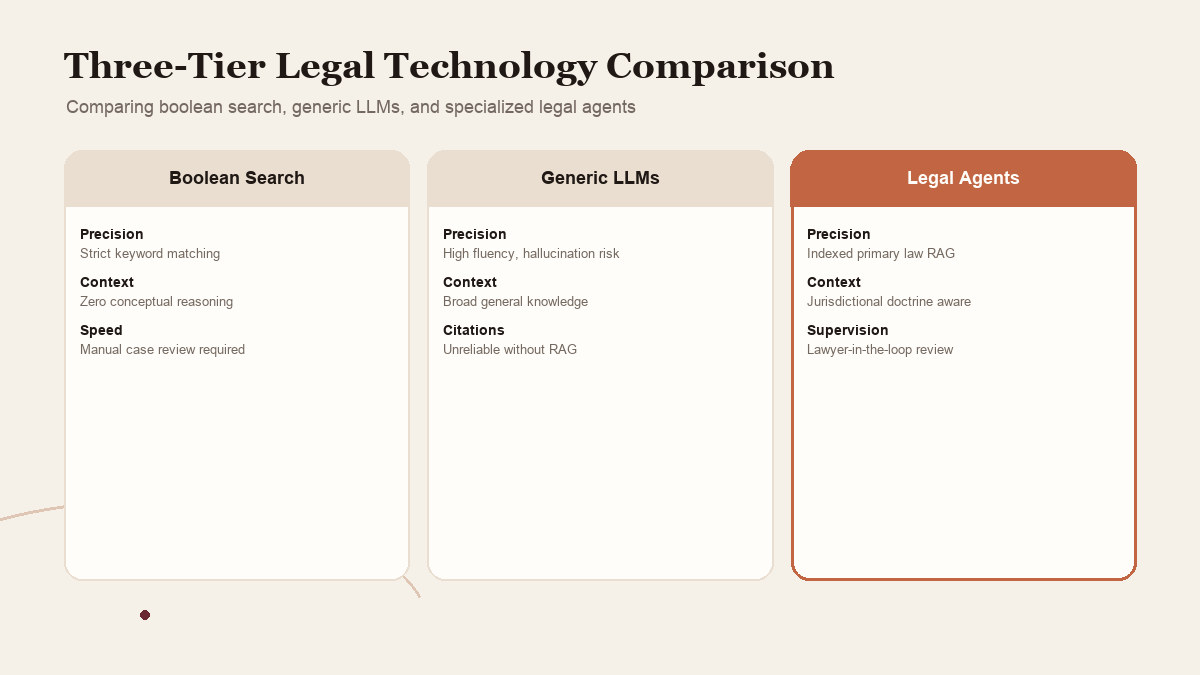
Comparing traditional boolean search, generic language models, and specialized legal research agents across retrieval depth, citation precision, and supervisory requirements.
What OpenAI Announced and How Astra for Law Differs
On September 17, 2026, OpenAI published details regarding Astra for Law across its official website and product Help Center. The product is not a generic language model given a legal prompt prefix. It represents a specialized model configuration and retrieval architecture designed specifically for legal practitioners.
Key capabilities highlighted in the announcement and verified in technical documentation include:
- Specialized Primary Law Corpus: The model queries an indexed database of United States federal and state case law, statutory codes, administrative regulations, and court procedural rules, prioritizing authoritative primary law over generic web commentary.
- Contextual Statutory and Case Retrieval: Rather than relying purely on pre-trained parametric memory, Astra for Law employs retrieval-augmented generation (RAG) calibrated for legal queries, returning direct statutory excerpts, holding summaries, and relevant docket references.
- Firm Tool Integrations: The system supports custom legal plugins, allowing firms to connect proprietary document management systems (such as iManage or NetDocuments), internal brief banks, and practice group templates into the research environment.
- Trusted Access Architecture: Access is initially restricted to selected eligible U.S. law firms through enterprise-grade data segregation environments, ensuring that firm prompts and client matter data are excluded from vendor model training.
Crucially, OpenAI's Help Center explicitly states that Astra for Law outputs do not constitute legal advice and must be verified by a licensed attorney. Furthermore, while the model is available via ChatGPT Enterprise and Codex interfaces for selected pilot firms, a general commercial API remains listed as coming soon.
Understanding these boundaries is essential. Astra for Law is designed as an investigative drafting and search accelerator, not an autonomous legal decider.
Evaluating the 54% Correctness Claim: Vendor Benchmarks Versus Legal Reality
In its launch announcement, OpenAI highlighted an internal evaluation showing that Astra for Law achieved 54.0% correctness compared to 38.7% for baseline GPT models on a 200-question test set derived from the Vals Legal Research Agent benchmark.
While a 15.3 percentage point improvement appears significant, managing partners must interpret this benchmark with professional skepticism:
 View image detail
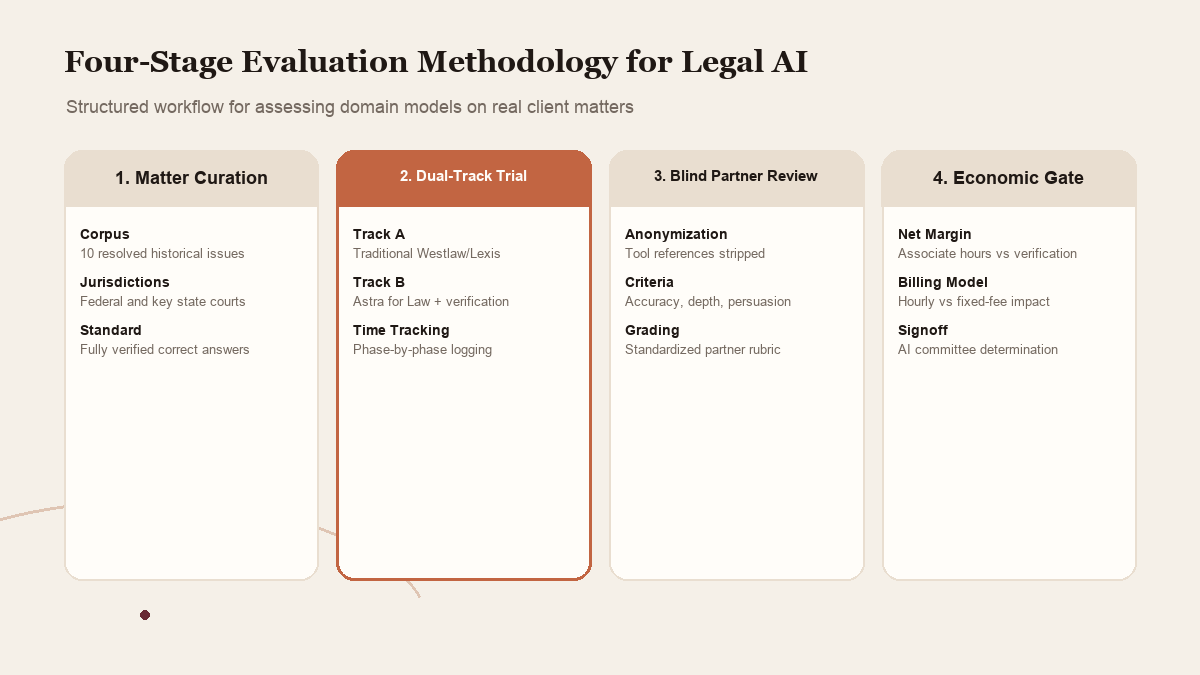
A four-stage evaluation methodology: matter curation, dual-track parallel research, blind partner scoring, and economic impact analysis.
1. The Composition of the Evaluation Set
The 200 questions evaluated by OpenAI were selected internally from broader benchmark methodologies. The public Vals benchmark evaluates agents on multi-step research tasks, including statutory interpretation, procedural rule navigation, and jurisdictional conflict spotting. An internal score on a proprietary subset is a valuable engineering indicator, but it does not represent independent academic or bar association certification.
2. The 46% Error and Incompleteness Margin
A 54.0% correctness score means that on 46.0% of test questions, the model either failed to identify the controlling legal authority, misstated a legal test, or produced an incomplete synthesis. In transactional law or appellate litigation, an error rate of that magnitude would be disastrous if unverified. Every output generated by Astra for Law must pass through rigorous associate and partner verification gates.
3. The Nature of Real-World Firm Research
Standardized benchmark questions typically involve closed-universe fact patterns with well-settled legal doctrines. Real-world client matters involve messy, incomplete facts, shifting evidentiary records, novel statutory ambiguities, and circuit splits. Testing must evaluate how the model handles jurisdictional conflict, procedural posture nuances, and statutory amendments enacted within the current legislative session.
The Citation Verification Rubric: Spotting Hallucinations and Bad Law
The most severe operational risk in deploying artificial intelligence for legal work is citation hallucination: generating convincing case names, reporter volumes, and page citations that do not exist or do not support the proposition asserted.
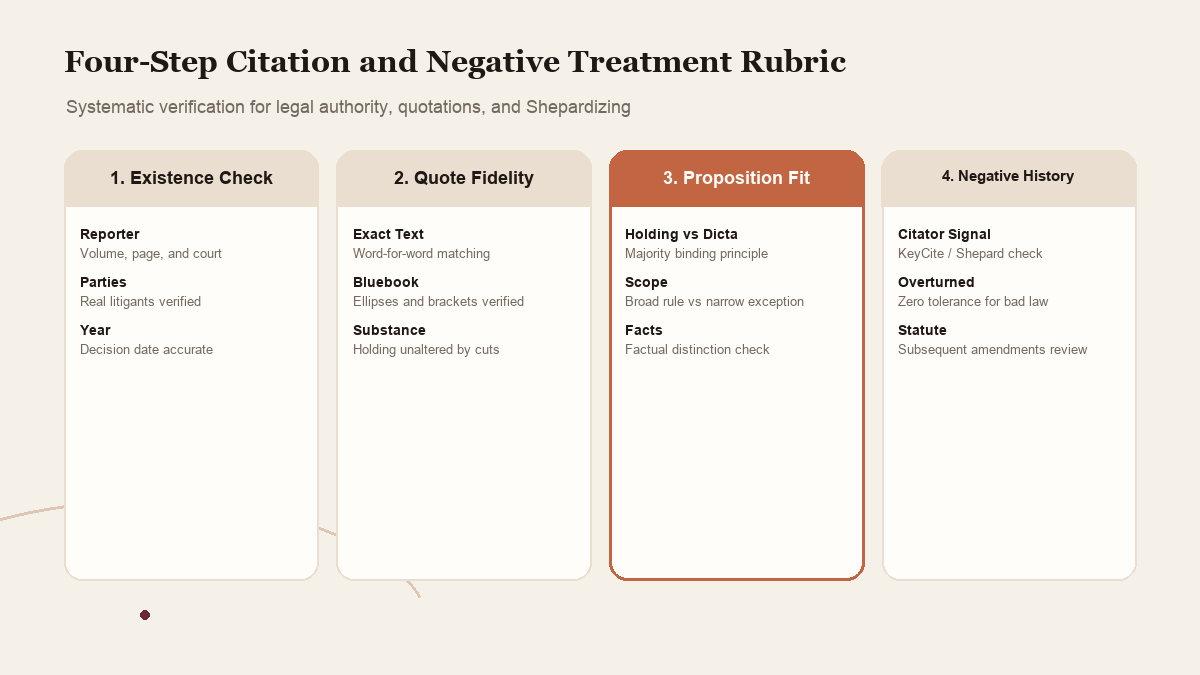
To evaluate Astra for Law's citation reliability, firms must implement Rise Productive's Four-Step Legal Citation Rubric:
 View image detail
Four verification checkpoints: existence verification, quotation fidelity, proposition alignment, and negative treatment checks.
Checkpoint 1: Existence and Reporter Verification
Every case, statute, or regulation cited by the model must be checked against an authoritative legal database (such as Westlaw, LexisNexis, or official court reporters):
- Does the docket number, reporter volume, reporter abbreviation, and first-page number correspond to an actual published or unpublished decision?
- Is the deciding court and decision year accurate?
- Are the party names spelled correctly without combining disparate litigants from unrelated matters?
Checkpoint 2: Direct Quotation Fidelity
When the model places language inside quotation marks and attributes it to a judicial opinion or statute:
- Does the quote match the authoritative text word-for-word, including punctuation and capitalization?
- Have ellipses or bracketed alterations been indicated accurately according to the Bluebook?
- Did the model truncate a sentence in a manner that alters the substantive legal holding?
Checkpoint 3: Substantive Proposition Support
A citation may be entirely real, yet fail to support the proposition asserted in the memorandum:
- Does the cited paragraph actually stand for the legal principle for which it is cited?
- Was the cited language part of the majority holding, or was it non-binding dicta, a concurring opinion, or a vigorous dissent?
- Did the court announce a narrow exception rather than the broad general rule claimed by the model?
Checkpoint 4: Negative Treatment and Subsequent History (Shepardizing / KeyCiting)
A model can accurately quote a genuine 1998 appellate decision, yet fail to recognize that the decision was overturned by the Supreme Court in 2015, questioned by subsequent panels, or superseded by statutory reform:
- Has the cited decision received a red flag, warning signal, or negative subsequent treatment in authoritative citators?
- Has the underlying statutory provision been amended or repealed since the decision was handed down?
In our testing protocols, any legal AI output that fails Checkpoint 1 (hallucinated authority) receives an immediate failing grade and triggers an inquiry into the prompting and retrieval parameters.
Economic Modeling: Associate Hours, Research Costs, and Value Billing
Law firm economics are undergoing a structural transition from pure billable hours toward fixed fees, capped budgets, and value-based billing. Evaluating Astra for Law requires analyzing both firm expense and client fee implications.
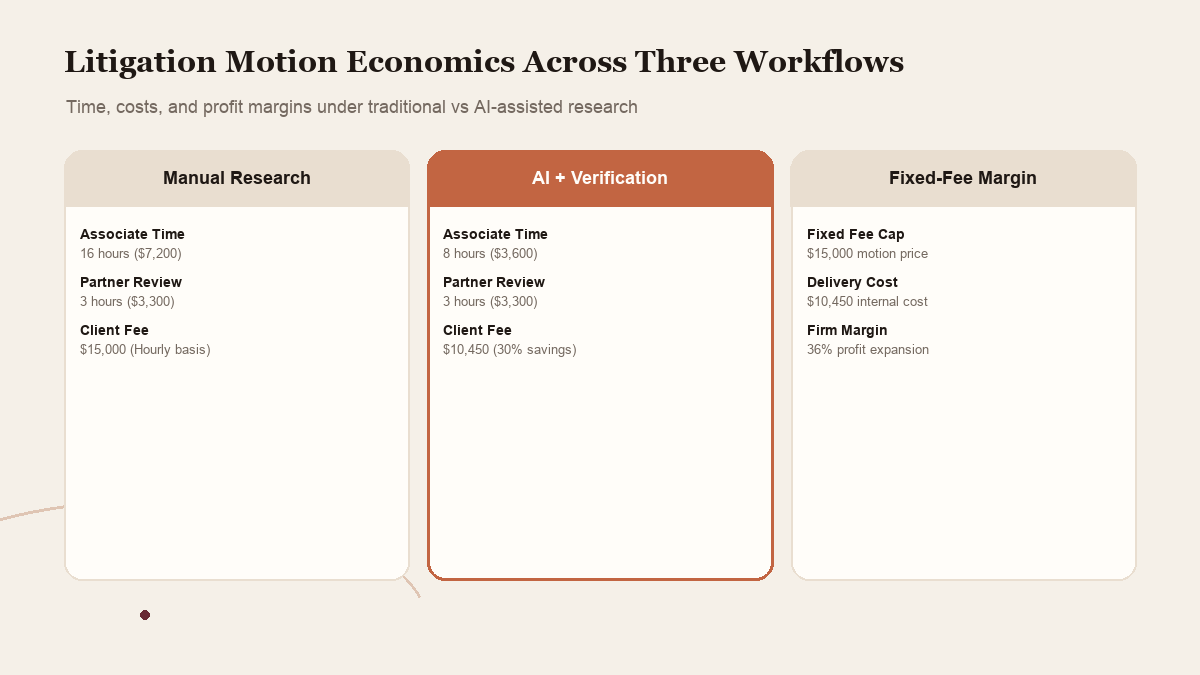 View image detail
Comparing research time, partner review hours, database search costs, and net matter margins across three practice workflows.
Baseline Practice Scenario: Complex Commercial Motion to Dismiss
Consider a typical federal commercial litigation matter involving a multi-claim Motion to Dismiss under Federal Rule of Civil Procedure 12(b)(6):
- Workflow A: Traditional Manual Associate Research
- Junior Associate Research & First Draft: 16 billable hours at $450/hour = $7,200.
- Traditional Database Search Charges (allocated): $600.
- Senior Associate Revision: 6 hours at $650/hour = $3,900.
- Partner Review and Final Polish: 3 hours at $1,100/hour = $3,300.
- Total Cost to Client: $15,000. Total Professional Time: 25 hours.
- Workflow B: Astra for Law-Assisted Research and Synthesis
- Junior Associate Guided Astra Prompts & Tool Queries: 4 hours at $450/hour = $1,800.
- Strict Citation Verification & Negative Treatment Audit: 4 hours at $450/hour = $1,800.
- Associate Synthesis & Custom Argument Tailoring: 5 hours at $650/hour = $3,250.
- Traditional Database Verification Charges: $300.
- Partner Review and Strategic Polish: 3 hours at $1,100/hour = $3,300.
- Total Cost under Hourly Billing: $10,450. Total Professional Time: 16 hours.
Strategic Billing Implications
Under standard billable hour models, reducing associate research time by 36% directly reduces gross billings unless the firm captures alternative value:
- Fixed-Fee and Alternative Fee Arrangements (AFAs): For firms billing litigation motions on a fixed-fee basis (e.g., $15,000 per motion), reducing internal delivery cost from 25 hours to 16 hours significantly expands matter profit margins.
- Client Budget Pressure: Corporate legal departments increasingly refuse to pay standard associate billing rates for routine legal research. Providing AI-accelerated, verified research demonstrates operational modernism and protects client retention.
- Capacity Expansion: Time saved on initial case law retrieval allows litigation associates to spend more hours on factual investigation, witness preparation, and strategic brief architecture.
The Practice Evaluation Scorecard: Assessing Model Quality
To compare Astra for Law against incumbent tools during pilot testing, use Rise Productive's Practice Evaluation Scorecard across four core dimensions:
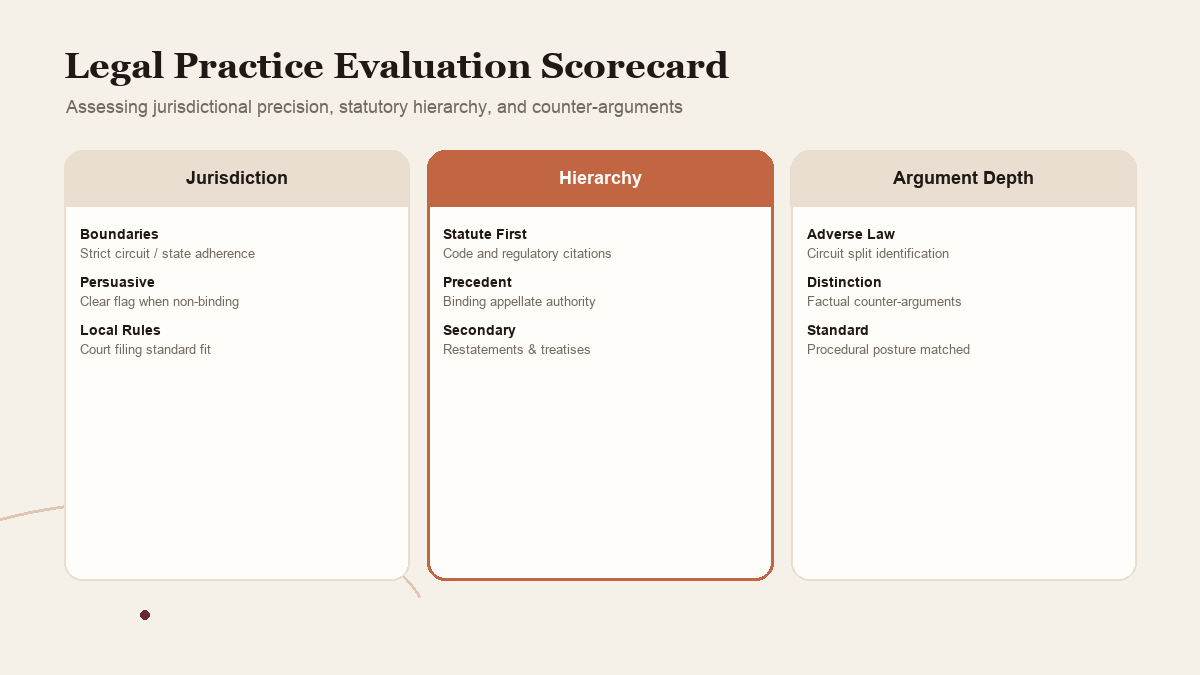 View image detail
Scoring criteria: jurisdictional precision, statutory hierarchy, argument synthesis, and citation accuracy.
Dimension 1: Jurisdictional Precision
Legal analysis is strictly jurisdictional. An argument valid under Delaware General Corporation Law may be completely inapplicable under California or New York jurisprudence.
- Does the model adhere strictly to the requested jurisdiction (e.g., Second Circuit precedent, Southern District of New York local rules)?
- Does the model appropriately recognize persuasive non-binding precedent from other circuits when intra-circuit authority is sparse?
Dimension 2: Statutory and Regulatory Hierarchy
Law begins with statutes, followed by binding administrative regulations, followed by judicial interpretations.
- Does the model prioritize current statutory language over secondary commentary?
- When answering statutory questions, does it retrieve the relevant code section, identify defined terms, and evaluate administrative agency interpretations (e.g., SEC or FTC guidance)?
Dimension 3: Procedural Context Sensitivity
The applicable legal standard depends heavily on procedural posture. A motion to dismiss requires evaluating plausible factual allegations under Twombly and Iqbal, whereas a motion for summary judgment evaluates the absence of genuine disputes of material fact under Celotex.
- Does the model tailor its synthesized arguments to the exact procedural posture specified in the prompt?
- Does it correctly identify burden of proof standards and presumptions applicable to the moving party?
Dimension 4: Depth and Counter-Argument Anticipation
A competent legal memorandum does not merely confirm a requested conclusion; it identifies adverse authority and anticipates the adversary's strongest arguments.
- Does Astra for Law identify contrary authority and circuit splits?
- Does it provide substantive factual distinctions that trial counsel can deploy to distinguish adverse precedent?
Technical Architecture: Trusted Access and Document Retrieval
Deploying Astra for Law in a modern law firm environment requires integrating cloud AI capabilities with firm document management infrastructure while preserving security perimeters.
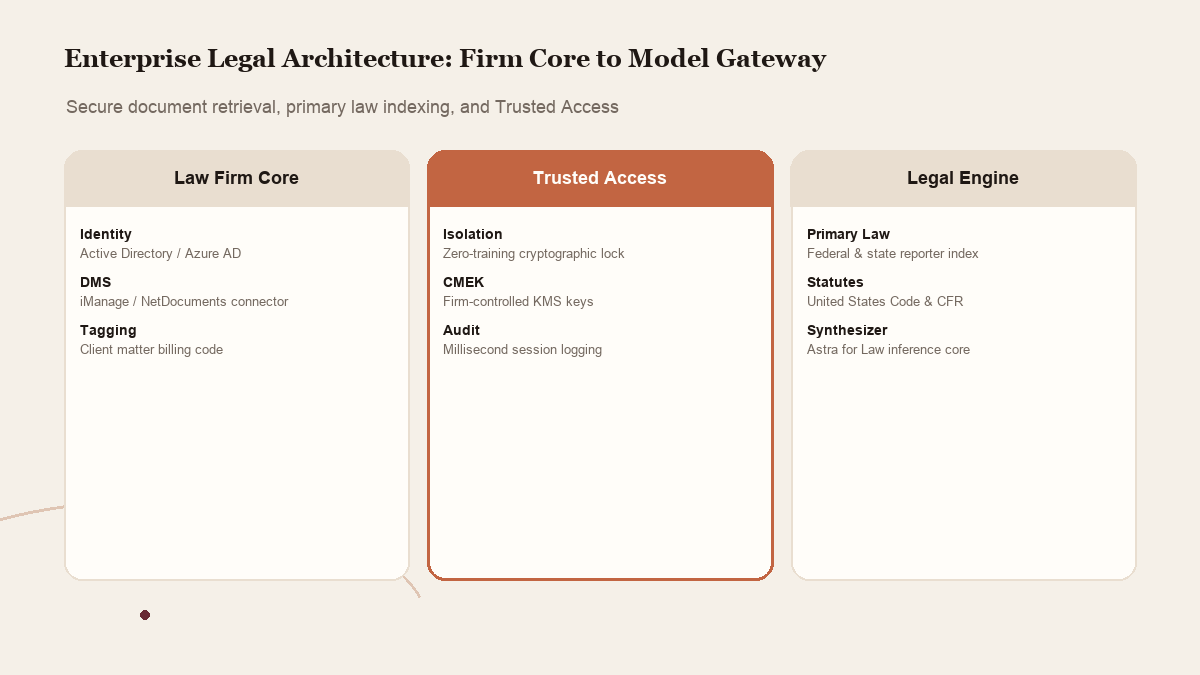 View image detail
System architecture: firm client matter workspace, Trusted Access encryption gateway, primary law search index, and proprietary brief bank connector.
Architectural Components
- Law Firm Client Environment:
- Secure web interface within ChatGPT Enterprise or customized Codex legal desktop plugins.
- Role-Based Access Control (RBAC) tied to firm Active Directory / Azure AD identity providers.
- Matter-specific billing code tagging for every prompt and session.
- Trusted Access Security Gateway:
- Enforces cryptographic isolation: firm inputs, internal documents, and client queries are never used to train foundation models.
- Customer-Managed Encryption Keys (CMEK) ensuring that stored session context remains under firm control.
- Comprehensive access logging recording the attorney ID, matter ID, timestamp, and query metadata.
- Hybrid Retrieval-Augmented Generation Engine:
- Primary Law Corpus Index: Direct integration with indexed federal and state reporters, statutory compilations, and administrative registers.
- Firm Document Repository Connector: Read-only, encrypted connectors to firm document management systems (iManage, NetDocuments) allowing queries across past firm work product and precedent briefs.
- Ranking and Filtering Service: Ranks retrieved legal authorities based on jurisdictional binding authority, recency, and relevance.
The Two-Week Law Firm Pilot Protocol
To assess Astra for Law without risking client confidences or disrupting active matters, execute a structured fourteen-day evaluation pilot using completed, non-active matters or anonymized research problems.
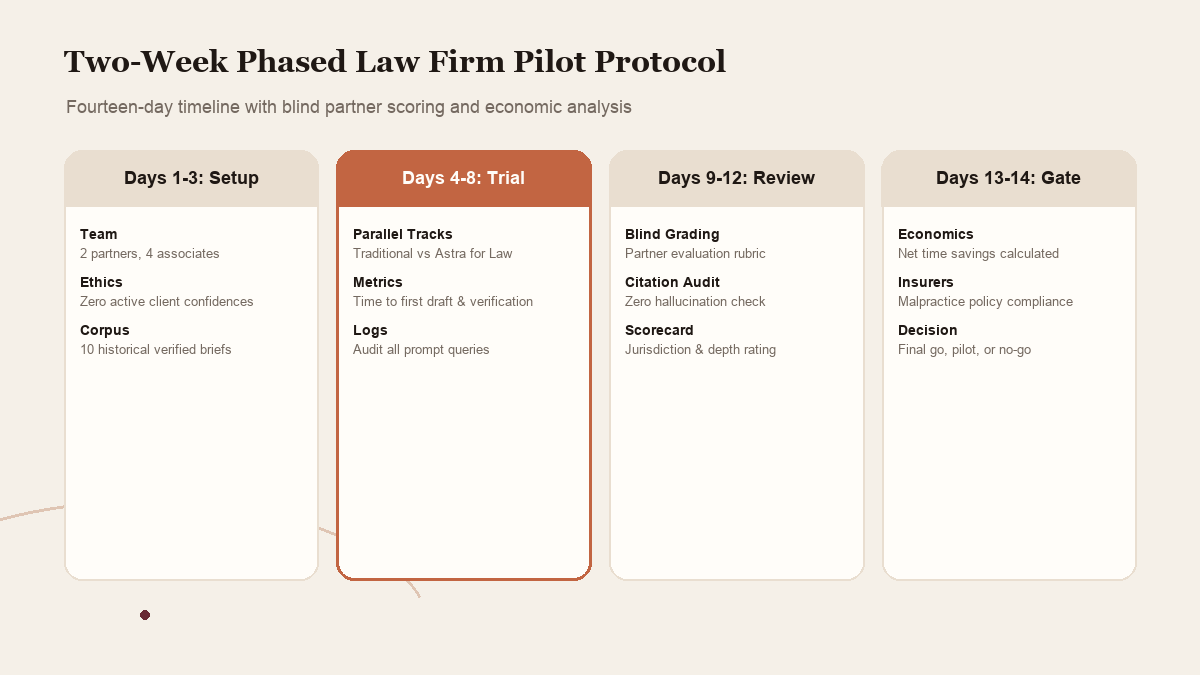 View image detail
Two-week pilot protocol: days 1 to 3 setup, days 4 to 8 parallel research, days 9 to 12 blind scoring, days 13 to 14 committee evaluation.
Phase 1: Setup and Ethical Guardrails (Days 1 to 3)
- Select six participating attorneys: two partners, two senior associates, and two junior associates across litigation and corporate practice groups.
- Establish strict pilot data rules: no active client confidential data, unfiled trade secrets, or un-redacted personal identifying information may be entered into test sessions.
- Curate ten historical, resolved research problems from firm archives where the correct legal answer, controlling precedent, and eventual court outcome are already fully established.
Phase 2: Parallel Blind Research (Days 4 to 8)
- Divide research assignments:
- Track A: Associates research five problems using traditional workflows (Westlaw, LexisNexis, manual brief bank search).
- Track B: Associates research five identical problems using Astra for Law, followed by standard verification procedures.
- Track precise time metrics: time to initial authority identification, time to complete first memorandum draft, and time required for citation checking.
Phase 3: Blind Partner Quality Review (Days 9 to 12)
- Anonymize the resulting research memoranda, removing references to the tools utilized.
- Distribute memoranda to participating partners for blind grading across four criteria: factual accuracy, legal analysis depth, citation validity, and persuasive writing quality.
- Audit all generated citations using the Four-Step Citation Rubric to catalog all hallucinations, quotation errors, or missed negative treatments.
Phase 4: Economics and Strategic Committee Review (Days 13 to 14)
- Calculate total associate time saved versus verification overhead incurred.
- Compare citation error rates between traditional and AI-assisted workflows.
- Convene the firm's AI steering committee to review findings against pre-defined go or no-go decision criteria.
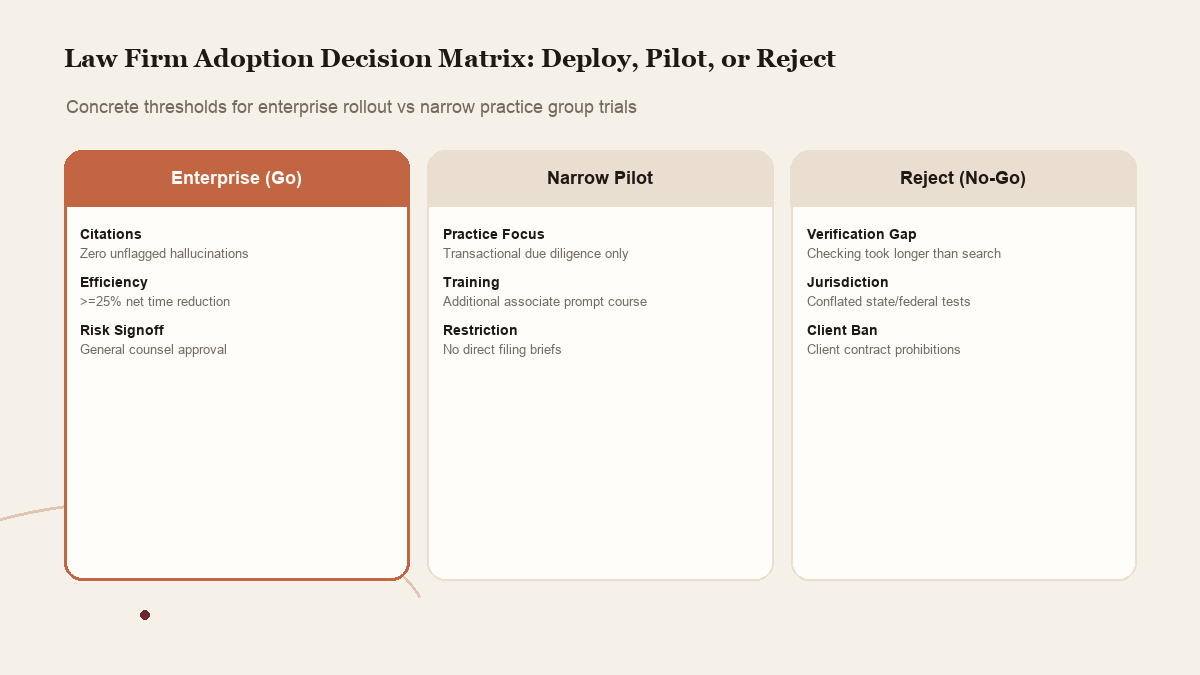
Law Firm Decision Matrix: Deploy, Pilot, or Reject
At the conclusion of the evaluation pilot, firm leadership must make a clear operational choice based on verified practice evidence.
 View image detail
Decision matrix: criteria for enterprise firm deployment, narrow practice group pilot, or total adoption rejection.
Scenario A: Enterprise Rollout (Go)
Approve firm-wide enterprise deployment only when all three conditions are met:
- Zero Hallucination Tolerance: The pilot demonstrated zero unflagged citation hallucinations in final work product, with junior associates successfully identifying and correcting all preliminary model discrepancies during verification.
- Documented Efficiency Lift: Participating associates achieved at least a 25% net time savings across end-to-end research and first-draft synthesis, even after accounting for citation verification time.
- Firm Risk Signoff: Information security, general counsel, and professional liability insurers certify that Trusted Access terms, encryption controls, and data segregation satisfy firm confidentiality obligations.
Scenario B: Specialized Practice Group Pilot (Constrained Adoption)
Restrict rollout to a narrow, specialized pilot if:
- The model performed exceptionally well on statutory retrieval and preliminary research in transactional due diligence or regulatory compliance, but struggled with nuanced procedural brief writing in appellate litigation.
- Associates require additional structured training on prompt formulation, citation verification, and counter-argument identification before broader firm release.
- Rollout is limited to internal research memos, strictly prohibiting direct use in court filings without secondary partner certification.
Scenario C: Rejection and Delay (No-Go)
Decline adoption and retain existing research workflows if:
- Verification overhead exceeded time savings: associates spent more time chasing questionable citations and checking incomplete quotes than it would have taken to conduct traditional research from scratch.
- The model repeatedly failed jurisdictional constraints, conflating federal circuit precedent or missing decisive state statutory revisions.
- Firm client agreements contain explicit prohibitions against utilizing third-party generative AI on client matters that cannot be modified.
Conclusion and Strategic Recommendations
Astra for Law demonstrates substantial technological progress in applying foundation models to domain-specific professional workflows. The integration of specialized legal corpora and enterprise Trusted Access provides a credible alternative to traditional search paradigms.
However, in the practice of law, speed is meaningless without accuracy. By instituting rigorous lawyer-supervised pilot protocols, enforcing strict four-step citation verification, and aligning model deployment with modern firm billing structures, forward-thinking law firms can harness generative legal AI responsibly while upholding their highest professional and ethical standards.
Checked for this article
Sources
Keep going
Related notes.
Automation and Agents
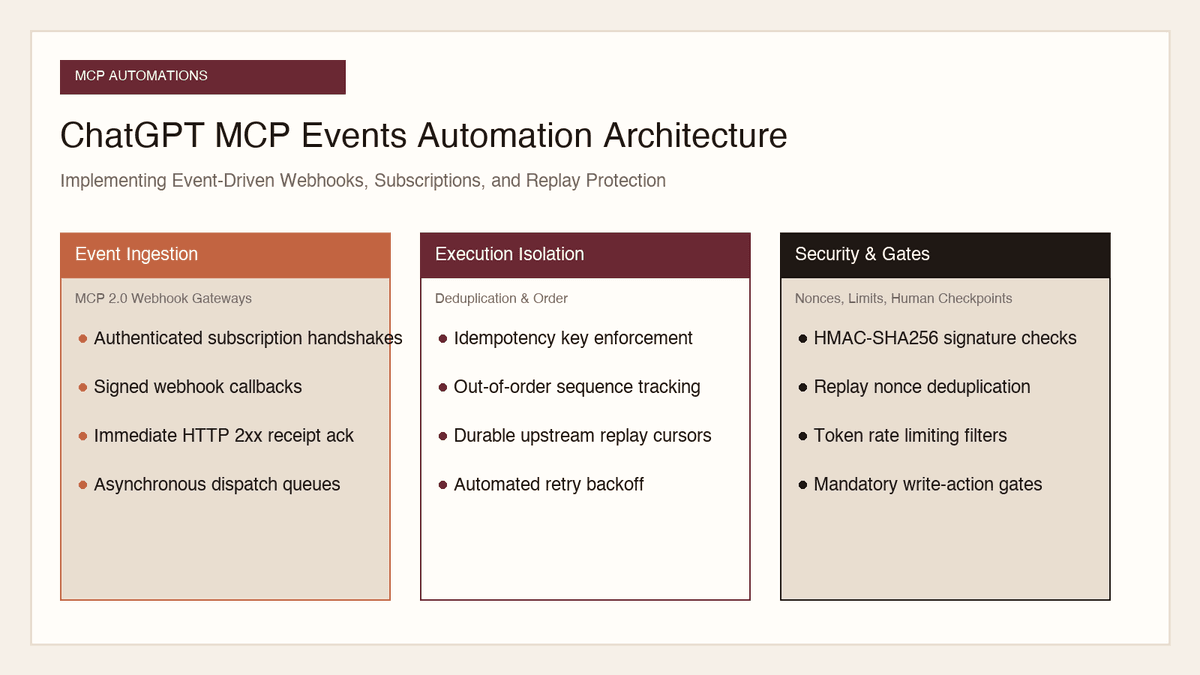
How to Implement MCP Events in ChatGPT: Event-Triggered Automations
Autonomous conversational agents no longer need to rely on wasteful polling loops. Here is how to implement event-triggered automations using ChatGPT MCP Events.
Read the article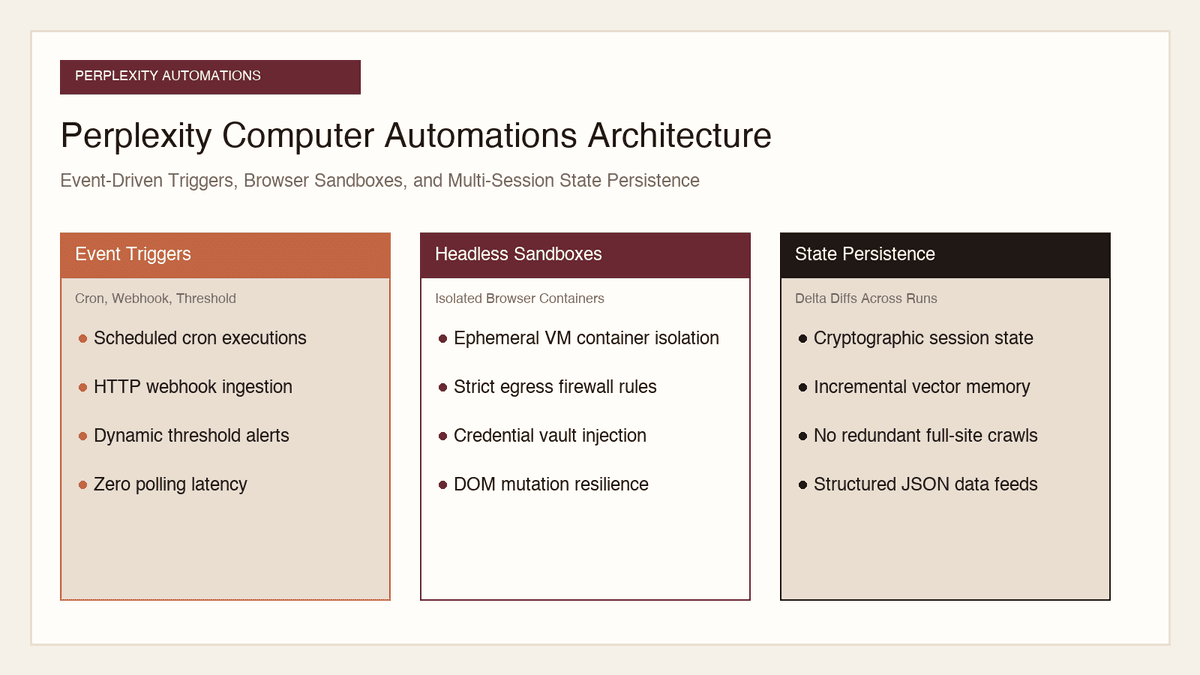
Automation and Agents
How to Build Recurring Web Automations with Perplexity Computer
Web scraping scripts break whenever a layout shifts. Here is how to build durable, recurring web automations using Perplexity Computer and persistent state.
Read the article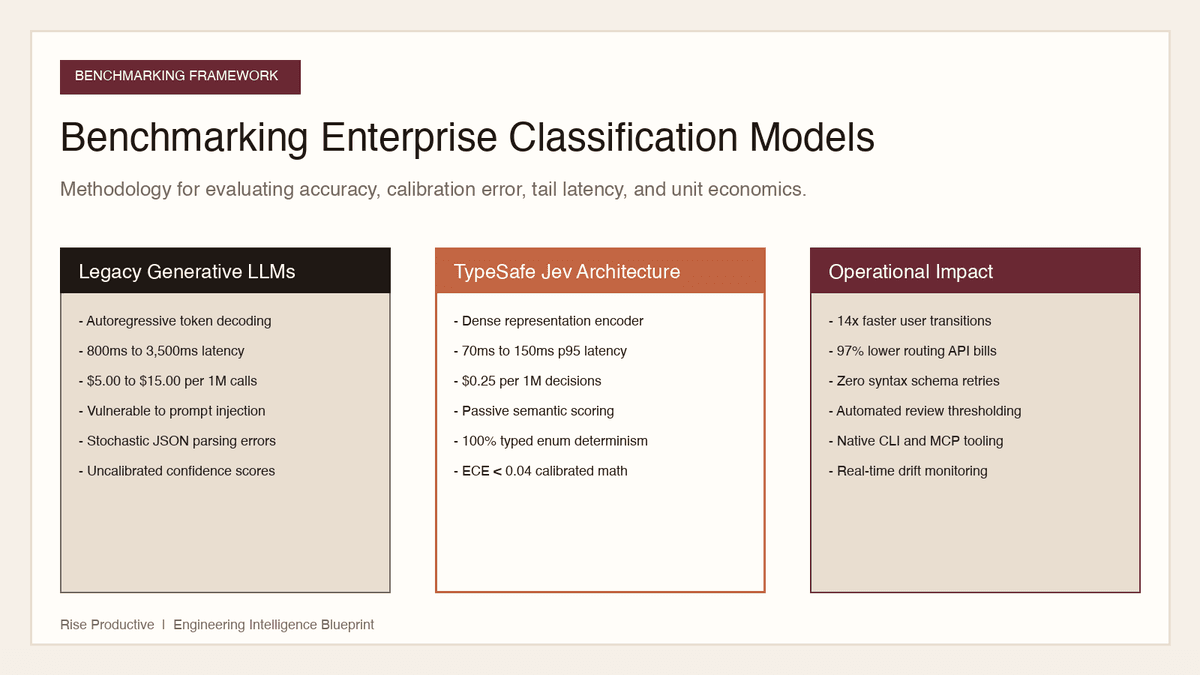
Automation and Agents
How to Benchmark Classifier Models: Latency, Cost, Determinism
Evaluating AI classifiers requires looking beyond static accuracy. Here is how to benchmark probability calibration, latency percentiles, and unit economics.
Read the article