
Automation and Agents
How to Supervise Parallel Voice Agents: Latency, Barge-In, Fallback
When voice agents run parallel background tools, state collisions and dead air threaten stability. Here is how to govern latency, barge-in, and fallbacks.
On this page
- The Real-Time Dilemma: Why Production Voice Systems Collapse Under Load
- 1. The Acoustic Barge-In Blindspot
- 2. Stale State Collisions in Asynchronous Tools
- 3. Compounding Latency Cascades
- Establishing Strict End-to-End Latency Budgets
- 1. Acoustic Ingestion and VAD Window (100 to 150 ms)
- 2. Inbound Network Transport (50 to 100 ms)
- 3. Model Reasoning and First-Token Audio Synthesis (200 to 350 ms)
- 4. Outbound Network Transport (50 to 100 ms)
- 5. Client Jitter Buffering and Playback (50 to 100 ms)
- Acoustic Echo Cancellation and Barge-In Threshold Calibration
- Hardware vs Software AEC
- The Double-Talk Dilemma
- Managing Asynchronous Tool Latencies and Degradation Tiers
- Tier 1: Optimal Execution (< 1,200 ms)
- Tier 2: Extended Execution with Conversational Filler (1,200 ms to 3,500 ms)
- Tier 3: Timeout Fallback and Graceful Degradation (> 3,500 ms)
- Resolving Stale State Collisions with Generational Turn IDs
- The Generational ID Architecture
- Designing Human Agent Escalation and Context Handoff
- Handoff Triggers
- The Structured Context Dossier
- The Warm Vocal Bridge
- Acoustic Noise Floor Profiling in Call Centers and Public Environments
- 1. Dynamic Noise Floor Tracking
- 2. Spectral Formant Filtering
- Telephony Integration Patterns: SIP Trunks, WebRTC Bridges, and Audio Codecs
- 1. SIP Trunking and Media Stream Ingestion
- 2. Managing Codec Transcoding Overhead
- 3. Latency Optimization in Telephony Media Bridges
- Operational Telemetry: Monitoring Voice Session Health
- 1. The Dead-Air Incident Rate
- 2. False Interruption Frequency
- 3. Tool Timeout and Degradation Ratio
- 4. Sentiment Drift Slope
- 5. First-Contact Resolution (FCR) Parity
- Conclusion: Engineering Resilience for Voice AI
- Sources
Deploying autonomous voice agents into customer-facing enterprise operations introduces operational risks that standard text-based chatbots never encounter. In a chat interface, if an API call takes four seconds to return data, the user sees a pulsing typing indicator. In a telephone conversation or native voice application, four seconds of dead air is an operational failure. Customers assume the call has dropped, speak over the silence, trigger race conditions, or hang up in frustration. Conversely, if an agent speaks aggressively over a customer because of poor interruption detection, customer satisfaction plummets.
With the advent of models like Gemini 3.8 Live that support parallel background tool calling during live audio streaming, the surface area for operational complexity multiplies. Voice agents now juggle simultaneous streams: receiving continuous microphone input, streaming synthetic voice output, executing asynchronous backend tools, monitoring network jitter, and listening for customer barge-in. When any single link in this chain falters, the agent can hallucinate, repeat stale data, or freeze entirely.
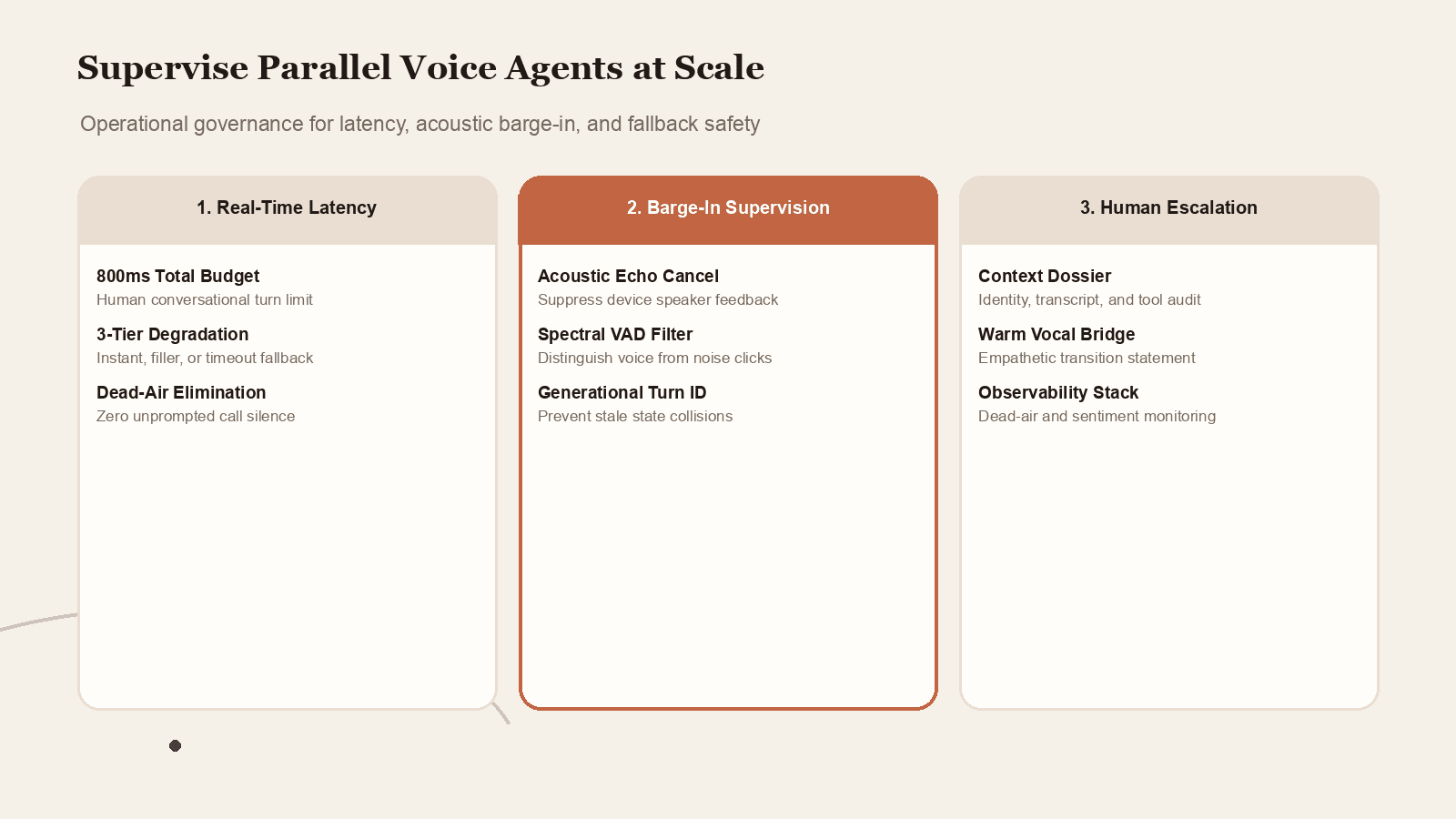
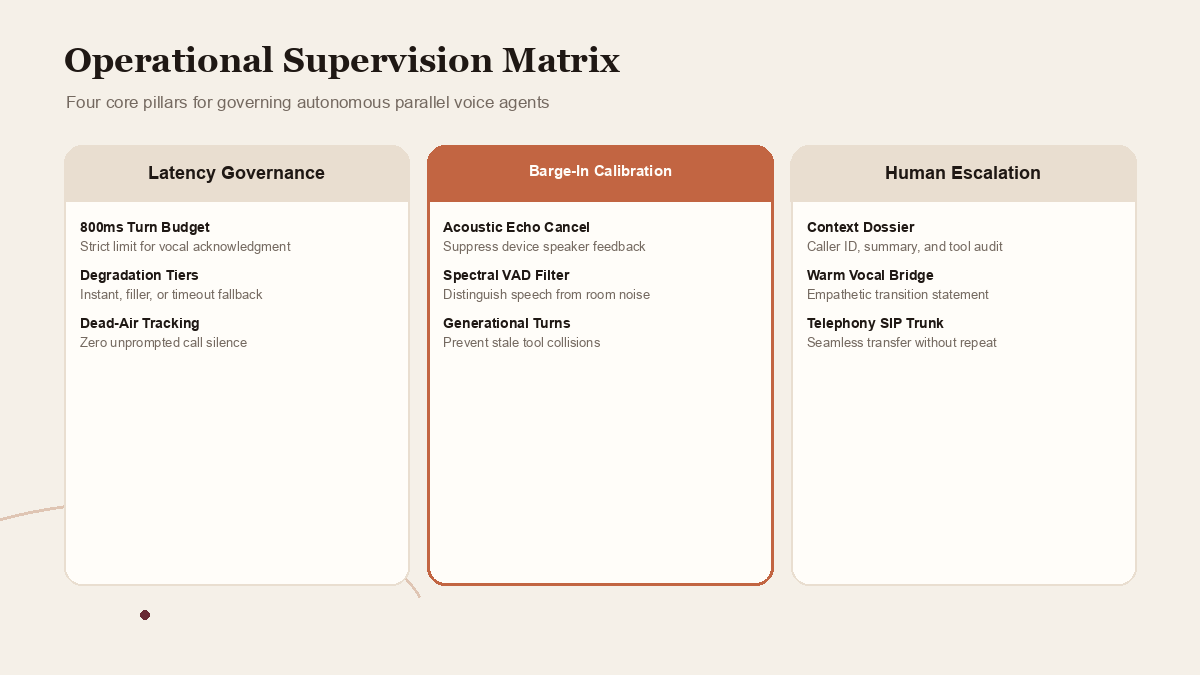
For chief technology officers, contact center leaders, and voice system architects, deploying parallel voice agents requires a rigorous operational governance and supervision framework. Grounded in telecommunications engineering and real-time systems principles, this guide outlines the protocols, metrics, and safety architectures necessary to supervise parallel voice agents at scale: establishing strict latency budgets, managing acoustic barge-in, handling tool timeouts, and orchestrating seamless human agent escalation.
 View image detail
The Real-Time Dilemma: Why Production Voice Systems Collapse Under Load
Voice agents operate under unforgiving physiological and psychological constraints. Human conversational pacing has evolved over millennia. Sociolinguistic research demonstrates that the average gap between spoken turns in human dialogue is between 200 and 300 milliseconds. When an automated system introduces delays exceeding 700 milliseconds, users perceive the interaction as sluggish. When delays exceed 1,500 milliseconds, users naturally repeat themselves or ask if the agent is still listening.
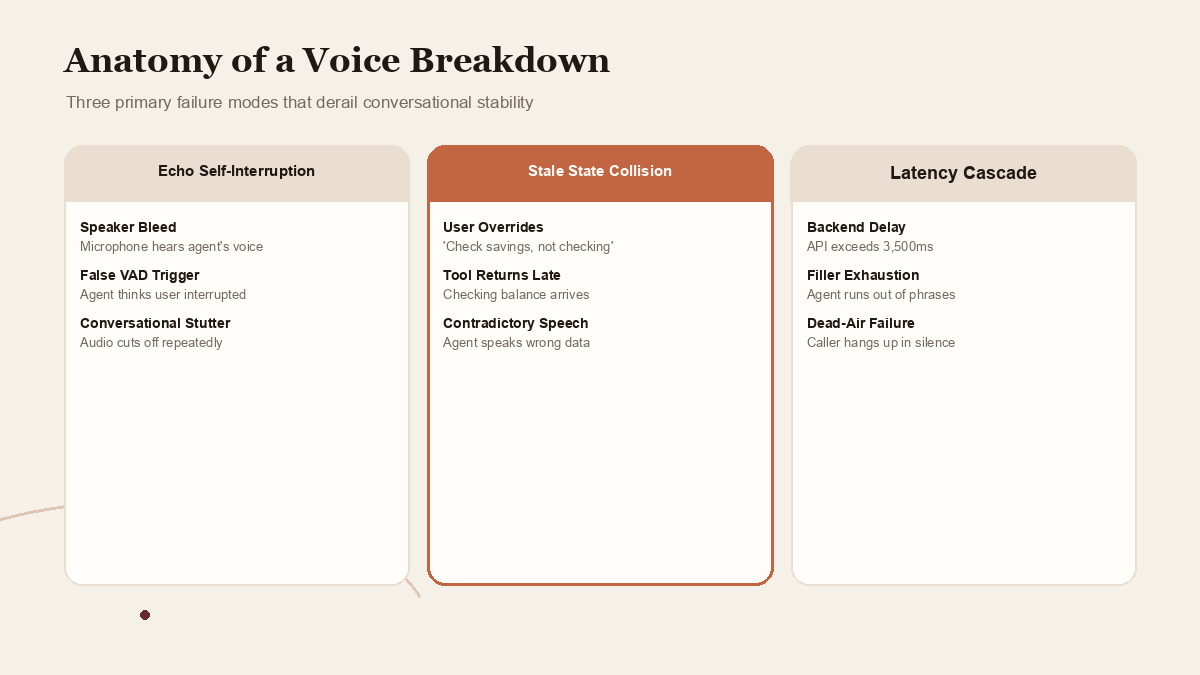
When parallel voice agents are deployed to production, system stability typically degrades across three distinct operational failure modes:
1. The Acoustic Barge-In Blindspot
Barge-in, the ability of a user to interrupt an AI agent while it is speaking, sounds simple in theory. In practice, it is technically challenging. The agent's microphone picks up both the user's voice and the sound of the agent's own voice coming out of the device speaker. Without flawless acoustic echo cancellation (AEC) and calibrated voice activity detection (VAD), the agent either interrupts itself on its own echo, or fails to hear the user attempting to stop an incorrect action.
2. Stale State Collisions in Asynchronous Tools
In a parallel voice agent, the user might ask: "Check my checking balance." The agent begins speaking filler dialogue while firing an API call. Two seconds later, before the API returns, the user interrupts: "Actually, make that savings, not checking."
If the architecture lacks strict state synchronization, the original checking API call completes, its payload is injected into the model context, and the agent announces the checking balance anyway, directly ignoring the user's latest instruction. This state collision destroys customer trust instantly.
3. Compounding Latency Cascades
In enterprise environments, backend microservices experience transient latency spikes during peak business hours. An inventory lookup that normally returns in 200 milliseconds suddenly takes 3,500 milliseconds. If the voice agent has no timeout fallback strategy, it runs out of conversational filler, lapses into prolonged silence, and leaves the caller stranded in dead air.
 View image detail
Establishing Strict End-to-End Latency Budgets
To manage real-time voice performance, operations teams must break down the end-to-end communication loop into a strict, non-negotiable latency budget. Every millisecond consumed by network transit or backend processing directly borrows from the user experience.
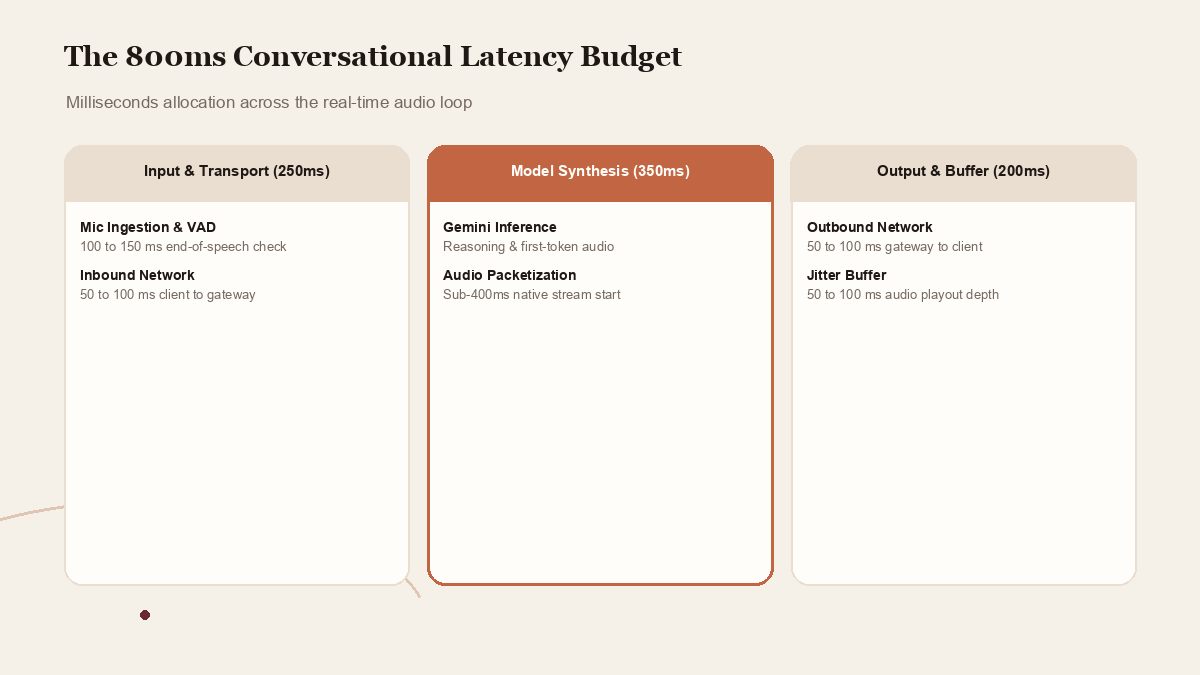
An enterprise voice session operates under a total turn-around budget of 800 milliseconds for initial conversational acknowledgment:
1. Acoustic Ingestion and VAD Window (100 to 150 ms)
The time required for the client-side audio engine to capture microphone input, filter ambient noise, verify that speech has concluded (end-of-speech detection), and packetize PCM frames.
2. Inbound Network Transport (50 to 100 ms)
The network hop from the client device to the enterprise session gateway. Managing this requires deploying regional edge gateways located geographically close to callers.
3. Model Reasoning and First-Token Audio Synthesis (200 to 350 ms)
The time required for the frontier model (such as Gemini 3.8 Live) to ingest the audio context, determine user intent, and begin emitting the first audio response packets.
4. Outbound Network Transport (50 to 100 ms)
The transit time for synthetic audio packets streaming from the gateway back to the client device.
5. Client Jitter Buffering and Playback (50 to 100 ms)
The shallow buffer required to prevent acoustic dropouts before speaker playback begins.
$$ ext{Total Latency} = 150 ext{ ms} + 100 ext{ ms} + 350 ext{ ms} + 100 ext{ ms} + 100 ext{ ms} = 800 ext{ ms}$$
If a backend business tool requires 2,000 milliseconds to complete, that tool cannot execute on the primary conversational turn-around track. It must be decoupled into an asynchronous background worker, while the model emits immediate vocal acknowledgment within the 800-millisecond budget.
 View image detail
Acoustic Echo Cancellation and Barge-In Threshold Calibration
A voice agent that cannot be cleanly interrupted feels aggressive and unnatural. When a caller says, "No, wait, stop," the system must cut its audio output instantly. Achieving clean barge-in requires calibrating hardware, software, and network thresholds.
Hardware vs Software AEC
Acoustic Echo Cancellation operates by subtracting the outgoing speaker signal (the reference signal) from the incoming microphone signal.
- Native Mobile and Hardware Endpoints: Smartphones and smart displays incorporate dedicated digital signal processors (DSPs) with hardware-level AEC. In these environments, barge-in detection is reliable because echo suppression occurs before audio frames reach the application layer.
- Web Browser and Telephony SIP Trunks: Web applications and telephony systems rely on software-based AEC (such as WebRTC AEC3). Software AEC is vulnerable to processing jitter and speaker-microphone coupling delays.
The Double-Talk Dilemma
The most critical calibration challenge in barge-in supervision is managing "double-talk", periods where both the user and the agent speak simultaneously.
If VAD sensitivity is set too high, ambient room noise, dog barks, or keyboard clicks trigger false interruptions, causing the agent to constantly stutter and stop speaking. If VAD sensitivity is set too low, the caller must shout to register an interruption.
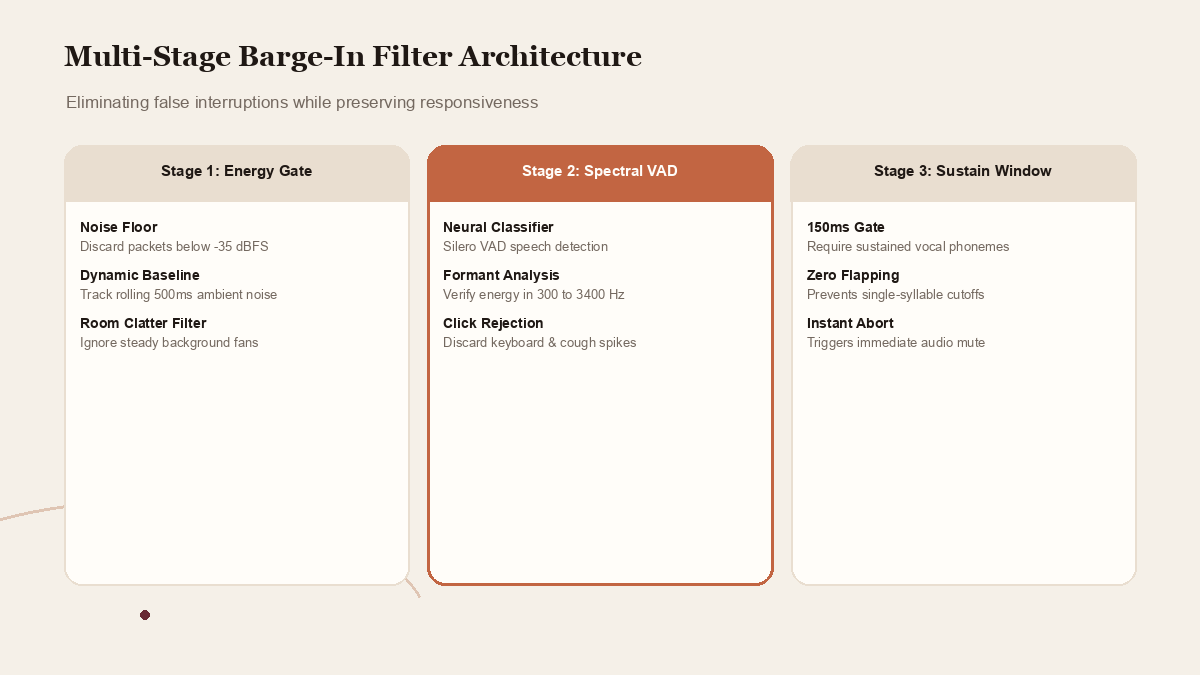
To achieve production stability, implement a multi-stage barge-in filter:
- Energy-Based VAD Pre-Filter: Discard audio frames below -35 dBFS.
- Spectral Voice Classifier: Run an ultra-lightweight neural speech classifier (such as Silero VAD) to confirm that incoming energy matches human vocal formant frequencies rather than transient background clicks.
- Minimum Interruption Window: Require sustained human speech for at least 150 milliseconds before triggering an interruption event, filtering out single-syllable throat clearing or brief acoustic coughs.
 View image detail
Managing Asynchronous Tool Latencies and Degradation Tiers
When a voice agent invokes backend tools, the supervisory system must govern execution through strict degradation tiers. Never allow an external API call to hold open an indefinite lock on conversational context.
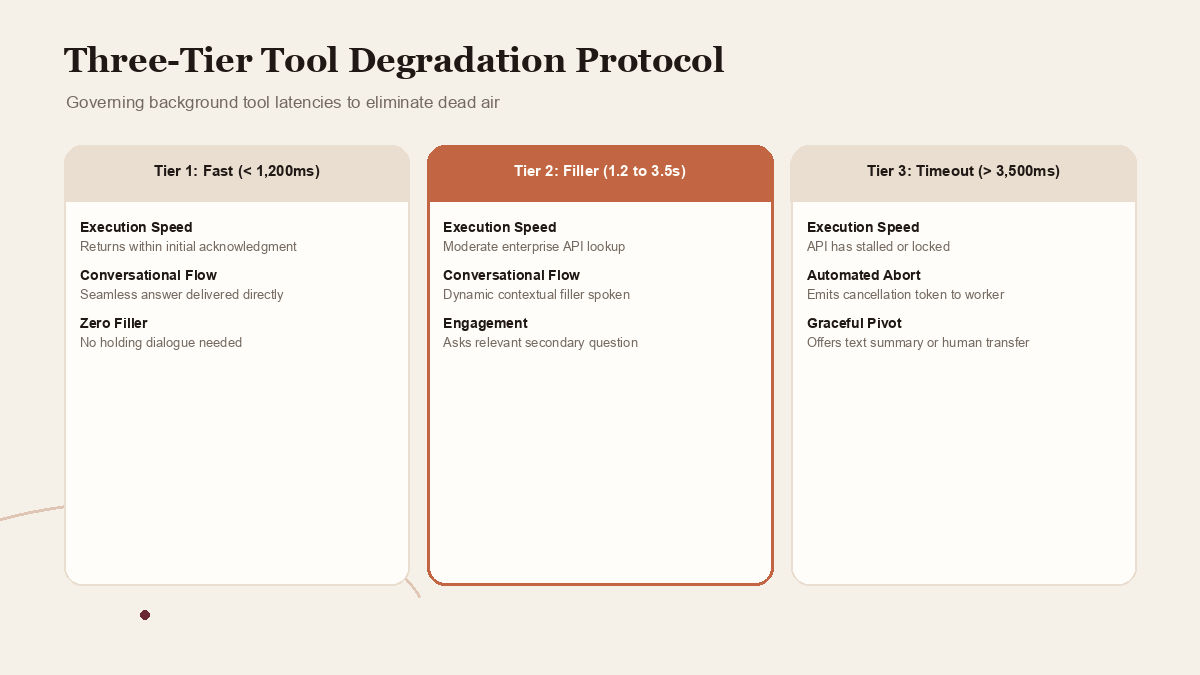
Every background tool declaration should be governed by a three-tiered timeout protocol:
Tier 1: Optimal Execution (< 1,200 ms)
The background tool completes within the duration of the agent's initial semantic acknowledgment sentence. The model receives the data payload seamlessly and presents the answer without requiring any filler dialogue.
Tier 2: Extended Execution with Conversational Filler (1,200 ms to 3,500 ms)
The tool requires additional time to query remote databases. The supervisory system triggers dynamic conversational filler. The agent acknowledges the task, provides relevant background context, or asks a clarifying question to keep the audio channel alive.
Tier 3: Timeout Fallback and Graceful Degradation (> 3,500 ms)
The backend service has stalled. At the 3,500-millisecond mark, the supervisory gateway emits an automated cancellation token to abort the backend microservice call and injects a fallback payload to the voice model: {"status": "TIMEOUT", "fallbackMessage": "Database is taking longer than usual to respond. Offer to text the details or transfer to an associate."}
The agent immediately pivots the dialogue without dead air: "That lookup is taking a bit longer than expected to load. I can text the summary directly to your mobile number on file, or connect you with an account specialist right now. Which do you prefer?"
 View image detail
Resolving Stale State Collisions with Generational Turn IDs
To prevent the state collision bugs discussed earlier, where an interrupted tool call returns data that contradicts a user's updated instruction, system architects must enforce generational turn tracking.
The Generational ID Architecture
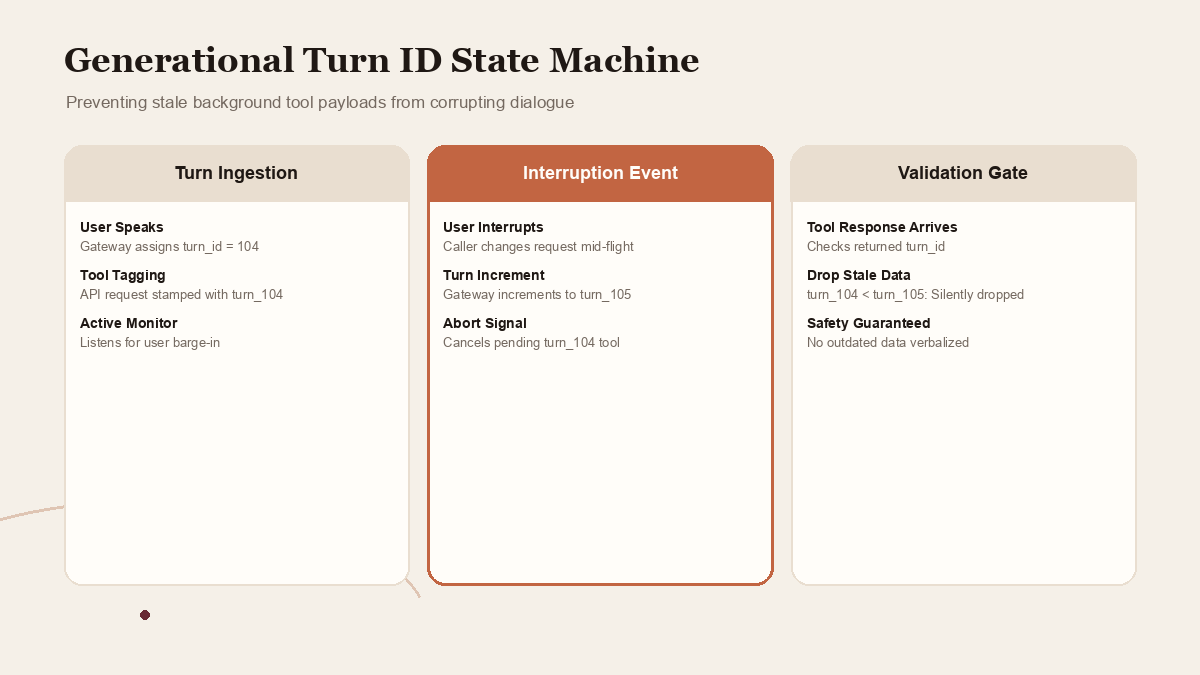
Every user conversational turn is tagged with a monotonically increasing integer: turn_id.
- Turn Initiation: When the user speaks, the gateway assigns a new
turn_id(e.g.,turn_104). - Tool Dispatch: When the model emits a tool call, the gateway tags the outgoing microservice request with both the tool call ID and the current
turn_id. - Interruption Invalidation: If the user interrupts before the tool returns, the gateway increments the active turn counter to
turn_105and broadcasts an abort signal. - Response Validation Gate: When any background tool returns, the gateway checks its associated
turn_idagainst the currently active session turn:
- If
tool.turn_id === session.current_turn_id, the payload is valid and forwarded to the model. - If
tool.turn_id < session.current_turn_id, the payload is stale. The gateway silently drops the data and logs a discarded state event.
This simple, deterministic rule guarantees that an agent never verbalizes answers to questions the user has already revoked.
 View image detail
Designing Human Agent Escalation and Context Handoff
No matter how sophisticated the frontier model, enterprise voice agents will encounter edge cases, emotional distress, or complex policy exceptions that require human intervention. An abrupt, clumsy handoff destroys the customer experience.
A resilient supervision architecture incorporates warm, context-rich escalation protocols:
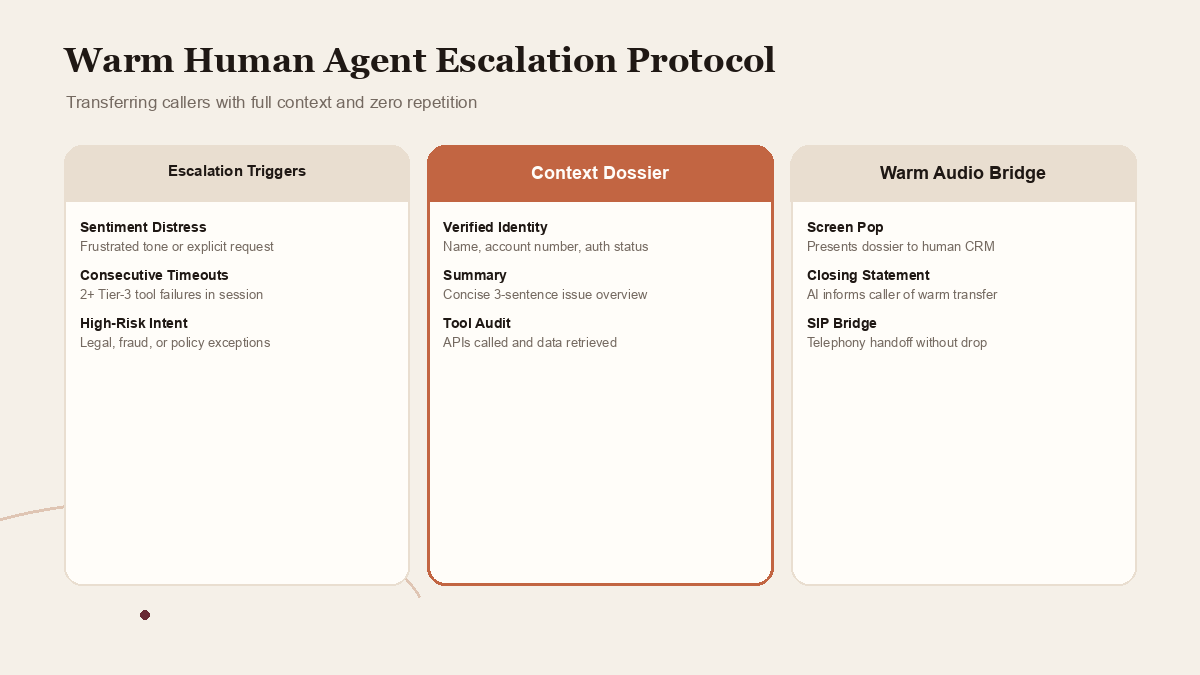
Handoff Triggers
The supervisory gateway should monitor automated escalation triggers:
- Repetitive Sentiment Distress: Detection of customer frustration, raised vocal pitch, or explicit demands for a human representative.
- Consecutive Tool Failures: Two or more Tier-3 timeout fallbacks occurring within a single session.
- High-Risk Intent Flags: Workflows involving legal disputes, fraud claims, or bereavement policy requests that enterprise governance reserves strictly for human specialists.
The Structured Context Dossier
When escalation triggers, the voice agent must not transfer the caller into a blind queue where they are forced to repeat their information.
The gateway compiles a structured JSON context dossier and delivers it to the human agent's CRM screen before the call connects:
- Verified Caller Identity: Name, account number, authentication status.
- Executive Summary: A concise 3-sentence summary of the caller's objective and what actions have been attempted.
- Executed Tool Audit: List of background tools invoked, returned data, and any timeouts encountered.
- Emotional Sentiment Profile: Baseline and current caller frustration trajectory.
The Warm Vocal Bridge
While the SIP telephony bridge transfers the audio stream to the human agent, the AI provides a professional closing statement: "I have transferred all our notes and your account details directly to Sarah on our account team so you will not need to repeat anything. Connecting you now."
 View image detail
Acoustic Noise Floor Profiling in Call Centers and Public Environments
Voice activity detection and acoustic echo cancellation cannot be calibrated in a vacuum. The physical acoustic environment of the caller fundamentally shapes how an autonomous voice agent perceives speech boundaries and interruptions.
A caller speaking from a quiet home office presents a clean acoustic profile with a low noise floor, typically below -45 dBFS, and high signal-to-noise ratio. Conversely, a caller dialing from a busy airport terminal, a crowded vehicle with window turbulence, or an open-plan office introduces severe acoustic challenges:
1. Dynamic Noise Floor Tracking
Static energy thresholds fail in variable environments. If an agent sets a fixed VAD cutoff at -30 dBFS, a caller in a quiet bedroom will be easily heard, but a caller on a noisy highway will constantly exceed the threshold, causing the agent to perceive continuous user speech and freeze its own vocal output.
Production voice gateways must implement dynamic noise floor estimation. By analyzing the lowest energy levels during non-speech intervals across rolling 500-millisecond windows, the audio engine continuously adjusts its detection threshold. The agent requires speech energy to exceed the ambient noise floor by at least 12 dB, preventing steady engine hum or air conditioning fans from triggering false interruptions.
2. Spectral Formant Filtering
Background noise frequently shares overall volume with human speech, but differs in spectral distribution. For example, keyboard typing and passing sirens exhibit sharp transient spikes in high frequencies, whereas human speech concentrates energy in vowel formants between 300 Hz and 3,400 Hz. Applying multi-band spectral subtraction before audio packet ingestion ensures that ambient urban clatter does not disrupt the bidirectional stream.
Telephony Integration Patterns: SIP Trunks, WebRTC Bridges, and Audio Codecs
While consumer voice applications often operate over proprietary WebSocket connections within native mobile apps, enterprise voice agents frequently connect to public switched telephone networks (PSTN) and legacy contact center infrastructure.
Bridging modern bidirectional AI models like Gemini 3.8 Live to enterprise telephony requires mastering telecommunications protocols:
1. SIP Trunking and Media Stream Ingestion
Enterprise contact centers route calls using Session Initiation Protocol (SIP). To connect a telephone call to an AI voice session, the enterprise gateway terminates the incoming SIP INVITE, negotiates Real-Time Transport Protocol (RTP) audio streams, and converts the standard G.711 telephony audio (8 kHz, 8-bit mu-law) into 16 kHz or 24 kHz linear PCM for ingestion into Gemini 3.8 Live.
2. Managing Codec Transcoding Overhead
Telephony audio codecs are heavily compressed and downsampled compared to modern web audio. Passing 8 kHz telephony audio directly to frontier multimodal models can degrade intent accuracy because high-frequency acoustic cues are lost. Enterprise session gateways should incorporate lightweight acoustic upsampling and bandwidth extension algorithms to reconstruct missing spectral harmonics before feeding the audio stream to the model.
3. Latency Optimization in Telephony Media Bridges
Every media bridge hop adds processing delay. If RTP audio is received by an edge session border controller (SBC), forwarded to a media gateway, converted to WebRTC, and finally sent over WebSockets to Google, the accumulated transport delay can exceed 400 milliseconds before model inference even begins.
To maintain the 800-millisecond conversational budget, organizations should deploy unified media gateways that handle SIP termination, audio transcoding, and WebSocket streaming within a single memory-mapped process on edge cloud infrastructure.
Operational Telemetry: Monitoring Voice Session Health
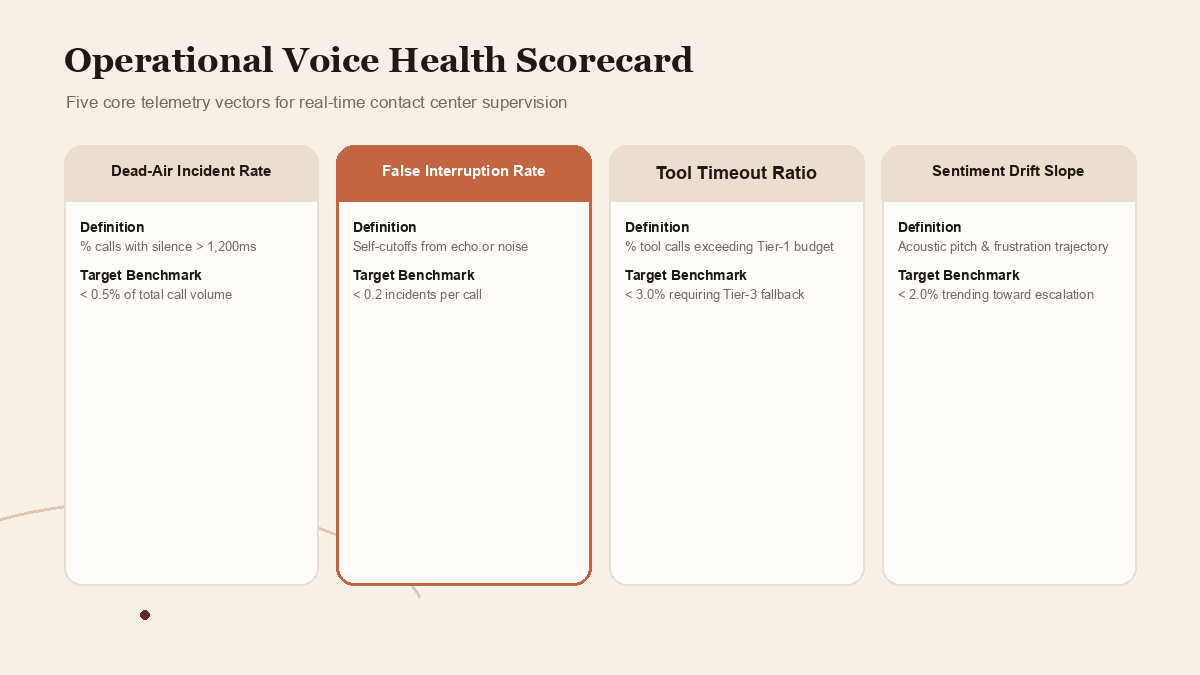
Supervising voice agents in production requires specialized observability metrics that differ fundamentally from web application monitoring. Operations teams must monitor voice health through real-time dashboards tracking five core telemetry vectors:
1. The Dead-Air Incident Rate
The percentage of calls that experience an unprompted silence exceeding 1,200 milliseconds. Top-tier contact centers maintain dead-air rates below 0.5 percent of total call volume.
2. False Interruption Frequency
The number of times per call the agent cuts off its own speech due to acoustic echo or background noise misclassified as user speech. Rates above 0.2 per call indicate improper VAD calibration.
3. Tool Timeout and Degradation Ratio
The percentage of background tool calls that exceed Tier-1 latency budgets and require conversational filler or fallback pivots.
4. Sentiment Drift Slope
Real-time tracking of acoustic vocal pitch and sentiment analysis across the call duration, alerting supervisors to calls trending toward frustration.
5. First-Contact Resolution (FCR) Parity
Comparing the issue resolution rate of AI-handled calls against human agent benchmarks on identical inquiry categories.
By establishing automated alerts on these five vectors, engineering and operations leaders can detect API degradations, voice pipeline anomalies, and customer friction before they impact brand reputation.
 View image detail
Conclusion: Engineering Resilience for Voice AI
The promise of parallel voice agents is immense: fluid, intelligent, conversational assistants that resolve complex customer inquiries in real time while maintaining natural, uninterrupted dialogue. But turning that promise into an enterprise asset requires recognizing that voice is fundamentally an engineering discipline governed by milliseconds.
By enforcing strict latency budgets, calibrating acoustic echo and barge-in thresholds, resolving stale tool states with generational turn IDs, and implementing structured human handoffs, organizations can build voice agents that customers trust. The future of enterprise automation belongs to the organizations that treat voice not merely as a novelty feature, but as a mission-critical, highly supervised operational capability.
Sources
- Google Official Announcement: Gemini 3.8 Live: Continuous Voice Streaming and Background Tool Execution
- Google DeepMind Research: Asynchronous Tool Integration in Real-Time Bidirectional Audio Models
Checked for this article
Sources
Keep going
Related notes.
Automation and Agents
How to Implement MCP Events in ChatGPT: Event-Triggered Automations
Autonomous conversational agents no longer need to rely on wasteful polling loops. Here is how to implement event-triggered automations using ChatGPT MCP Events.
Read the article
Automation and Agents
How to Build Recurring Web Automations with Perplexity Computer
Web scraping scripts break whenever a layout shifts. Here is how to build durable, recurring web automations using Perplexity Computer and persistent state.
Read the article
Automation and Agents
How to Benchmark Classifier Models: Latency, Cost, Determinism
Evaluating AI classifiers requires looking beyond static accuracy. Here is how to benchmark probability calibration, latency percentiles, and unit economics.
Read the article