
AI in Practice
Atlassian and OpenAI: Should Your Team Use Rovo, ChatGPT, or Codex?
Atlassian and OpenAI expanded their partnership. Compare Rovo, ChatGPT, and Codex by workflow, context, action, and what is available today.

On this page
- What changed, and what did not
- Four paths, not one blended product
- Match the tool to the unit of work
- A worked selection, without pretending to run a benchmark
- Why the partnership announcement is not a selection verdict
- A short pilot that can answer the real question
- Compare evidence handling, not just response style
- Add a fourth question: what happens after the answer?
- The practical answer
The short answer is to choose the place where the work already has an owner and a review path. Use Rovo when the task belongs inside Atlassian's work system. Use ChatGPT when a person needs to reason across Atlassian context and other material in a general assistant conversation. Use Codex when the work is part of a software-development loop and a developer needs project context alongside code. Those are starting points, not proof that one tool is better or that any connection is enabled for your account.
Atlassian and OpenAI announced an expanded partnership on October 6, 2026. The announcement describes OpenAI models across Rovo and the Atlassian platform, and connections that let ChatGPT and Codex reach Atlassian context through Atlassian's Model Context Protocol (MCP) integration. It also describes deeper agent workflows as future work. The practical question is therefore not “which company won?” It is which work surface best matches a specific decision, and what a team should verify before relying on it. (Atlassian announcement; OpenAI announcement)
The partnership update makes the relationship more explicit and broadens the options Atlassian says it will offer. Atlassian says OpenAI models are being added to the model mix across Rovo and the broader platform. OpenAI says its GPT-6 family models will power agents across Atlassian and Rovo. Both companies also describe ways to connect ChatGPT and Codex to Atlassian work context. These are company statements about product direction and available integrations, not a neutral comparison of output quality. (Atlassian; OpenAI)
The announcement is an expansion, not the first time these products have touched. Atlassian dates the collaboration to 2023. OpenAI says it relies on Jira for workflows, and both describe Codex use by Atlassian developers. VentureBeat's October 6 report also treats the announcement as an expansion of earlier integrations and notes Atlassian's multi-model posture. That history matters because a launch headline can make a new agreement sound like a new capability everywhere at once. A buyer should separate the commercial partnership, a model available in a product, a connector that can retrieve context, and an agent that can take action. They are related, but they are not the same deployment decision. (OpenAI; VentureBeat)
The key distinction is what teams can use today and what the companies still plan to build. Atlassian lists model access in Rovo and Atlassian MCP connections for ChatGPT and Codex as available now. It describes autonomous agents picking up Jira work, running tests, syncing local coding sessions back to work boards, and coordinating multiple agents with human checkpoints as work being designed or “on the horizon.” OpenAI similarly says the companies are exploring deeper Jira assignment, progress tracking, decision capture, and review. Those planned steps may be useful, but the October announcement does not show that a team can use them today. (Atlassian; OpenAI)
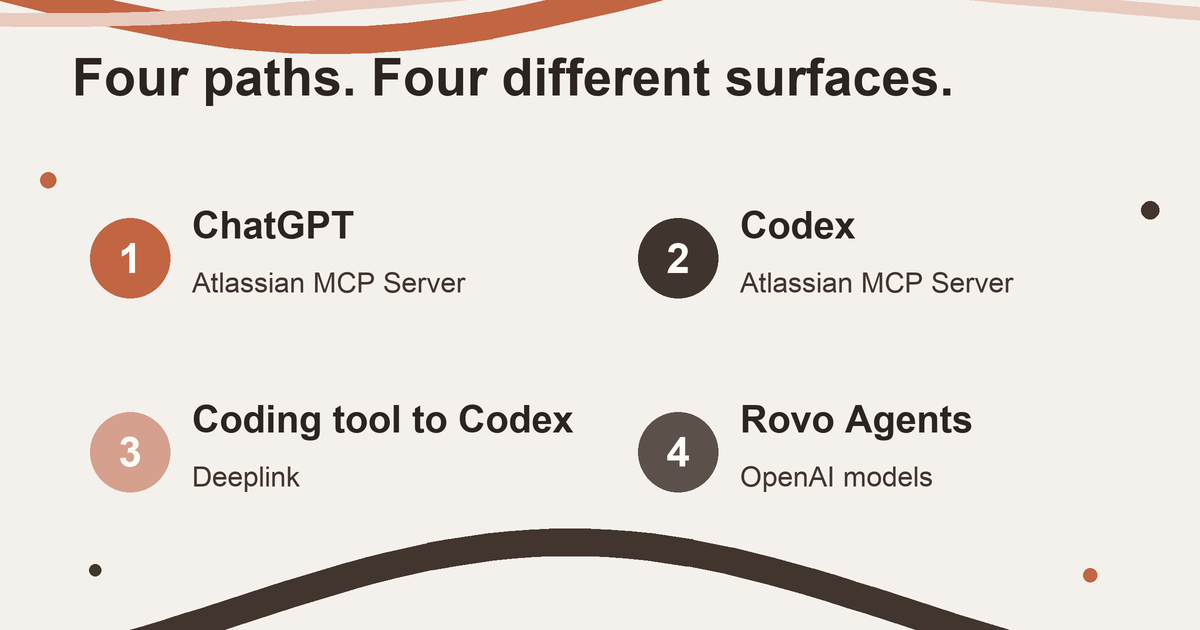
Atlassian's current OpenAI guide describes four paths: use Atlassian's MCP Server from ChatGPT; use it from Codex; send a coding tool into Codex with a deeplink; or select OpenAI models in Rovo Agents. That list is useful because each path places context and work in a different location. It does not mean each path is equally available to every customer or interchangeable in a workflow. The guide's setup instructions, account prerequisites, and current product labels should be checked at the moment an administrator configures access. (Atlassian OpenAI guide)
 View image detail
The guide also describes the Teamwork Graph CLI as a complementary option for terminal and CI/CD workflows, while recommending Atlassian MCP for IDE, web, or sandboxed Codex hosts. That adds a practical choice for developers: use MCP where the client integration fits, or assess the CLI when the workflow is terminal-native or scripted. Atlassian describes the CLI as using existing permissions; confirm its current setup, authentication, and supported actions before choosing it. The guide also points to ChatGPT Deep Research for synthesizing evidence across Atlassian work. Treat that as another possible research surface, subject to the workspace's current availability and access controls. (Atlassian OpenAI guide)
Rovo is the natural first candidate when the work is already organized around Atlassian objects. A product manager asking whether a release is blocked may want an answer assembled from Jira items, Confluence decisions, and team relationships. OpenAI's announcement gives a similar launch-readiness example. Within Rovo, the reasoning is presented in the environment that already contains those objects and workflows. That can reduce context switching and leave the answer near the records a team maintains. It does not guarantee that the source data is current, the synthesis is correct, or that every Rovo agent has the same capabilities. Those questions depend on the specific Rovo experience, model selection, permissions, and configuration. (OpenAI; Atlassian OpenAI guide)
ChatGPT is a candidate when the work begins as a broader conversation. A person may want to compare an Atlassian roadmap with notes from a customer call, a draft launch plan, or general research. The Atlassian connection can make relevant Jira, Confluence, and people context available in ChatGPT, subject to the connection and the user's applicable permissions. That is different from saying ChatGPT has an unrestricted copy of an organization's workspace. The actual context exposed depends on the authenticated connection, account eligibility, enabled tools, and the user asking the question. A team should check what the connected app can read or change and whether its intended job fits a conversation surface. (OpenAI announcement; Atlassian OpenAI guide)
 View image detail
The data-handling decision also depends on where the model runs. Atlassian's current guide says the organization's OpenAI plan and terms govern OpenAI-side processing when Atlassian content is sent to ChatGPT or Codex. It distinguishes that path from OpenAI models used inside Atlassian-managed Rovo experiences. Before connecting a workspace, review the applicable plan, terms, and organizational policy for the chosen surface. (Atlassian OpenAI guide)
Codex is the clearest candidate when the reader is building or reviewing software. Atlassian and OpenAI say developers can connect Codex with work items and technical documentation, and Atlassian's guide lists a direct Codex server path and coding-tool deeplinks. It also presents the Teamwork Graph CLI as a complementary terminal and CI/CD option. This can make a Jira task or a Confluence design decision available near a code workflow; the right route depends on the host, authentication, and workflow requirements. It does not mean Codex has independently verified that a ticket describes the current code, or that the partnership's announced future automation for test-running and Jira updates is already shipped. A developer still needs to inspect repository state, run the actual test suite, and decide what to record back to Jira. (Atlassian; OpenAI; Atlassian OpenAI guide)
 View image detail
The fourth path, selecting OpenAI models in Rovo Agents, is not just another connector. It keeps an agent inside Atlassian's Rovo environment while allowing the model choice to change. That may suit teams who want Atlassian to remain the execution and governance surface. It should not be described as “Rovo is now ChatGPT inside Jira.” The model, agent tools, permissions, and user interface all matter. Atlassian's model mix is broader than one provider, and VentureBeat reports that the company is maintaining a multi-model platform position. For a buyer, that can preserve choice, but it also means checking what a selected model can do in a given Rovo workflow rather than assuming every model offers the same behavior. (Atlassian OpenAI guide; VentureBeat)
A practical selection begins with the smallest useful unit of work. For a broader framework on assigning a task to an interface, see Rise’s comparison of GUI, code, MCP, and API workflows; this article applies that decision to Atlassian’s specific Rovo, ChatGPT, and Codex paths. If the task is “summarize the risks across the release's unresolved Jira tickets,” Rovo may be a better first trial because the question and the records belong together. If the question is “compare the launch plan with customer notes and identify what we still need to learn,” ChatGPT may make more sense because the reasoning spans material beyond Atlassian. If the request is “inspect this repository's implementation against Jira issue ABC-123,” Codex is the stronger fit because the task crosses a codebase and a work item. These examples are workflow hypotheses, not results from a Rise-run product test.
The next criterion is where the source of truth should remain. Rovo can keep the analysis close to Jira and Confluence, where the organization may already maintain decisions and status. ChatGPT can be useful as a flexible synthesis surface, but a conversation answer should not quietly become a system-of-record update. Codex can support development work, but code changes, test results, and project status each have their own artifact and review path. Before enabling any action, specify which system owns the final state. If nobody can answer that question, the pilot is not ready to write anything back.
 View image detail
A third criterion is the shape of the context. “Atlassian context” can mean a single issue, a project roadmap, multiple Confluence pages, a code repository, or a relationship among teams and decisions. A broad request may sound attractive, but it can be harder to evaluate. Start with one workflow that has a known answer or a human reviewer who can establish whether the answer is adequate. For example, ask for a summary of a few named Jira issues and verify every statement against those issues. Do not begin with “tell us everything we need to know about the program” unless you already know how to detect omissions and stale material.
Fourth, match the tool to the person's normal review habit. Product teams may already review plans in Rovo or Jira; developers may already inspect code in Codex; a cross-functional lead may compare documents in ChatGPT. A new surface can add friction even if it returns a plausible response. The trial should measure whether the answer arrives in a place where someone can evaluate and act on it, not merely whether a demo looks fluid. Record who checks the answer, what evidence they inspect, and how corrections return to the source record.
Finally, separate “can connect” from “should connect.” Atlassian's guide lists ChatGPT Team or Enterprise with developer mode. OpenAI's current Help Center lists custom MCP and full MCP support for Business and Enterprise/Edu on web, and says Pro can connect with read/fetch permissions. Its current Plugins path does not require Developer Mode first. The plan labels and setup routes differ, so confirm the current workspace requirements before configuring access. (Atlassian OpenAI guide; OpenAI Help Center)
Imagine a release team facing three questions. First, “Which open issues could affect the launch?” Second, “Do the issues and decisions agree with the latest customer research?” Third, “Does this code change satisfy the acceptance criteria?” The team should not route all three questions through whichever assistant has the newest partnership announcement. They should treat each as a different job, with different evidence and a different reviewer.
 View image detail
For the first question, the team could start in Rovo and ask for the relevant issue list, dependencies, and unresolved blockers. The reviewer should click through to the cited Jira items and check that statuses and owners are current. The success condition is not a confident summary. It is a concise list where every blocker has a traceable record and the reviewer can quickly identify missing or contradictory information.
For the second question, ChatGPT may be useful if the customer research lives outside Atlassian while the roadmap and decisions live inside it. The owner should identify which external notes are allowed in the conversation and which Atlassian spaces the connection may reach. Then the reviewer can compare the assistant's claims with both sets of source material. If one side is inaccessible, the output must say so. The team should not infer that because ChatGPT can search one Atlassian project, it sees all relevant customer evidence.
For the third question, Codex may help the developer use the code repository alongside Jira acceptance criteria. The developer should inspect the proposed changes and run tests in the actual development environment. If a task fails, the reviewer should distinguish a model suggestion, a local code edit, a test execution, and a Jira status update. Those are separate events. Atlassian and OpenAI describe deeper agent connections that could eventually link some of these steps, but the partnership posts label them as exploratory or future work. A current trial should use only the actions documented in the current tool setup. (Atlassian; OpenAI)
This scenario suggests a simple evaluation sheet: workflow, tool surface, source records, allowed actions, reviewer, expected evidence, and stop condition. Add one row for each distinct job, not one row for each vendor. If two surfaces can do the same task, test them against the same small set of records and the same reviewer rubric. Keep the prompt, record IDs, date, answer, corrections, and time spent. That is a local comparison design. Unless the team actually runs it, it is not evidence that one option is faster, cheaper, or more accurate.
Partnership language often compresses the stack into a story about “intelligence plus context.” That is a useful strategic description, but it does not answer the operational questions. Which model version handled the request? Which workspace permissions applied? Did the assistant read the expected records? Did a human confirm an action? Is the output saved in a place that the next person can audit? A buyer needs those details before extrapolating from a company announcement to a production workflow.
The companies also use adoption and impact language. Atlassian says more than 3,000 developers use Codex through ChatGPT Enterprise across terminals, IDEs, and code review workflows. OpenAI repeats a version of the figure. Treat it as vendor-reported usage, not independent proof of improved delivery speed. The pages do not publish a controlled comparison, a baseline, or a measured improvement attributable to Codex. Likewise, OpenAI says Jira helps manage critical workflows at OpenAI, but that does not establish that another organization's Jira configuration or workload will benefit in the same way. (Atlassian; OpenAI)
VentureBeat adds useful context about Atlassian's multi-model approach and reports that a prior ChatGPT connection existed before this announcement. It also reports that an OpenAI representative described the commercial arrangement as a spend commitment on background. The contract details are not disclosed in the official posts, so neither a spending amount nor a guaranteed purchase volume belongs in a buying recommendation. The independent article helps distinguish the partnership narrative from the platform's existing direction, but it is not a substitute for checking each organization's actual contract or product access. (VentureBeat)
There is also a nearby Atlassian announcement from October 6 about its MCP server at Team '26 Europe. It includes vendor claims about a larger tool surface and daily calls. Those metrics belong to that separate product announcement, not proof of the OpenAI partnership's performance. Shared date, company, and MCP topic do not make two events one event. A team choosing among Rovo, ChatGPT, and Codex does not need to rely on token savings or call volume to make the basic workflow decision.
Choose one recurring task with clear source records and a human who knows the answer. Before connecting anything, write down the request, the expected source set, what a correct answer must include, and what a wrong answer would look like. Select the surface that best matches the work, then compare a second surface only if that would change a real decision. Avoid turning a pilot into an open-ended contest across three interfaces.
 View image detail
During the pilot, retain a compact record of what happened. Note the date, user role, surface, model or agent selection if visible, source records, answer, reviewer corrections, and whether anyone acted on the result. Ask the reviewer to classify errors: missing evidence, stale evidence, mistaken inference, incorrect action, or a useful answer that needs clearer provenance. One successfully answered prompt is an anecdote. A small, repeatable set of reviewed cases can tell a team what to examine next, but it still may not establish broad productivity or quality gains.
Set a stop condition before launch. Stop if the tool exposes records outside the pilot scope, cannot provide enough provenance for review, writes where the team intended read-only use, or produces confident answers that reviewers cannot verify. Also stop if the surface creates a second place where work status drifts from Jira. A successful pilot is not one that never makes an error. It is one where the team can observe errors, correct them, and decide whether the remaining risk fits the workflow.
When teams compare two surfaces, they should score how the answer handles evidence as carefully as they score whether the prose sounds helpful. Ask whether the answer identifies the Jira issues or Confluence pages it used, distinguishes a current status from an older decision, says when a source is missing, and lets a reviewer open the record quickly. The exact citation and source-display experience can differ by client and tool, so inspect it in the current interface instead of assuming all four paths expose evidence identically.
 View image detail
A second dimension is correction cost. If the assistant is wrong, can the reviewer see which source caused the error and fix it at the source? Does the correction live in the conversation only, or should the project owner update Jira or Confluence? Is there a risk the same fact will be copied into several places? A workflow that produces a slightly shorter answer but makes review and correction straightforward may fit better than one that produces a polished summary requiring a second investigation.
These criteria make the comparison local and actionable. They do not require a universal winner. One organization might decide that Rovo best fits release coordination, while Codex fits code review and ChatGPT supports cross-functional analysis. Another might have different data locations, account settings, or review habits. The output of a useful pilot is a mapping from workflow to surface, not a claim that one brand wins across every task.
A workflow choice is incomplete until the team decides what to do with the output. A summary can remain in a chat, become a comment on a Jira issue, or inform a person who edits a project plan. Each route carries a different maintenance cost. If the information will matter to the next person who opens the issue, it probably needs to be reviewed and recorded in the system of record. If it is exploratory reasoning that may never become a decision, a conversational surface can be appropriate. If it is code work, the repository history and tests are the evidence for what changed, while Jira can capture the ticket's status and decision context.
 View image detail
This distinction also helps prevent duplicate state. Suppose ChatGPT summarizes a dependency and a project lead copies that answer into Confluence. The copied paragraph can become stale even if the source issue changes. The team should decide whether the assistant is helping a person update an authoritative record, or whether a supported action is part of the workflow. Until a team has reviewed the action's scope and result, manual review is the safer assumption. Atlassian's current guide describes reviewing proposed actions, but the partnership announcement's more autonomous Jira assignments and multi-agent checkpoints remain future work. The reader should select the surface according to today's review path, not the most ambitious future diagram. (Atlassian OpenAI guide; Atlassian announcement)
Rovo, ChatGPT, and Codex are not a single product choice. They place a model, a context source, and a review step in different parts of work. Start with Rovo for Atlassian-native synthesis, ChatGPT for broader conversational work that needs selected Atlassian context, and Codex for developer tasks that cross issues and repositories. Then validate the actual access path, account eligibility, action scope, source traceability, and human review in your own environment.
The October 6 expansion makes more combinations possible and signals future agent workflows. It does not make those future capabilities current, prove a general performance gain, or decide where a team's system of record should be. A small workflow-first pilot will answer more than choosing based on the partnership headline.
Checked for this article
Sources
Keep reading
Related posts

AI in Practice
A Practical Atlassian MCP Pilot for ChatGPT and Codex Administrators
Use Atlassian's Read, Write, and Search controls to stage an MCP pilot, test real permissions, and decide what to expand.
18 min read
Automation and Agents
Codex Cloud Environment Access: A Practical Sharing Checklist
Sharing a prepared environment is not the same as sharing a teammate's task. It can still make prepared files, credentials or connected resources available, so check the access path before rollout.
14 min read
Automation and Agents
Codex Cloud Environments: Is Reusable Setup Worth It?
A reusable coding environment can remove repeated preparation, but it does not prove that work finishes faster. Here is a practical way to test the whole workflow.
14 min read