
AI in Practice
Cloudflare Auto Router: Is Cheaper Model Routing Worth the Trade-Off?
Cloudflare reports lower costs with trade-offs in task success. Read the benchmark limits and decide whether your workload merits a pilot.

On this page
- What did Cloudflare release?
- What does Cloudflare's benchmark actually show?
- What the result can and cannot tell you
- How Auto Router chooses a model
- When would it be worth testing?
- What would make a local test persuasive?
- The practical answer
- Frequently asked questions
- Does Cloudflare Auto Router guarantee the same quality as a frontier model?
- How much does Cloudflare say Auto Router can save?
- Is Cloudflare's Auto Router free?
- Sources
--- title: "Cloudflare Auto Router: Is Cheaper Model Routing Worth the Trade-Off?" blogTitle: "Cloudflare Auto Router: Is Cheaper Model Routing Worth the Trade-Off?" metaTitle: "Cloudflare Auto Router: Is Cheaper Model Routing Worth the Trade-Off?" metaDescription: "Cloudflare's Auto Router reports lower costs with trade-offs in task success. Read the benchmark limits and decide whether your workload merits a pilot." description: "Cloudflare's Auto Router reports lower costs with trade-offs in task success. Read the benchmark limits and decide whether your workload merits a pilot." category: "AI in Practice" author: "Demetri Panici" excerpt: "Cloudflare's Auto Router reports a lower total bill than two fixed-model baselines, alongside fewer successful trials than Opus. Here is what that result can and cannot tell you." hero: ../assets/main-cover-hero.png heroAlt: "Cloudflare-labeled route branches from one work request toward models of different sizes, with a person checking the result." status: private_draft ---
Cloudflare's Auto Router merits a workload-specific test when requests vary in difficulty and each result can be checked. Its benchmark is a reason to investigate, not a savings figure to copy into a forecast: reported cost was lower than Claude Opus 5.5, but so was the success rate. The useful denominator is cost per accepted task, including provider charges, retries and review time. Cloudflare cannot supply that number for your workload.
Cloudflare announced the AI Gateway Auto Router public beta on September 30, 2026. When a request uses the model name cloudflare/auto, the gateway picks from the eligible models. It bases the choice on a classification of the conversation and a score that weighs quality against cost. Cloudflare says the router itself is free while in beta, but that says nothing about the underlying model calls, your gateway setup, retries or review labor. Cloudflare's announcement and current Auto Router documentation describe the feature. Every benchmark figure below comes from Cloudflare's own internal test. A search on October 1, 2026 for an independent Auto Router benchmark surfaced the announcement and summaries, but no reproducible rerun; Rise has not run the test either.
 View image detail
What did Cloudflare release?
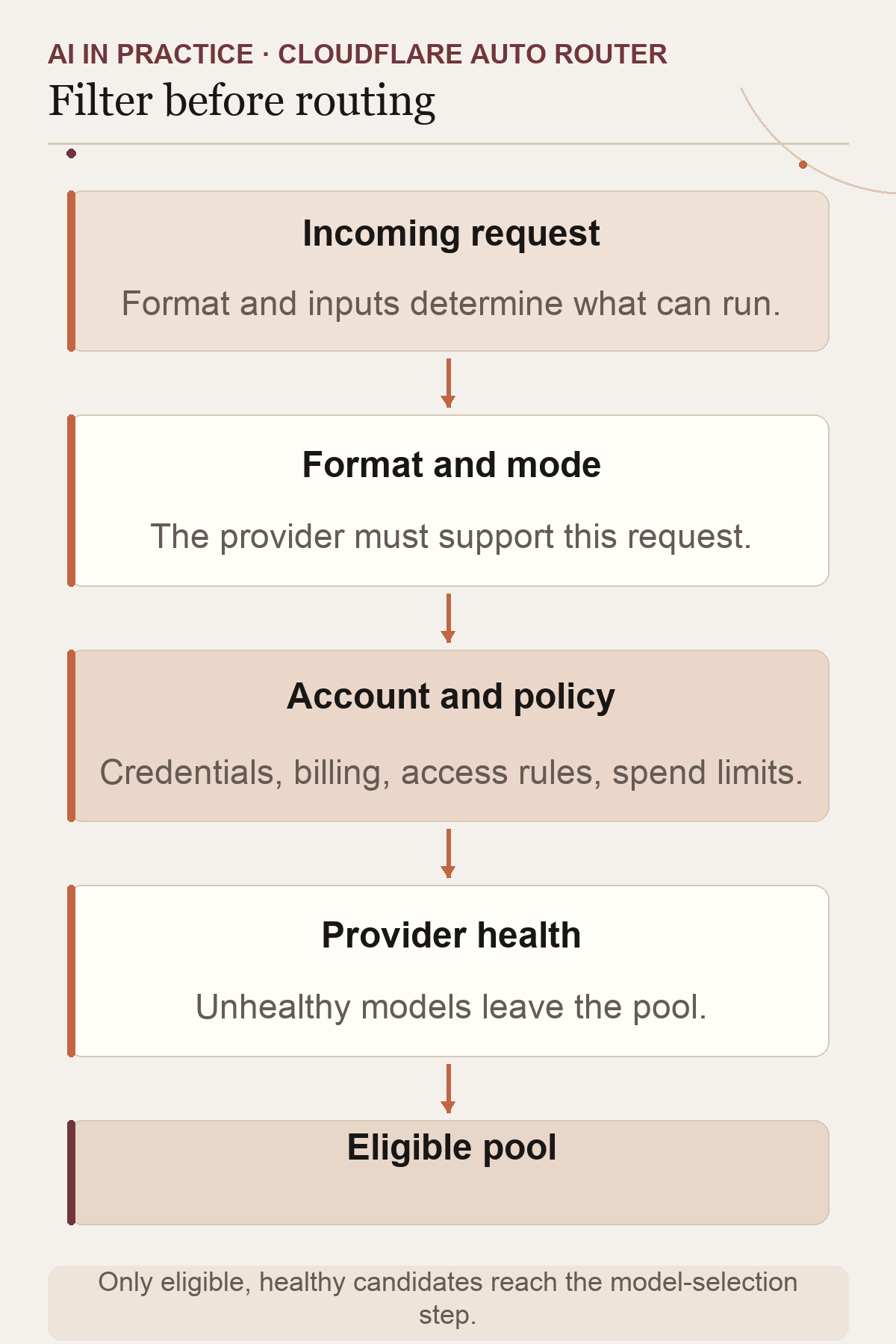
Auto Router is a model-selection layer inside Cloudflare AI Gateway. You no longer have to put one provider-specific model name in every request: a compatible request can use cloudflare/auto instead. The gateway first builds a pool of models that can handle the request. Cloudflare's announcement lists request format and execution mode, credentials, billing, access-control policies and spend limits as eligibility inputs. Its docs also describe filtering unhealthy providers and returning them to the pool after an outage.
The eligibility step matters more than the word "automatic" suggests. Not every model Cloudflare can name will be available for every request. A provider may not support the required input type, the gateway may have no credential for it, a policy may exclude it, or it may be unhealthy. Cloudflare manages the default pool, and the pool may change over time. The docs also describe headers that restrict the candidates to allowed models or providers. Those controls let you design an experiment on purpose, but you still have to verify the exact model identifiers and configuration in your own account.
Read "free during beta" as a statement about the router's price, not about inference. Each eligible upstream model still has its own charges and billing terms. A serious cost comparison counts those requests, any tools an agent calls, any retries, and the time someone spends reviewing or correcting output. The router fee can be zero while the task stays expensive.
What does Cloudflare's benchmark actually show?
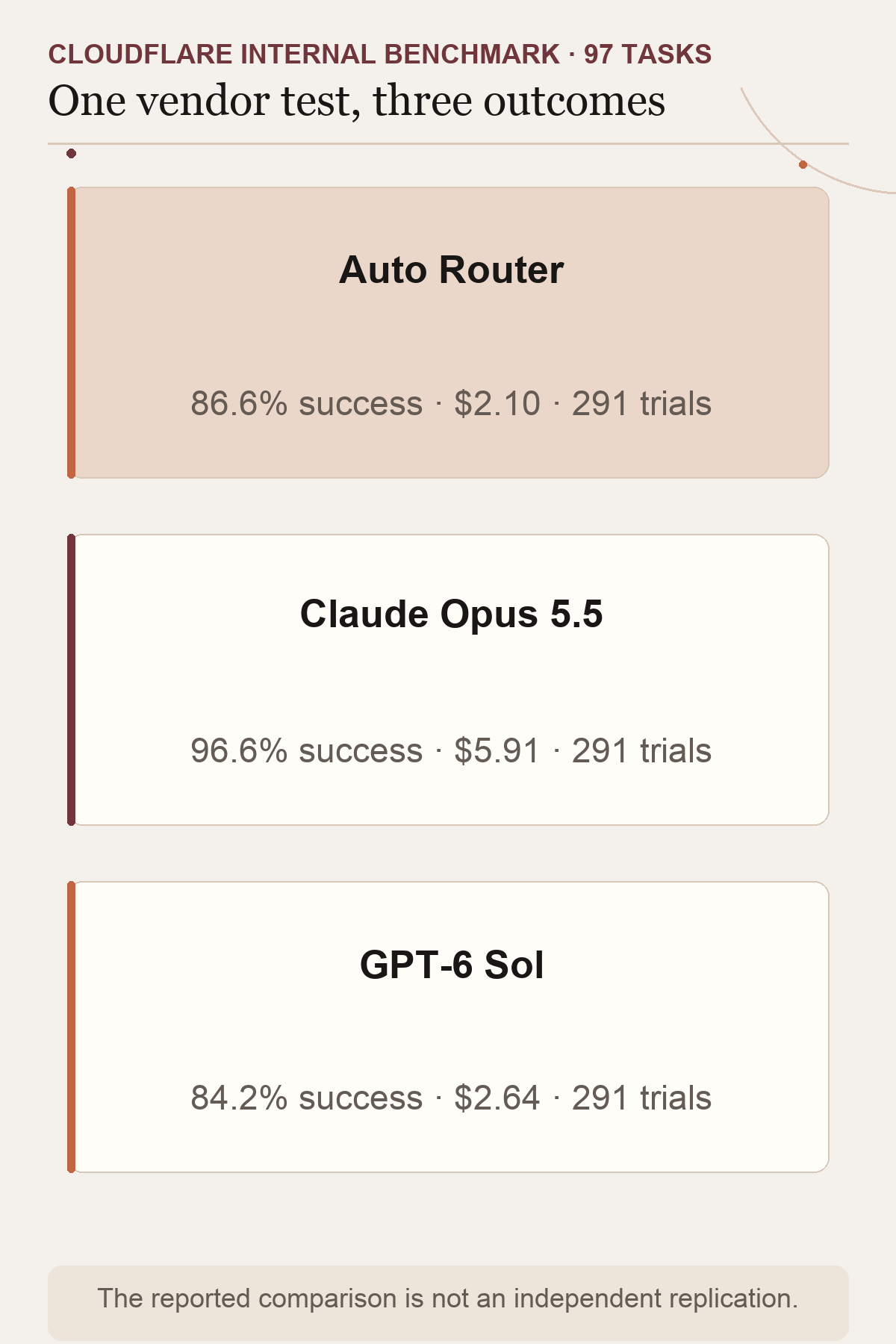
In Cloudflare's own test, Auto Router cost about 35.5% as much as Claude Opus 5.5 and succeeded less often. The test was an internal general-knowledge-work benchmark of 97 tasks. Cloudflare says the tasks use simulated workspace tools across email, calendars, Slack, files, travel and finance. In each task, the model has to produce a verifiable answer or complete an action. Cloudflare reports three samples per task and model, which gives 291 trials for each of the three configurations in its table.
- Cloudflare Auto Router: Successful trials: 252 / 291; Reported success rate: 86.6% (+6.2 / -6.9 percentage points); Total reported cost: $2.10; Reported cost per success: $0.0084
- Claude Opus 5.5: Successful trials: 281 / 291; Reported success rate: 96.6% (+2.7 / -3.8 percentage points); Total reported cost: $5.91; Reported cost per success: $0.0210
- GPT-6 Sol: Successful trials: 245 / 291; Reported success rate: 84.2% (+6.5 / -6.9 percentage points); Total reported cost: $2.64; Reported cost per success: $0.0108
Source: Cloudflare's September 30 announcement. The figures are vendor-reported internal results, not independent measurements. Parenthetical intervals are the 95% task-level bootstrap intervals Cloudflare reports. “Cost per success” is Cloudflare's reported table value.
 View image detail
Two comparisons matter most. First, Auto succeeded in 29 fewer trials than Opus, a gap of 10.0 percentage points, while its reported total cost was about 35.5% of Opus's. Second, Auto's total cost was lower than GPT-6 Sol's, and its success rate was 2.4 points higher. Both comparisons hold only within the test Cloudflare ran. They cannot predict another team's answer quality, workload mix, actual provider bill or review needs.
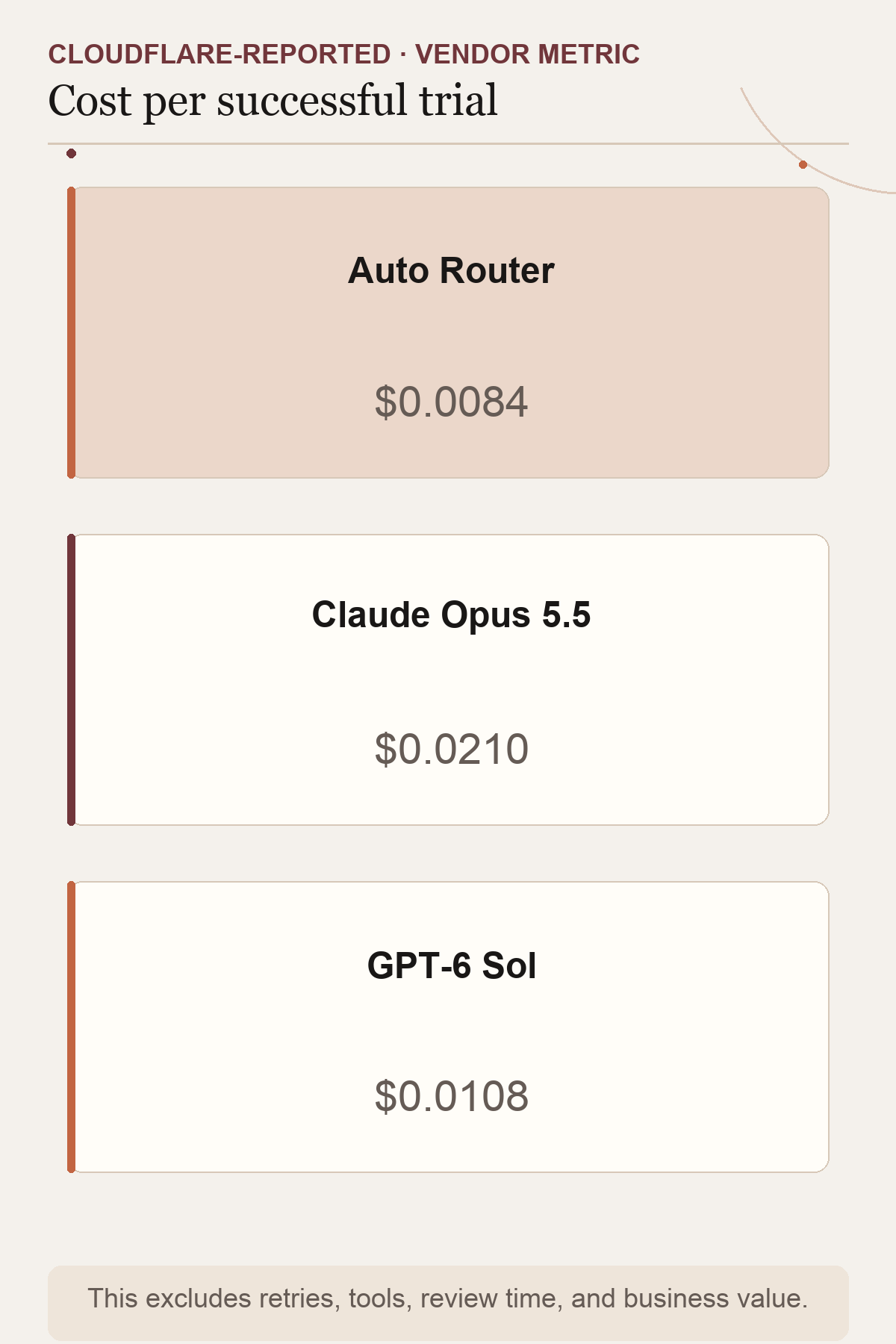
The cost-per-success column is the most useful way to read Cloudflare's own data. It makes each configuration pay for its failures as well as its wins: a cheap failure is still a failure if someone has to repeat or repair the task. By that measure, Opus's reported $0.0210 per success is about two and a half times Auto's $0.0084. That is the gap a team would actually weigh, rather than treating every request as an equal win. But the column stops at the model bill. The table does not say what happened to the unsuccessful trials, whether a person corrected them, how long review took, or how much an accepted result was worth. It measures Cloudflare's stated cost per successful trial, not the cost of finished work for your organization.
There is also a small arithmetic note. Dividing the displayed, rounded $2.10 total by 252 successes gives about $0.0083, not the $0.0084 Cloudflare reports. The announcement does not publish the unrounded total that would reconcile the two numbers. So treat $0.0084 as Cloudflare's reported value, not as something the visible inputs reproduce. Dividing $5.91 by 281 gives about $0.0210, which matches at the displayed precision.
 View image detail
The confidence intervals need the same care. Cloudflare says it bootstrapped at the task level, keeping all three repetitions of each task together. Auto's printed interval reaches 92.8% at its high end, and Opus's reaches 92.8% at its low end. The two displayed intervals touch at one point. That is not a substitute for the raw data or a formal pairwise analysis, so it does not show that the quality gap is definitely meaningful, or that it is unimportant. What the intervals do show is the uncertainty around the reported rates under Cloudflare's method.
What the result can and cannot tell you
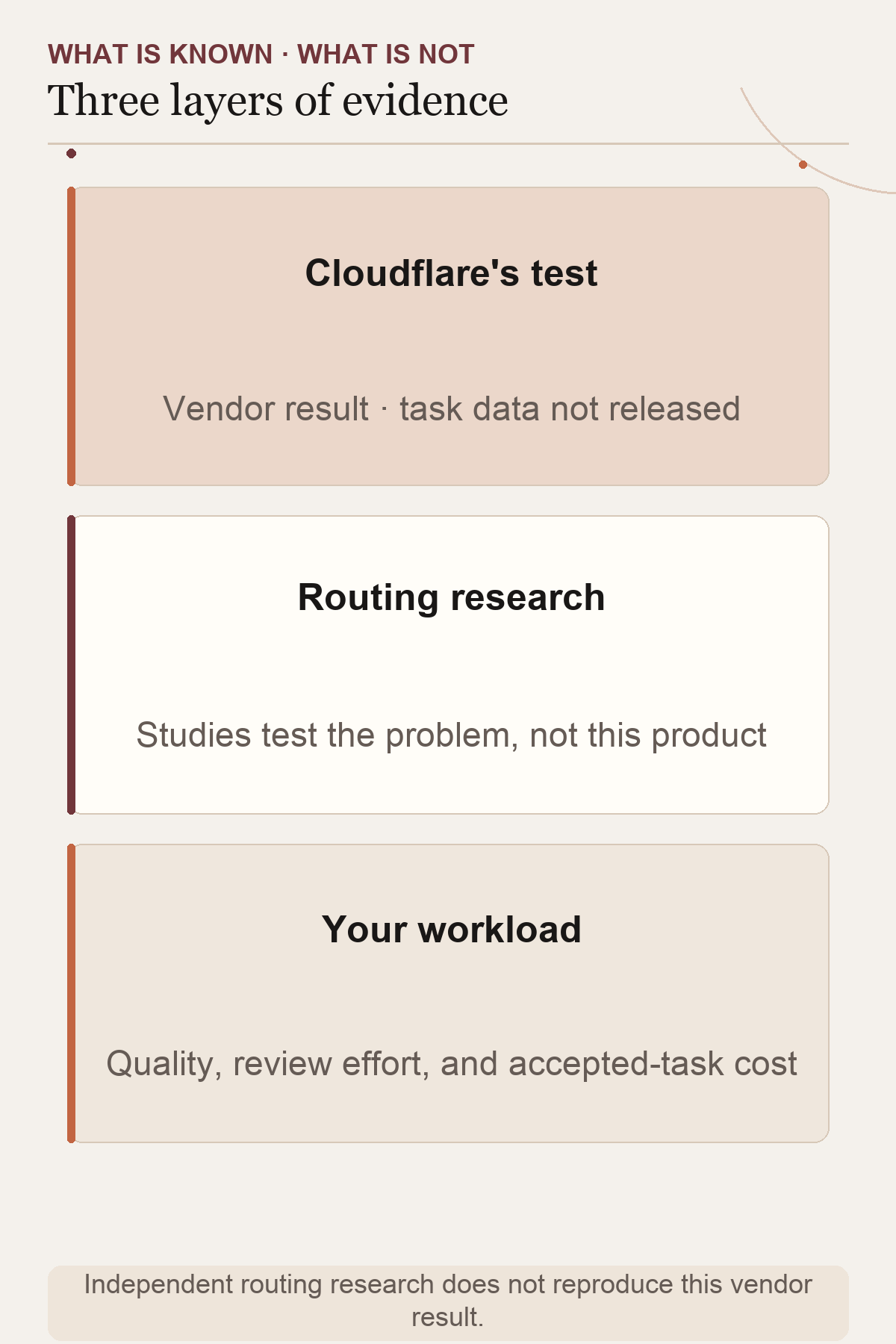
The benchmark answers a narrow question. It tells you how Auto Router, Opus 5.5 and GPT-6 Sol performed on simulated work tasks that Cloudflare selected, using Cloudflare's test setup. It does not tell you which system wins on support tickets, code review, legal intake, customer research, or a long-running agent in your environment. Cloudflare describes the tasks and part of its statistical method, but an outside reader cannot rebuild its internal harness from the announcement alone.
The benchmark also does not isolate every part of the system. The router chooses among models, so the measured outcome reflects several things together: the router, its model pool, the prompt and tool setup, the task mix, and the scoring rubric. The post includes no independent evaluator's replication and not enough task-level data for a reader to rerun the comparisons. The table is still useful, especially because it reports successes alongside cost. But it is evidence for asking whether to pilot, not a savings rate you can carry over.
 View image detail
Independent research supports the general idea that a router can trade cost against response quality. It does not validate Cloudflare's product. The RouteLLM paper studies learned routing between stronger and weaker models using preference data, reporting cost reductions greater than two times in certain benchmark settings without quality loss. A 2026 LLMRouter preprint notes that fair comparison is difficult across different router formulations and introduces a multi-family benchmark. Both studies help explain why evaluation design matters, but their models, datasets and procedures differ from Cloudflare's Auto Router benchmark.
Keep that distinction in view. Independent research shows that routing is a real engineering problem with measurable trade-offs. It does not show that Cloudflare's implementation is best for your workload, or that the benchmark savings will carry over. For an operator, having a router is not the outcome. The outcome is a completed task that meets a standard, at a total cost your team can accept. Whether that is likely depends partly on how the router makes its choices.
How Auto Router chooses a model
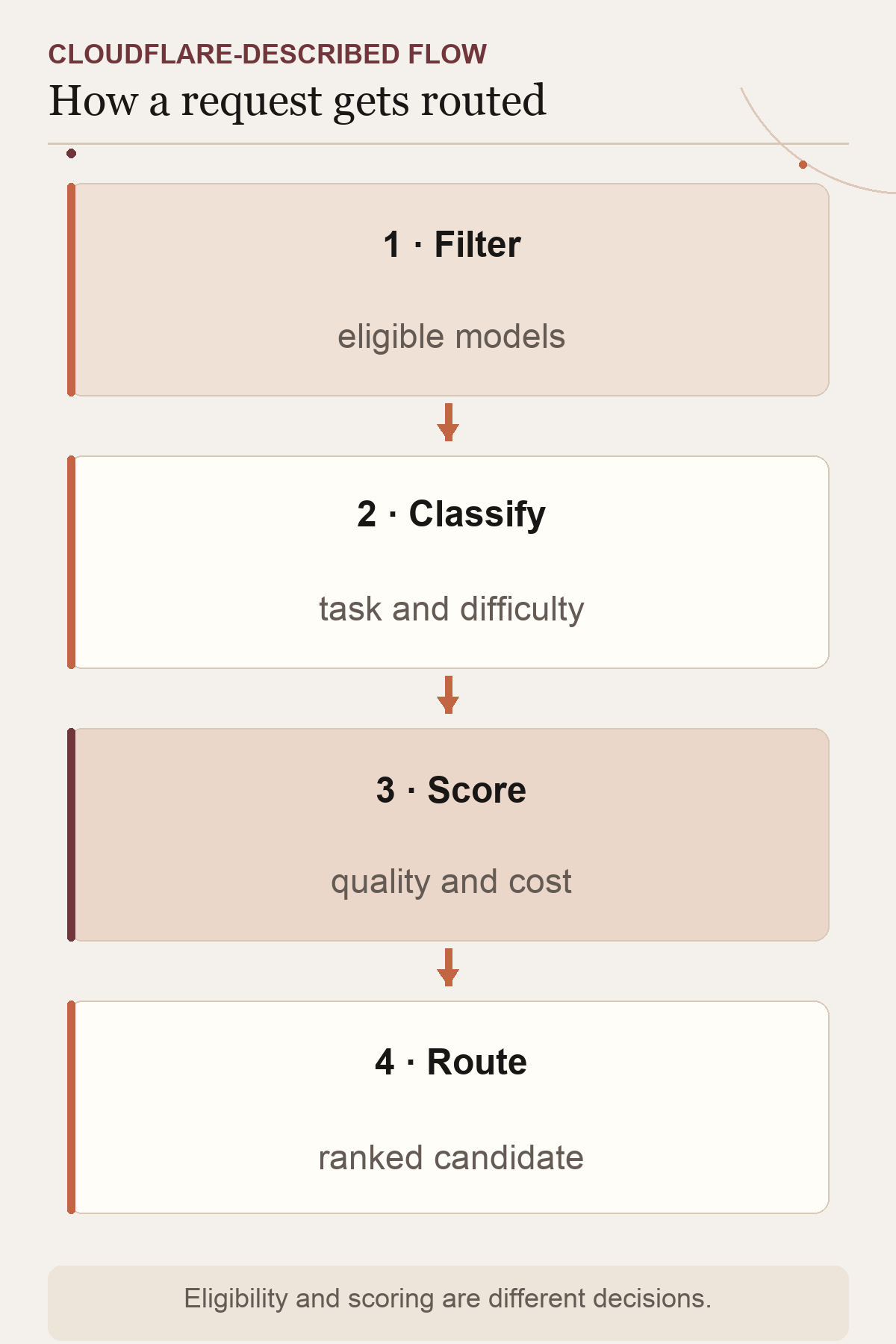
Cloudflare describes a two-stage selection process. First, the gateway builds the eligible pool. Then it sends a compact view of the conversation to a multi-head classification model running on Workers AI. Cloudflare says the classifier estimates task categories such as coding, planning, research and data analysis. It also rates complexity, ambiguity, stakes and how much the request depends on earlier context. A separate scoring matrix combines those signals with model benchmark data to estimate which model fits.
Next, the router weighs expected quality against each model's input and output prices. Cloudflare summarizes the objective as expected quality minus an adaptive cost penalty. For a straightforward request, lower cost can count for more. For a harder request, more capable candidates have more room to win. The system returns a ranked list and tries the top eligible model first. If that provider cannot serve the request, it can fall back to another candidate.
 View image detail
This is not the same as sending every prompt to the lowest advertised rate. A router has to estimate what a task requires, and a wrong estimate can cause a failure in its own right. A model with a lower token price can still cost more if it uses more tokens, needs several attempts, or leaves more work for a person. On the other hand, sending a simple, repeatable request to a frontier model may spend more than the task needs. These are plausible trade-offs, not proof that any particular routing decision is correct.
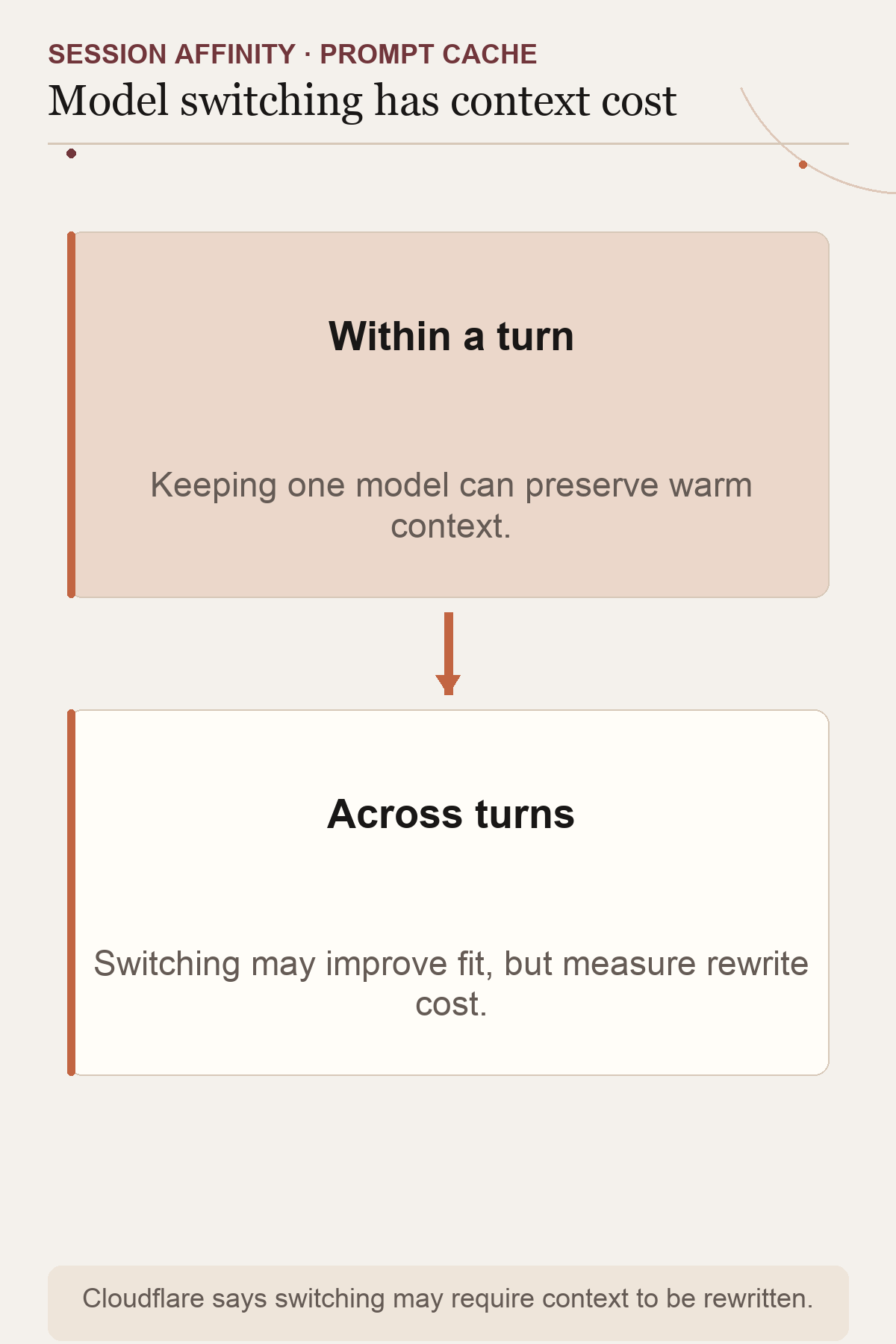
Long conversations add a complication. Cloudflare says switching models mid-session can throw away a warm prompt cache, force the new model to process the context again, and lose reasoning tokens the next model cannot read. Any of these can make the apparent per-token savings misleading. The Auto Router documentation describes session and turn identifiers that keep the same model for the whole of a turn and account for context when switching between turns. If you test a multi-turn agent, record the actual route choices and cache behavior, not just which model was picked first.
 View image detail
Several capabilities are still on Cloudflare's roadmap. The launch post says it plans to add provider-capacity signals, zero-data-retention requirements, reasoning-level selection, and full support for the Responses API and WebSockets. Responses API support needs particular care. The October 2 documentation says Auto Router supports both Chat Completions and Responses API formats, while the September 30 launch post lists "full support" for the Responses API as future work. In the material we reviewed, that conflict is unresolved. If your application depends on Responses API behavior, test the exact endpoint and features you need, or get current clarification from Cloudflare first. The docs say plainly that WebSockets are not yet supported.
When would it be worth testing?
A local test teaches you the most when the workload mixes simple and difficult tasks. The work should also happen often enough to give you a representative sample, and the team should be able to judge whether each task passed. A routine request that can be checked against a fixed schema, policy or human rubric makes the experiment easier to learn from. Automatic routing may be the wrong first move if a failure would be costly, if no reasonable review step exists, or if sensitive data cannot go to every possible candidate.
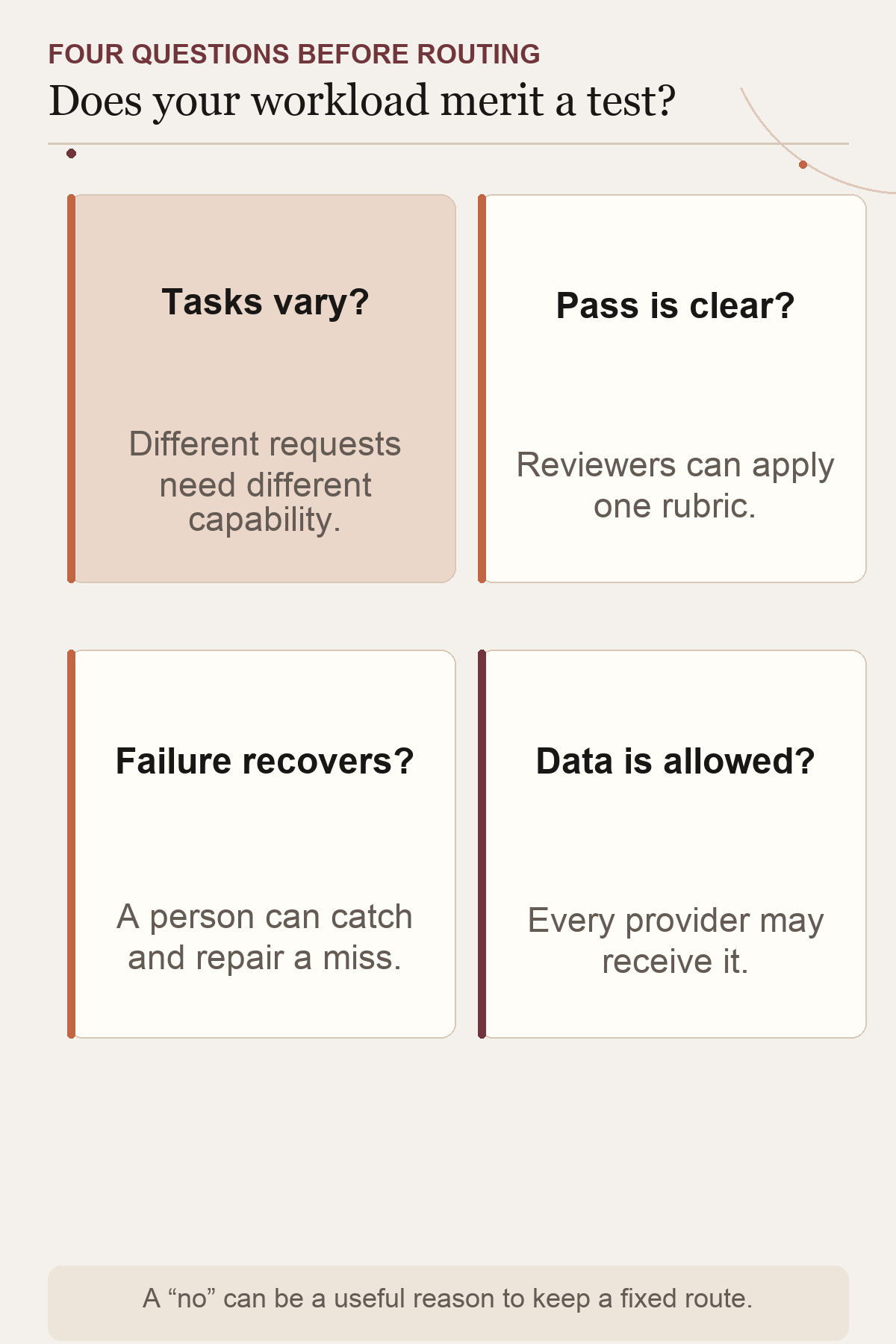
Four questions help frame the decision:
- Do requests vary in difficulty?: Why it matters for a router test: A portfolio of tasks gives routing room to select different models. A nearly uniform task may not benefit from complexity-based selection.
- Can the team define a pass?: Why it matters for a router test: Without a stable acceptance rule, “quality” becomes a preference after seeing the outputs.
- Is failure reviewable and recoverable?: Why it matters for a router test: A recoverable miss with a person checking may be acceptable; an unreviewed consequential action may not be.
- Can each candidate receive this data?: Why it matters for a router test: Provider terms and retention rules can exclude otherwise capable models.
 View image detail
The last question is where the router's own safeguards stop. Cloudflare says Auto Router filters candidates by configured credentials, spend limits, access controls and provider health. That is useful infrastructure, but it does not answer your company's legal, contractual or data-governance questions. Zero-data-retention filtering is still listed in the launch post as future work. Before sending confidential work, check the current provider pool and the terms that apply to every possible path. If you cannot enforce your data policy across the candidate pool, keep those requests on an approved fixed route.
What would make a local test persuasive?
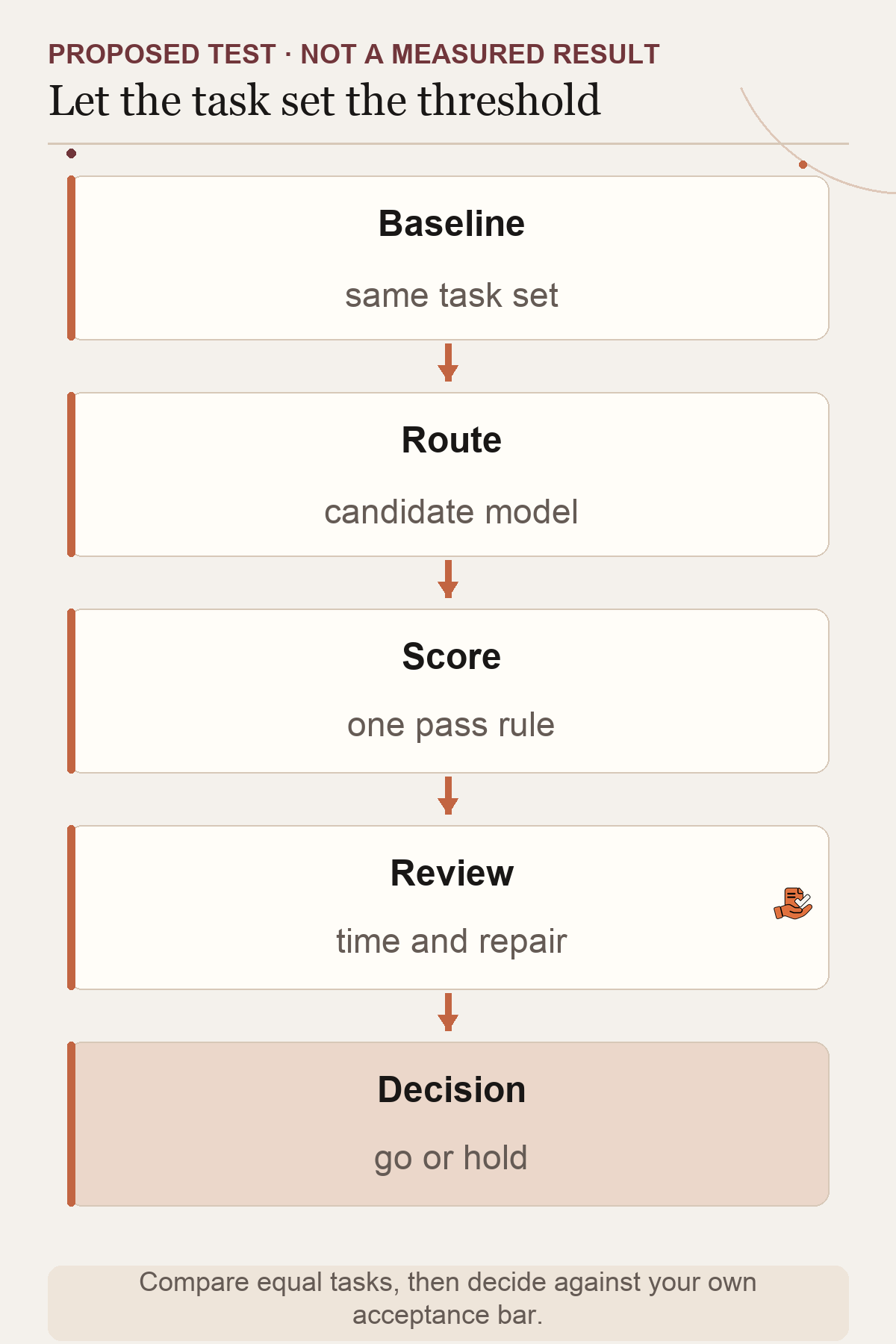
The benchmark is most useful as a reason to run a narrow, fair comparison, not as a pilot recipe. Choose one workflow where requests vary in difficulty and a reviewer can tell whether the result is acceptable. Compare the current route and Auto Router on the same representative tasks, under a pass rule written before anyone sees the outputs. Count the whole accepted task: model and tool charges, retries, and review time. A cheaper first response is not a saving if it creates more repair work.
The result should answer a practical question: did the task pass, what did the accepted result cost, and what failure types appeared? Keep the recommendation no broader than the evidence. A bounded pilot also needs logging, privacy checks and stop rules. For the underlying economics, see what an AI task really costs, why lower API prices do not settle a workflow decision, and whether the work is worth automating.
 View image detail
The practical answer
Cloudflare's benchmark makes Auto Router worth investigating for mixed work that can be checked. It does not show that your company will save 65%, even though its total benchmark cost was roughly 65% lower than the Opus row. The success rates differ, the benchmark is internal, and your model pool, input data, retry pattern and review process may look nothing like Cloudflare's.
I would start with a job you recognize and can check, run the same cases through your current route, and calculate the cost of accepted work. Confirm the exact API format and the data terms first. Keep a fixed-model path for work that needs stronger guarantees or cannot tolerate the candidate pool. If Auto Router clears your own bar, expand it with monitoring in place. If it does not, you will have learned what the task needs before making a broader change.
Frequently asked questions
Does Cloudflare Auto Router guarantee the same quality as a frontier model?
No. In Cloudflare's own benchmark, Auto Router had a lower success rate than Claude Opus 5.5. The feature picks among eligible models based on estimated fit and cost; it does not guarantee that any given output will meet your requirements.
How much does Cloudflare say Auto Router can save?
Cloudflare gives two different internal comparisons. Its early results through the OpenCode harness claim savings of up to 30% against using only frontier models. Its separately described 97-task benchmark reports $2.10 total cost for Auto Router versus $5.91 for Opus 5.5, about 64.5% lower, alongside a 10.0-point lower success rate. The announcement does not establish that these figures use the same workload or method, so neither is a forecast for another team.
Is Cloudflare's Auto Router free?
Cloudflare says the router is free while in beta. The underlying model providers, gateway configuration, agent tools, retries and human review can still cost money, so check the current billing terms for your setup.
Sources
- Cloudflare, Cut your AI spend with AI Gateway's Auto Router, September 30, 2026.
- Cloudflare, Auto Router documentation, last updated October 2, 2026.
- Cloudflare, Dynamic routing.
- Cloudflare, Spend limits.
- Isaac Ong et al., RouteLLM: Learning to Route LLMs with Preference Data, 2024.
- Tao Feng et al., LLMRouter: Unified Infrastructure for Developing, Evaluating, and Deploying LLM Routers, 2026 preprint.
Checked for this article
Sources
Keep going
Related notes.
AI in Practice
How to Try Meta Muse With One Bounded Task and Limited Access
A personal agent can look useful long before you know whether you should connect everything. Start with one reversible job, narrow permissions, and verified completion.
Read the article
AI in Practice
ChatGPT Sites and Connected Apps: Who Can See What?
A shared Site does not make every coworker\x27s source account the same. Map the separate controls, test a normal member\x27s path, and make access understandable before rollout.
Read the article
AI in Practice
ChatGPT Sites Plugins: How to Scope MCP Tools Before You Share
A ChatGPT Site can host a supported plugin, but the useful question is what its tools should be allowed to do. Here is a practical contract-and-test process before you share.
Read the article