
Automation and Agents
DeepSeek V4.1 Flash: Cost per Successful Agent Task
DeepSeek V4.1 Flash's low rates and smaller reported cache make it worth testing, but your task cost depends on quality, retries, tools, and review.

On this page
- What changed with V4.1 Flash?
- Read the price table as three different meters
- Why “cheap per call” can still mean expensive work
- What independent measurements can add
- Pick a task before picking the model
- A pilot that could answer the question
- Calculate cost per accepted task
- Where a trial makes sense, and where it does not
- A practical decision rule
- The useful question is smaller than “Is it the best model?”
The short answer: DeepSeek V4.1 Flash is a candidate for a proposed matched pilot when an agent uses images, repeated context, or multi-step tool calls. Its public rates and vendor cache claims justify testing, but do not prove lower cost per successful task. Compare representative work, include failures and review time, and expand only if the agreed quality and safety bar holds.
DeepSeek V4.1 Flash is worth a controlled trial when your agent repeatedly processes long context, needs image input, or spends meaningful time reasoning through tool calls. Its smaller reported key-value cache and lower API rates give you a credible reason to run that trial. They do not prove that it will finish your work more cheaply, more accurately, or with less human correction.
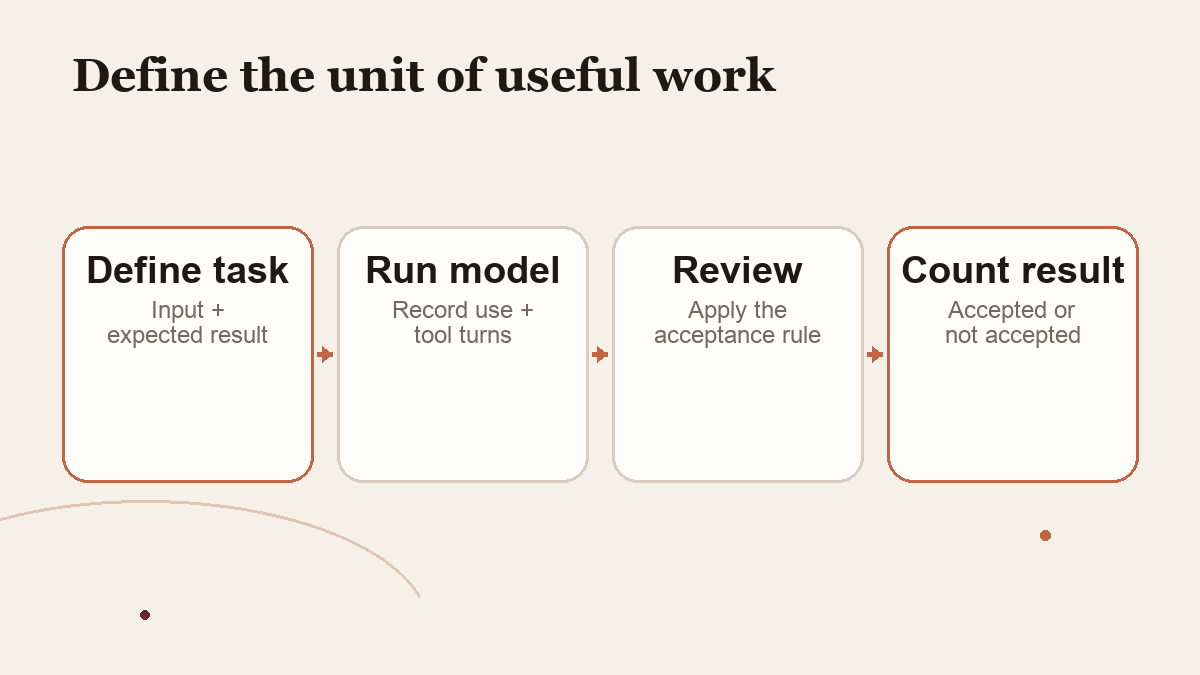
The useful comparison is cost per accepted outcome, not price per million tokens. If one model uses fewer dollars but fails more often, retries more, writes much longer answers, or sends a person back through the whole task, the apparent saving may disappear. If it reaches the same quality with less review on a workflow that fits its strengths, a low-cost API can matter.
Rise Productive's broader AI task-cost comparison applies the same distinction across several models with hypothetical token workloads. This article applies that method to DeepSeek V4.1 Flash through a proposed multimodal-agent evaluation.
This is a research synthesis and proposed pilot plan. Rise Productive has not run the proposed test. The evidence cutoff is October 2, 2026. Model rates and routing can change, so reopen DeepSeek's current API pricing and change log before you configure a live evaluation.
A date-sensitive correction: DeepSeek's September 10 launch post initially described a future period in which API requests todeepseek-v4-prowould route to Flash after September 14. The current API change log and price table say DeepSeek continued V4 Pro service after that date with billing unchanged. Treat V4 Pro and V4.1 Flash as separate API choices. The current docs separately say that the retireddeepseek-v4-flashanddeepseek-v4-flash-vision-expidentifiers are compatibility names routed to V4.1 Flash.
 View image detail
What changed with V4.1 Flash?
DeepSeek's September 10 announcement and its later technical report describe V4.1 Flash as a 552-billion-parameter mixture-of-experts model with a new causal encoder-decoder architecture. The report says the system activates 8 billion parameters per token during input prefill and 16 billion during output decoding. Those are model architecture details, not a promise that every request costs a particular amount or runs a fixed number of times faster.
The current API pricing page identifies deepseek-flash as DeepSeek-V4.1-Flash. It lists text and image as supported input modalities, text output, a one-million-token context length, and up to 384,000 maximum output tokens. The context window describes the combined space a request can use. It does not mean an application should send a million tokens, that all of them will be useful, or that the model will produce a million-token answer. The same page confirms tool calls and the Responses API, which makes the API potentially relevant to agent workflows. None of this establishes that a specific agent framework, prompt, or tool schema will work without adaptation.
DeepSeek's technical report describes its compressed-sparse-attention design and FP4 key-value cache. It claims the V4.1 Flash global key-value cache requires about one-quarter the space of V4 Flash at the same sequence length, and persistent cache storage about one-eighth as much. The company also says it trained on a 45-trillion-token multimodal corpus and reports results on agent benchmarks.
The careful verbs here are “describes,” “claims,” and “reports.” DeepSeek authored the report and generated those model comparisons. They explain why the company built this version and what it says it measured. They are not independent reproductions of every benchmark, and they do not answer whether a particular business workflow is dependable enough to hand off.
There is a practical difference between cache footprint and your invoice. A smaller cache can reduce the memory and storage requirements of serving long sequences. A service may pass some of those infrastructure savings through in pricing, as DeepSeek says it is doing. But your request still incurs the rates for its actual cache hits, uncached input and generated output. The architecture is a reason to measure repeated-context work, not a substitute for measuring it.
 View image detail
Read the price table as three different meters
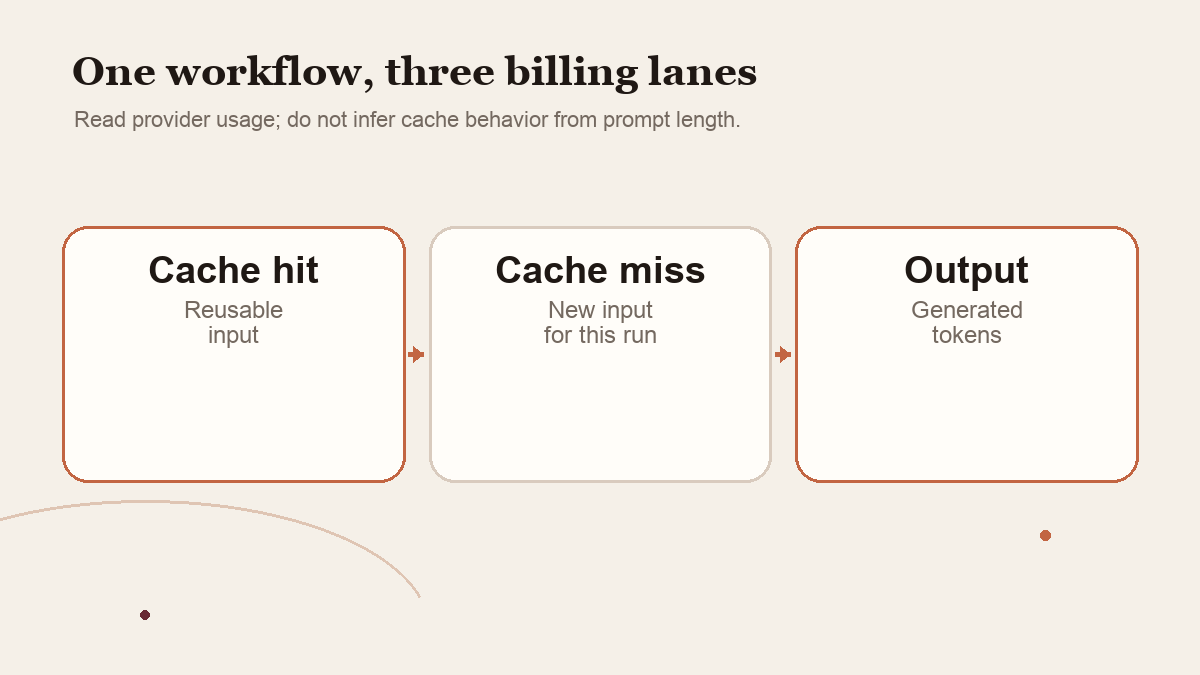
As checked on October 2, DeepSeek's direct API price schedule for Flash distinguishes cached input, uncached input and output, and it varies the price by time. At peak time, it lists $0.006 per million cache-hit input tokens, $0.30 per million cache-miss input tokens, and $1.20 per million output tokens. Off peak, the listed prices are half those amounts: $0.003, $0.15 and $0.60. DeepSeek defines peak periods as 01:00 to 04:00 and 06:00 to 10:00 UTC, Monday through Friday, excluding Chinese public holidays. Weekends and those holidays are off peak. These terms are the provider's current schedule, not a permanent guarantee.
That schedule matters because one request can contain a different mix of work than another. An agent might carry a large reusable instruction prefix, add fresh evidence on each turn, and generate a long answer after several tool calls. If the reusable prefix is actually recognized as a cache hit, its per-token charge differs from both new input and output. The API response's usage information should be your accounting source; token estimates and the number of characters in a transcript are only approximations.
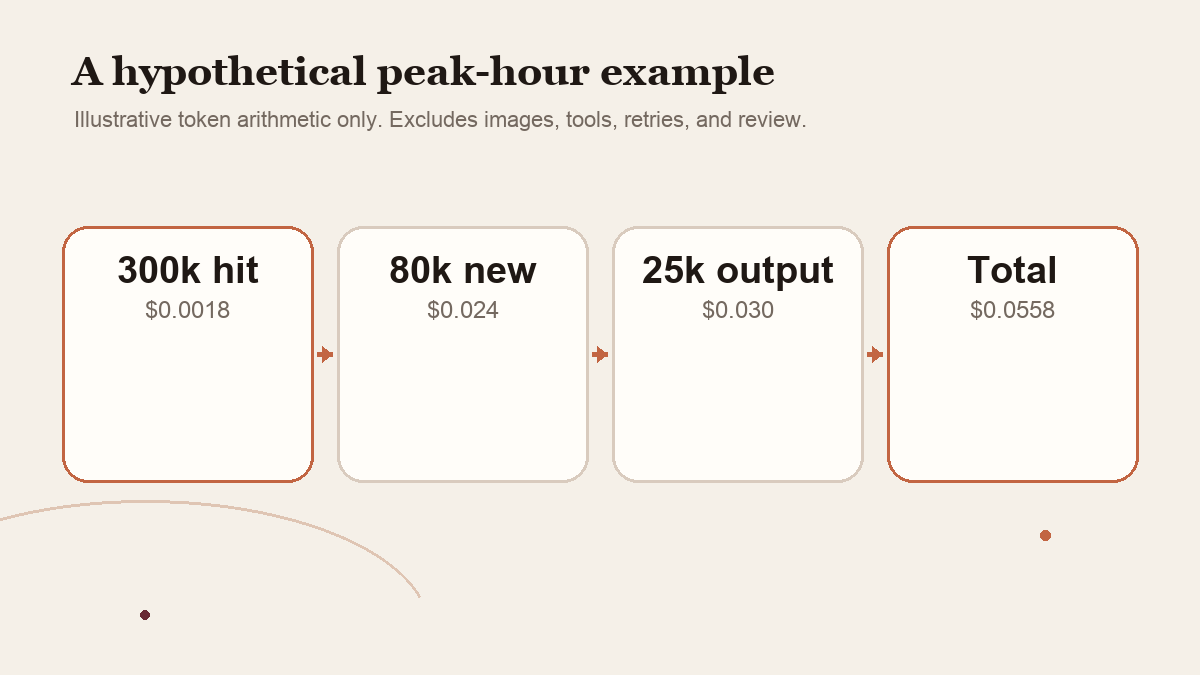
Consider an illustration, not a real request: suppose a completed run billed 300,000 input tokens at the cache-hit rate, 80,000 uncached input tokens, and 25,000 output tokens during peak hours. Applying the rates above gives $0.0018 for cache-hit input, $0.024 for uncached input and $0.03 for output, or $0.0558 for these model-token charges. If the same billed token mix fell entirely into an off-peak window, the listed rates would make those charges $0.0279. The math is simple; the difficult part is obtaining the mix for a representative successful task and confirming which pricing window actually applied.
This estimate leaves out failures, retries, framework or tool-service charges, image input's token accounting, storage, monitoring, and human review. It also assumes the cache-hit volume in the example is recorded as such by the service. It should never be presented as a typical bill or a guaranteed amount saved. A short-text question with no reused prefix can have a radically different breakdown from a long-running agent. So can a workload that generates many reasoning and answer tokens.
The schedule also makes time a test variable. If your work can run at night, you might see lower token charges for jobs that qualify for off-peak treatment. But a delayed overnight run may carry a different business cost than a response needed during working hours. Moving a batch job to a cheaper window is useful only if the extra delay does not reduce the value of its result. Measure the service window with the workload rather than reporting an off-peak token rate as if every call will receive it.
 View image detail
Why “cheap per call” can still mean expensive work
An agent does not necessarily call the model once. It may inspect a screenshot, plan an action, invoke a tool, read the result, reconsider, and try again. Some frameworks provide instructions on every turn. Some requests reuse a prefix successfully; others change enough text that less context is cached. The service measures what it bills, not what your mental model of the workflow assumes it billed.
Output is an especially easy cost to overlook. A model that uses more generated tokens may be fast and capable, but the extra explanation, intermediate reasoning returned to the client, or repeated summaries can outweigh low cache-hit prices. Provider interfaces and reasoning settings differ, so record both visible output and any separately metered reasoning tokens if the API exposes them. Do not assume two products' “thinking” modes use equivalent token accounting simply because their labels sound similar.
Image input needs its own measurement, too. DeepSeek now identifies Flash as supporting image input through its API. That is a meaningful change for screenshot review, chart reading or visual computer-use tasks. A text-only test will not tell you whether visual evidence was recognized correctly, whether the agent selected the right action, or whether the host application's coordinates, permissions and state were safe. Conversely, a model's ability to accept an image does not grant it computer access. The application supplies the screenshot, tools, environment, and stop conditions.
Human work belongs in the same cost model. Someone may need to approve an action, verify a generated record, correct an error, or review a longer explanation. If that person spends four minutes checking every run, a few cents of token spend might be the least important part of the workflow. That does not make the model useless. It means the system has a human-control cost that the API rate card cannot capture.
This budget-first approach also helps with research runs that can stop at a cost or time boundary. Rise Productive's guide to setting safe budgets for an AI research task shows why a partial result needs its own completion state and review gate. The products are different, but the reader decision is related: decide what a useful, accepted result is before deciding whether a low bill is a success.
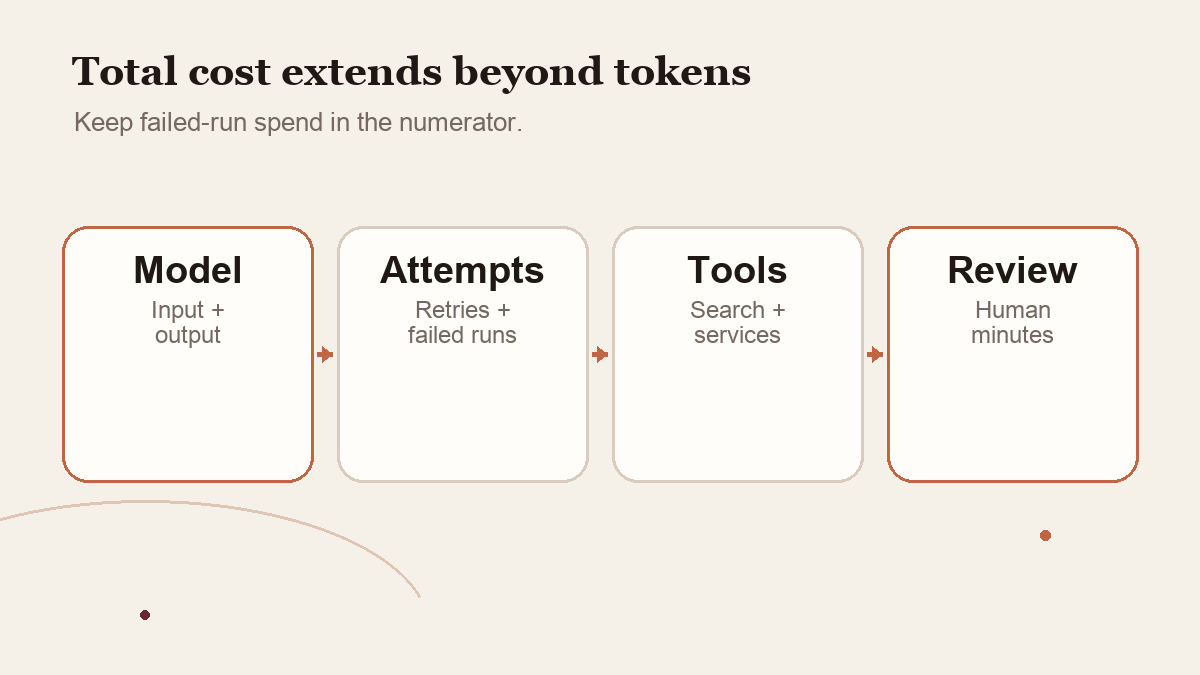
For a real task, I would separate these components:
- Model usage: cache-hit input, uncached input, output, image input, and any other billable token class reported by the API.
- Retries and tool rounds: every additional completion and every retry triggered by a failure, timeout, or low-quality result.
- External services: browser, search, OCR, storage, orchestration and observability charges that are attached to the run.
- Human review: active review minutes multiplied by a consistent loaded-labor rate, if you are comparing operational cost rather than API spend alone.
- Unaccepted outcomes: the cost of a task that did not meet the predefined quality or safety bar. It still consumed tokens, time and attention.
The fifth line is why cost per accepted result can be more informative than average cost per request. A workflow that needs many attempts to cross its quality bar has a hidden denominator problem. It produces fewer accepted outcomes from a larger number of paid calls.
 View image detail
What independent measurements can add
Artificial Analysis maintains an independent model profile for DeepSeek V4.1 Flash and says its headline speed and cost measurements are based on DeepSeek's first-party API for this model. As accessed October 2, its profile showed an Intelligence Index score of 39, output speed of about 209 tokens per second, and an estimated $0.27 per Intelligence Index task. The page describes its index as a weighted set of evaluations and explains that task cost is calculated from used input, cache-read, cache-write, reasoning and answer token prices. These figures offer a second-party reference point for the vendor's API in Artificial Analysis's workload and method, not a result for your agent. Recheck that live profile before citing the values in a later release.
They are more useful than repeating a promotional adjective, but they still are not your answer. An index score combines the tasks and scoring rules that Artificial Analysis selected. A reported speed from their API observation will vary with prompt type, output length, demand, network conditions and time. The task-cost figure reflects their token mix and evaluation. None is a direct measure of whether your claims pass review, your spreadsheet is correct, or your browser agent safely completes its last step.
DeepSeek's own report includes another kind of evidence: internal and public agent benchmarks run with the company's setups. The report documents settings for its evaluations and says performance changes with the reasoning-effort level. That matters because the effort setting changes both quality and how much output the model may generate. When comparing with a different model, match the result criteria and actual task, not just the displayed number. A vendor benchmark against one harness cannot establish the same ordering for a different agent stack.
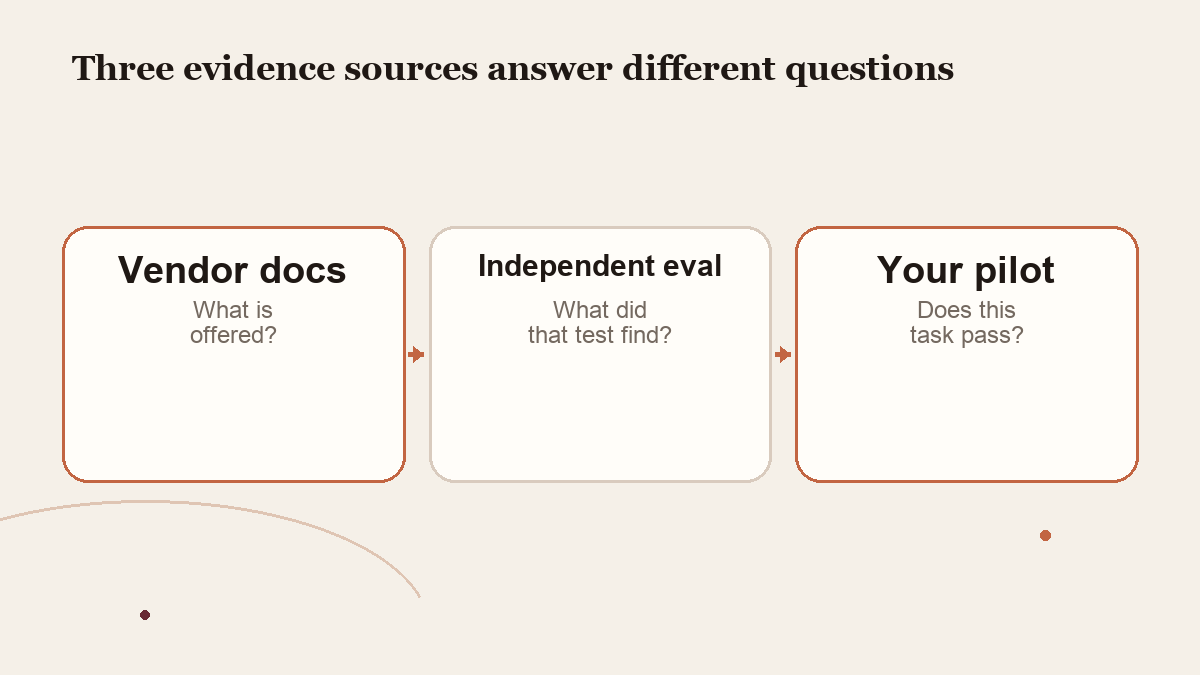
The evidence hierarchy for a decision should be clear. First, use product documentation to establish which model and API capabilities are offered. Second, use independent evaluation to identify whether there is an interesting candidate or a likely constraint. Third, run a private, matched evaluation on your own representative tasks. The final step is the one that can justify changing a workflow. If you do not have representative tasks or a trusted review rubric, the right next move may be to build those before choosing a new model.
 View image detail
Pick a task before picking the model
“AI agents” is too wide a test category. Write one sentence that names the user, input, permitted action and accepted result. For example: “Given one screenshot of a dashboard with a visible date range, identify the requested weekly total and return the value with a citation to the exact visual region.” That task makes image understanding relevant and exposes a check a reviewer can repeat. Another candidate could be “Read a fixed set of issue descriptions, classify each according to a documented rubric, and prepare a draft assignment for a human to approve.”
These are candidate designs, not tested results. Start in a sandbox or with read-only inputs, especially when tools can change records, send messages, make purchases or affect customers. For computer-use work, include realistic screenshots and application state, then check the before and after state. A model describing a button does not prove the tool clicked it correctly.
If the task itself is still unclear, start with Rise Productive's practical test for what work is worth automating: define the job and its human decision boundary before choosing a model.
Then define acceptance before sampling outputs. “Looks good” is not a stable standard when several reviewers or runs are involved. A useful rubric might ask whether the model identified the correct field, respected the date range, returned evidence, used an approved tool, stopped when uncertain and avoided an unsafe action. Use a stricter critical-error definition for actions with consequences. An output that is eloquent but unsupported should not count as successful just because a judge prefers its tone.
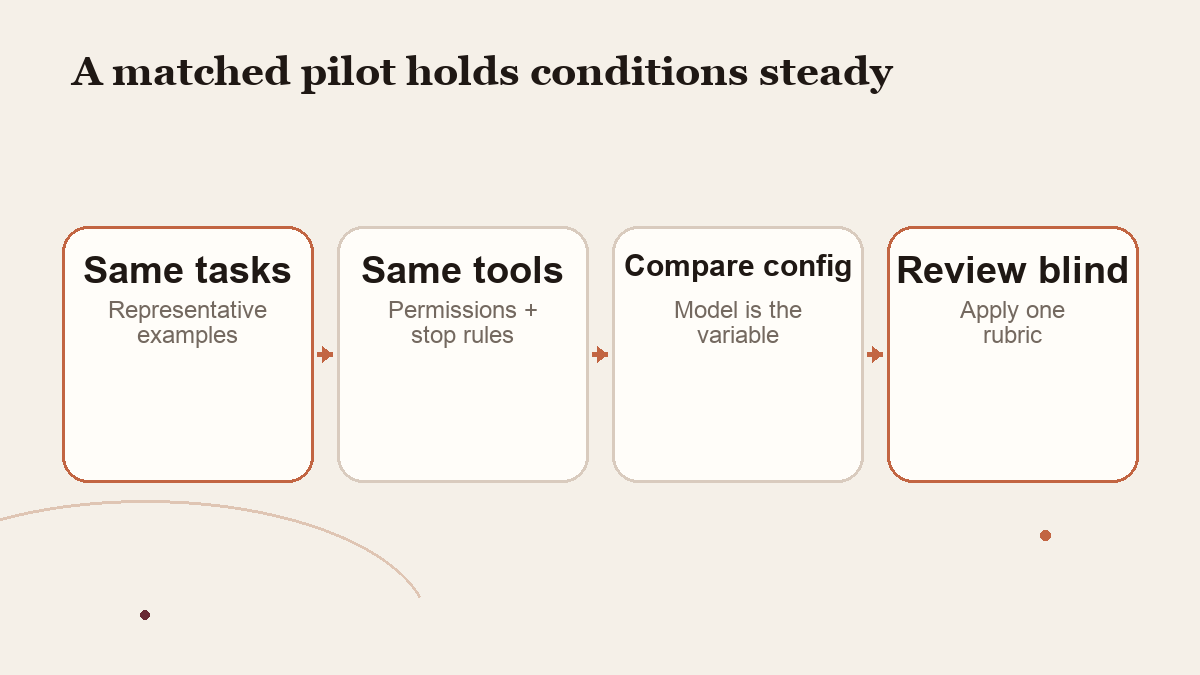
If there is an incumbent model, include it. Freeze the version or alias your application actually calls and confirm it remains the intended baseline during the experiment. Use identical inputs, same task examples, same tools and permissions, same stop rules, same timeout, and same review rubric. When configurations differ by product, record what cannot be matched rather than claiming a perfectly controlled trial. Log the request settings that affect reasoning, sampling, output limits, image resolution and caching.
A pilot that could answer the question
For the selected task, build a small set of ordinary and boundary cases: cropped screenshots, ambiguous dates, long context, missing evidence, tool timeouts, and a request that should be declined. Label expected results and keep holdout cases out of prompt tuning. Decide who reviews outputs and whether to blind reviewers to model identity.
Run the incumbent and V4.1 Flash over the same set. If output variation is material, repeat each task enough times to reveal inconsistency. A single successful run is a demonstration, not a reliability estimate. Keep prompts, tools, application state, allowed rounds and retries consistent. Record the application, region, provider, endpoint and exact model identifier. If the model has multiple reasoning settings, either compare the settings that you might actually deploy or treat each as a separate configuration.
For each attempt, record the provider-reported usage object rather than estimating from prompt length. Preserve the cache-hit and cache-miss counts separately, output token usage, image input if visible in the usage fields, model identifier, service window, duration, number of tool calls, retry count and final task status. Keep data minimization in mind: screenshots and prompts can contain sensitive business information. Use an approved test copy, not customer data, unless your governance process authorizes the latter.
Human reviewers should score the rubric independently and record minutes spent. Reconcile disagreements before declaring a pass threshold. A task counts as accepted only if it meets the minimum quality bar and any required policy checks. If it fails, include its cost in the total. Do not silently discard outputs that are awkward, late or wrong because they make the candidate look bad. Those outcomes are part of the candidate's real operating profile.
 View image detail
Calculate cost per accepted task
For a pilot, first calculate API spend per attempt from the actual usage record and the pricing window that applied to that request. Sum the corresponding cache-hit input, cache-miss input, and output costs. Add actual image charges if the provider reports them separately; if image input is billed through token usage, preserve the usage fields and do not add it twice. Add retry calls rather than hiding them in an average. If separate services charge by invocation, attach their measured cost to the attempt.
For a small batch, the simplest result is:
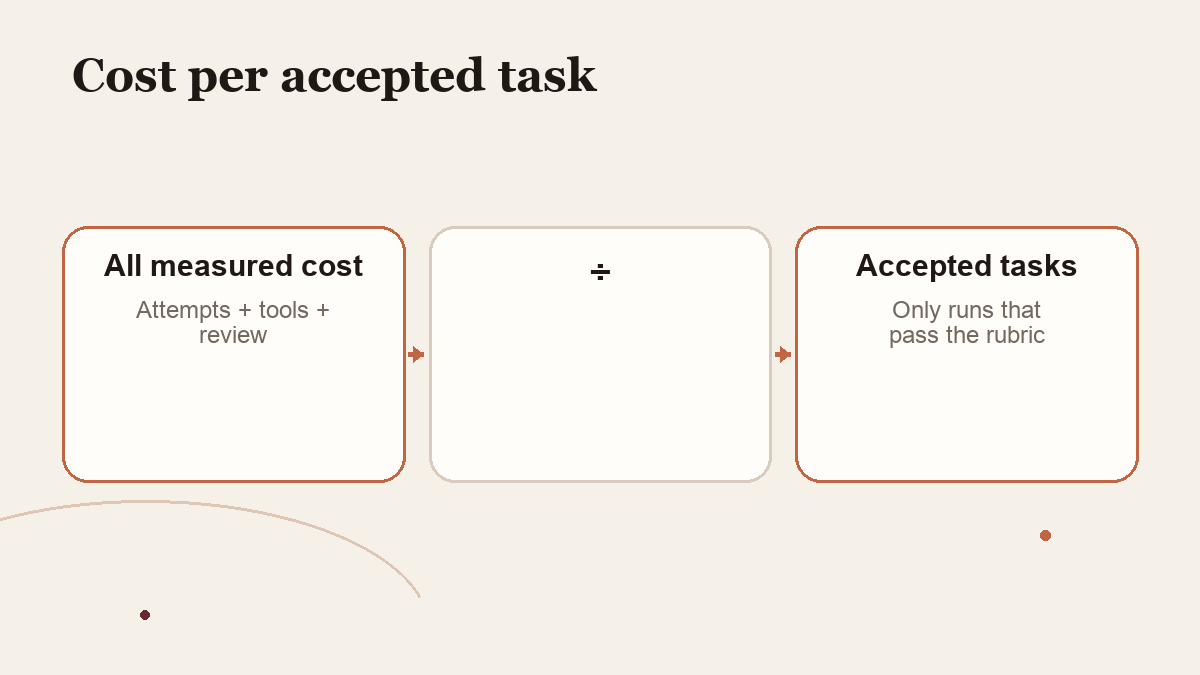
Cost per accepted task = total measured cost of all attempts and reviews ÷ number of accepted tasks
The numerator includes failed attempts as well as accepted ones. The denominator includes only tasks that passed the agreed rubric. If none are accepted, report that no accepted-task unit cost can be calculated for that batch, and show the total spent and failure reasons. Do not divide by zero or label a low-spend failure as a cost win.
For illustration only, imagine a 30-case test where two candidates pass 24 and 27 cases. Calculate each cost from every attempt, retry, external charge and review minute, then divide by its accepted cases. These figures are hypothetical, not DeepSeek results. Report pass rates and critical errors beside cost so a lower unit cost cannot hide a quality or safety regression.
Small batches are noisy. Show task types, per-task results and uncertainty appropriate to the sample. Do not infer a durable advantage from a few cases; use the breakdown to see whether one easy task or costly failure drives the average.
Latency deserves its own column. A workflow that costs less per accepted result but takes an hour longer may be wrong for an interactive job. Track median and high-percentile completion time, timeouts, tool stalls and time a person waits before making a decision. A background document labeling queue can tolerate a different response time than a customer-support suggestion. In a user-facing workflow, perceived responsiveness and escalation behavior can matter as much as a small rate difference.
 View image detail
Where a trial makes sense, and where it does not
V4.1 Flash deserves a closer look when the task truly uses image understanding, the prompt or agent context repeats enough to make cache behavior relevant, and the work has a clear acceptance check. An image-assisted triage task, a screenshot comparison with a human approval step, or structured extraction from a stable form could be reasonable candidates, provided the inputs are representative and the impact of a mistake is controlled. A large context window can remove a chunking step for some systems, but it is not itself proof of lower cost or better recall. Send only context needed for the job.
Be cautious if your workflow depends on narrow tool semantics, a particular structured output shape, consistent short responses, a certain visual precision or low-variance behavior. These are not claims that V4.1 Flash fails those tasks; they are dimensions to test. An API feature listed in documentation is not a warranty that each edge case works in your application. Test malformed tool calls, missing fields, refusal behavior, retries and attempts to act on stale screens.
Do not use a model-only benchmark to justify giving an agent broader authority. The environment and tool permissions define what the model can change. Keep destructive steps out of an initial pilot, require review where consequences warrant it, and ensure a failed check stops the action instead of advancing with guessed data. A token rate cannot price a privacy breach or an irreversible customer-facing action.
Likewise, do not infer deployment economics from total parameter count, activated parameters, cache size or the phrase “Flash.” DeepSeek states a 552-billion total model size with a lower active path on each token, but hosted inference pricing depends on the API schedule and provider implementation. Self-hosting adds hardware, energy, bandwidth, staff, deployment and utilization costs. The paper mentions open deployment support as a direction; that does not establish that you can run a production serving stack today at an equivalent cost or service level.
A practical decision rule
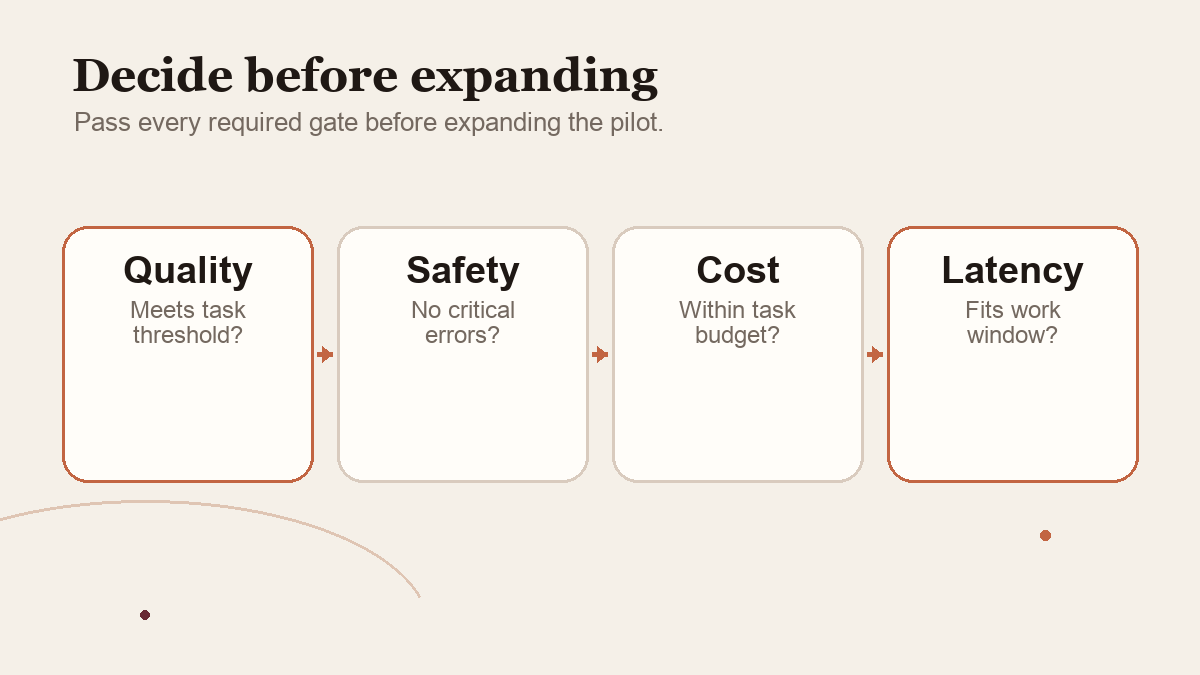
Before testing, write down the decision rule. For example: “Consider a limited rollout for one read-only visual-triage task only if V4.1 Flash meets our quality floor, has no critical misreads, lowers total cost per accepted record, and stays within the p95 response limit.” This is a proposed threshold, not a result or DeepSeek recommendation. Set the quality and safety floor first; lower cost cannot compensate for critical errors or unsustainable review. If results are thin, extend the test rather than declare a winner.
End the pilot with three possible outcomes:
- Stop: a critical safety or correctness condition fails, or the result is too unstable for the workflow.
- Extend: there is promise, but the sample does not cover enough difficult cases or the reviewers disagree about acceptance.
- Expand cautiously: the candidate clears the predefined bar on the target tasks; increase traffic in a limited group, keep monitoring, and preserve a rollback path.
Those gates should be decided before the result arrives. Otherwise, a dramatic benchmark or one pleasing screenshot can make the team change the rules after seeing the answer.
 View image detail
The useful question is smaller than “Is it the best model?”
The evidence supports evaluating one workflow where image input or repeated context matters. Use actual usage and review records to decide whether the candidate clears that task’s limits. Neither provider claims nor third-party index results can settle the choice for your workload.
Checked for this article
Sources
Keep going
Related notes.
Automation and Agents
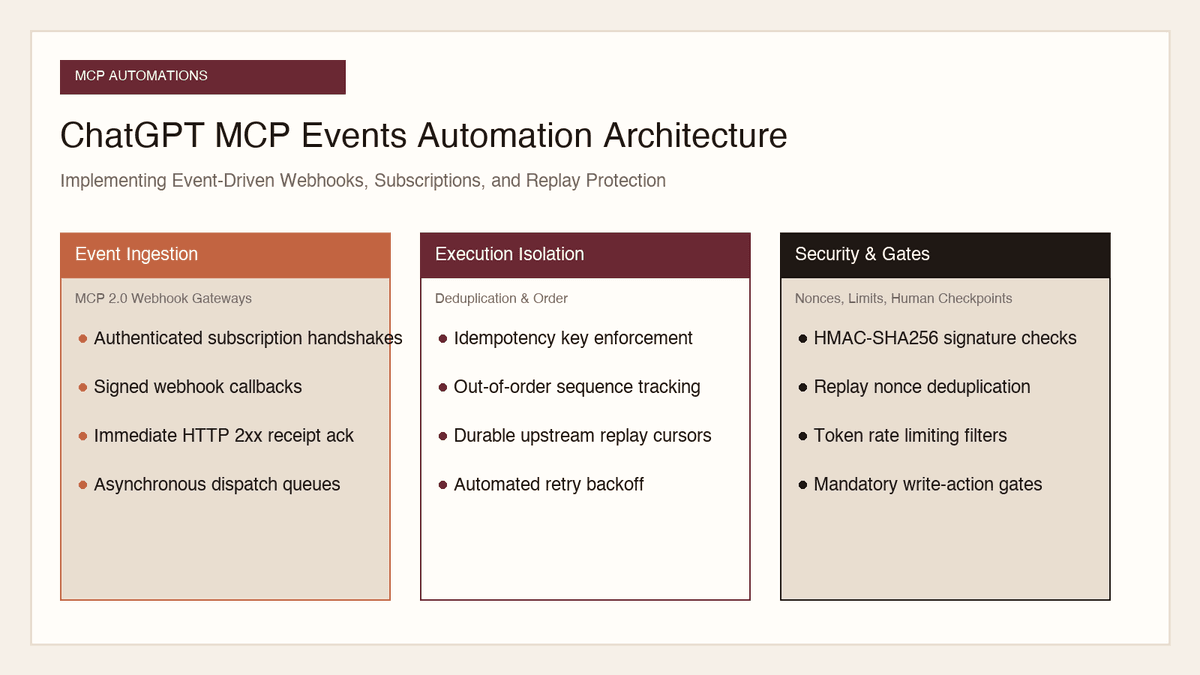
How to Implement MCP Events in ChatGPT: Event-Triggered Automations
Autonomous conversational agents no longer need to rely on wasteful polling loops. Here is how to implement event-triggered automations using ChatGPT MCP Events.
Read the article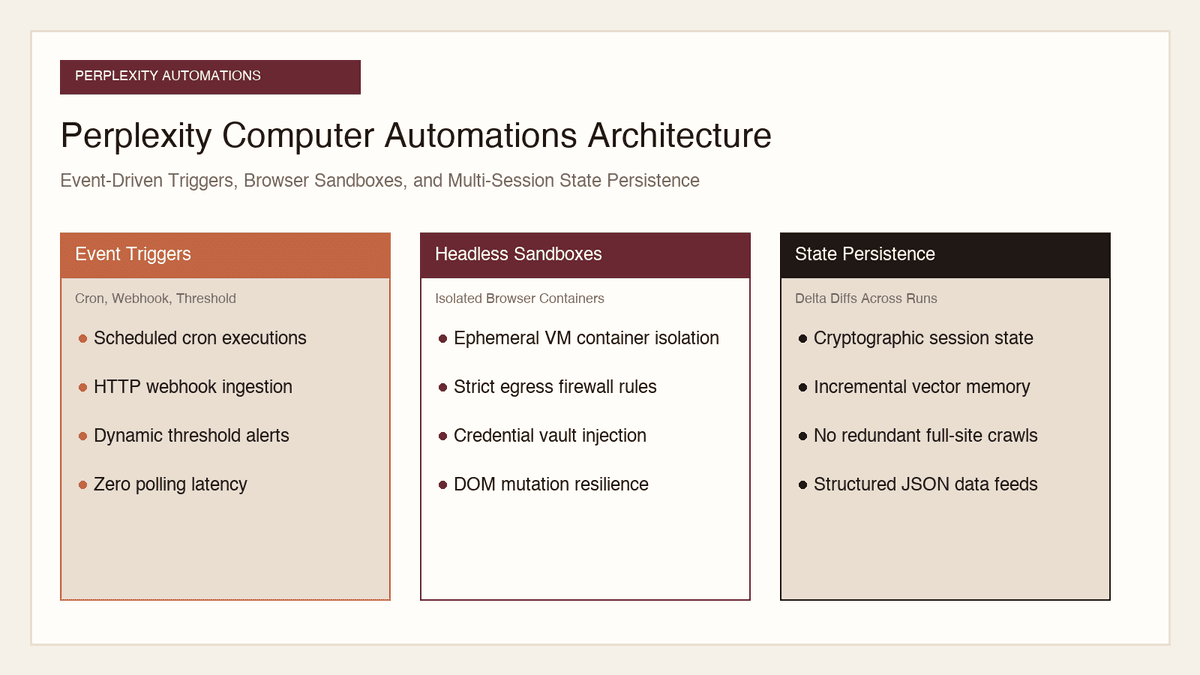
Automation and Agents
How to Build Recurring Web Automations with Perplexity Computer
Web scraping scripts break whenever a layout shifts. Here is how to build durable, recurring web automations using Perplexity Computer and persistent state.
Read the article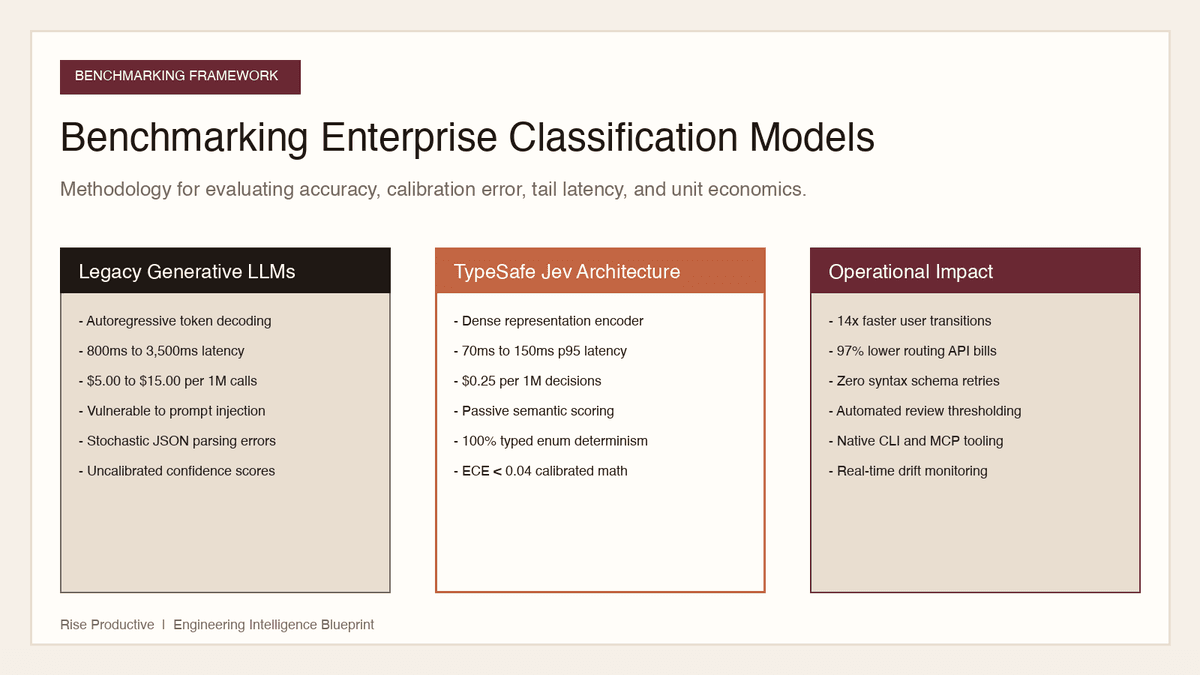
Automation and Agents
How to Benchmark Classifier Models: Latency, Cost, Determinism
Evaluating AI classifiers requires looking beyond static accuracy. Here is how to benchmark probability calibration, latency percentiles, and unit economics.
Read the article