
Automation and Agents
Qwen Code Durable Shell Results: Can You Review Them Later?
Saved Shell results could support a later handoff, but the intended reviewer must be able to retrieve the right output under the deployment’s publication and access settings.

On this page
- Start with what the prerelease actually lists
- A saved result needs a trustworthy history
- Decide which representation the reviewer needs
- Work out access before promising an archive
- Read the contributors’ tests at their actual scope
- Output can support review without becoming the deliverable
- Run a bounded closed-Session evaluation
- The adoption decision
A Hosted agent finishes a command while an agency team is preparing a client deliverable. By the time the project lead reviews the work, the live Session has closed. The lead needs to know whether the command ran, what it returned, and whether anyone can still inspect that output. A success message in a handoff note would be easier to read, but it would answer fewer questions.
Qwen Code’s October 1 nightly lists durable remote Shell result delivery and a WebShell view for those results. The durable-results pull request describes a path from committed Hosted Shell receipts to saved tool results, authenticated reads, and browser paging and streaming. Under the right access and publication settings, that path could give a reviewer something to inspect after the live Turn ends. The PR also says the feature, original-byte publication, and shared previews are each disabled by default.
The useful question for an operator is whether a particular reviewer can retrieve the particular result needed for a handoff after a Session closes. The captured sources describe an implementation and contributor-reported checks. They do not establish access in every deployment. Later independent reports exercise a physical stack using a proxy for unfinished public Shell admission. Rise Productive did not run a Qwen deployment. Here is how to read the reported evidence and design a bounded evaluation without turning a release entry into a promise to a client.
 View image detail
Start with what the prerelease actually lists
The captured official release page identifies the build as the v0.24.7 nightly dated October 1 and labels it a prerelease. Its change list includes durable remote Shell result delivery and the projection of durable tool results to WebShell. Those entries explain why saved output is a reasonable subject to investigate. They do not show that an operator’s account exposes the feature or that publication has been enabled for a given Workspace.
The displayed release time in the supplied capture is “01 Oct 22:01.” That display does not establish a year, timezone, or seconds. The dashboard snapshot supplies a precise UTC timestamp, but the captured release page does not verify it. The release page’s Full Changelog compares v0.24.7 with this nightly. The captured text does not establish the dashboard’s comparison with a September 30 nightly. Those details should stay out of a precise timeline until an original source verifies them.
Other entries in the same release include Hosted approvals, a private Managed ACP child, and scheduled cron prompt persistence. Their presence does not turn this article into a claim that the Managed engine is generally available. The supplied capture does not include the implementation body for the private host or the scheduled-prompt fix. It cannot establish the dashboard’s claims about a production caller or prompts appearing in transcripts.
A release note answers whether a change was listed in that prerelease. A handoff plan needs a different answer: which capability is present in the intended Session, which output was saved, and which actor may read it? That is why the implementation PR and an eventual environment-specific observation matter more than the breadth of the nightly’s change list.
 View image detail
A saved result needs a trustworthy history
The durable-results PR says committed Hosted Shell receipts are projected into durable public tool results. It describes live updates and restored snapshots using the same result identity. For a reviewer arriving after the live Turn, that identity is useful: it provides a way to relate the saved result to the work that produced it. The PR also says public reads do not rerun a command or acquire a Session writer.
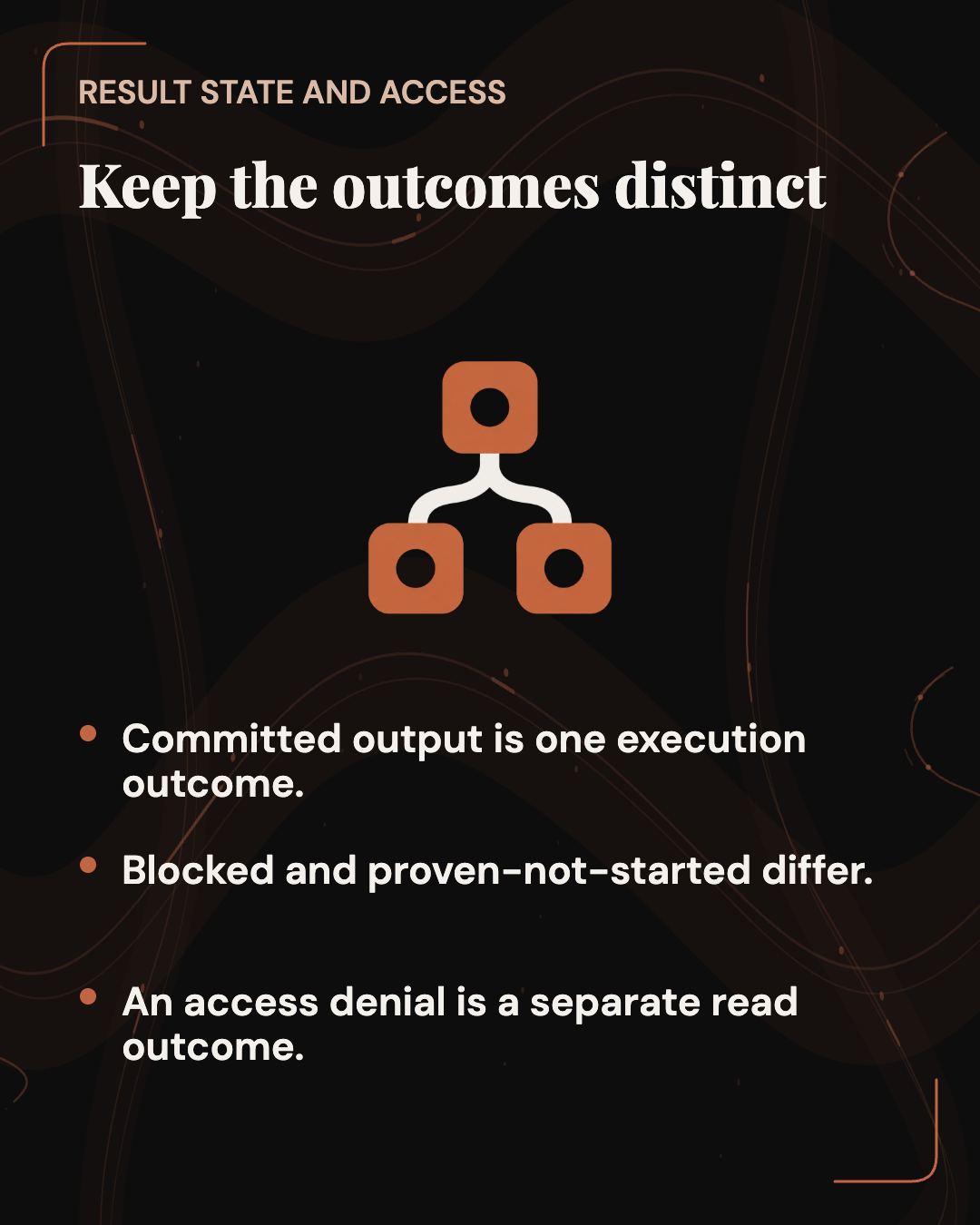
The result model keeps execution, capture, and delivery outcomes separate. That distinction deserves attention before anyone treats a blank output panel as a completed job. A command may have run and produced empty stdout. A request may have been blocked. A command may be proven not to have started. A result may exist while a particular representation is unavailable to the current reader. Those states can lead to different next actions even when none gives the reviewer a line of text to read.
Imagine a hypothetical overnight report job. In one case, the command completes and writes a report file while producing no stdout. In another, permission blocks the command before it starts. In a third, a reviewer lacks access to the saved bytes. Calling all three cases “no output” would hide whether work happened, whether evidence was captured, or whether access was denied. The PR’s separated outcomes are intended to preserve those facts. The report file still needs its own review.
The captured PR describes bounded backfill and replayable projection. That matters when a result becomes visible after the original Turn, but it does not prove every delayed or failed delivery path in a deployed service. An operator should record the Turn and result identifiers seen live, then check whether the restored view refers to the same work. If the identifiers or status appear inconsistent, the answer is a finding to investigate, not a reason to infer that the command ran again.
 View image detail
Decide which representation the reviewer needs
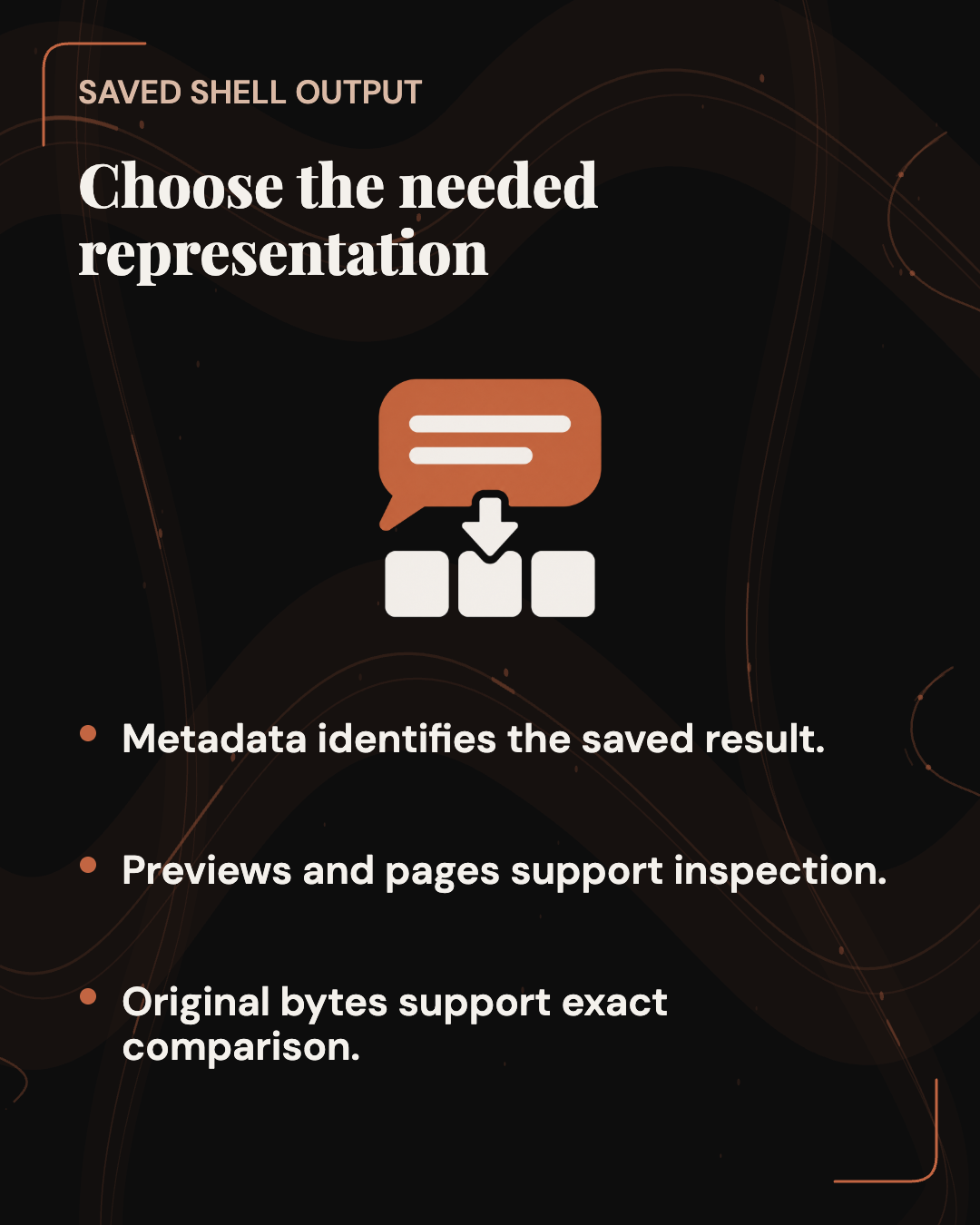
The PR describes authenticated metadata and byte APIs for approved stdout and stderr. It also describes a WebShell view with bounded paging and streaming downloads. These interfaces serve different review jobs. Metadata can identify the saved result and its state. A shared preview may help someone locate a warning quickly. Paged content can expose more of a long stream. Original bytes can support an exact comparison when publication and access policy permit the read.
Suppose a project lead only needs to find the error that stopped a sample job. A preview could be sufficient if it includes the relevant line. Suppose an engineer needs to compare a saved stream byte for byte with a known fixture. A preview would be the wrong evidence because it may be bounded or transformed for display. The engineer would need access to the original representation and a supported way to save or compare it. Those are proposed uses of the described interfaces, not claims that either actor can use them in a current production deployment.
Stdout and stderr also have different meanings. An empty stderr stream can be a valid captured result. It does not certify that a generated client report is accurate. A nonempty stderr stream can contain a warning without proving the whole task failed. The result status, the stream contents, and the artifact the job was meant to produce each answer a different question. A reviewer needs the combination appropriate to the job.
For a large stream, paging and streaming could make inspection manageable. The PR reports a synthetic 100 MiB browser representation checked byte by byte through its WebShell provider and host sink. That is evidence for the fixture and path the contributors exercised. It is not a measurement of every browser, proxy, object store, or deployed Hosted service. If a team requires downloadable records, its evaluation should include the browser and save method it intends to use. The PR says native browser file-picker saving was not exercised in the cited validation.
 View image detail
Work out access before promising an archive
The PR says the durable-result feature, original-byte publication, and shared previews are each disabled by default. It also says original-byte reads check current Workspace grants and publication policy. These controls make a difference to what “saved” means for a reader. A result may be retained by the system while the intended reviewer cannot open its original stdout or stderr. A Session view should not be treated as proof of access to every output representation.
The PR calls public output sensitive and asks deployment owners to choose a publication audience and policy before enabling it. That concern is easy to understand in client work. Depending on the command, Shell output may contain paths, excerpts of working data, or errors that reveal details about the environment. This article does not claim a particular Qwen deployment leaks those details. The practical decision is to identify who needs the output, which form they need, and whether the configured publication path grants that access.
Consider a proposed agency handoff with three people. The Session creator diagnoses the command and may need original bytes. A project lead reviews whether the job can proceed and may need a bounded view. A client sees the finished deliverable and an explanation of its status. These are illustrative roles, not Qwen product roles or documented access tiers. The team would have to map its real identities to actual Workspace grants and publication policy, then verify each read under the correct account.
There is also a time dimension. The PR says publication decisions and shared previews are retained, and changing flags does not retract already saved previews or republish READY results. Its captured text says current raw reads remain subject to grants and policy. A team changing a setting should therefore examine what was already saved as well as what a new raw read permits. The supplied material does not support a promise that switching a flag removes every previously shared preview.
That is a reason to make publication choices before placing client data in the workflow. It is also a reason to record those choices in a pilot report. Otherwise a later reviewer may see a missing download and mistake it for missing output, or see an old preview and assume a current setting created it.
 View image detail
Read the contributors’ tests at their actual scope
The durable-results PR reports several useful checks. Its Java publication and receipt fixture produced public events, snapshots, and schema-validated metadata. The contributor report describes reads after writer seal and Session close. It also describes range reads across output segments, an explicit empty stderr, and failures for invalid preconditions or ranges. Those are relevant checks for a feature that must preserve and retrieve exact data.
The captured PR reports MySQL migration and store/API work, focused WebShell tests, a Chromium rendering of a small stdout example from a Java DTO, and the separate synthetic browser streaming check. It also describes authorization tests for a missing actor, wrong tenant or Session, missing or revoked grants, raw-policy denial, quarantine, and deletion. These are contributor-reported observations and test results. Rise Productive did not reproduce them.
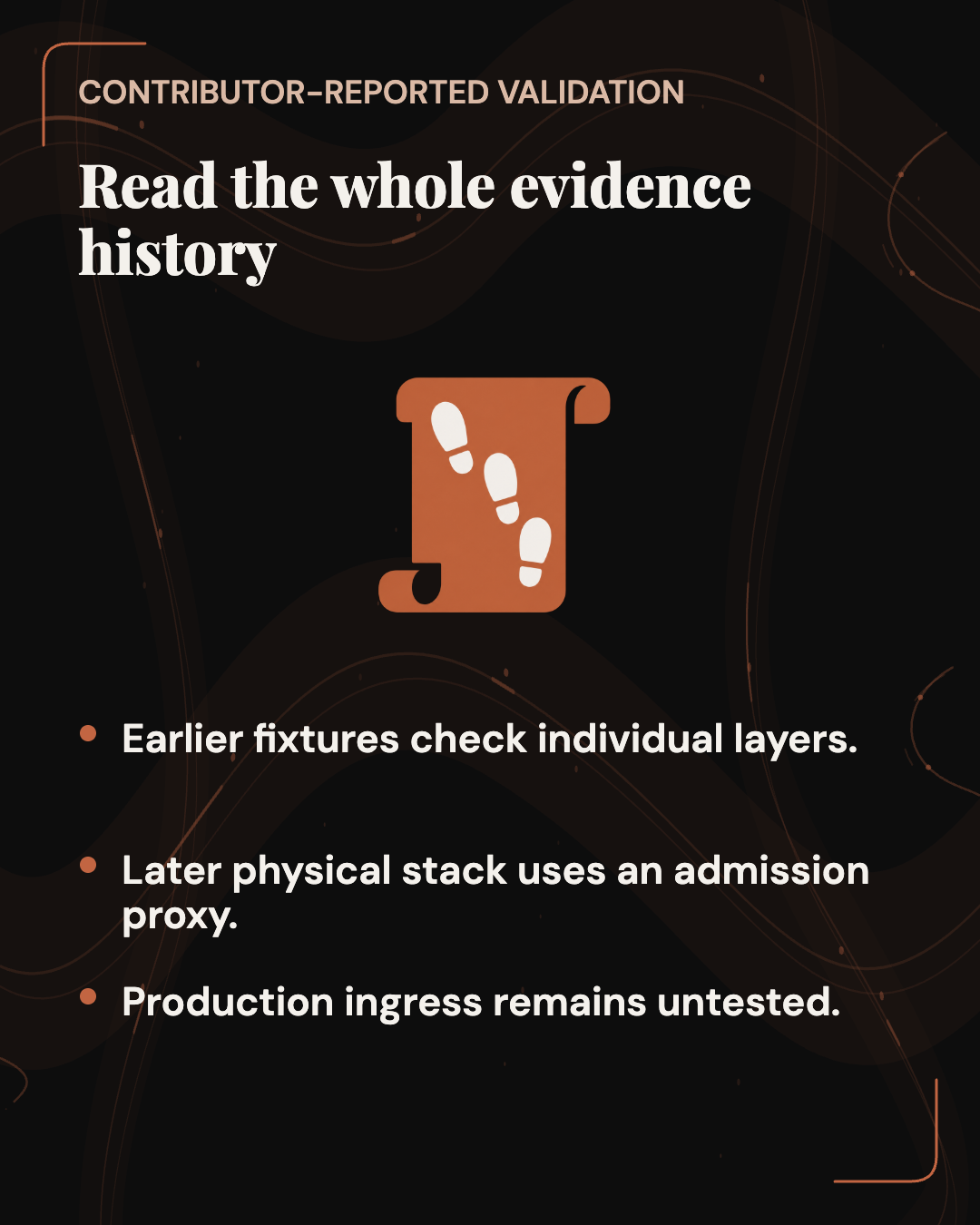
The boundaries are as informative as the successful checks. The earlier author account separated Java and browser fixtures and excluded real object-store credentials. Subsequent independent rounds used actual Shell workers, a Spring server and browsers, with a private object-store check reported in round two. They still required an admission-profile proxy. The post-merge round left production ingresses untested and reported a development-proxy interruption gap. Those qualifications remain relevant when choosing a deployment to evaluate.
A reviewer comment in the captured PR raised concerns about ANSI control characters, browser saving support, and some paging behavior. Later comments discuss fixes, but this capture does not provide a final verdict for every output format and browser combination. Those comments are useful prompts for an environment-specific test, not proof that a particular current deployment fails or succeeds.
The distinction between a source-reported test and an operator’s own observation is especially important when a handoff promise depends on retrieval. The PR gives the operator a technical map and test ideas. It does not identify the operator’s actors, grants, publication settings, browser, network, or client data. Those are the conditions that determine whether the saved result is actually useful in that workflow.
 View image detail
Output can support review without becoming the deliverable
A saved result is evidence about a step. It is not necessarily evidence that the whole job met its brief. A hypothetical command might print “done” after writing a report. That message can help a reviewer locate the step, but it cannot establish that the report uses the right client, date range, or calculation. A byte-exact copy of stdout settles what the command returned; it does not settle whether the report is useful or correct.
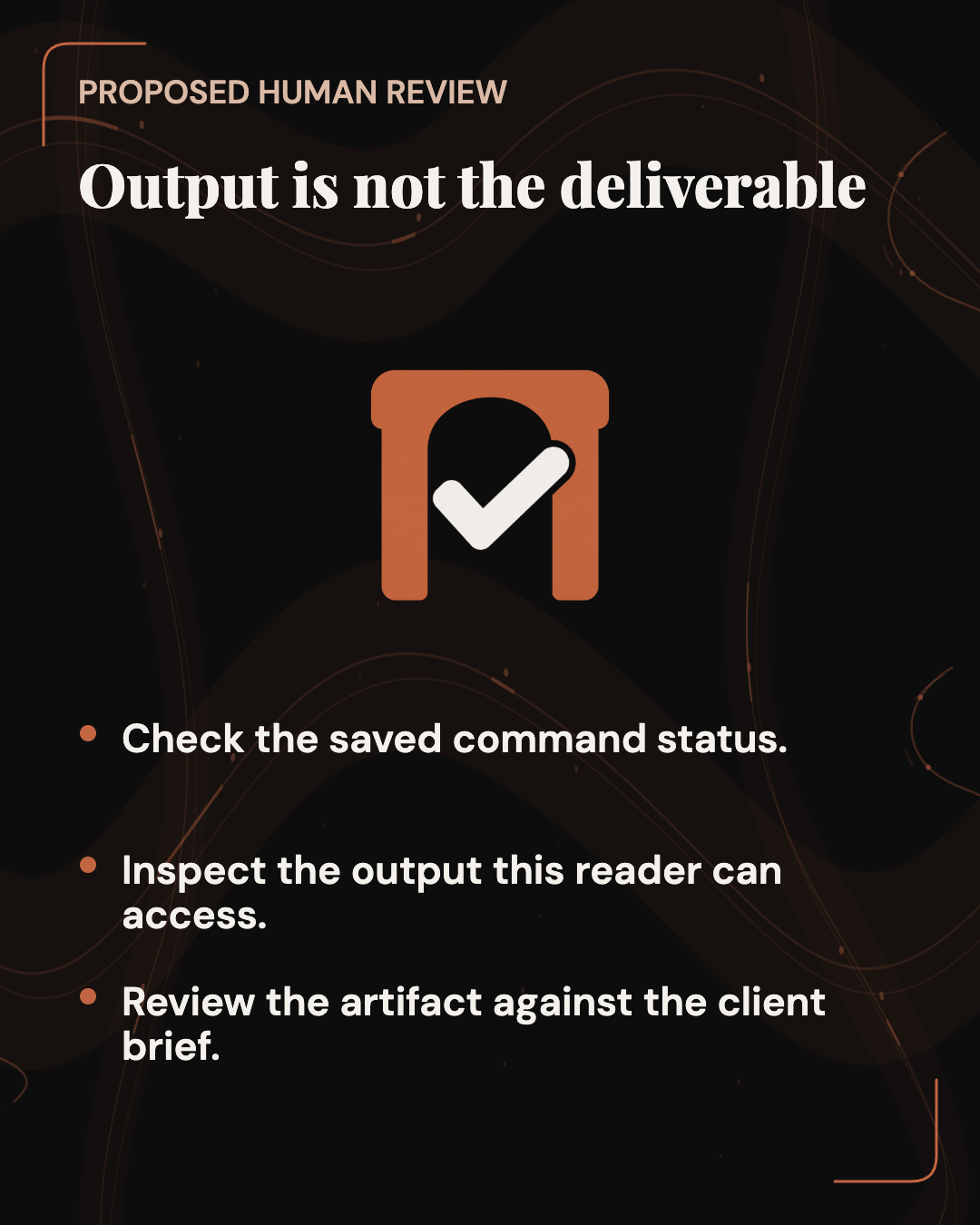
This suggests three separate review questions for a connected workflow. Did the command execute, and what status was recorded? What output can this reviewer inspect under current access? Does the produced artifact satisfy the client’s request? The first two questions concern the saved Shell result. The third concerns the deliverable and the human judgment applied to it.
The same separation helps when something goes wrong. A blocked result may call for a permission or task-design decision. A committed result with a warning may call for diagnosis. A correct result hidden from a reader may call for an access or publication review. A clean stream beside a poor report may call for a content correction. Combining these situations into a single “agent succeeded” label would make the next person’s job harder.
The opportunity is a more useful morning handoff. A project lead could inspect a saved result, route a warning to the right person, and then review the client artifact. That is a proposed workflow, not a measured time saving or a result observed by Rise. It becomes worth adopting only when the team can show that the intended person sees the needed representation after closure and can connect it to the actual deliverable.
 View image detail
Run a bounded closed-Session evaluation
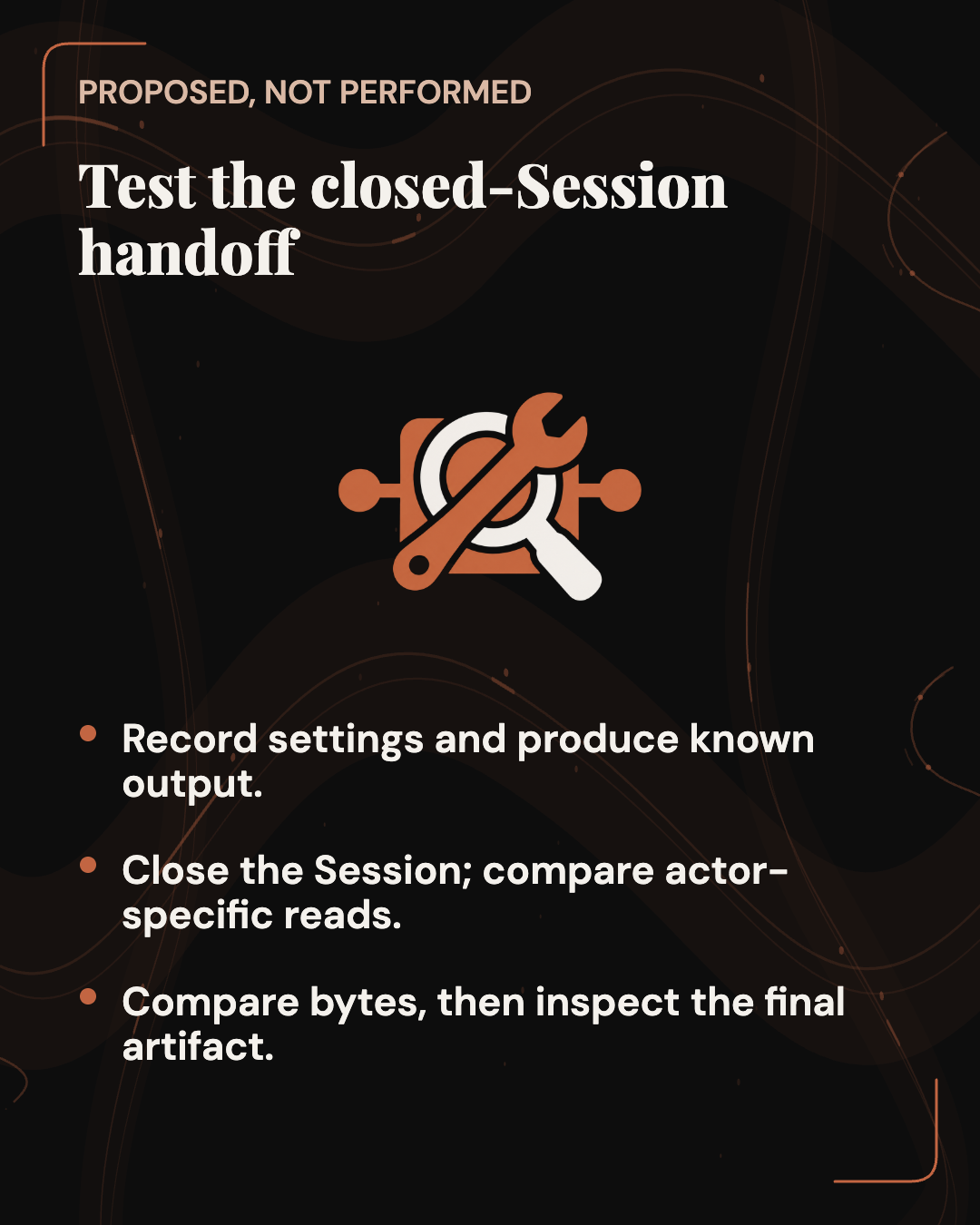
The following is a proposed test plan. It has not been performed for this article. Begin in an authorized environment that exposes a Hosted Workspace Session and the relevant durable-result capability. Record the exact build, Session and Turn identifiers, actor identities, Workspace, feature settings, publication decisions, and policy. If the capability is absent, record that observation. Do not infer access from the nightly tag.
Use harmless sample data. Have a foreground Shell step write one recognizable short line to stdout and a different line to stderr. Include an empty-stream case so the team can distinguish captured emptiness from a blocked or not-started command. Record the live result identifier and status. Close the Session through the supported path, reopen its saved view, and look for the same result identity and status. Note any missing or delayed projection rather than filling in the expected result from the PR.
Next, read under each intended identity. Check which actor receives metadata, a shared preview, paged content, and original bytes. Include an actor without the required Workspace grant. Change one access condition at a time, then record the response. A visible control is not proof of authorization, and a successful read by the creator does not establish that the project lead can make the same read.
For an exactness check, use a known sample whose bytes can be compared with the retrieved representation. If the team relies on large output, add a separate case that exercises paging or streaming in its intended browser and save path. The PR’s synthetic 100 MiB report can guide expectations, but the pilot must record its own size, environment, method, and observed result. A failed or unsupported save path is a finding, even if the panel displays a preview.
Finally, open the file or artifact the command was meant to produce. Compare it with the actual client brief. A useful report would state which command status was saved, which stream representations were readable after closure, which actor made each read, which access was denied, and whether the deliverable passed review. Those lines can then support a decision about this specific workflow. They should not be collapsed into a single pass mark for “hosted agents.”
 View image detail
The adoption decision
The captured October 1 prerelease and durable-results PR describe a guarded route for reviewing saved Hosted Shell output. Contributor-reported validation covers important parts of that route, from earlier fixtures to a later proxy-assisted physical stack. It does not establish general access or unmodified production admission and ingress behavior.
For an operator, the next step is specific: choose the result a reviewer needs, identify that reviewer’s real access, and test retrieval after the Session closes. Then inspect the actual deliverable. If those observations hold for the intended build and workflow, saved Shell output can become one useful part of the handoff. Until then, the prerelease is a reason to evaluate the capability, with its publication controls and evidence limits intact.
For the before-execution decision, read what to check before allowing Qwen Code Hosted approvals. A later saved result does not establish what the creator knew when approving the action.
This is the Work Worth Doing question behind the feature: decide what deserves a human judgment, then make the relevant action or result inspectable at that point in the workflow.
Checked for this article
Sources
Keep going
Related notes.

Automation and Agents
Agent-Native 0.200.0: A Prompt Recovery Plan for Chat Hosts
Builder.io describes the pieces of setup recovery. This plan defines the host decisions and disposable checks needed to make a recovered request understandable.
Read the article
Automation and Agents
Agent-Native 0.200.0: Check Prompt Recovery After Setup
Builder.io says toolkit 0.200.0 saves setup-refused prompts and coordinates retries. Here is how to check the request and result in a host you use.
Read the article
Automation and Agents
OpenClaw 2026.8.35: Check Whether Agents Deliver the Full Answer
OpenClaw reports fixes for delegated, CLI, and scheduled answers. Here is a proposed way to check what reaches each recipient and how to interpret the result.
Read the article