
Automation and Agents
OpenClaw 2026.8.35: Check Whether Agents Deliver the Full Answer
OpenClaw reports fixes for delegated, CLI, and scheduled answers. Here is a proposed way to check what reaches each recipient and how to interpret the result.

On this page
- What the release reports
- Find the point where an answer becomes useful
- Inventory the routes people rely on
- Design a check that exposes missing material
- Give each outcome a precise meaning
- Review correctness as its own decision
- Keep scheduled output inside its permission boundary
- Decide whether this branch belongs in the plan
- Make the decision from the record
- Related reading
An agent can finish its work while the person waiting for it receives only part of the answer. OpenClaw says its 2026.8.35 extended-stable release repairs complete delegated and CLI answers and recovers full output from scheduled jobs. The useful question for an operator is whether the whole answer reaches the destination their workflow depends on.
Start with one real delivery route. Define what a complete answer must contain, identify where it should arrive, and compare that expectation with what the recipient receives. Review the answer’s accuracy separately. The check below is a proposed method. No OpenClaw installation or runtime test was performed for this article, so it offers no measured reliability result.
What the release reports
OpenClaw calls v2026.8.35 a gateway-only extended-stable release and describes that branch as its equivalent of LTS at release time. It says the release combines its end-of-August 2026 branch with later security, reliability, performance, and model-support changes. The notes identify 2026.9.7 as the latest OpenClaw version at the time of this release. That statement does not identify the current mainline version or establish which branch a particular installation should use.
The agent-delivery notes report preservation of complete delegated and CLI answers, recovery of full cron replies, retention of detached transcripts, release of suspended child slots, honored skipped announcements, and protection against failed requests replacing earlier questions with a steer. These are different repairs. A reply that arrives in full says little about whether a later child task can start or whether an earlier question remains intact after a failed request.
OpenClaw also lists release-verification references and says manual finalization followed owner-approved checks. Those statements belong to OpenClaw’s release record. The linked workflows, packages, signatures, and runtime results were not independently examined for this article. The captured notes provide no before-and-after answers, reproduction conditions, or failure rates for a reader’s installation.
The captured GitHub page displays the release line “02 Oct 14:06.” That line does not display a year, time zone, or seconds. The dashboard snapshot supplies October 2, 2026 at 14:06:34 UTC, but the captured page text does not confirm that exact timestamp.
 View image detail
Find the point where an answer becomes useful
Consider a hypothetical request to review five supplied records and return one finding for each. The task might end, and an inspectable retained answer might contain five findings, while the recipient sees only three. The person acting on that reply cannot use the two findings that never arrived. This example explains the delivery question; it is not a reproduced OpenClaw incident.
An operator can inspect several points in the route, depending on what their installation exposes: the original request, a completion state, an authorized retained result, and the reply at its intended destination. The last point matters because it is what the next person or system can actually use. A finished status cannot tell that person whether all five findings arrived.
The points also help narrow an investigation. If a retained answer contains five findings but the received reply contains three, the first visible gap appears between those observations. If both contain three, the missing material appears earlier in the visible record. Either comparison is useful, but neither identifies a software defect or proves its cause. Record what is visible before assigning an explanation.
Use the same discipline for the release’s other agent fixes. Suspended child capacity concerns whether later delegated work can proceed. A failed request consuming a steered question concerns which question remains available. The captured notes do not give the previous trigger conditions for either problem. If those behaviors affect your work, define an observation for each one; a complete answer on another route cannot stand in for it.
The practical rule is to name the outcome first. For a scheduled report, the outcome is the report at its configured recipient. For a delegated task, it may be what the parent agent receives before a final response is shown. For a CLI task, it is the reply at the session or other configured destination. Those are possible workflow shapes, not paths verified for a particular installation.
 View image detail
Inventory the routes people rely on
Write down the installed version and intended branch before attributing any result to this release. Then list the workflows whose answers matter to people. An interactive delegated task, a CLI session, and a scheduled report may have different recipients. Checking one route gives evidence about that route under the conditions observed. A team that relies on a morning report needs to inspect that report’s destination; an interactive reply cannot settle the scheduled path.
For each workflow, record the authorized request, the route it takes, its normal answer destination, and the person who can inspect that destination. Include the permission context when tools or scheduled work are involved. Leave unknown fields visibly unknown. If nobody can identify where a scheduled reply should appear, find that destination in the installation’s configuration and applicable guidance before judging a run.
A compact worksheet can hold one row per route: installed version, intended branch, request type, expected destination, permission context, reviewer, and observed output. Fill in the last field only after a run occurs. The worksheet is a proposed review aid, not an OpenClaw feature or evidence that this article tested a deployment.
Imagine a team using an agent to prepare a weekly project update. A delegated task may return findings to a parent agent; the parent may then prepare the message a project owner reads. The parent’s retained material and the owner’s message answer different questions. If the owner needs five project findings, the team should examine that message, even if an intermediate result looks complete. The example is a possible handoff, not an observed OpenClaw configuration.
This inventory also keeps a check proportionate to the work. An installation that never uses cron does not need a cron result to answer its immediate delegated-task question. A team that depends on several routes should give each one its own record. Combining their results into a single “agents work” verdict would hide which recipient was observed.
 View image detail
Design a check that exposes missing material
Choose an authorized task whose expected output is easy to inspect. One proposed exercise supplies five fictional entries labeled A through E, each with a short value. Ask for one line containing the label and supplied value for each entry, followed by a closing line that accounts for all five. Write down the expected five pairs and closing line before sending the request.
For example, the fictional input could contain A=1, B=2, C=3, D=4, and E=5. A reply with A, B, D, and E plus “five entries reviewed” is incomplete because C is absent. A reply listing all five labels but leaving C’s value blank is incomplete in another way. A reply containing all five pairs but no requested closing line is missing its ending. These are inspection examples, not outputs from an OpenClaw run.
Compare meaning as well as labels. If all required values are present in different but clear wording, the answer may satisfy the request. If a value is wrong, record that separately from a missing line. Exact text matching is useful only when exact text is part of the authorized task. Otherwise, it can call a harmless wording change a failure while missing a substantive omission.
Save the request, supplied entries, expected elements, installed version, route, and intended destination. Run the exercise only through a route the installation uses and is authorized to use. Read the output where that route’s normal recipient would read it. Record the received output and retrieval time. An intermediate log can help explain a discrepancy, but it cannot substitute for what arrived at the recipient.
For scheduled work, identify the intended run before examining the result. Record when output was expected and how you matched the reply to that run. An old answer at the same destination could otherwise look like a new success. OpenClaw says the release recovers full cron output and delivers manual runs after their creating turn ends. The captured notes do not provide a command sequence or describe a reader’s schedule, so the exercise must follow the installation’s applicable guidance and existing authorization.
A five-entry exercise has a narrow purpose: make an omitted middle item or ending visible. If the normal workflow produces a long report, follow it with a representative authorized request whose expected sections are also defined in advance. Keep the two observations separate. A short complete reply does not show how a long report will arrive, and one long complete reply does not establish a general reliability rate.
 View image detail
Give each outcome a precise meaning
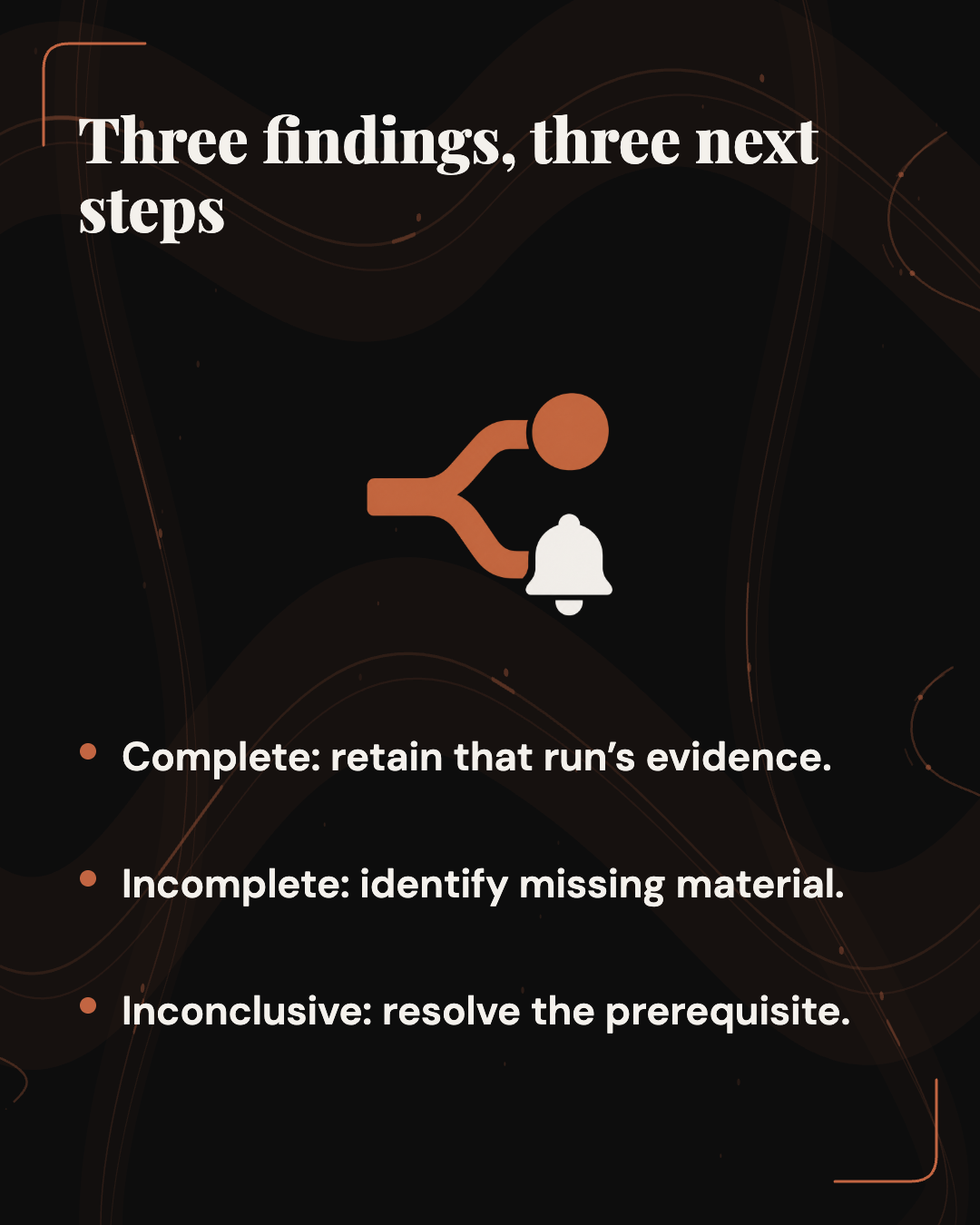
A complete result means every expected element reached the observed destination on that run. Record the route, version, request, destination, and received answer with that finding. It supports a narrow statement about the run. It does not establish uptime or cover routes and output shapes that were not observed.
An incomplete result needs the missing element named. Preserve the exact request and reply. If an authorized retained answer or transcript is available, compare it with the recipient’s output and identify the first visible gap. That comparison can direct an investigation toward answer creation or a later handoff. It does not, by itself, assign the discrepancy to a particular OpenClaw fix.
An inconclusive result means a prerequisite for judging delivery is missing. A task that never finished may have produced no completed answer. An unknown destination leaves uncertainty about which output to inspect. An unconfirmed installed version prevents a result from being attributed confidently to 2026.8.35. Resolve the missing prerequisite, then interpret a new observation.
Suppose the fictional five-entry reply contains only A through C. If a retained result shows A through E, the next question is what happened between that retained result and the recipient. If no retained result is available, the record still establishes what the recipient saw; it simply cannot narrow the earlier point. If the output was collected from an unconfirmed destination, even the recipient finding remains unsettled. These are different conclusions from superficially similar short replies.
Repeat a check when repetition answers a defined operational question, such as whether a representative report arrives through the same route on another authorized run. Keep dates, output shapes, and conditions with each observation. Do not convert a handful of proposed or observed examples into a failure percentage without an appropriate measurement design. Neither the release capture nor this article provides one.
 View image detail
Review correctness as its own decision
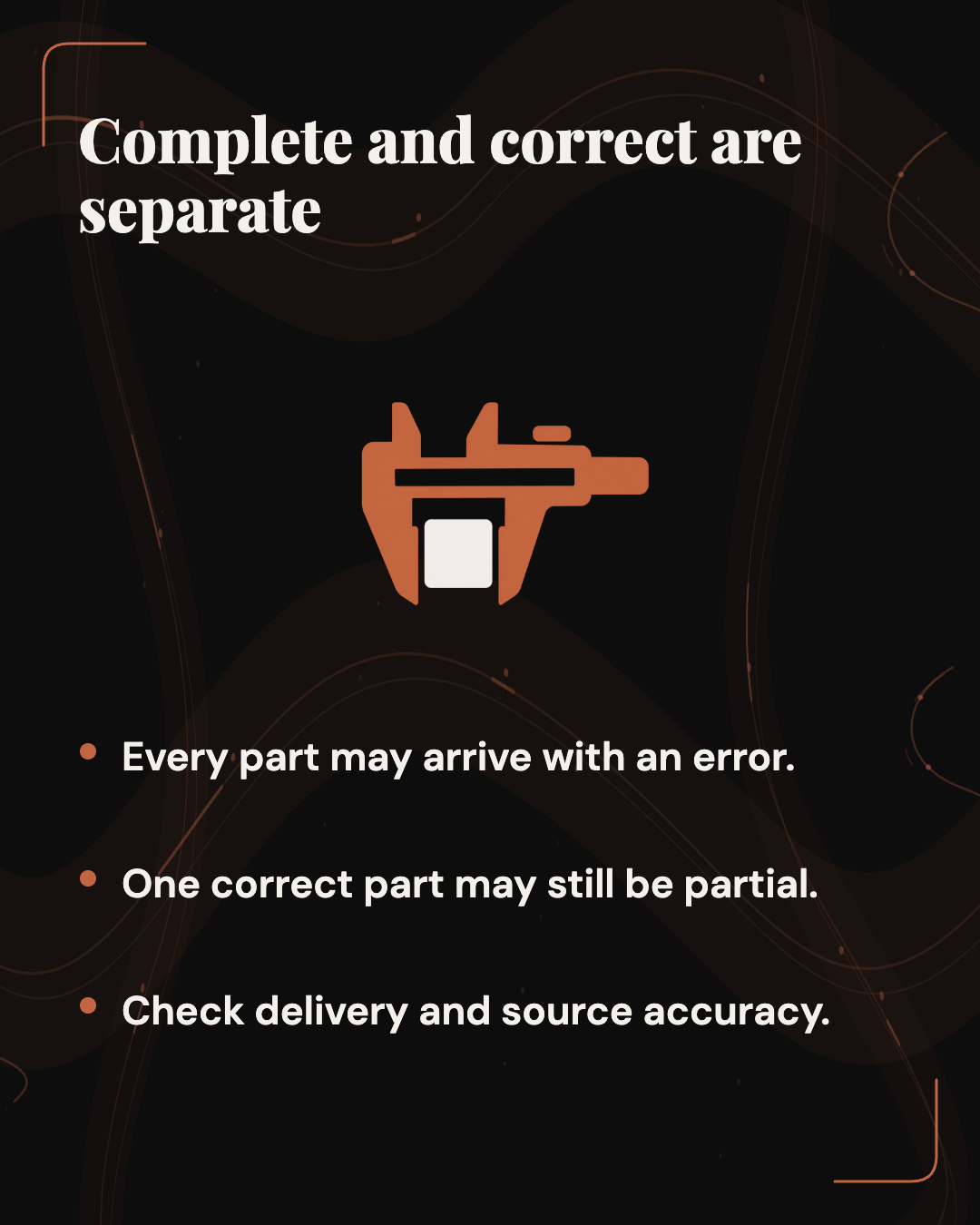
Receiving every requested part does not mean the answer is right. The fictional reply might contain all five label-value pairs while copying C’s value incorrectly. Delivery asks whether the expected material arrived. Correctness asks whether that material accurately answers the request. Keep both judgments in the review record.
For a real record review, a person could compare each finding with the authorized source record. For a summary, a reviewer could look for omissions and unsupported claims in the source material. The review should match the consequences of using the output. The five-entry exercise isolates completeness; it is not a reasoning benchmark and does not establish that a consequential answer is safe to use.
The reverse also matters. A correct finding for A cannot make a reply complete when B through E are absent. An answer that looks final while omitting material may encourage a recipient to act too early. Define what the recipient should do when output is partial: request the missing material, route it for review, or stop a downstream action, according to the actual workflow. That decision belongs to the operator’s process, not to the release notes.
Rise’s five-part test for what to automate is useful here: the consequences of failure and the amount of human judgment affect where review belongs. It is an editorial decision guide, not evidence that OpenClaw’s reported fix works in a particular installation.
 View image detail
Keep scheduled output inside its permission boundary
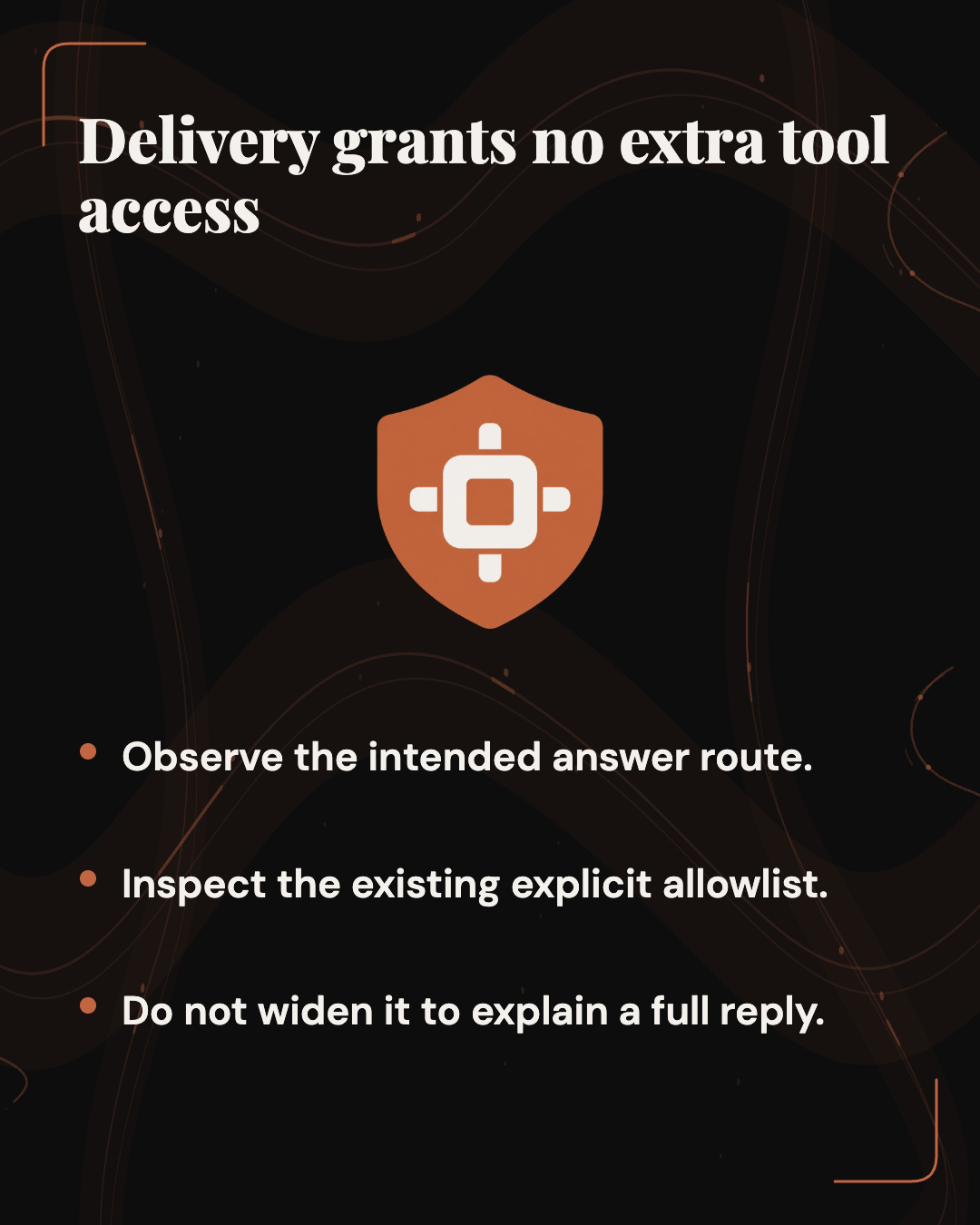
The release notes say repair of stale automatic cron tool snapshots retains explicit tool allowlists. That is OpenClaw’s description of a permission boundary. The capture does not show any reader’s job configuration, establish that an existing allowlist is appropriate, or prove what a scheduled run did.
A scheduled workflow therefore needs two findings from its own evidence. Did the complete output reach the intended destination? Did the job operate within its intended tool permissions? Inspect the existing configuration and output route before interpreting a reply. If a task lacks a tool it needs, expanding permissions would change the workflow being evaluated. A complete message alone cannot justify that change.
Consider a hypothetical report authorized to read one approved source and send a summary to an internal recipient. A full summary at that recipient would support a delivery finding for that observed run. The operator would still need to check whether the approved source was used and whether the job stayed inside its intended tool boundary. Keep those observations with the received output so the result can be interpreted later.
The allowlist claim has a specific scope: OpenClaw says the snapshot repair does not widen explicit allowlists. It does not say every existing allowlist is correct, every snapshot in a particular installation is current, or every scheduled task is safe to execute. Those questions require the installation’s configuration and, where appropriate, its observed behavior.
 View image detail
Decide whether this branch belongs in the plan
The branch label starts an update decision; it does not supply an upgrade procedure. OpenClaw calls 2026.8.35 gateway-only extended-stable and connects it to the end-of-August 2026 branch. The captured page does not give complete eligibility rules or migration steps for every deployment. An operator considering an update needs the installed version and configuration, plus applicable OpenClaw guidance for that environment. That separate guidance was not verified for this article.
The release also reports preservation of plugin settings and inventory through recovery or migration, avoidance of pnpm package-update terminal failures, and protection against duplicate Gateway startup. Those update-safety claims tell an operator what to examine if plugins or startup behavior matter. They do not establish that a specific upgrade succeeded. Keep an upgrade outcome separate from a later answer-delivery outcome.
OpenClaw further reports GPT-6.1 Sol compatibility across OpenAI routing, discovery, reasoning, harness, and Reef guard-model boundaries. That is a compatibility claim for this branch. The captured notes do not verify provider-account access, present availability, pricing, or a successful run in a reader’s configuration. Someone considering the branch for model support must establish those conditions separately from answer delivery.
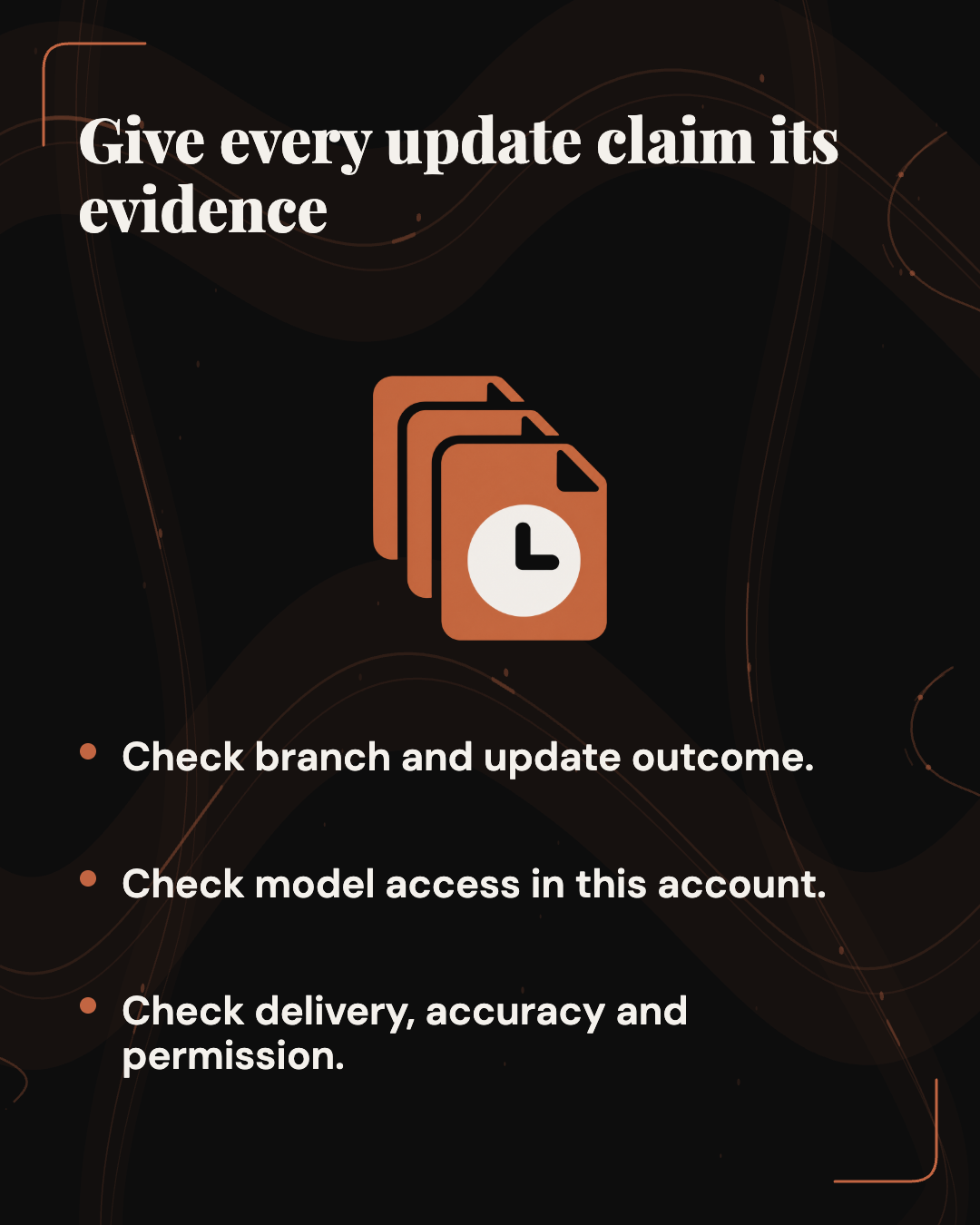
The six decisions are distinct: whether the branch applies, whether an update succeeded, whether an account can use the model, whether the whole answer arrived, whether that answer is correct, and whether scheduled tools stayed within their intended permissions. A release note can motivate each check. It cannot fill in an installation’s results.
 View image detail
Make the decision from the record
Confirm the branch that actually applies to the installation. Name the answer destination for each workflow people rely on. For scheduled work, inspect the existing permissions. Then make an authorized, bounded check with expected elements defined beforehand and retain the request, version, route, received output, destination, and result. Review accuracy against the task’s source material when the output will inform a decision.
If material is missing, the record tells you where to investigate next. If the version or destination is unknown, resolve that uncertainty before calling the result a pass or failure for this release. If the bounded reply arrives in full, record exactly that and decide whether a representative workload needs review. The useful conclusion is what reached whom, through which route, under which known conditions.
Related reading
For a related look at the authority boundary, read OpenAI Agents API browser permissions and recovery. For a different coding-agent decision, see what to review before expanding an AI agent’s authority.
Checked for this article
Sources
Keep going
Related notes.

Automation and Agents
Google CC for Households: What Members Can Share and What to Check
Google says CC can turn selected household information into a shared brief, Calendar entries and Tasks. Here is how to assess the inputs, the plan and permission before outside action.
Read the article
Automation and Agents
Agent-Native 0.200.0: A Prompt Recovery Plan for Chat Hosts
Builder.io describes the pieces of setup recovery. This plan defines the host decisions and disposable checks needed to make a recovered request understandable.
Read the article
Automation and Agents
Agent-Native 0.200.0: Check Prompt Recovery After Setup
Builder.io says toolkit 0.200.0 saves setup-refused prompts and coordinates retries. Here is how to check the request and result in a host you use.
Read the article