
Automation and Agents
Verify Grok Voice Transcribe 2.0 Before an Agent Acts
A transcript can prepare an action, but it cannot authorize one. Here is a practical verification boundary for audio that feeds an agent.
On this page
- A transcript is evidence about speech, not permission to act
- The full path from recording to approved action
- Let transcript status decide when extraction may run
- Keep a link from each field back to its source
- Check the fields most likely to change the action
- Accuracy scores measure recognition, not the action
- Set approval levels by consequence
- Plan the undo before the action runs
- Sort failures by the layer that caused them
- Accept actions through a narrow pilot
- Record the model ID through the October 2 transition
- A checklist before any transcript drives an action
- Decide what the transcript is allowed to do
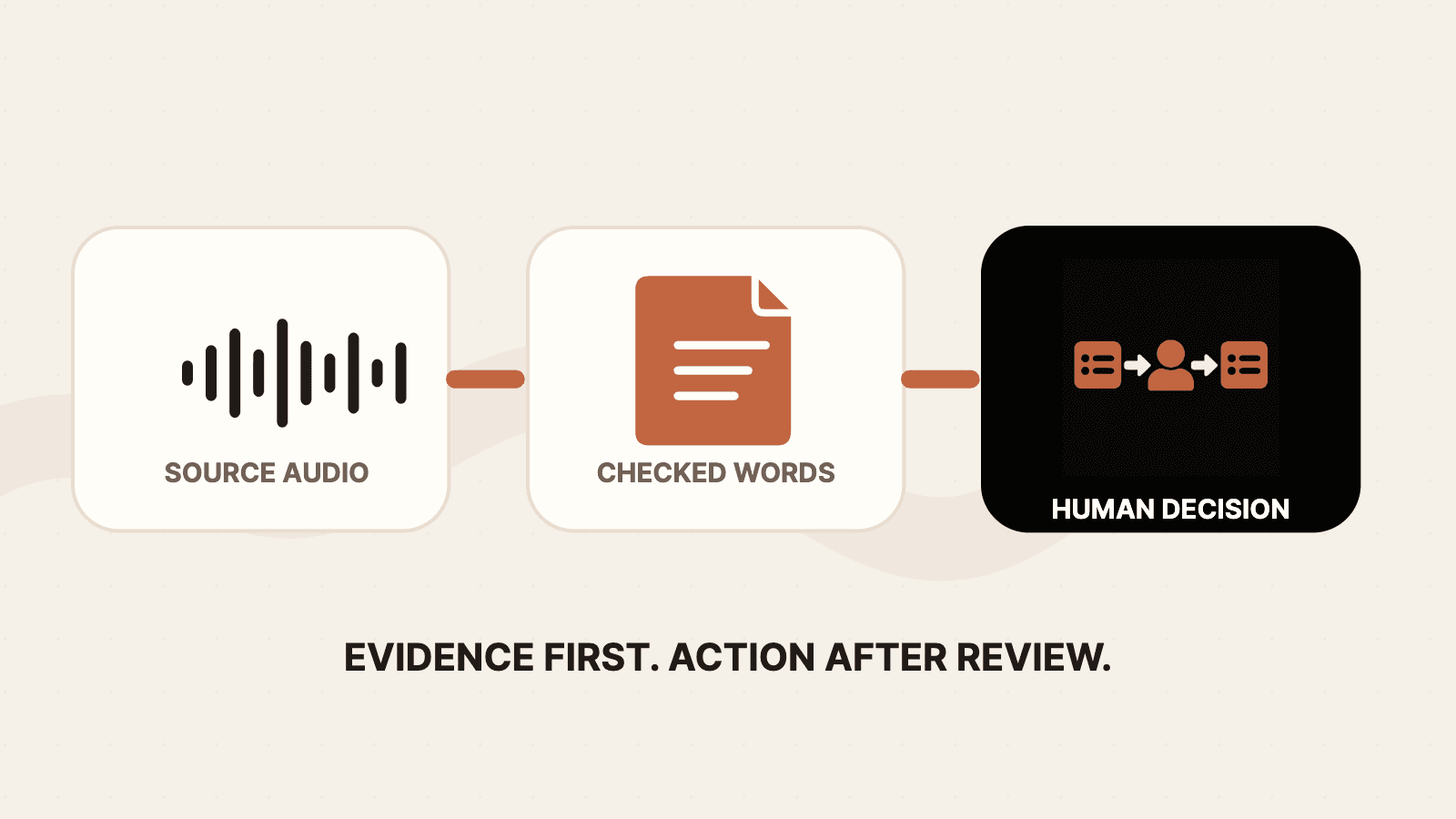
A transcript can help an agent prepare a useful next step. It should not be treated as permission to take that step. When recorded speech turns into a customer update, a task, a payment instruction or a promise, someone needs to be able to trace the text back to the audio, check the details that matter, and decide whether the action goes ahead.
xAI released Grok Voice Transcribe 2.0 on September 18, 2026, with batch and streaming speech-to-text. Its product announcement lists word-level timestamps and confidence, speaker diarization, up to eight independent channels, up to 100 key terms, formatting, filler removal and smart turn detection. The current Speech to Text API guide separates interim, chunk-final and utterance-final transcript events. All of that helps an application keep context. None of it tells you whether a speaker meant a sentence as an instruction, or whether the dollar amount in it is right.
This article picks up after a different decision. Choosing between batch and streaming, and judging whether pilot transcripts are good enough, is a separate decision. The question here comes later and is narrower: once you have a transcript, what is it allowed to do, and who decides?
What follows is a proposed workflow design, not a tested Rise integration. I have not sent audio through an authenticated xAI API call or connected a transcript to a live tool. The checks come from the documented interface and from tracing where a speech-to-action chain can turn a recognition error into an operational one.
Key Takeaways- A transcript is evidence of what was said. Use it as input to a proposal, never as approval.- Let extraction run only on utterance-final streaming text or a complete batch result.- Keep each important field linked to its transcript time range, audio reference and model ID, as far as your retention policy allows.- Check names, numbers, negation, commitment, scope and speaker before anything consequential.- Set approval and undo plans by consequence. A named person approves external, financial, access and deletion actions.
 View image detail
A transcript is evidence about speech, not permission to act
Speech-to-text turns an acoustic signal into text. A later model may summarize that text, extract fields, suggest tasks or call a tool. Each step makes a different claim. "These words were recognized from this section of audio" is not the same claim as "this person approved this action."
People rarely speak in clean instructions. A speaker may brainstorm, quote a customer, correct themselves mid-sentence, describe a hypothetical, or say "don't do that" a minute after asking for it. A listener in the room uses tone, timing and shared history to tell these apart. A transcript flattens much of that, and an agent reading only the text may lack what it needs to resolve a name, a quantity, a pronoun or a negation.
If the agent then writes a CRM record or sends a confirmation, the mistake stops being a transcription detail and becomes something another person relies on. Polished, well-formatted text does not restore the missing context. It can make the output look more settled than the conversation was.
The goal is not to make someone replay every sentence of every call. It is to match review effort to what happens next. An internal draft summary needs one kind of check. A message that commits the business to a date or a price needs a stronger one. The workflow should make those boundaries visible rather than leaving them to whoever happens to be watching.
The full path from recording to approved action
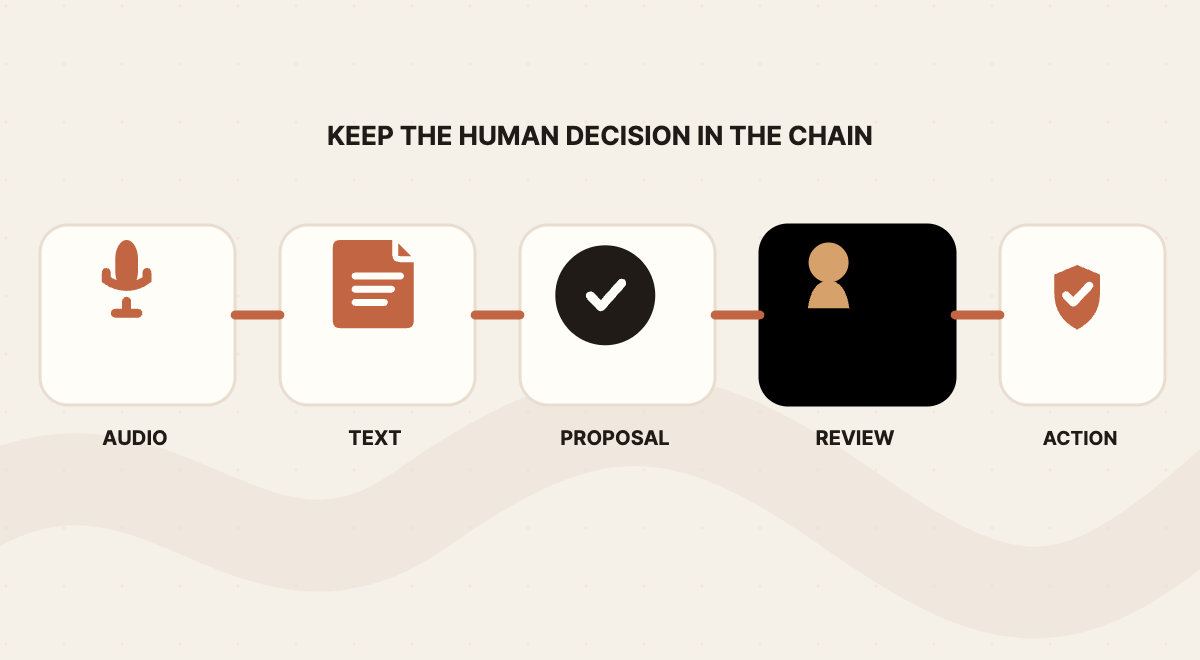
A design that connects transcription directly to a tool call leaves the intervening checks unstated. A safer chain names each stage so that each one has an owner and a record:
- Consented capture. The recording is made and kept under the organization's own consent and retention rules.
- Transcription. Batch or streaming, with the model ID recorded for every job.
- Versioned transcript. Text, word timings, speaker or channel labels where available, and the event state each segment reached.
- Field extraction. Names, amounts, dates and requests pulled only from completed text.
- Checked proposal. Each extracted field linked to its source span, with mismatches and uncertain spots flagged.
- Human approval. A named reviewer approves, edits or rejects the proposal.
- Action. The tool runs with the approved values only.
- Audit and undo. The system logs what changed, who approved it, and how to reverse it.
Removing any stage has a specific cost. Without stage 3, nobody can say which model or event produced a field. Without stage 5, the reviewer has to search the whole recording to check one number. Without stage 8, a wrong action has no route back. The rest of this article works through the stages where a transcript most often gets more authority than it has earned.
Let transcript status decide when extraction may run
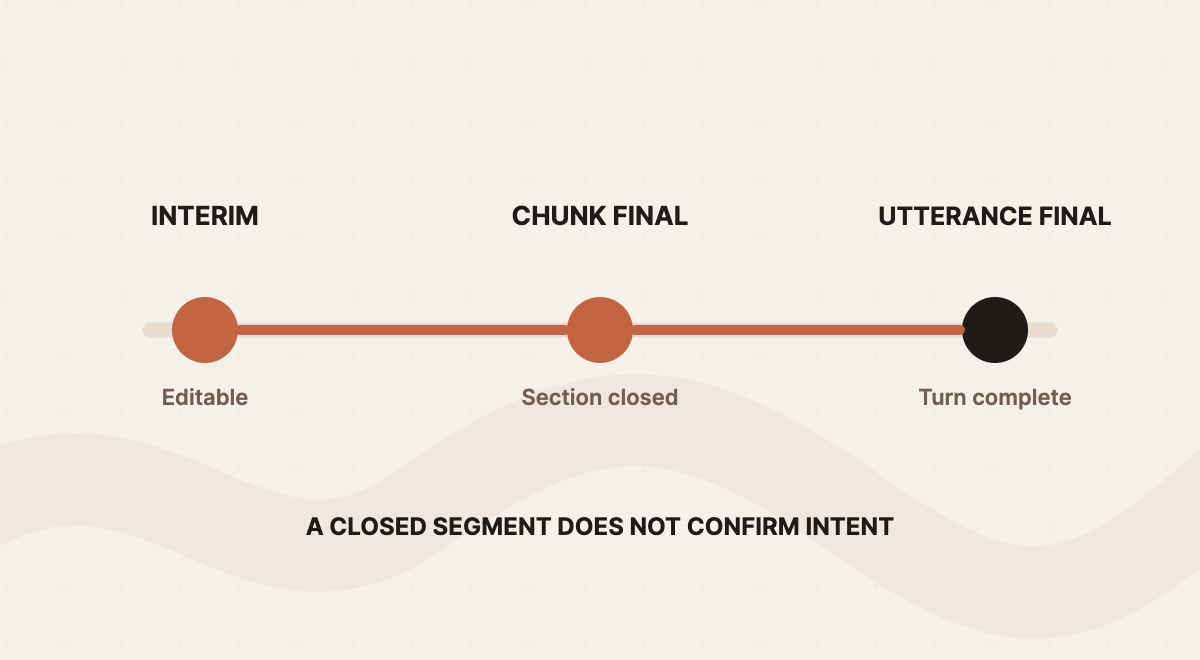
The current xAI streaming guide describes three event states. Interim results may arrive while audio is still coming in, and their text may change. A chunk-final segment is stable text, but it does not necessarily mean the speaker has finished the thought. An utterance-final event marks the completed utterance under the configured endpointing or Smart Turn behavior, and the guide also documents a timeout that can force an utterance-final event.
For an action pipeline, those states are best used as a gate. Consider someone dictating, "Move the follow-up to Thursday, actually Friday." An extractor that runs on the first stable chunk can create a Thursday task before the correction arrives. Or someone says, "We could refund the charge, but I need to check the contract first." Cut at the comma, that reads like a decision.
A practical rule follows:
- Interim text may update a visible draft so the person can follow along.
- Chunk-final text may be stored, but it should not trigger extraction of an instruction.
- Extraction runs only after the utterance-final event.
- If a timeout forced the utterance-final event, mark it. The segment closed on silence, which is a technical boundary, not proof the speaker finished.
The word "final" names a segment state. It says nothing about whether the words are correct or what the speaker intended.
Batch needs its own completeness check. The batch route accepts an uploaded file, up to 500 MB, or a URL, and returns a transcript after processing. Before extraction, confirm the job finished, the duration matches the recording, every expected channel is present, and timestamps came back. If the file ends mid-sentence, mark that boundary. A succeeded job means the request was processed, not that the conversation contains a complete instruction.
 View image detail
Keep a link from each field back to its source
A reviewer can only check a field quickly if the system can show where it came from. The current API guide says batch responses can include word text with start and end times, plus speaker labels when diarization is enabled. In streaming, multichannel PCM mode returns events identified by channel; the guide notes that multichannel is not supported for Opus encoding. Those details matter when you plan provenance, because a channel-based design only works with the audio format that supports it.
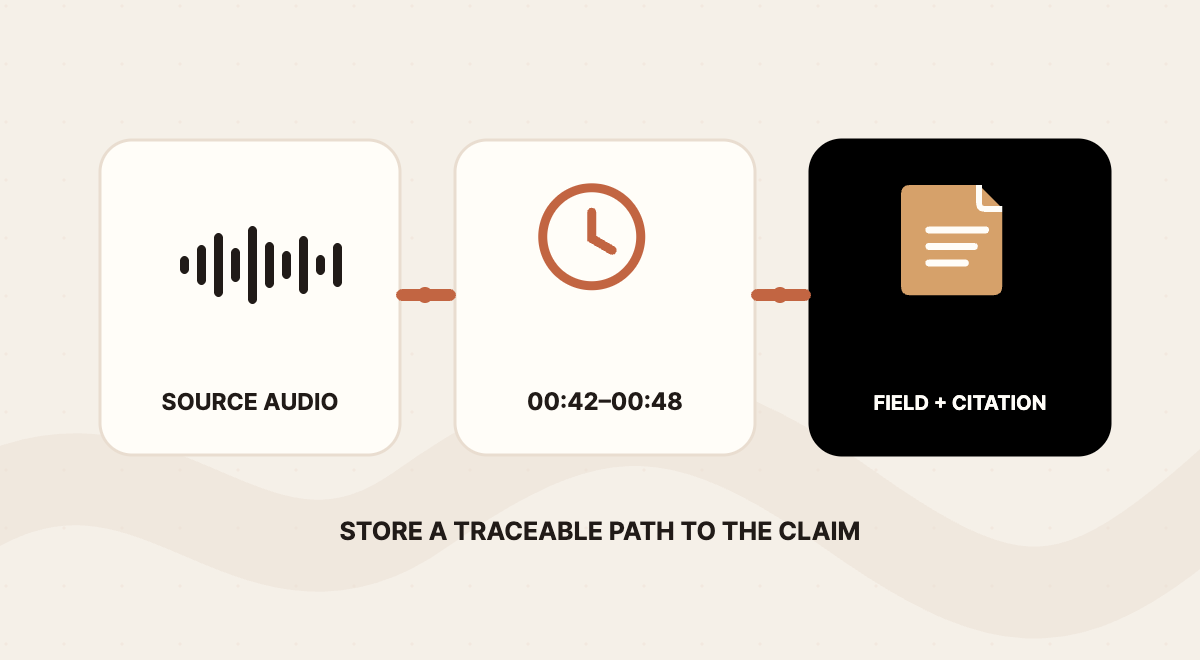
For every extracted field that could change an outcome, store:
- the transcript time range the field came from
- a reference to the source audio, where policy allows
- the speaker label or channel, if available
- the event state at extraction time
- the model ID that produced the transcript
With that record, the reviewer can play a short window around the phrase instead of the isolated word. A few seconds of context often settles whether a number was later corrected, whether the speaker was repeating a customer's words, or whether a name was only an example.
The source will not always remain available. Consent terms, contracts, privacy commitments or data-minimization choices may limit what an organization keeps, and this article makes no legal claims about what those rules require. What the workflow should not do is lose provenance silently. Keep only what the organization is authorized to keep, store an approved audio identifier when the file itself cannot stay, record when evidence expires, and have the workflow ask for review when the proof a field needs is no longer reachable.
Access control belongs in the same design. xAI's current docs advise routing streaming WebSocket connections through your own backend so the API key never appears in client-side code. That protects the integration secret. It does not decide who may submit recordings, who may retrieve them, which outputs get logged, or how access is revoked. The application still owns those choices.
 View image detail
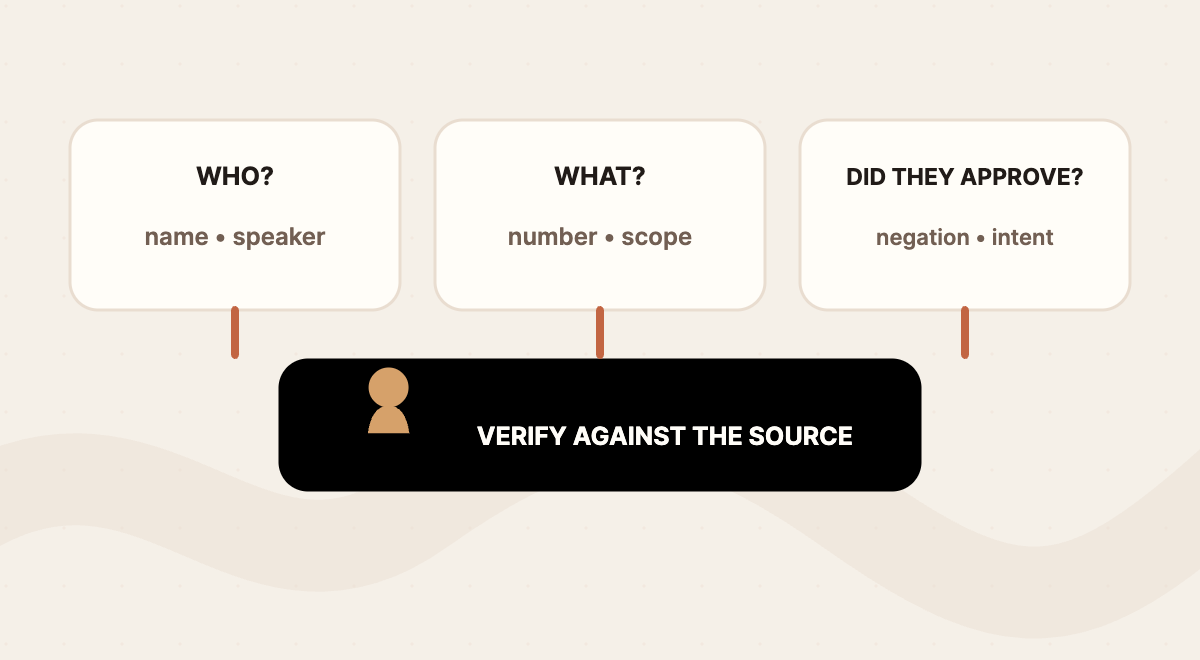
Check the fields most likely to change the action
"Listen again" is not a review instruction. A useful review starts with the details that can flip the next step:
- Names and identity. Is this the right customer, employee, vendor or account? Did the speaker label attach to the right voice?
- Numbers and dates. Is the amount, account suffix, deadline, quantity or phone number right? Was it repeated or revised later?
- Negation and conditions. Did the speaker say "send" or "don't send," "approved" or "if approved"?
- Commitment and intent. Is the person authorizing a change, asking for a draft, weighing an option, quoting someone else, or reporting what already happened?
- Scope. Which record, item, project or customer does "it" refer to? Does the surrounding speech actually settle that?
- Speaker and channel. Is attribution reliable enough for this action? If channels were split at capture, does the mapping still match the call?
Several API features make this review faster without making it unnecessary. Key terms can help domain vocabulary come through accurately. The format option, used with a language parameter, can normalize spoken numbers, currency and units into written form, which makes amounts easier to scan. xAI's announcement also lists word-level confidence, which can point a reviewer toward weak spots.
Each of those helps attention, and none of them is verification. Normalized text can look checked when it was only reformatted, so keep the recognized words or the source span alongside any normalized value that matters. Confidence on a word says nothing about whether the sentence was an instruction. Multichannel capture can separate speakers at the source, and diarization can label speakers within mixed audio, but neither confirms identity. Test channel order, overlapping speech, speaker changes and edited or joined files before an action depends on who said something, and show the reviewer which speaker or channel the field came from.
 View image detail
Accuracy scores measure recognition, not the action
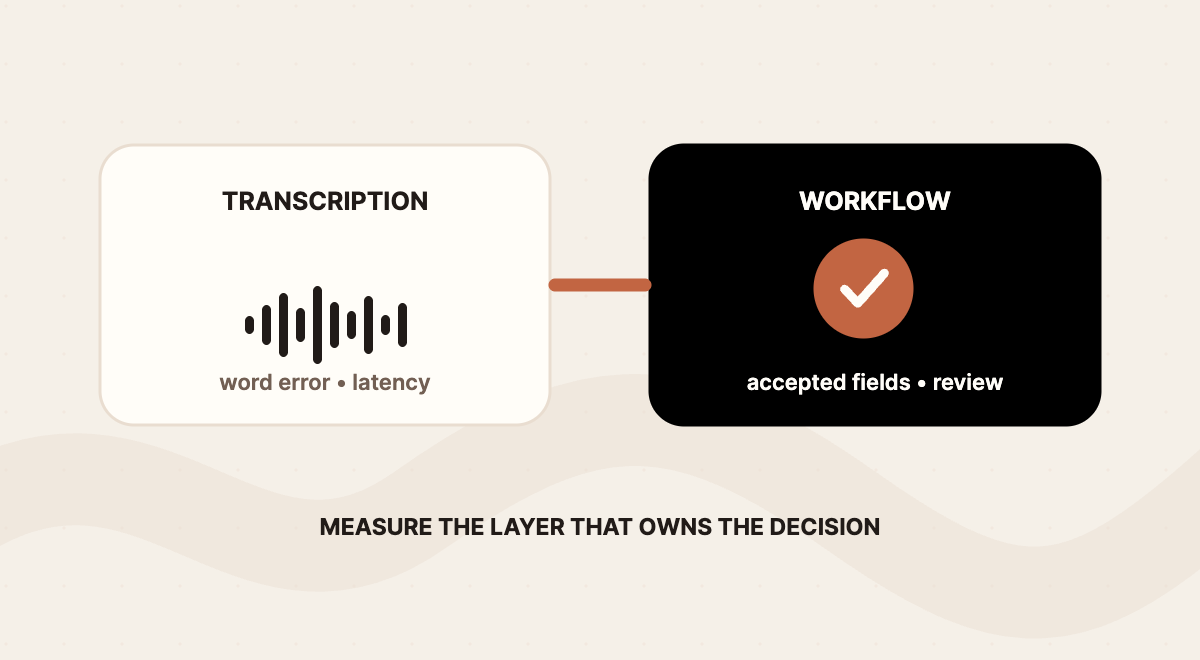
Word error rate compares recognized words with a reference transcript, and latency measures when text arrives. Artificial Analysis's AA-WER Streaming article evaluates the two together, separates first partial from first final output, and notes that results vary across its datasets. Neither number tells you whether the extracted amount was right or whether the action should have run, which is why the pilot below measures accepted fields and actions instead. Use those measurements to evaluate a transcription route, then test the fields and actions separately.
 View image detail
Set approval levels by consequence
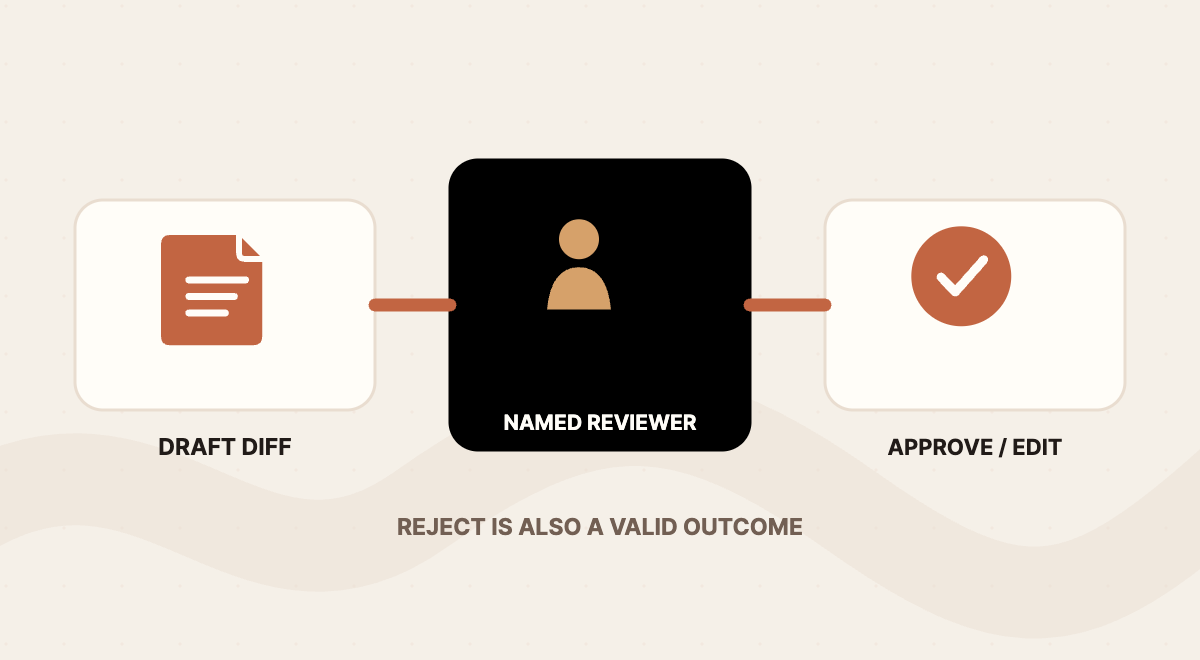
The agent's job at this stage is to prepare, not execute. A summary arrives with cited transcript spans. A task arrives as a draft with an owner and a proposed date. A CRM update arrives as a diff showing old and new values. An outgoing message sits in a held state. The reviewer sees what is about to change, compares it with the supporting speech, and approves, edits or rejects it.
One rule for every output either slows down harmless drafts or under-protects risky actions. A proposed pattern with three levels:
- Private draft summary: Suggested boundary: A person checks it before sharing; Evidence the reviewer sees: Transcript spans for decisions and commitments; Undo route: Edit or discard the draft
- Reversible internal task or record: Suggested boundary: Reviewer confirms fields and destination; Evidence the reviewer sees: Source time, speaker or channel, proposed diff; Undo route: Restore the logged prior value
- External message, payment, access change or deletion: Suggested boundary: Explicit approval before the tool can act; Evidence the reviewer sees: Source context, exact recipient, amount and scope; Undo route: Recovery plan agreed before approval
This is a Rise proposal, not an xAI feature or an industry standard. The owner should set the lines using the actual contract, data policy and cost of a wrong action. What should never count as a threshold is "the model heard it." A high-impact action should not appear preselected because the transcript contained an imperative phrase.
Within each level, let the evidence decide how much review a single item needs. If the source span is clear, the amount and recipient match, and the change is reversible, a short preview may be enough. If the audio is noisy, the segment closed on a timeout, the speaker cannot be attributed, or the sentence contradicts an earlier instruction, the proposal should pause and escalate. "Needs a person" should be a normal result the system shows openly, not an error hidden from the user.
 View image detail
Plan the undo before the action runs
Approval decides whether an action happens. The undo plan decides what happens when an approved action turns out wrong. Both should exist before the tool is connected.
For reversible changes, store the prior value with the action, record who may reverse it, and decide how long the reversal stays available. For record updates, that can be as simple as keeping the old field values in the log so a revert is one step.
Some actions cannot be taken back. A sent message stays sent, and a payment may need a separate refund process. For those, the approval is the last real control, and the recovery plan is a correction rather than a reversal: who contacts the customer, what the follow-up says, who owns it. Writing that down before approval tends to sharpen the review, because the reviewer can see what a mistake would cost.
Keep the agent's original proposal and the reviewer's edits as separate entries. When something goes wrong later, the difference between what the agent proposed and what the person approved shows which side of the boundary the error came from.
Sort failures by the layer that caused them
When a speech-driven action goes wrong, a single "accuracy" label hides who should fix it. Sorting each failure by layer points to an owner. Hypothetical examples:
- Capture. A missing channel or truncated file, so the record is written without the customer's final request. The owner of the recording setup fixes it.
- Segmentation. Extraction ran on chunk-final text, so a task was created from the first half of a correction. The integration's gating rule fixes it.
- Recognition. A misheard surname matched a different contact, and the update landed on the wrong record. Key terms, review of names, or a confirmation step fixes it.
- Extraction. A suggestion was read as a decision, so a refund was proposed that was only discussed. The extraction rules and the intent check fix it.
- Policy. No approval rule covered a new action type, so a message went out unreviewed. The process owner fixes it.
- Action. The tool wrote a duplicate record or the wrong destination. The tool integration fixes it.
The same visible symptom, a wrong CRM entry, can come from any of these layers. A log that records event state, source span, model ID, proposal and reviewer edits for each action is what makes the sorting possible.
Accept actions through a narrow pilot
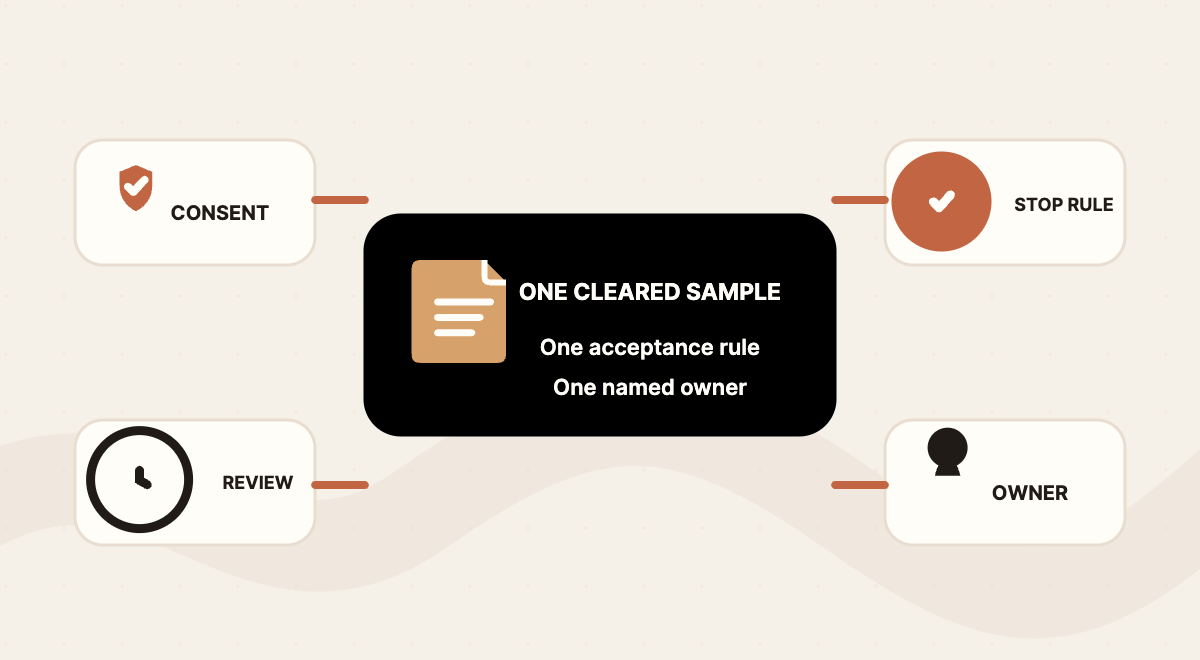
Choose representative samples and evaluate transcription quality before connecting a tool. The pilot here tests the next stage: whether proposals drawn from transcripts are safe to act on. Use audio the team is permitted to process for this purpose, and keep the trial inside the organization's consent and retention rules.
Set the acceptance rules before looking at results. Hypothetical examples a team might choose:
- No external action runs without a reviewer's approval during the pilot.
- Every customer name and dollar amount in a proposal is checked against its source span.
- Every proposal links to the transcript time range and audio reference it came from.
- No proposal is generated from interim or chunk-final text.
For each proposal, record the event state at extraction, the fields, the reviewer's edits, whether it was accepted or rejected, and the reason. Edits are the most useful signal. A field the reviewer corrects again and again tells you where the chain needs another check, or where the action should stay manual.
Add a stop rule. If the evidence trail cannot be preserved, if review misses high-impact fields, or if an ambiguous statement reaches a tool without approval, disconnect the action step. Keep transcription as an assisted draft until the design changes and another round of testing supports reconnecting it.
 View image detail
Record the model ID through the October 2 transition
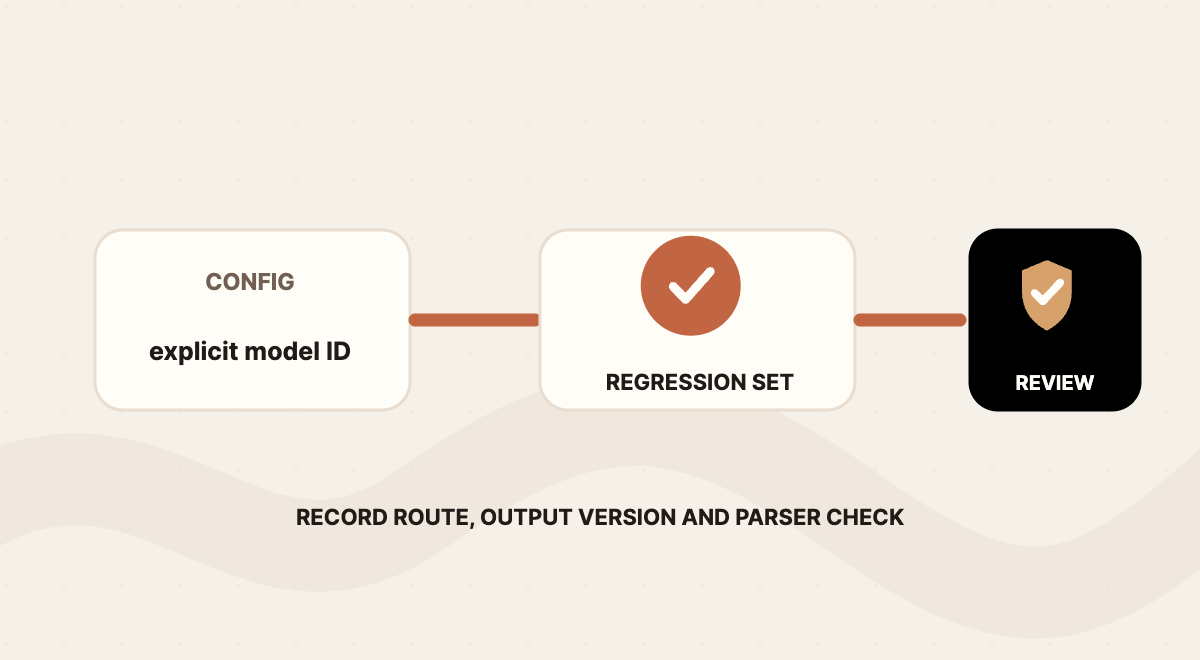
As checked on October 2, 2026, xAI's API guide names grok-voice-transcribe-2.0 as the default. It says the grok-voice-transcribe-1.0 identifier is deprecated, reaches end of life on October 2, 2026, and routes to 2.0 at the same price. The September 18 announcement had described this change as coming in the following weeks; the current guide is the better source for its present state.
For an action pipeline, the point is narrow. A model change is a change to the component that produces your evidence, even when requests keep succeeding. Set the model ID explicitly rather than relying on the old ID's routing, store the ID with every transcript, and rerun the action checks after any model change: event states, speaker labels, formatting of numbers and dates, and the fields your reviewers correct most often.
 View image detail
A checklist before any transcript drives an action
Before connecting transcript output to a tool, confirm that:
- The recording is used and retained under the organization's own consent and retention rules.
- Every transcript stores the model ID, settings and event states that produced it.
- Extraction runs only on utterance-final streaming text or a verified complete batch result, and timeout-closed segments are marked.
- Each consequential field links to its transcript time range and, where allowed, an audio reference.
- Names, numbers, negation, commitment, scope and speaker are checked before approval.
- The approval level matches the consequence, and external, financial, access and deletion actions need a named person.
- Every action has a logged outcome and an undo or recovery route agreed before it runs; reversible changes also retain the prior value.
- A stop rule disconnects the action step when evidence is missing or ambiguous input reaches a tool.
Decide what the transcript is allowed to do
Grok Voice Transcribe 2.0 provides batch and streaming transcription, and the current docs describe timing, speaker, channel and formatting features that help an application move from audio to an organized proposal. Those features do not establish a speaker's authority, approve a commitment, or confirm that the text holds everything that mattered in the conversation.
The value of a speech-to-action chain is often not the transcript itself. It is shorter, more focused verification: a reviewer checks six fields against linked audio instead of replaying a call to find one. That shift has to be observed in the pilot, by counting corrections, review time and exceptions, rather than assumed. The Work Worth Doing automation guide gives a useful frame for that decision: frequency, input stability, required judgment, failure consequence and maintenance. Regular voice notes in a repeatable format may justify the build. Irregular requests with serious outcomes may be better served by cleaner intake and a human decision.
Keep the boundary where the evidence puts it. Let the transcript prepare the work, let a named person decide the consequential part, and let the system stop when the evidence runs out. That keeps the agent useful while responsibility stays with the person who understands the context and the outcome.
Checked for this article
Sources
Keep going
Related notes.
Automation and Agents
How to Implement MCP Events in ChatGPT: Event-Triggered Automations
Autonomous conversational agents no longer need to rely on wasteful polling loops. Here is how to implement event-triggered automations using ChatGPT MCP Events.
Read the article
Automation and Agents
How to Build Recurring Web Automations with Perplexity Computer
Web scraping scripts break whenever a layout shifts. Here is how to build durable, recurring web automations using Perplexity Computer and persistent state.
Read the article
Automation and Agents
How to Benchmark Classifier Models: Latency, Cost, Determinism
Evaluating AI classifiers requires looking beyond static accuracy. Here is how to benchmark probability calibration, latency percentiles, and unit economics.
Read the article