
Automation and Agents
How to Evaluate Gemini 3.8 Live Video Avatars for Enterprise Workflows
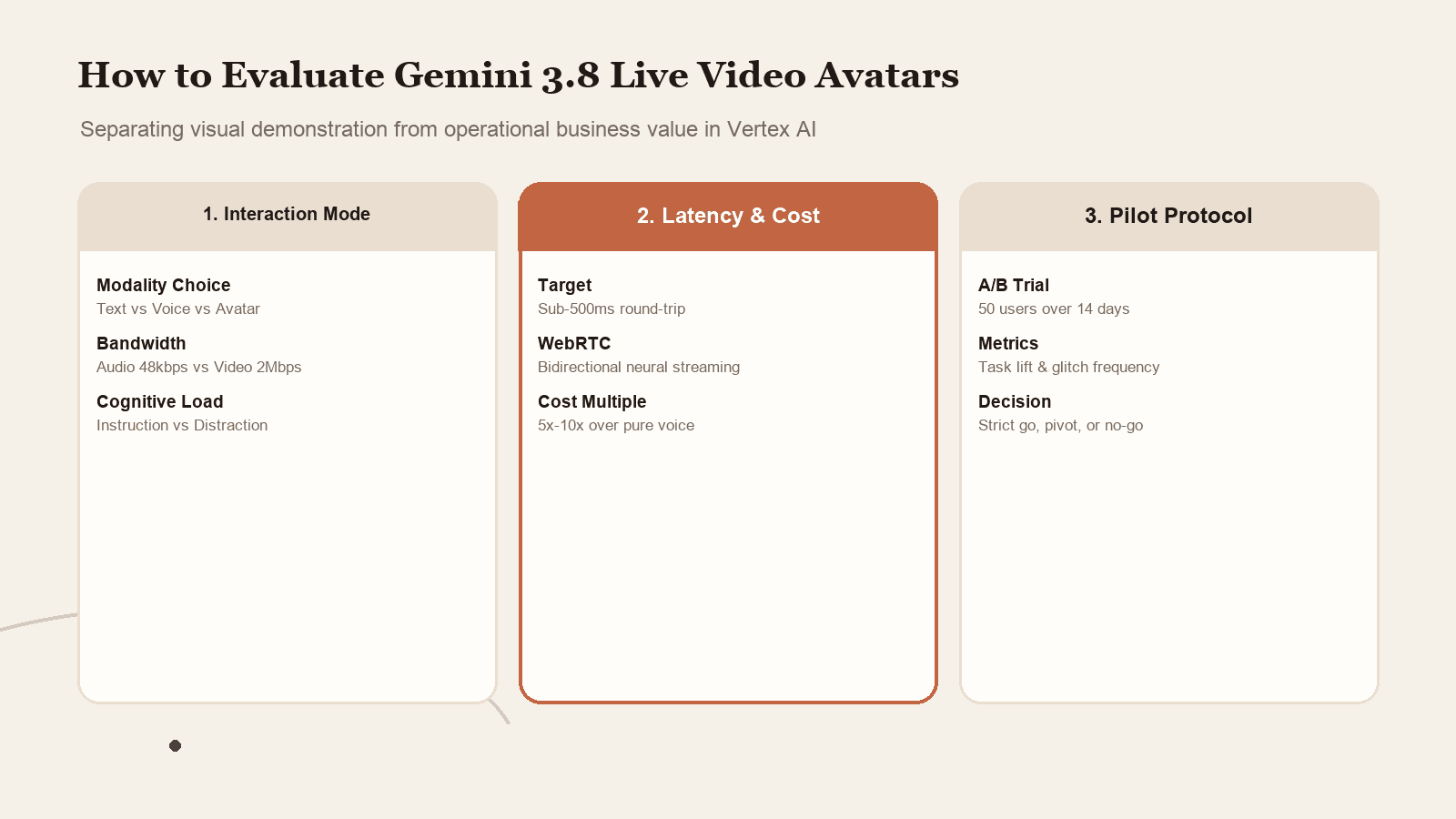
A talking face does not automatically make an AI agent more effective. Here is how to evaluate Gemini 3.8 Live video avatars against real business metrics.
On this page
- What Google Announced and What Vertex AI Delivers
- When Does a Video Avatar Truly Add Value?
- Filter 1: Visual Demonstration and Physical Instruction
- Filter 2: High-Empathy Customer Touchpoints
- Filter 3: Latency and Network Tolerance
- Filter 4: Economic Justification
- The Real-Time Latency Budget
- Managing the Latency Boundary
- Financial Modeling: The True Cost of Synthetic Video
- Three Tier Cost Comparison
- Return on Investment Thresholds
- Evaluating the Human Experience: The UX Scorecard
- Dimension 1: The Uncanny Valley and Visual Artifacts
- Dimension 2: Conversational Interruption Handling
- Dimension 3: Information Density and Cognitive Fatigue
- Technical Architecture: WebRTC and Tool Calling
- Core Architectural Components
- Configuration Best Practices
- The Two-Week Evaluation Pilot Protocol
- Phase 1: Environment and Baseline Setup (Days 1 to 3)
- Phase 2: User Cohort Testing (Days 4 to 8)
- Phase 3: Telemetry Analysis and UX Surveying (Days 9 to 12)
- Phase 4: Financial and Operational Gate Review (Days 13 to 14)
- Enterprise Decision Matrix: Go, Voice-Only, or No-Go
- Scenario A: Full Video Avatar Deployment (Go)
- Scenario B: Voice-Only Deployment (Pivot)
- Scenario C: Return to Text or Standard Workflows (No-Go)
- Conclusion and Strategic Outlook
A talking face does not automatically make an AI agent more effective. When Google announced the general availability of Gemini 3.8 Live with Live Avatar on September 24, 2026, it brought real-time, tool-using synthetic video agents to Google Cloud Vertex AI enterprise customers. The technology demonstrates impressive technical craft: sub-500 millisecond visual latency, synchronized lip movements, responsive facial expressions, and bidirectional WebRTC streaming. For enterprise executives and operations leaders, however, the critical question is not whether Google can render an expressive digital face. The real question is whether adding a video stream produces measurable business value, improves customer understanding, or simply introduces extra latency, network fragility, and unnecessary compute expense.
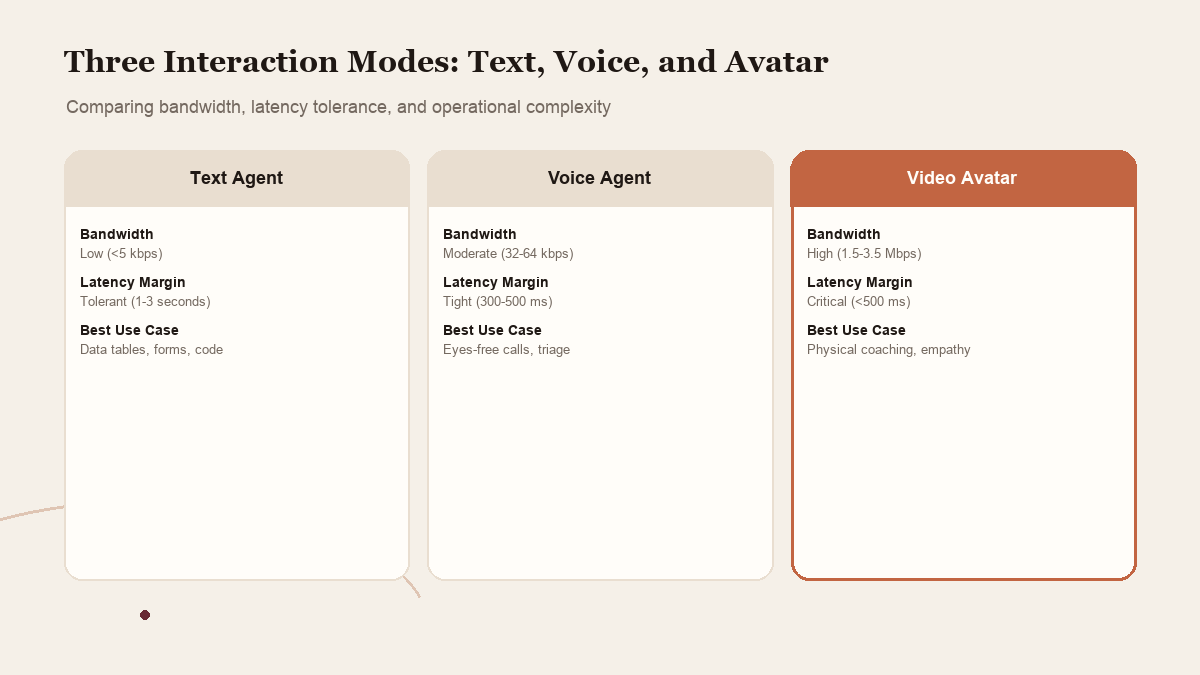
Before allocating engineering resources to an avatar pilot, organizations must separate novel interface demonstrations from dependable operational workflows. Adding a synthetic visual layer changes how users interact with software. It introduces emotional expectations, alters acceptable response latency, and increases bandwidth requirements by orders of magnitude compared to text or voice.
This guide outlines an objective evaluation methodology for testing Gemini 3.8 Live Avatars in enterprise settings. We examine the trade-offs between text, audio-only voice agents, and live video avatars, construct a realistic latency budget, analyze true operating costs, and provide a two-week pilot protocol with strict go or no-go decision criteria.
 View image detail
Comparing text, voice, and real-time video avatars across bandwidth, latency tolerance, and emotional engagement.
What Google Announced and What Vertex AI Delivers
On September 24, 2026, Google published its launch details across The Keyword and the Google Cloud blog. According to Google's official announcement, Gemini 3.8 Live with Live Avatar is now generally available on Vertex AI for commercial deployments. The system combines Google's low-latency Gemini 3.8 Live foundation model with a specialized neural rendering pipeline that streams video frames over WebRTC directly to client browsers and mobile applications.
The documented features include several notable technical capabilities:
- Synchronized Audio and Video Generation: The model synthesizes spoken voice audio and accompanying facial video simultaneously, ensuring that mouth shapes match phonemes accurately without noticeable desynchronization.
- Dynamic Tool Calling: While speaking and maintaining visual presence, the agent can trigger background functions, query databases, and incorporate live results into ongoing conversation.
- Pre-Built and Custom Personas: Google Cloud offers a library of validated enterprise personas alongside a training path for custom brand avatars, subject to Google's identity verification process.
- Enterprise Network Controls: The service integrates with Google Cloud VPC Service Controls, customer-managed encryption keys, and private endpoints.
Crucially, Google noted that while base Live Avatar is generally available, Extended Thinking capabilities remain in private preview for select accounts. That boundary matters: the generally available model prioritizes rapid conversational responsiveness over prolonged multi-step reasoning. If an enterprise workflow requires complex logical deduction, attempting to force it into a live conversational avatar stream will lead to awkward conversational pauses or shallow answers.
Google's launch materials make ambitious claims regarding engagement and customer connection. Those are vendor descriptions of potential capability, not verified benchmarks within your specific operational environment. Your evaluation must test those claims against concrete business metrics.
When Does a Video Avatar Truly Add Value?
Most business processes do not require a visual avatar. In fact, for many daily transactions, visual avatars actively hinder productivity by forcing users to wait for conversational pleasantries instead of scanning information rapidly on a screen.
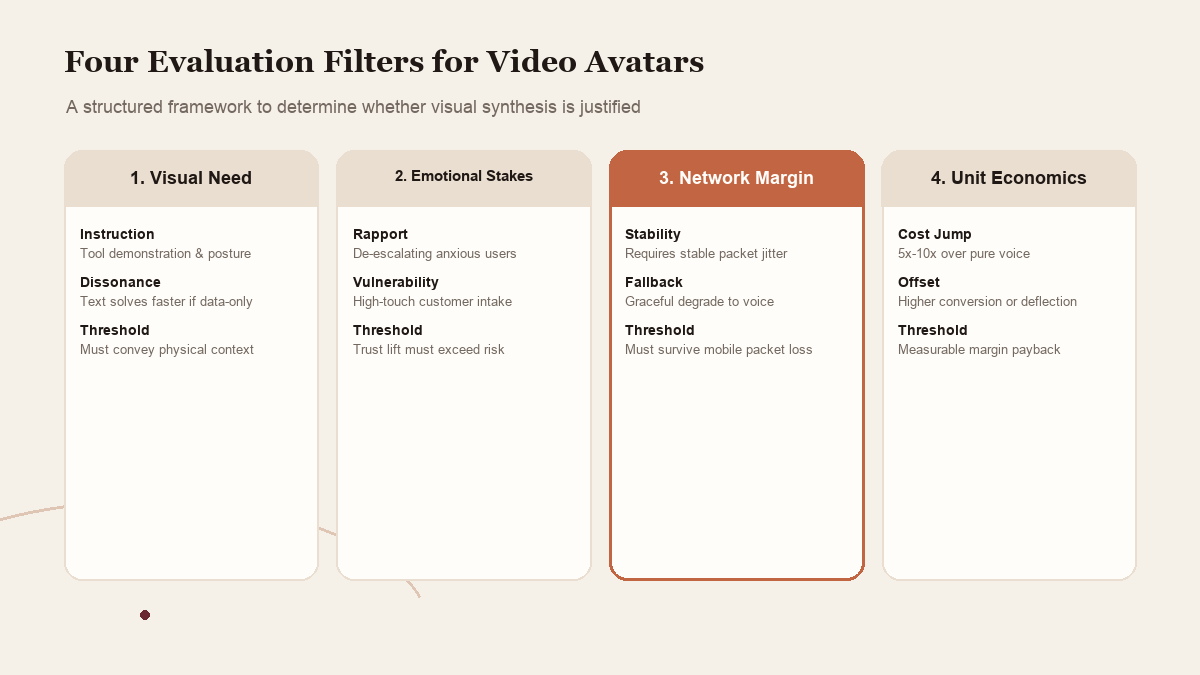
To determine whether a business process warrants a video avatar, apply Rise Productive's Four Evaluation Filters:
 View image detail
Four sequential filters: visual necessity, emotional stakes, operational tolerance, and economic justification.
Filter 1: Visual Demonstration and Physical Instruction
A video avatar delivers genuine value when the visual dimension conveys critical instructional context that audio alone cannot convey. Examples include:
- Step-by-step physical assembly or troubleshooting where the avatar demonstrates tool orientation, hand placement, or part alignment.
- Medical intake or physical therapy check-ins where visual pacing, posture demonstration, or guided breathing exercises provide therapeutic benefit.
- Language learning and pronunciation coaching where viewing the instructor's lip, teeth, and tongue positioning directly assists skill acquisition.
Conversely, if the task consists primarily of reading account balances, confirming reservation dates, resetting passwords, or booking calendar slots, an avatar is pure distraction. A clean text table or lightweight voice response solves the user's problem faster and with less cognitive strain.
Filter 2: High-Empathy Customer Touchpoints
Text interfaces often feel cold and bureaucratic during stressful or emotionally fraught interactions. In scenarios such as initial insurance claims intake, patient navigation in healthcare portals, or executive concierge services, a calm, visually attentive presence can de-escalate anxiety and establish rapport.
However, empathy is fragile. If the avatar exhibits subtle visual glitches, freezes mid-sentence, or displays incongruous facial smiles while a user describes a disaster, the uncanny valley effect destroys trust faster than a simple text interface would.
Filter 3: Latency and Network Tolerance
A live video stream requires stable bandwidth and low packet jitter. In mobile field environments, warehouses, or low-connectivity branches, WebRTC video feeds degrade quickly, dropping frames or causing audio to stutter. If your end users access the service from variable cellular connections, an audio-first or text-first architecture provides vastly superior reliability.
Filter 4: Economic Justification
Streaming high-definition video synthesized in real time on cloud GPUs costs significantly more than generating text tokens or streaming compressed opus audio. The operational benefit, measured in higher conversion rates, reduced escalation to expensive human tiers, or improved compliance, must cleanly exceed the infrastructure cost.
The Real-Time Latency Budget
Conversational fluidity depends entirely on turnaround time. In human-to-human speech, normal conversational pauses range between 200 and 400 milliseconds. When an automated system exceeds 600 milliseconds, users experience the pause as an awkward interruption, often leading them to repeat themselves and talk over the agent.
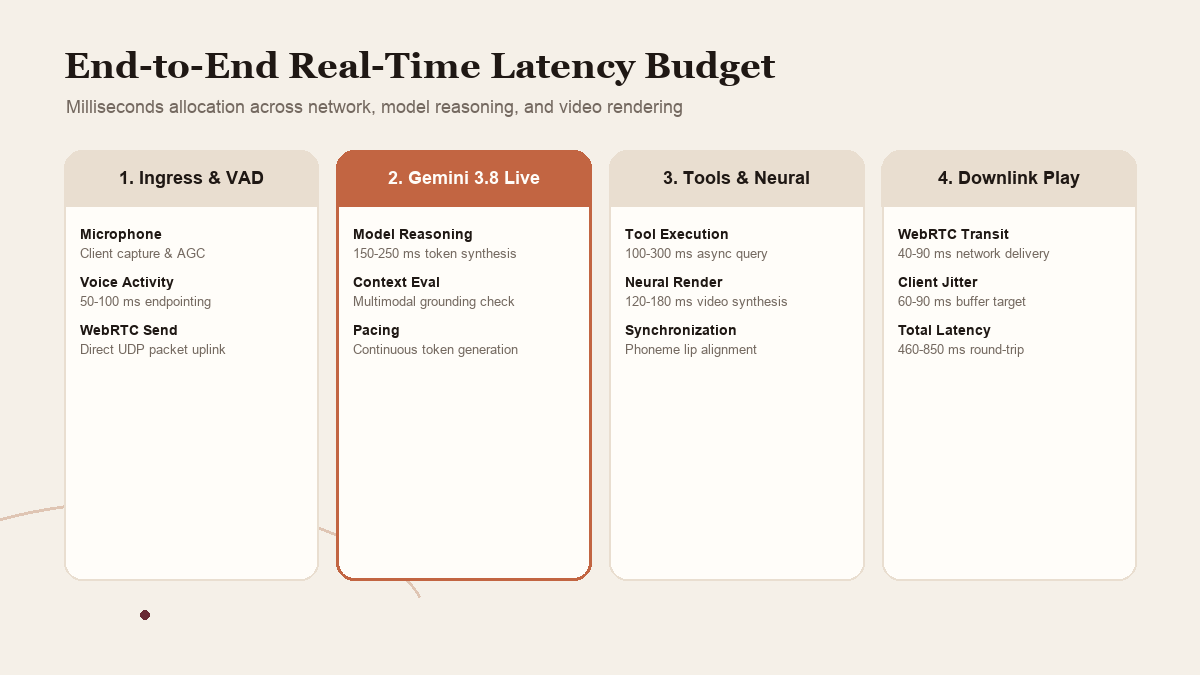
When deploying Gemini 3.8 Live Avatar, every millisecond counts across five distinct network and compute stages:
 View image detail
Latency budget breakdown: client audio capture, foundation model reasoning, tool execution, video synthesis, and WebRTC streaming.
- Client Audio Capture and VAD (50 to 100 ms): The client application captures user speech, runs local Voice Activity Detection (VAD) to identify the end of an utterance, and sends audio packets over WebRTC.
- Model Ingestion and Multimodal Reasoning (150 to 250 ms): Gemini 3.8 Live processes the incoming audio tokens, evaluates conversational context, and generates the initial response tokens.
- Tool Call Execution (100 to 400 ms, if triggered): If the agent queries an external database or CRM, the external API round-trip adds unavoidable latency. To maintain natural pacing, the model must begin speaking filler phrases or acknowledged responses while tool results resolve in the background.
- Audio and Video Synthesis (120 to 180 ms): Vertex AI neural rendering servers synthesize the spoken voice waveform and render corresponding video frames with synchronized lip movements.
- WebRTC Network Delivery and Decoding (40 to 90 ms): Downlink video packets travel across public or private networks to the client browser, where the client WebRTC decoder unpacks and displays the stream.
Managing the Latency Boundary
Total round-trip latency typically falls between 460 milliseconds (under optimal network conditions without external tools) and 850 milliseconds (with background tool execution). While 460 milliseconds feels acceptable for structured interviews or guided onboarding, 850 milliseconds begins to feel sluggish.
If your pilot tests reveal that average latency exceeds 700 milliseconds, you must implement immediate optimizations:
- Move client-side VAD thresholds closer to speech cessation to shave off 50 milliseconds of dead air detection.
- Utilize Google Cloud Private Service Connect or dedicated edge interconnects to minimize network transit hops between end users and the Vertex AI endpoint.
- Architect tool calls asynchronously: prompt the avatar to acknowledge the user query immediately with conversational affirmation while the backend tool call resolves.
Financial Modeling: The True Cost of Synthetic Video
Building a realistic financial model for Gemini 3.8 Live Avatar requires calculating costs beyond standard language model token pricing. Real-time video agents combine token fees with continuous media streaming surcharges.
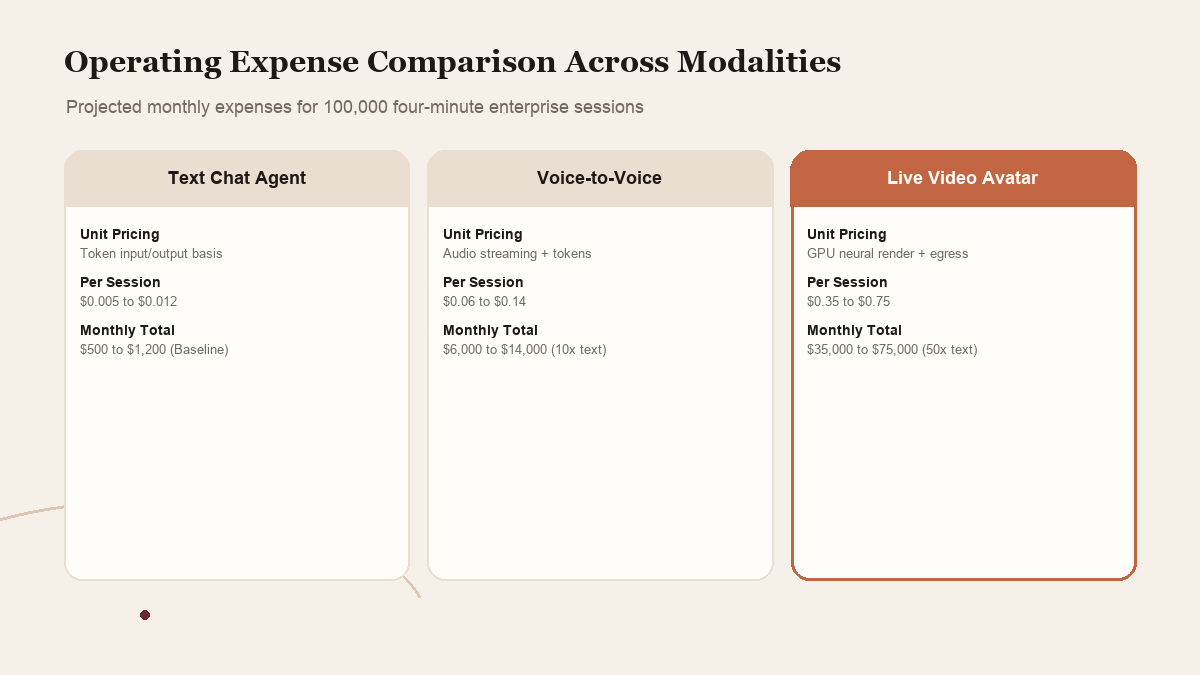 View image detail
Comparing operational expenses across text, voice-to-voice streaming, and real-time video avatar sessions.
Three Tier Cost Comparison
Consider a representative enterprise deployment handling 100,000 monthly user sessions, with each session averaging 4 minutes of active interaction:
- Tier 1: Text-Based Agent (Chatbot)
- Pricing basis: Input and output tokens.
- Typical session usage: 1,500 input tokens and 800 output tokens.
- Average cost per session: approximately $0.005 to $0.012.
- Monthly total: $500 to $1,200.
- Tier 2: Voice-to-Voice Agent (Speech In, Audio Out)
- Pricing basis: Audio input/output duration plus base model token usage.
- Typical session usage: 4 minutes of bidirectional audio streaming.
- Average cost per session: approximately $0.06 to $0.14.
- Monthly total: $6,000 to $14,000.
- Tier 3: Live Avatar Video Agent (Audio and Video Out)
- Pricing basis: Real-time GPU rendering time, video egress bandwidth, plus multimodal token consumption.
- Typical session usage: 4 minutes of high-definition 720p/1080p video generation at 24 to 30 frames per second.
- Average cost per session: approximately $0.35 to $0.75.
- Monthly total: $35,000 to $75,000.
Return on Investment Thresholds
Deploying a video avatar increases interface delivery costs by 5x to 10x relative to pure voice, and by 50x to 100x relative to text. To achieve a positive return on investment, the avatar cannot simply be a novel cosmetic feature. It must drive clear economic offsets:
- Measurably higher customer conversion in premium sales consultations.
- Substantial reduction in customer drop-off during complex self-service compliance or onboarding flows.
- Proven deflection of tier-two and tier-three technical support escalations that currently cost $25 to $40 per human agent session.
If the avatar does not demonstrably improve one of these core financial levers, standard voice or text provides superior unit economics.
Evaluating the Human Experience: The UX Scorecard
User experience for synthetic avatars involves unique perceptual psychology. Unlike text interfaces where speed and factual accuracy dictate user satisfaction, visual avatars are judged on perceptual realism, emotional congruence, and cognitive fatigue.
When conducting user tests, evaluate your implementation using Rise Productive's Avatar UX Scorecard:
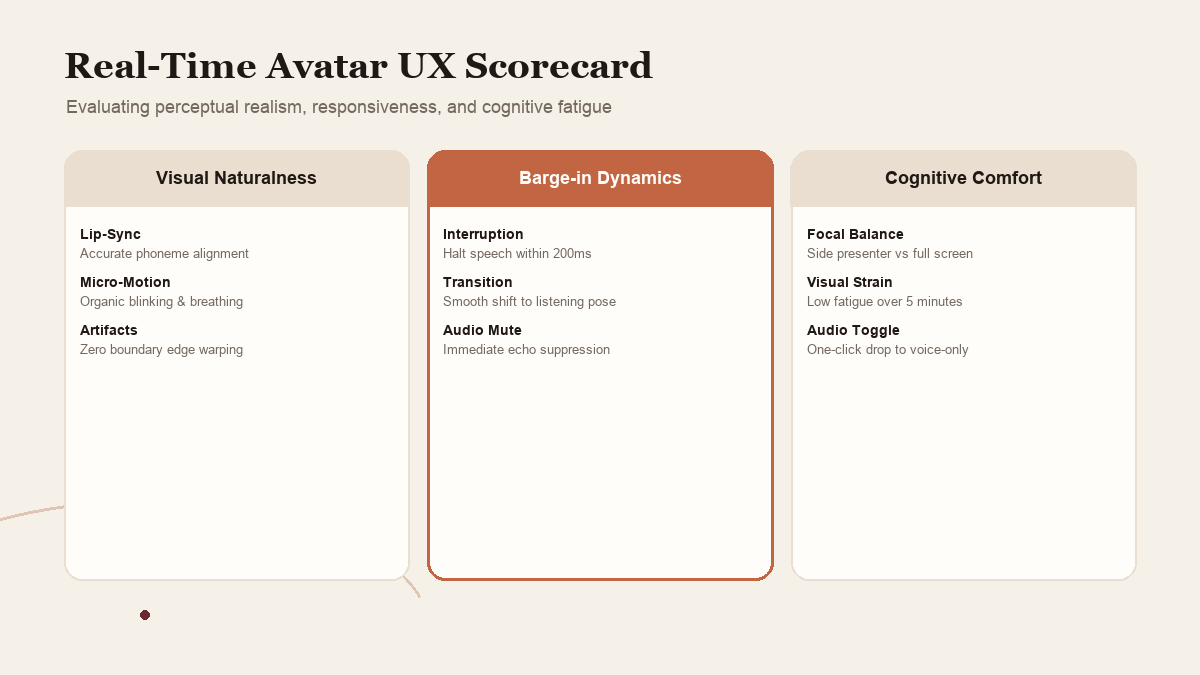 View image detail
Key UX evaluation dimensions: visual naturalness, conversational synchronization, task completion speed, and user fatigue.
Dimension 1: The Uncanny Valley and Visual Artifacts
Users possess acute sensitivity to unnatural human movement. In real-time neural rendering, visual anomalies can occur when the agent shifts expressions rapidly or transitions between speaking states:
- Lip-Sync Accuracy: Do the avatar's lips match plosives, fricatives, and vowels precisely? Misalignment of even two frames creates noticeable dissonance.
- Micro-Expressions and Blinking: Natural humans blink irregularly and make subtle head micro-movements. If an avatar freezes while thinking or displays repetitive, mechanical blinking loops, users report feelings of unease.
- Lighting and Background Integration: Pre-rendered avatar lighting must blend cleanly with the corporate user interface background to avoid looking like a pasted cutout.
Dimension 2: Conversational Interruption Handling
In real-time dialogue, users frequently interrupt with clarifying questions or brief affirmative noises like "right" or "uh-huh."
- Barge-in Latency: When the user begins speaking while the avatar is talking, does the avatar halt its speech and stop its lip movements within 200 milliseconds?
- Visual Freeze Recovery: When interrupted, does the avatar transition smoothly into an attentive listening pose, or does it abruptly snap between rendering frames?
Dimension 3: Information Density and Cognitive Fatigue
Interacting with a video avatar requires continuous visual attention. For complex analytical tasks, such as reviewing invoices or configuring software settings, forcing a user to look at a talking avatar while attempting to read data increases cognitive strain.
- For high-density data review, the user interface should position the avatar as an optional side presenter rather than a dominant full-screen focal point.
- Provide users with an instantaneous toggle to collapse the avatar into audio-only mode without interrupting the ongoing conversation.
Technical Architecture: WebRTC and Tool Calling
Integrating Gemini 3.8 Live Avatar into an enterprise cloud architecture requires connecting client-side WebRTC components with backend enterprise services through Google Cloud Vertex AI.
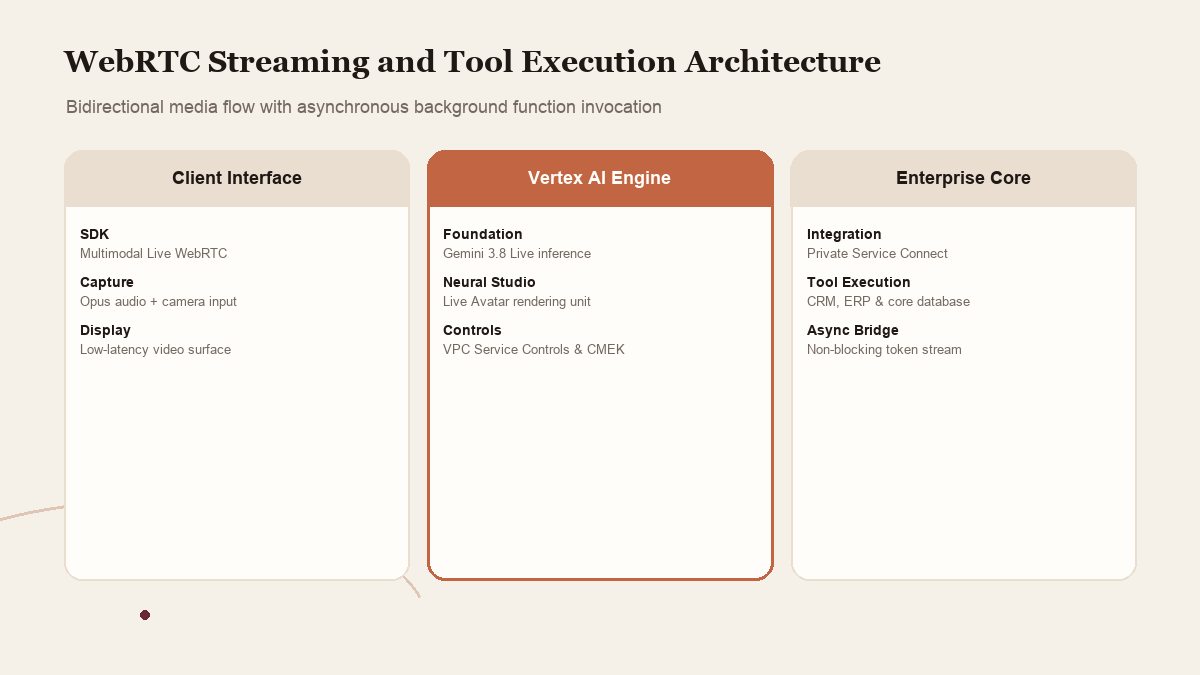 View image detail
Enterprise architecture: client WebRTC interface, Vertex AI Gemini 3.8 Live endpoint, private service connectors, and enterprise databases.
Core Architectural Components
- Client Application Layer:
- WebRTC client running in browser or mobile application using the Gemini Multimodal Live SDK.
- Local audio capture pipeline with automated gain control, echo cancellation, and noise suppression.
- Dual-channel media player rendering incoming Opus audio and VP9/H.264 video streams.
- Session Gateway and Authentication:
- Secure token exchange service validating user credentials before granting ephemeral WebRTC session tokens.
- WebRTC STUN/TURN server cluster facilitating peer connection traversal across restrictive corporate firewalls.
- Vertex AI Streaming Endpoint:
- Hosted Gemini 3.8 Live inference engine executing low-latency multimodal reasoning.
- Neural rendering pipeline synthesizing synchronized video frames based on generated phonemes and emotional tags.
- Private Service Connect binding the Vertex AI endpoint directly to the enterprise Virtual Private Cloud (VPC).
- Asynchronous Tool Execution Pipeline:
- Backend microservices handling database lookups, CRM queries, or transactional updates.
- Function calling orchestrator returning structured JSON payloads back into the active Gemini session context without tearing down the media stream.
Configuration Best Practices
When configuring your Vertex AI endpoint for production pilots, enforce these specific parameters:
- Video Resolution: Cap outgoing video at 720p (1280x720) at 24 frames per second. Streaming 1080p at 30 or 60 frames per second doubles GPU rendering overhead and bandwidth consumption with negligible improvement in perceived facial realism.
- Audio Bitrate: Enforce 32 kbps to 48 kbps Opus audio encoding, which ensures high vocal clarity while preserving headroom for video data packets.
- Buffer Thresholds: Set client jitter buffer targets between 60 ms and 90 ms. Tighter buffers cause packet drop stuttering on mobile networks, while looser buffers introduce sluggishness.
The Two-Week Evaluation Pilot Protocol
To avoid open-ended, expensive science projects, run a structured fourteen-day evaluation pilot with fifty target users and clear statistical criteria.
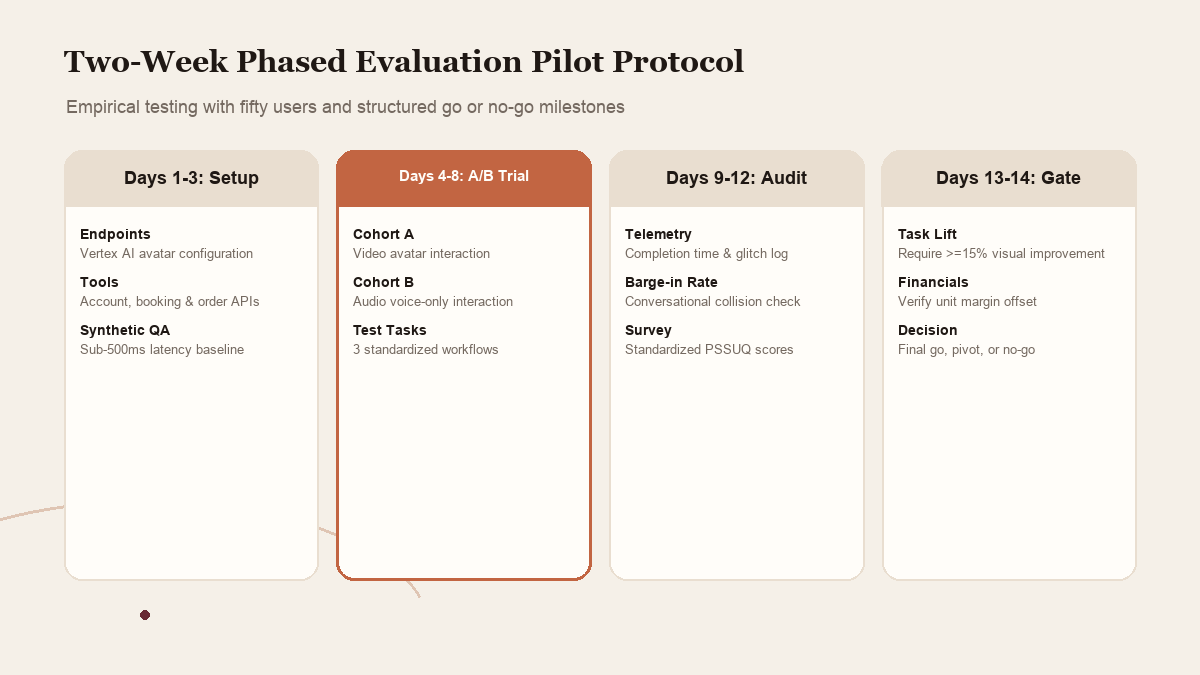 View image detail
Two-week pilot timeline: days 1 to 3 baseline setup, days 4 to 8 user testing, days 9 to 12 metric review, days 13 to 14 final evaluation.
Phase 1: Environment and Baseline Setup (Days 1 to 3)
- Configure Vertex AI Gemini 3.8 Live endpoints with standard enterprise persona templates.
- Integrate three core tool functions: account lookup, appointment scheduling, and order status retrieval.
- Establish baseline performance benchmarks using automated synthetic clients to verify sub-500ms network round-trip latency.
Phase 2: User Cohort Testing (Days 4 to 8)
- Divide fifty participants into two randomized test cohorts: Cohort A uses the Gemini 3.8 Live video avatar; Cohort B uses the identical Gemini 3.8 Live backend configured in pure audio voice mode.
- Require each participant to complete three standardized operational tasks:
- An account verification and update task (high data density).
- A troubleshooting walk-through for a physical device or complex workflow (visual instructional context).
- A policy explanation and disputed charge inquiry (high emotional stakes).
Phase 3: Telemetry Analysis and UX Surveying (Days 9 to 12)
- Extract automated telemetry logs: measure average task completion time, barge-in frequency, visual glitch rate, and tool execution latency.
- Administer standardized Post-Study System Usability Questionnaires (PSSUQ) and qualitative fatigue assessments.
Phase 4: Financial and Operational Gate Review (Days 13 to 14)
- Compare task completion rates, user error counts, and customer satisfaction scores between Cohort A (video avatar) and Cohort B (audio only).
- Calculate the incremental operational cost per successfully resolved user inquiry.
- Present formal findings to leadership against pre-determined go or no-go criteria.
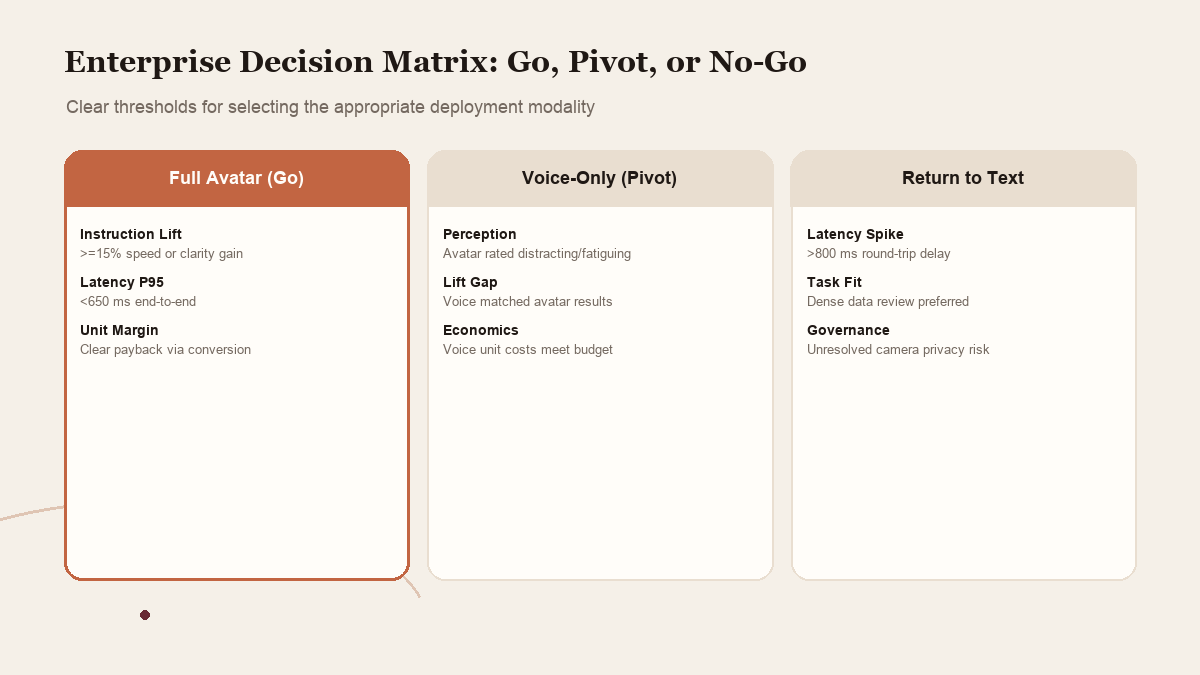
Enterprise Decision Matrix: Go, Voice-Only, or No-Go
At the conclusion of the evaluation pilot, leadership must make a decisive architectural selection based on empirical evidence rather than technological enthusiasm.
 View image detail
Decision criteria matrix mapping business outcomes to architectural choices: full video avatar, voice-only agent, or return to text.
Scenario A: Full Video Avatar Deployment (Go)
Approve production deployment only when all three conditions are satisfied:
- Measurable Task Lift: Cohort A demonstrated at least a 15% improvement in task completion speed or comprehension accuracy compared to Cohort B on visually instructional tasks.
- Acceptable Latency and Stability: 95th percentile end-to-end latency remained below 650 milliseconds, with a WebRTC frame drop rate under 1.5% across tested network configurations.
- Clear Economic Unit Economics: The projected cost per interaction ($0.35 to $0.75) is cleanly justified by higher customer conversion or proven support tier deflection.
Scenario B: Voice-Only Deployment (Pivot)
Pivot immediately to pure voice streaming without video rendering if:
- Users reported high satisfaction with conversational fluidity and tool accuracy, but rated the visual avatar as distracting, irrelevant, or visually fatiguing.
- The 15% instructional lift failed to materialize, meaning audio-only instructions performed identically to visual demonstrations.
- Operating costs for continuous GPU video synthesis fail to meet internal hurdle rates, whereas voice-only unit economics ($0.06 to $0.14) align with budgetary targets.
Scenario C: Return to Text or Standard Workflows (No-Go)
Halt conversational rollout and retain structured text interfaces if:
- Total end-to-end latency consistently exceeded 800 milliseconds due to backend tool dependencies or enterprise network hops, leading to frequent conversational collisions and user frustration.
- Tasks involved high-density data review where users expressed strong preference for reading structured tables over listening to verbal explanations.
- Information security or compliance teams identified unresolvable privacy concerns regarding user camera permissions or synthetic likeness liability.
Conclusion and Strategic Outlook
Gemini 3.8 Live with Live Avatar marks a substantial technological milestone in generative artificial intelligence. Google has solved many of the hardest engineering challenges in real-time neural rendering, multimodal synchronization, and WebRTC streaming.
However, operational excellence in enterprise computing is never about adopting the most elaborate interface available. It is about matching the interface modality to the exact cognitive and emotional needs of the task. By subjecting Gemini 3.8 Live Avatar to rigorous latency testing, financial modeling, and structured A/B user pilots, enterprise leaders can invest confidently where visual synthetic presence delivers genuine business value, while avoiding costly cosmetic traps.
Checked for this article
Sources
Keep going
Related notes.
Automation and Agents
How to Implement MCP Events in ChatGPT: Event-Triggered Automations
Autonomous conversational agents no longer need to rely on wasteful polling loops. Here is how to implement event-triggered automations using ChatGPT MCP Events.
Read the article
Automation and Agents
How to Build Recurring Web Automations with Perplexity Computer
Web scraping scripts break whenever a layout shifts. Here is how to build durable, recurring web automations using Perplexity Computer and persistent state.
Read the article
Automation and Agents
How to Benchmark Classifier Models: Latency, Cost, Determinism
Evaluating AI classifiers requires looking beyond static accuracy. Here is how to benchmark probability calibration, latency percentiles, and unit economics.
Read the article