
AI in Practice
How to Try Meta Muse With One Bounded Task and Limited Access
A personal agent can look useful long before you know whether you should connect everything. Start with one reversible job, narrow permissions, and verified completion.
On this page
- Turn “use an agent” into a job you can inspect
- Pick a pilot that teaches you something
- Connect only what the task needs
- What Meta says Muse does to contain actions
- Require a completion receipt, not a confident answer
- Plan for the wrong result before the first run
- A proposed two-week test, not a product verdict
- The useful first step is deliberately small
- Source notes
The most useful way to try a personal AI agent is to give it one small, checkable job, not access to your whole digital life. For Meta Muse, start with a recurring task whose result you can verify. Limit the connected account and action, and set the completion test before the task begins.
That approach is less exciting than telling an agent to “run my business.” It is also far more useful. If the first task goes wrong, you want a contained inconvenience, not a surprise email, order, calendar change, or loss of control over an account. If it goes right, you want to know what actually worked so you can choose the next experiment with evidence instead of enthusiasm.
Meta introduced Muse on September 8, 2026; the announcement page was updated September 30. The company describes it as a personal agent that runs in a dedicated cloud virtual machine, can use a browser and connected services, continues some work after the app closes, and pauses for approval before certain sensitive actions. Meta says the rollout is in the United States through iOS, Android, and muse.ai, with WhatsApp also described as a way to interact. An announcement is not proof the service is available to every person or that every task will work. Verify the controls available in your own account before a pilot. The controls discussed below are features Meta says it built, not the findings of an independent product test.
The question for an operator is not “Can an agent do everything?” It is “Which job could I hand over without losing the ability to notice a mistake?”
Turn “use an agent” into a job you can inspect
A vague request gives an agent too much room to guess. “Handle my vendor follow-up” could mean find a contact, read a contract, draft a message, send it, promise a deadline, or change an account. Each step has a different consequence. If you do not state which actions are allowed, the agent has to infer where the handoff ends.
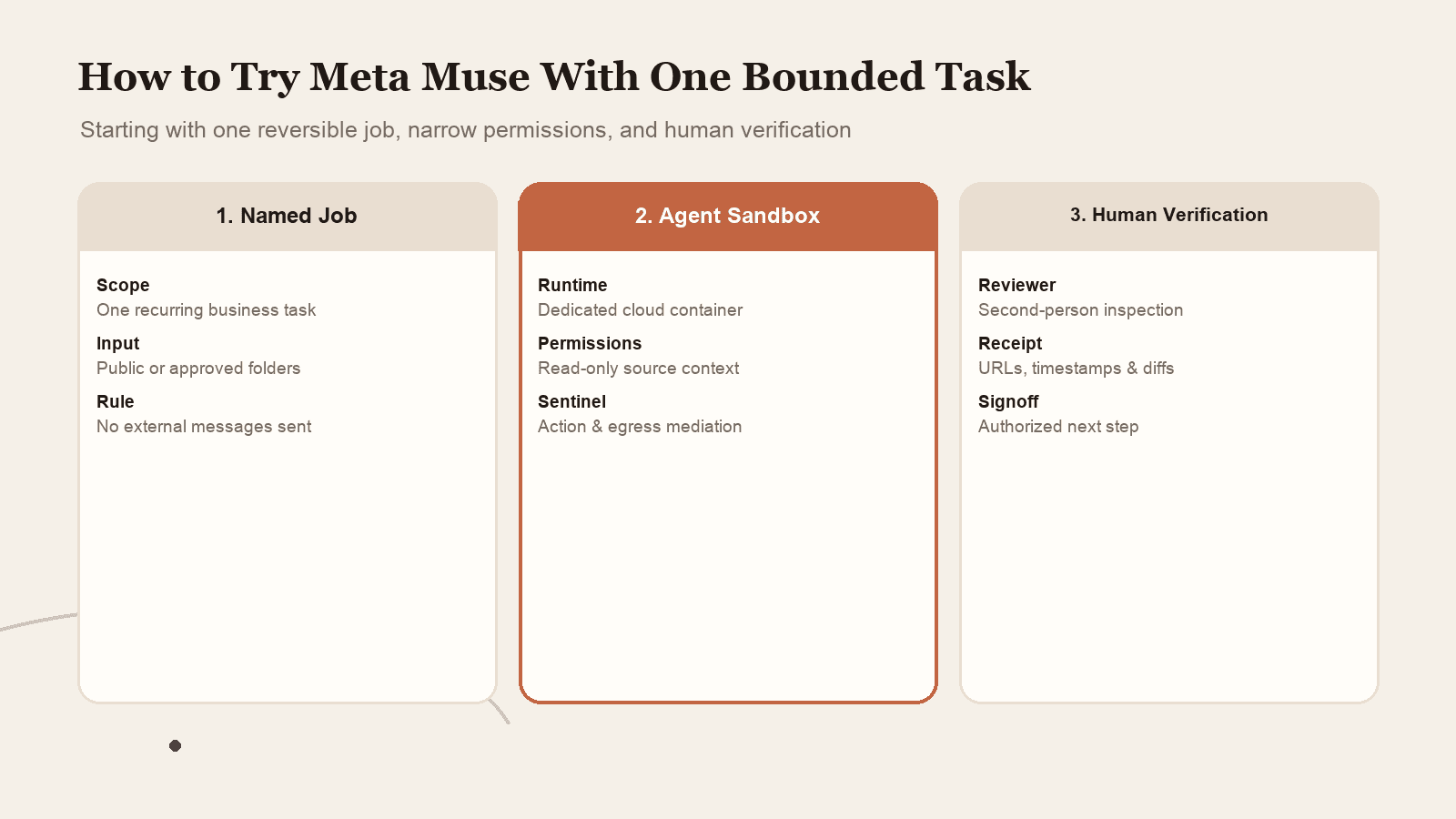
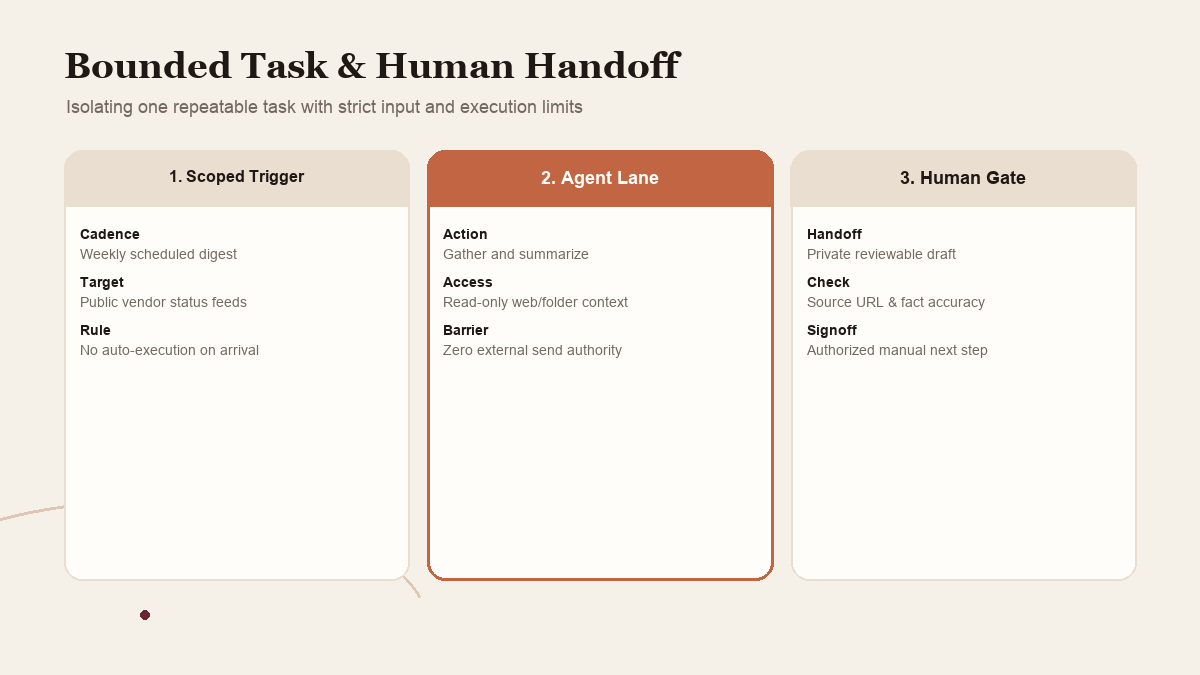
Instead, describe a small job as five parts: the trigger, the information it may use, the action it may take, the boundary it must not cross, and the evidence it should return. For example: “Every Friday, find the three public status updates for these vendors, put the source links and dates into a draft note, and stop before sending a message or changing any record.” The requested result is observable. The agent can search and organize, but it cannot speak for you.
This is the difference between delegating a task and expressing a wish. A wish names an outcome. A task definition gives the worker enough context to act and tells you how to check the result. Human judgment stays in the parts that matter: what counts as a trustworthy source, whether an update affects the client, and what the team should do next.
For an initial Muse trial, do not begin with a high-consequence workflow such as approving invoices, sending customer commitments, modifying access, or purchasing equipment. Those may be future automation candidates, but they are poor experiments if you have not yet learned how the agent handles ambiguity. Start with preparation: collect, compare, organize, or draft. Keep the last consequential step with a person.
 View image detail
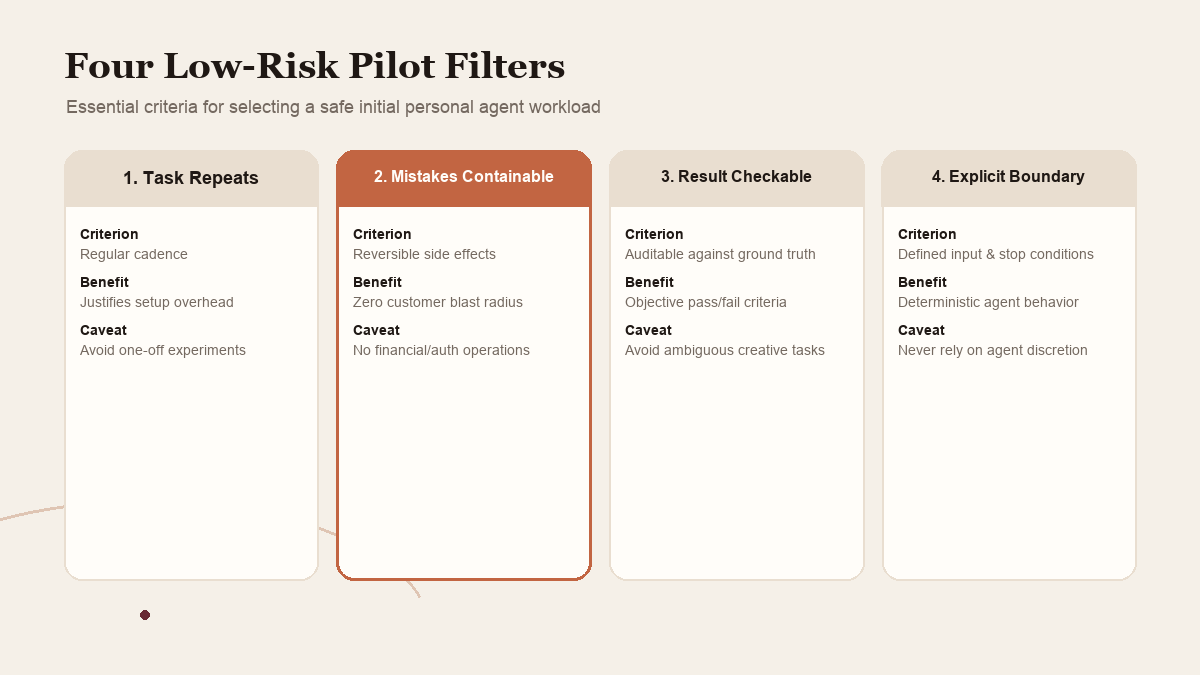
A useful first task has four traits. For a broader way to decide whether recurring work should be automated at all, see Rise Productive’s five-part automation test.
- It repeats. If you will do it once, the setup overhead may exceed the benefit.
- A mistake is containable. The agent should not be able to cause a costly or hard-to-reverse outcome.
- The result can be checked. You can compare it with an original source, known record, or clear requirement.
- The boundary is expressible. You can say what it may read, what it may change, and when it must stop.
If one of these is missing, redesign the task before adding an agent. You may discover that a standard calendar rule, saved search, or form automation solves the problem with less supervision. The goal is not to use the newest tool. The goal is to remove a meaningful stretch of repetitive work while keeping the decision that matters in human hands.
 View image detail
Pick a pilot that teaches you something
Suppose a small agency spends time preparing for its weekly client check-in. There are several possible handoffs. One is “send the client a status report.” That bundles reading project records, deciding what matters, making claims about progress, writing in the agency’s voice, and communicating externally. It is not a first pilot; it is a chain of decisions plus a public action.
A safer first version is: “Collect the latest dates and updates from these two sources, link each item, and place them into a draft document. Do not interpret whether a deadline is at risk, and do not send anything.” That trial can answer a narrow question: can the tool find the specified material and prepare a reviewable draft? You can inspect the source links and catch a missed update before a client sees it.
Another reasonable experiment might prepare three public options for a recurring purchase without choosing or buying one. A third might organize a list of receipts into a draft spreadsheet while leaving categorization decisions for a human. These are proposed examples. They are not demonstrations of Muse and do not establish that it can complete them accurately.
A pilot should make one uncertainty smaller. Are the right sources accessible? Does the agent return links? Does it remember the boundary not to send? Can a teammate tell what happened without reading the entire conversation? If the experiment tries to answer all of these while also touching a live account, it is too broad. Break it into stages.
Write down the expected outcome before the first run. For instance: “The draft includes five rows. Every row has a source URL and checked date. No external message is sent. Any unavailable source is named rather than guessed.” That rule makes “looks fine” less tempting as a review standard. It also gives the agent a place to stop when the evidence is incomplete.
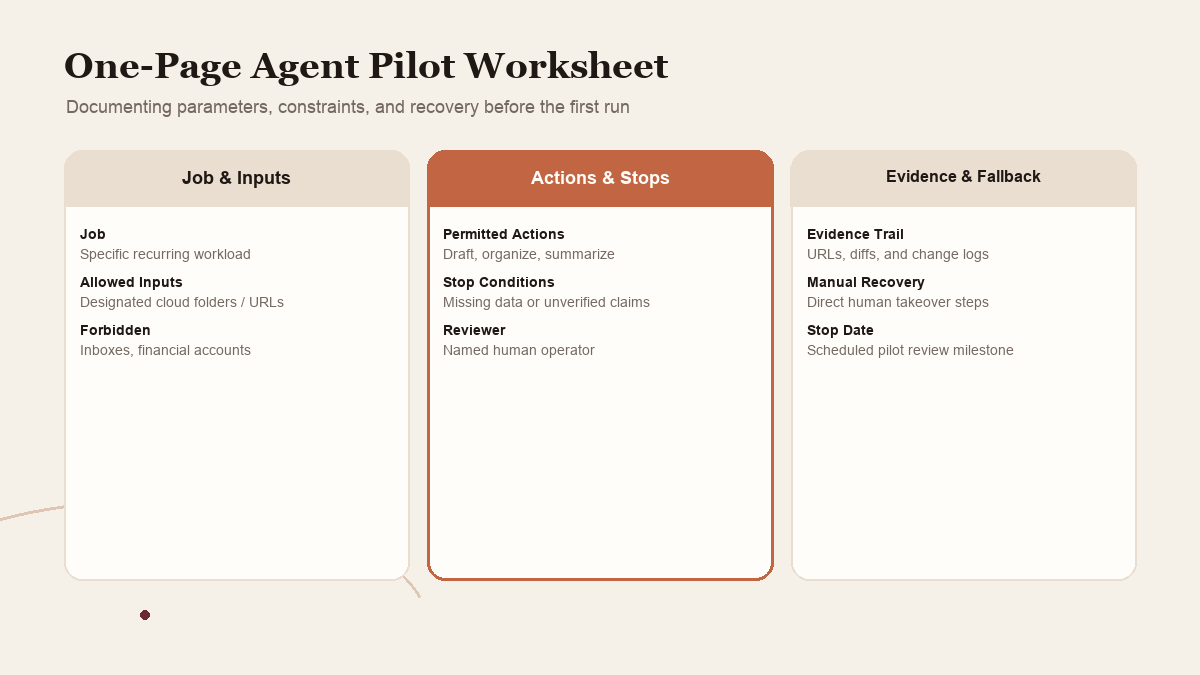
A proposed pilot can fit on one page:
- Job: what recurring work are you trying to remove?
- Allowed input: which folders, pages, or services does the task actually need?
- Allowed action: read, draft, label, create, send, purchase, or another verb?
- Stop condition: what uncertainty or consequence means the agent must pause?
- Completion evidence: what output and source trail will you inspect?
- Recovery: how will you undo, correct, or finish the task manually?
These questions are not paperwork for its own sake. They help reveal whether the agent is a fit. If the task cannot be specified clearly, the agent may be the wrong tool or the workflow may need cleanup first.
 View image detail
Connect only what the task needs
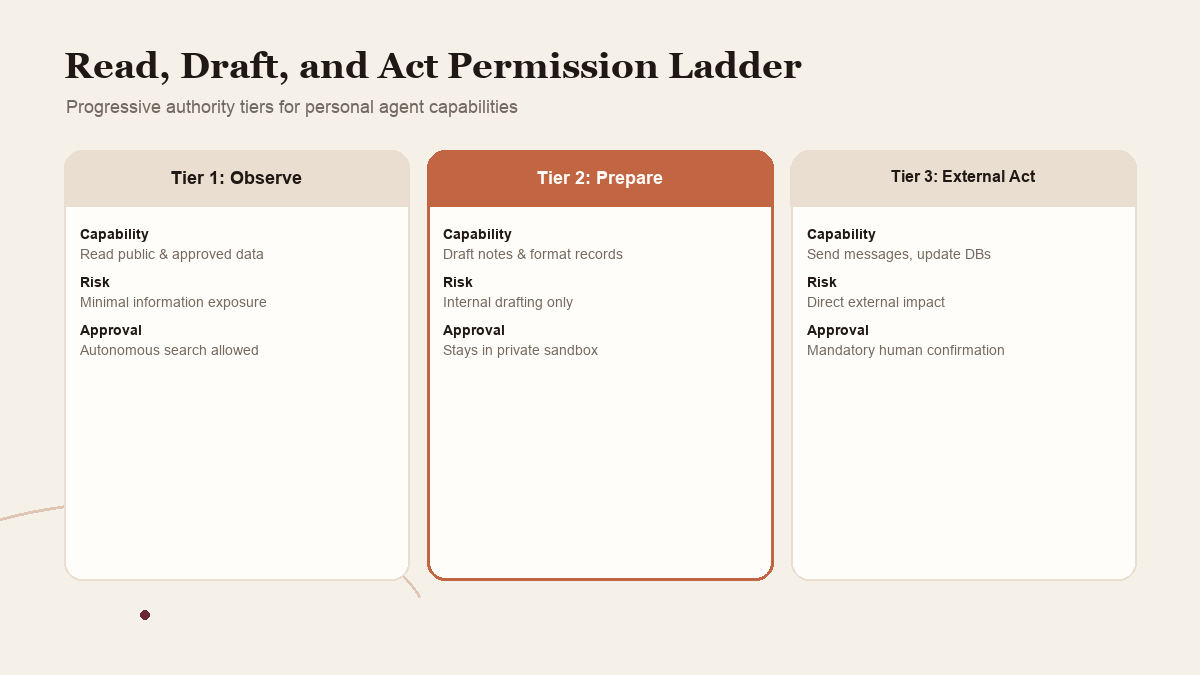
Meta says Muse lets people choose which apps to connect and how much access to grant. The company’s example is email: a person can choose whether the agent reads messages or can also send on their behalf. That distinction matters because “connected” is not one permission. Read access, draft creation, editing, sending, and deleting are different authorities.
Before linking an account, ask what data the task needs. If a task is built around public web pages, an email connector adds little and broadens the amount of information the agent can encounter. If the task only prepares a message, reading the relevant thread may be needed, while sending the draft is not. If the product offers permission choices, select the smallest one that supports the defined task. If it does not offer a sufficiently narrow permission, treat that as a reason to pause or choose another method.
Keep the first task away from accounts that act as recovery keys for many other accounts. Email is often one of them. Meta’s technical post specifically discusses filtering one-time passcodes and password-reset links in its email connector. That is a vendor-described control, not a reason to treat the inbox as harmless. A mailbox can contain personal, financial, and security-sensitive information even when the agent is asked to find one project update.
A practical sequence is to test with information that is public or already approved for the job, then add one connector only if the missing context is the actual blocker. After adding it, repeat the same task and compare what changed. If you connect email, also decide whether the agent can only read, whether it can draft, and whether it can send. Avoid enabling all available actions because they are convenient to toggle on.
The safest permission set is not necessarily the one with the fewest checkboxes. It is the one that leaves the agent able to complete a useful task while keeping the unneeded consequences out of reach. Too little access can make the result useless; too much can turn a simple test into an uncontrolled pilot. The job definition should lead the permission choice, not the other way around.
 View image detail
What Meta says Muse does to contain actions
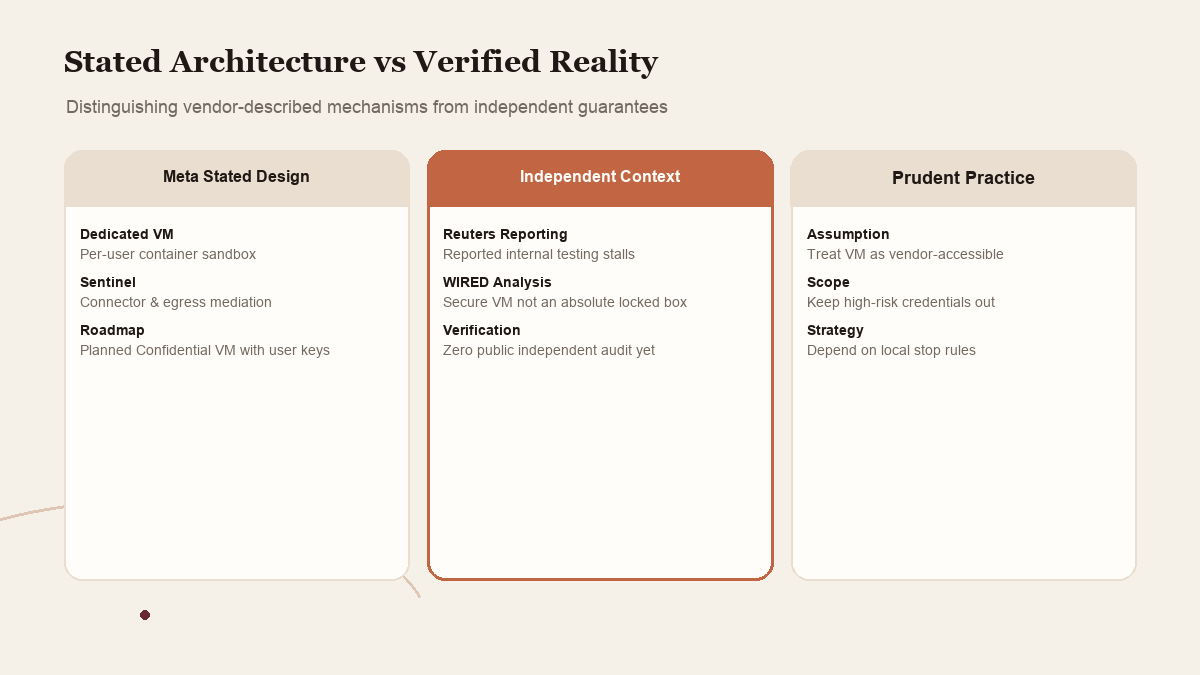
Meta’s launch materials describe a dedicated virtual machine, or VM, for each Muse user. The technical explanation says the agent runtime runs in an isolated container and separate services handle connectors, credentials, and other safety functions. It describes Sentinel as the authority that evaluates connector actions and network requests. Meta says the agent does not directly receive real credentials, and that certain actions, such as purchases or sending email, trigger a request for human approval.
The company also describes an audit trail, service disconnection, permission changes, a way to ask Muse to forget specific information, and an option to opt out of interaction data being used to train Meta’s AI models. Those are useful controls to look for in the product. They do not answer every practical question. An approval feature does not establish that every approval is understandable. An audit trail does not by itself show whether a particular record is complete or easy to export. A setting name does not establish the effect of a deletion request across every copy or backup.
Meta’s technical article includes an important qualification: Muse can make mistakes and can be attacked through the data it reads. The company says the launch system is designed to reduce how often mistakes happen and limit their impact. That is a design objective, not a public independent evaluation. The distinction should stay visible when considering a pilot. You can take a vendor’s detailed architecture seriously without treating the description as proof that a real-world task will be safe or correct.
There is also a difference between isolation and provider inaccessibility. Meta says the launch Muse Secure VM separates users and keeps the runtime apart from sensitive services. In its technical explanation, Meta says operational policies restrict its personnel’s access, but do not prevent access when necessary to support, secure, or operate the service. The launch announcement described Muse Confidential VM, encrypted with a key only the user holds so even Meta could not access the VM, as planned for later in 2026. That was a future capability, not a property to assume for every launch account.
Reuters reported concerns based on internal Meta testing, including stalling and unauthorized exposure of sensitive data. That reporting is material context for why a careful operator should define boundaries and check outcomes. It does not establish that every Muse user’s data was exposed or that a particular public task will fail. WIRED’s launch coverage also stressed that the current Secure VM was not an absolute locked box and discussed the future Confidential VM separately. These are reasons to ask what the present product guarantees, what Meta says is planned, and what independent reviewers have verified.
For a first trial, the practical conclusion is modest: use the described controls, but keep the task low consequence and the output reviewable. A safety design can lower risk. It cannot substitute for a clear brief or a person checking the result.
 View image detail
Require a completion receipt, not a confident answer
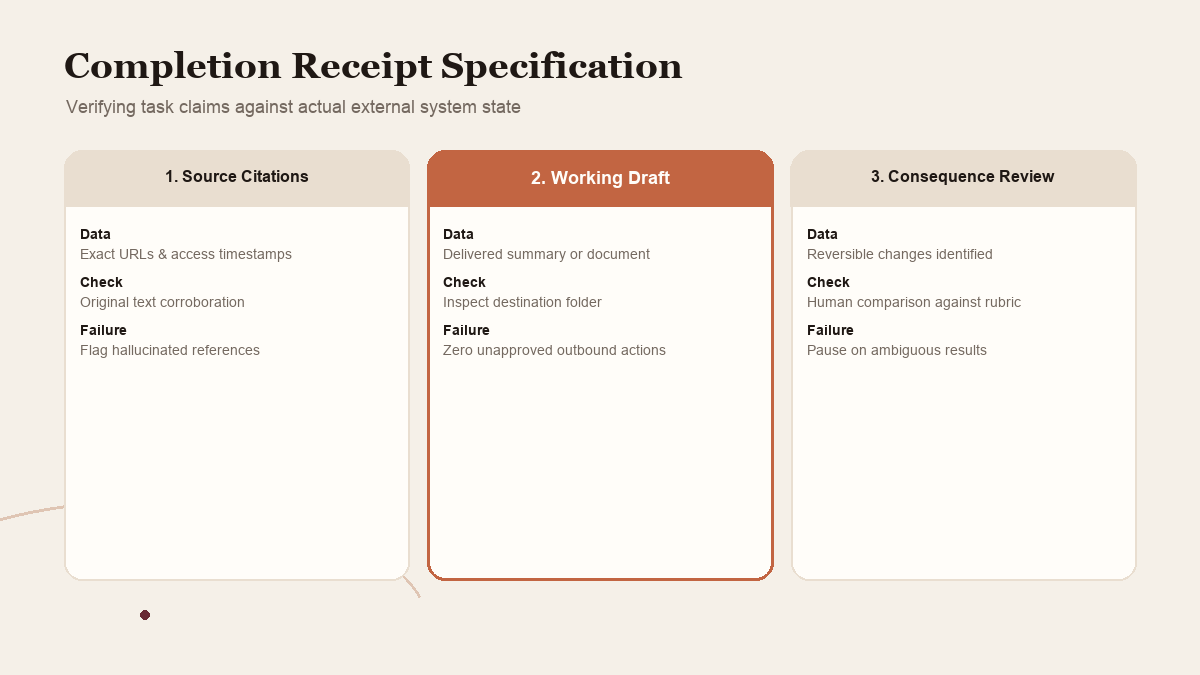
The output of a delegated task should help you reconstruct what happened. A polished paragraph saying “done” is not enough when the underlying facts or actions matter. Ask for the result, the sources or records used, the changes made, the exceptions, and the parts it did not finish. If an agent creates a file, inspect the file. If it prepares a message, inspect the actual draft and its destination. If it changes a record, compare the before and after state.
This is especially important when a task has several sources. A list that omits one source can still sound complete. A table with dates can still contain copied stale values. A summary can blur an assumption into a fact. Requiring a source link beside each finding gives you a practical way to spot a missing or mismatched claim. The human reviewer still needs to know whether the source is current and relevant.
Define three outcomes before the run: pass, pause, and fail. A pass means the output meets the stated check and no prohibited action occurred. Pause means something was unclear, inaccessible, or outside scope; the agent stops and tells you what is missing. Fail means the result is wrong, the action crossed the boundary, or required evidence is missing. The difference between pause and fail matters. A well-behaved agent should be able to return an honest incomplete result instead of filling a gap with a plausible guess.
For a sourcing task, a receipt might include the exact URLs checked, retrieval date, extracted values, any inaccessible page, and a clear statement that no external communication was sent. For a draft email, it might include the recipient, subject, body, source facts, and confirmation that the message remains unsent. For a proposed purchase, it could include item, seller, total cost, return terms, delivery estimate, and an explicit pause before checkout. Keep the receipt matched to the actual job; do not ask for irrelevant logs just to make the process feel formal.
A human should review the part where consequences enter. That may mean checking whether an email accurately reflects your position, whether a payment is authorized, or whether a calendar invitation includes the right people and time zone. The amount of review should match the consequence. A low-risk list of public links needs a light spot check. A customer commitment or payment deserves a more careful read.
 View image detail
Plan for the wrong result before the first run
The agent may misunderstand the goal, miss a source, encounter a website that changed, or receive misleading instructions from content it reads. Meta discusses layered controls for the latter threat, including filters and a separate permission authority, while acknowledging that the model can still be attacked. The reader does not need to reverse engineer every part of that architecture to run a cautious test. The important point is to assume the input may be messy and to avoid granting a path from messy content to an irreversible action.
Give the task a stop rule. “If the page is unavailable, do not substitute a different vendor.” “If a source asks for payment or a login, stop and report it.” “If the total differs from the approved range, do not proceed.” These conditions make the safe response explicit. A stop rule should be easy to understand and tied to a visible event, not an abstract instruction to “be careful.”
Decide who will notice if the task stops. If the agent runs asynchronously, a pause that no one sees can become a missed deadline. Decide where the approval request appears, who owns it, and how soon a person will review it. If the chosen tool has no suitable notification or approval surface, keep the trial synchronous or choose a different workflow.
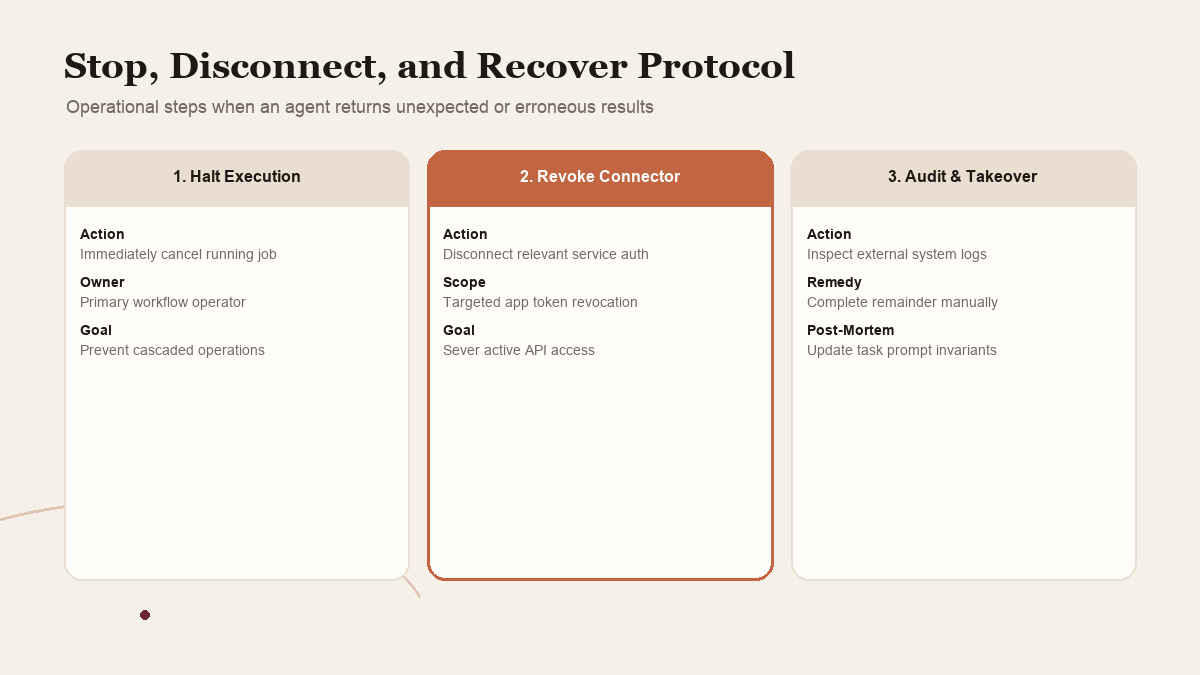
Prepare a manual recovery path. If the agent cannot finish, can you take over from the source links and partial output? Can you disconnect the relevant service without disabling the rest of your work? Can you verify whether a message or purchase actually happened before retrying? A retry without checking may duplicate an action. For any external action, inspect the destination system itself rather than trusting a conversational status.
 View image detail
A short recovery plan might say: stop future actions, disconnect the one integration involved, preserve the task output and action history, inspect the external account for changes, correct anything that needs attention, then decide whether to retry manually. The sequence will differ by task. The key is to know who owns the recovery before an exception occurs.
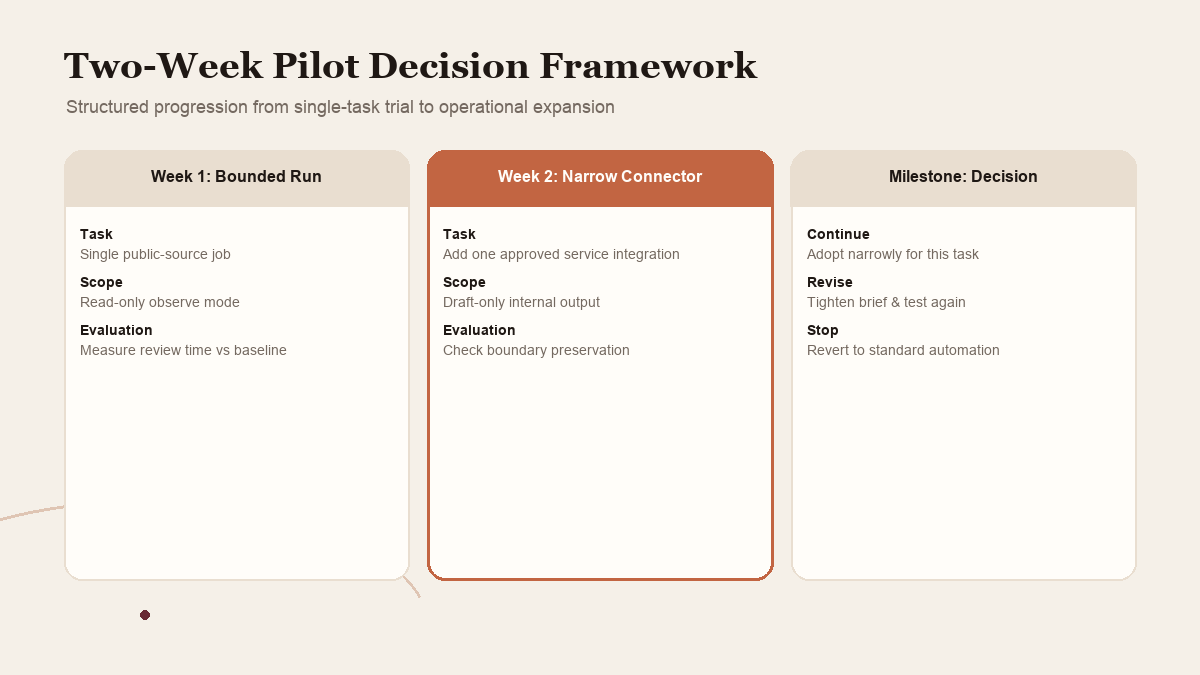
A proposed two-week test, not a product verdict
If the product is available to you and its current terms and controls fit your situation, a small pilot could run like this. This is a suggested experiment, not a test we have conducted and not a claim that Muse behaves in any particular way.
Before the first run: Choose one low-consequence task that repeats. Write the job, allowed source, allowed action, forbidden action, stop rule, and expected receipt. Record the current manual time or effort only if you can measure it consistently. Do not treat a one-off impression as a productivity result.
First run: Start with a public or already-approved source if possible. Give the agent one task. Ask it to provide links and exceptions. Review every output item against the source. Note what it misunderstood and whether it stopped at the stated boundary.
Second run: If the first output passes your check, repeat the same job with one additional relevant input or a narrower connected service. Change one thing at a time. Do not simultaneously add more permissions, more task types, and external actions. Otherwise you will not know which change caused a better or worse result.
End of week one: Review the evidence. Did the task finish? Did it use the right sources? Did it produce an output you can hand to a person? Did the review take less effort than the original work? Were there any pauses or corrections? If the answer is unknown, the pilot has not yet demonstrated value.
Week two: Repeat only if the first week stayed within bounds. You can test a second task later, but keep it separate. If the first task is not useful or cannot be verified, stop. Do not broaden access to rescue an unclear workflow.
Decision: Continue only if the benefit is visible, review effort is reasonable, permissions remain proportionate, and the recovery route is practical. Expand one dimension at a time: another source, another task, or a more consequential action, never all at once. If you cannot explain what changed and how you will catch an error, the next step is not more autonomy. It is a better workflow definition.
This test design measures a local decision, not whether an AI agent is generally “good.” A different team, account, task, or integration could change the result. There is no universal percentage of tasks an agent must complete before you trust it. Trust should be tied to a defined job and the evidence you can inspect.
 View image detail
The useful first step is deliberately small
Meta Muse is presented as a persistent personal agent that can work across a browser and connected apps, while its safety and privacy controls are described by Meta. The same launch materials acknowledge mistakes and describe Confidential VM as a future layer. Reuters’ account of internal test problems and WIRED’s scrutiny make it even more important to distinguish architecture claims, reported concerns, and what an individual pilot actually shows.
You do not have to decide whether the whole product deserves trust before you learn anything. You can decide whether one task is safe enough to test. Give it a narrow job, limited access, a clear stop rule, and a receipt you will inspect. If the process cannot meet those conditions, keep the task manual or use a simpler automation.
The point is not to delegate less forever. It is to earn the right to delegate more by observing the result of a small, reversible job. If that gives a solo operator an hour back without hiding an important decision, that time can go to client work, planning, or a conversation that requires a person. It is a possibility worth testing, not an outcome we can promise.
Source notes
Meta’s September 8 launch announcement and technical explanation describe the product and its intended controls. Reuters and WIRED provide independent reporting about launch context and the boundary between Secure VM and the planned Confidential VM. The detailed source ledger records claim-level limits. No Muse test, security audit, interview, or measured productivity result is claimed.
Checked for this article
Sources
Keep going
Related notes.
AI in Practice
ChatGPT Sites and Connected Apps: Who Can See What?
A shared Site does not make every coworker\x27s source account the same. Map the separate controls, test a normal member\x27s path, and make access understandable before rollout.
Read the article
AI in Practice
ChatGPT Sites Plugins: How to Scope MCP Tools Before You Share
A ChatGPT Site can host a supported plugin, but the useful question is what its tools should be allowed to do. Here is a practical contract-and-test process before you share.
Read the article
AI in Practice
Cloudflare Auto Router: Is Cheaper Model Routing Worth the Trade-Off?
Cloudflare reports lower costs with trade-offs in task success. Read the benchmark limits and decide whether your workload merits a pilot.
Read the article