
AI in Practice
Manus 2.0 Studio: When to Keep an Editable AI Project
Manus Studio adds editable video and game projects. Decide when the next person needs the source, which elements an edit must preserve and how to check the final export.

On this page
- The handoff is part of the deliverable
- Pick the kind of edit you expect
- When a timeline saves a real handoff
- Game Dev has a different kind of source project
- Shared context still needs a current owner
- Make the final file part of the test
- Manus Studio or final export: a comparison for small teams
- A first Manus Studio edit test
- Decide what leaves the workspace
- Frequently asked questions
- What is Manus Studio?
- Does an editable timeline guarantee that other parts remain unchanged?
- Should every recipient receive an editable project?
- How should a team test a new editing workspace?
An AI-generated file is not always the work a team needs. Sometimes the result is a draft, and the next person needs to change one clip, one line, one game scene, or one calculation without starting over. Manus 2.0's new Studio workspace makes that handoff question concrete: not only what can an agent make, but what can a person inspect and keep changing after the first result appears?
Manus describes Studio as a shared workspace in its desktop app; it says Manus 2.0 overall is available on web, desktop, and mobile. The September 28, 2026 Manus 2.0 announcement introduces Video Editor, where users can change separate timeline elements, and Game Dev, where they can edit assets, code, movement, art, and scenes. The Video Editor feature page describes the timeline controls. The announcement also says users can send changes back for another Manus pass.
Choose an editable source project when the next person must make a controlled change and preserve the rest; choose a finished export when the result is accepted and no meaningful edit is expected. Rise Productive has not tested Manus Studio hands-on. Bloomberg Law and Investing.com separately reported Manus 2.0's launch. This article offers a decision framework based on documentation and launch reporting. For the separate question of when work should start automatically, see the companion guide to testing Manus 2.0 event-triggered automations.
Key takeaways- Manus describes Studio as a shared workspace with new Video Editor and Game Dev environments.- An editable source is useful when a specific next-person revision is likely and the team can own the project files.- A finished export may be the clearer handoff when the result is approved and no meaningful edit is expected.- Test one local change in both Manus Studio and the current editor. Check the changed layer, preserved elements, export, and reviewer effort.
The handoff is part of the deliverable
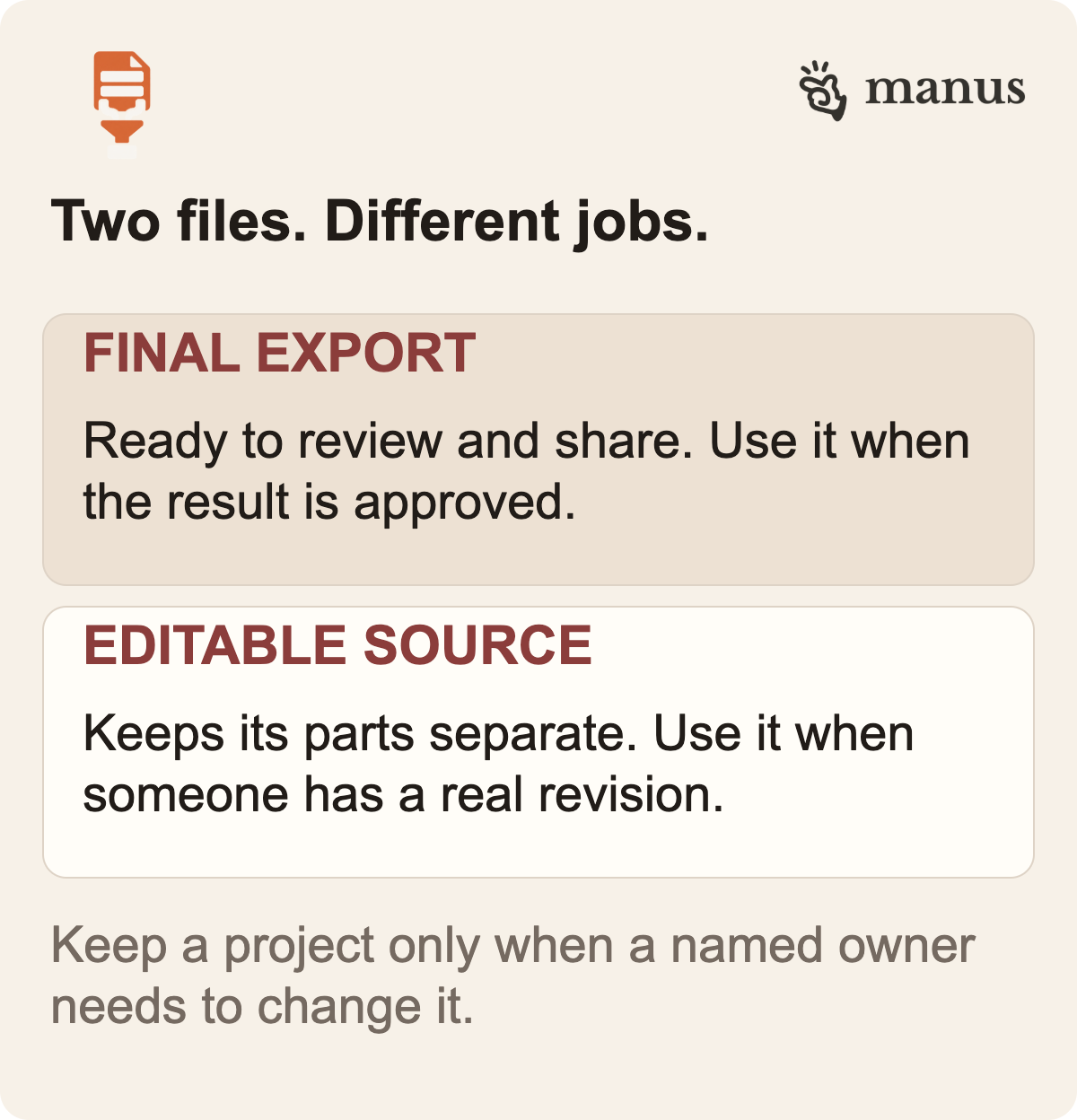
A good handoff specifies whether the recipient needs only the finished output or also the source project. A final MP4, PDF, slide deck, or website can be exactly right when the next action is to review or distribute it. But a finished output can hide the work behind it. If the editor needs a different product shot, the producer needs to shorten one scene, or a client wants to correct one label, the team has to return to a source project or reconstruct it from the rendered file.
Manus's Video Editor is aimed at this case: its timeline separates clips, images, text, motion graphics, and audio. Manus says users can send their changes back for another pass. Inspect a real project to find out whether the specific elements you need remain editable and whether an edit preserves the parts you did not ask to change.
The distinction is familiar outside AI. A flattened image is easy to share, but a layered source file is easier to revise. A PDF can show a report, while its spreadsheet and notes keep the assumptions available. The finished item serves the person who consumes it. The source project serves the person who must adjust it. Sometimes the same person needs both at different moments.
That is why an editable handoff should be treated as a deliverable requirement, not a bonus feature. Before generating anything, decide who receives the result, what they are expected to change, and which parts must remain stable. If the editor is only going to watch the video, source timeline control may be unnecessary. If the editor must change the licensed music, correct a claim, or insert a replacement brand asset, the ability to touch one part without recreating everything could matter.
 View image detail
Pick the kind of edit you expect
“Editable” sounds like one property, but the useful level depends on the task. A video team might need the ability to change a selected clip, trim its duration, correct a caption, swap an asset, adjust audio, and preserve the rest of the timeline. A game creator might need to adjust a character's movement while keeping the scene layout and code path intact. A finance team may need to edit the assumptions behind a report, not only the visible sentence in a slide.
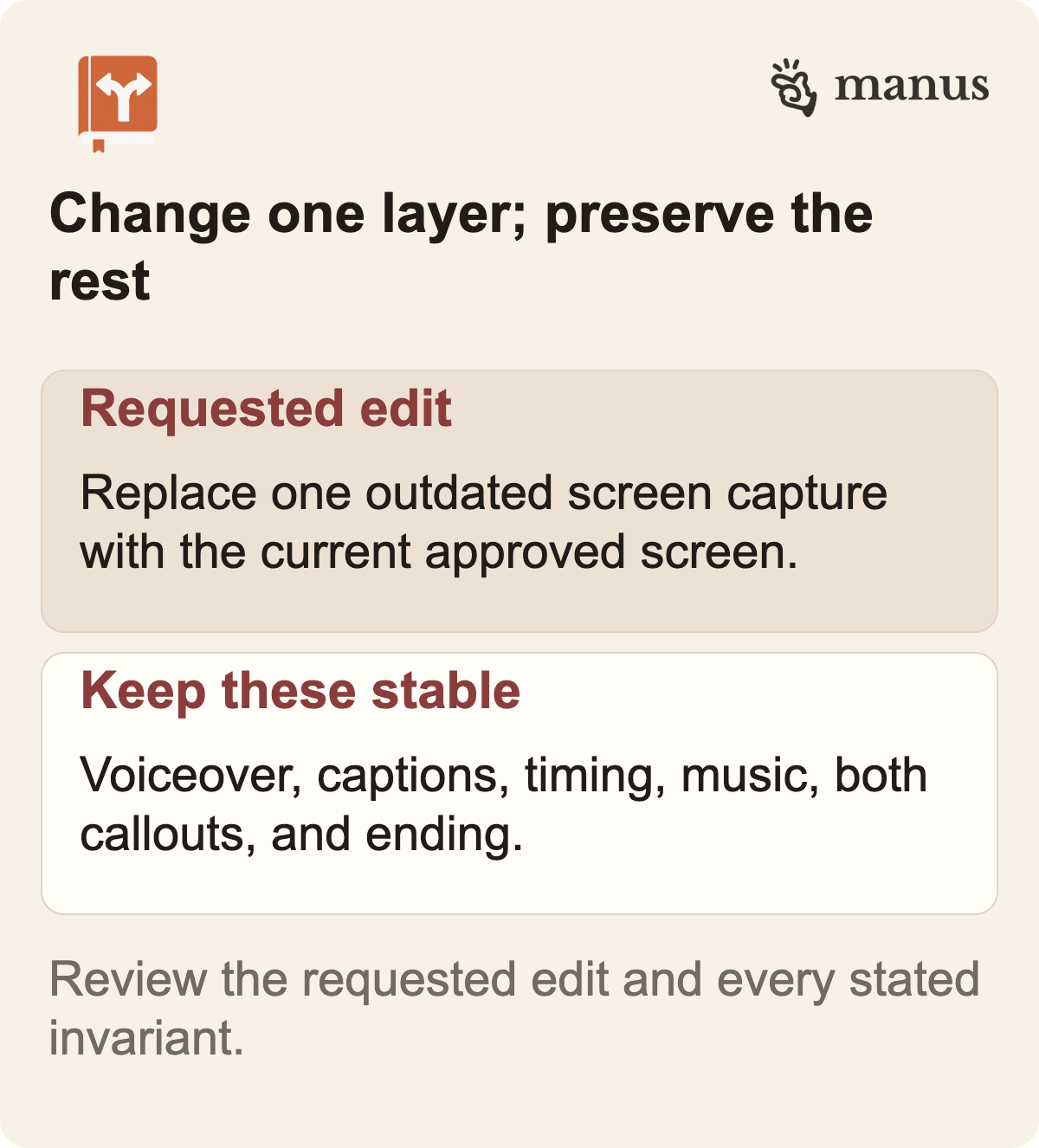
A good production brief makes one requested edit and its invariants explicit. For a short product walkthrough, it might say, “Keep the voiceover, captions, timing, background track, both animated callouts, and ending. Replace only the outdated screen capture with the current approved screen.” If the system returns a new video that ignores the constraints, the visually polished file has still failed the handoff.
Before a client depends on an editable timeline, confirm that an editor can reopen the source, make the named change, and resolve conflicting instructions. The feature may support part of a professional editing workflow, but only a representative project can show whether it covers the work your team needs.
A review should compare the requested edit against the new project state. Did the intended layer change? Did unrelated elements stay fixed? Are captions and sound still synchronized? Those checks test the workflow around the feature, not only the model's ability to produce attractive media.
 View image detail
When a timeline saves a real handoff
A timeline helps when one local change should leave the approved narration, captions, timing, and other clips intact.
Consider a 45-second product walkthrough with a screen capture, voiceover, captions, background track, and two animated callouts. A product owner spots one outdated screen, while the claims and narration are correct. In a flattened file, that correction may require rebuilding the video elsewhere. In an editable project, the hoped-for advantage is to replace the screen capture while leaving the narration, timing, and approved callouts intact.
This is a test scenario, not a result from Manus. Its value depends on the exact change, the preserved elements, the delivery file, and how much repair still happens outside the workspace.
Another production might need a change that is global rather than local. The brand voice changes, the opening promise changes, and three scenes need new footage. The system may be able to take that change as a new creative brief, but that is a larger revision than swapping one clip. The team should expect some regeneration and review. It can still be useful to preserve the source project, but the person directing the work needs to define the new scope and verify every dependent asset. Reuse does not mean that old approval automatically applies to changed claims or artwork.
When the final file will not be revised, an editable project can add unnecessary review. A team with a one-time event graphic and a signed-off message may only need the approved export. Keeping a complicated source file creates a stewardship decision: who owns it, which version is final, what fonts or media are needed to reopen it, and where those dependencies live? Editable can increase the number of things a team is responsible for. The value appears when expected changes justify that custody. The five-part work-worth-doing test can help judge whether recurring revisions justify that maintenance.
 View image detail
Game Dev has a different kind of source project
Game Dev projects require behavior checks alongside visual review because one asset or code change can affect controls and play.
Manus says its Game Dev environment brings video, image, and coding models together. The announcement describes starting from a playable template, watching the game run, managing assets, editing code, and changing movement, art, or scenes. It gives the example of changing one villager's hair from brown to silver while leaving the rest unchanged. These are product descriptions, not evidence that a particular project will isolate changes reliably or be ready for public release.
For multiplayer hosting, confirm what setup and ongoing operation the team owns before planning a public test. Manus says Game Dev can publish a game as a website or let friends join, with a purchased Cloud Computer for persistent multiplayer hosting. Cloud Computer predates Manus 2.0; the June 5 Help Center overview describes persistent files and processes, while the September 28 announcement connects it to the multiplayer example.
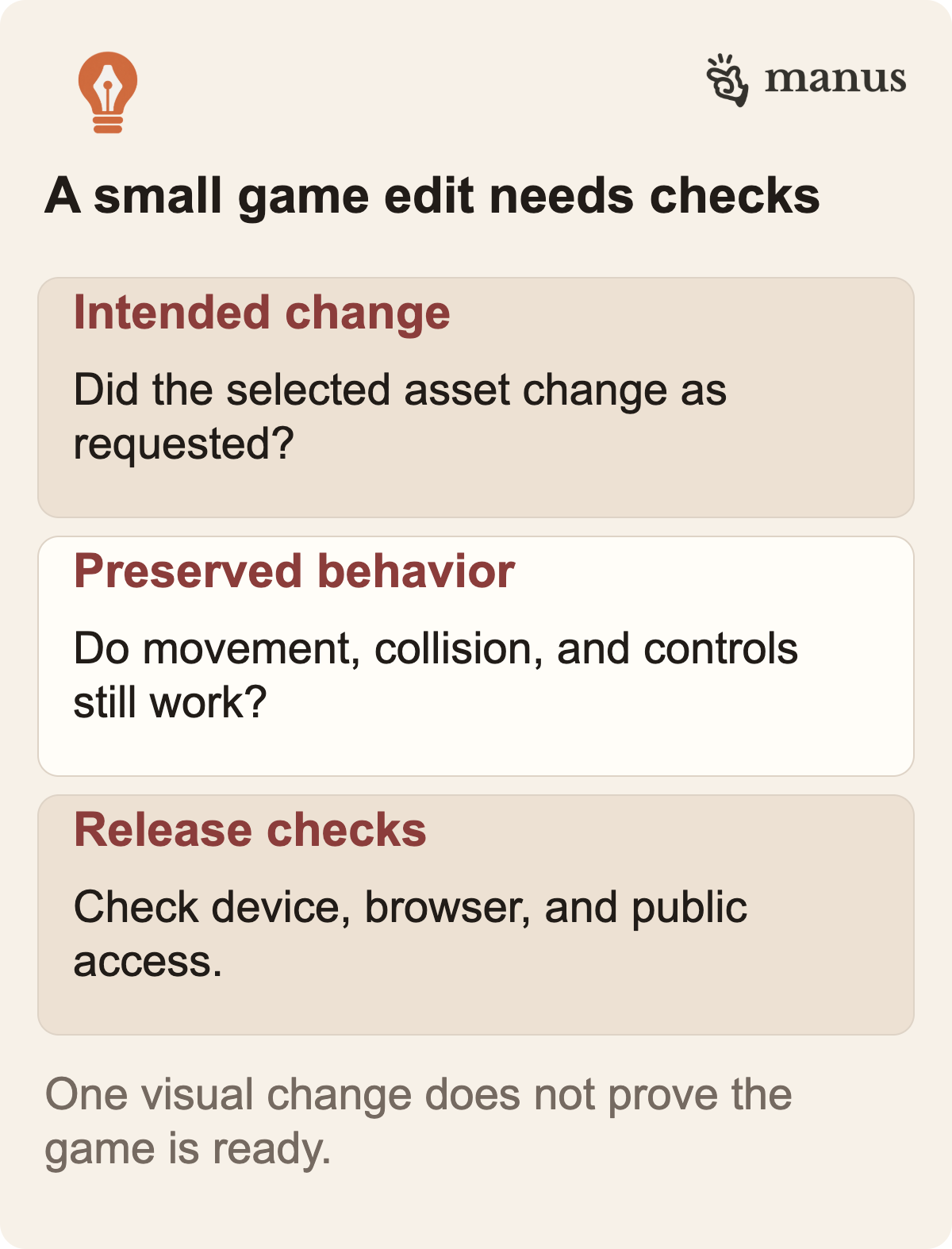
A small-looking change to a character can affect readability, animation, collision, player feedback, or consistency with the surrounding scene. The more useful question is which edit can be reviewed locally. If the request is to replace one sprite, the team can compare before and after in the same scene, with the same movement and input. If the request changes the rules of play, the reviewer needs a test plan that covers both the visible design and the game behavior. A screenshot cannot prove that collision still works. A successful load cannot prove that user data, multiplayer state, or every route behaves correctly.
A modest prototype should have a list of preserved behaviors. “Change the player color, keep the hitbox, speed, controls, level geometry, and save state the same” is more reviewable than “make it more fun.” Then replay the relevant tests and inspect the source elements that matter. The point is not that an AI should never make broad changes. It is that the operator has to know whether the change is cosmetic, structural, or consequential, and what evidence is needed to accept it.
 View image detail
Shared context still needs a current owner
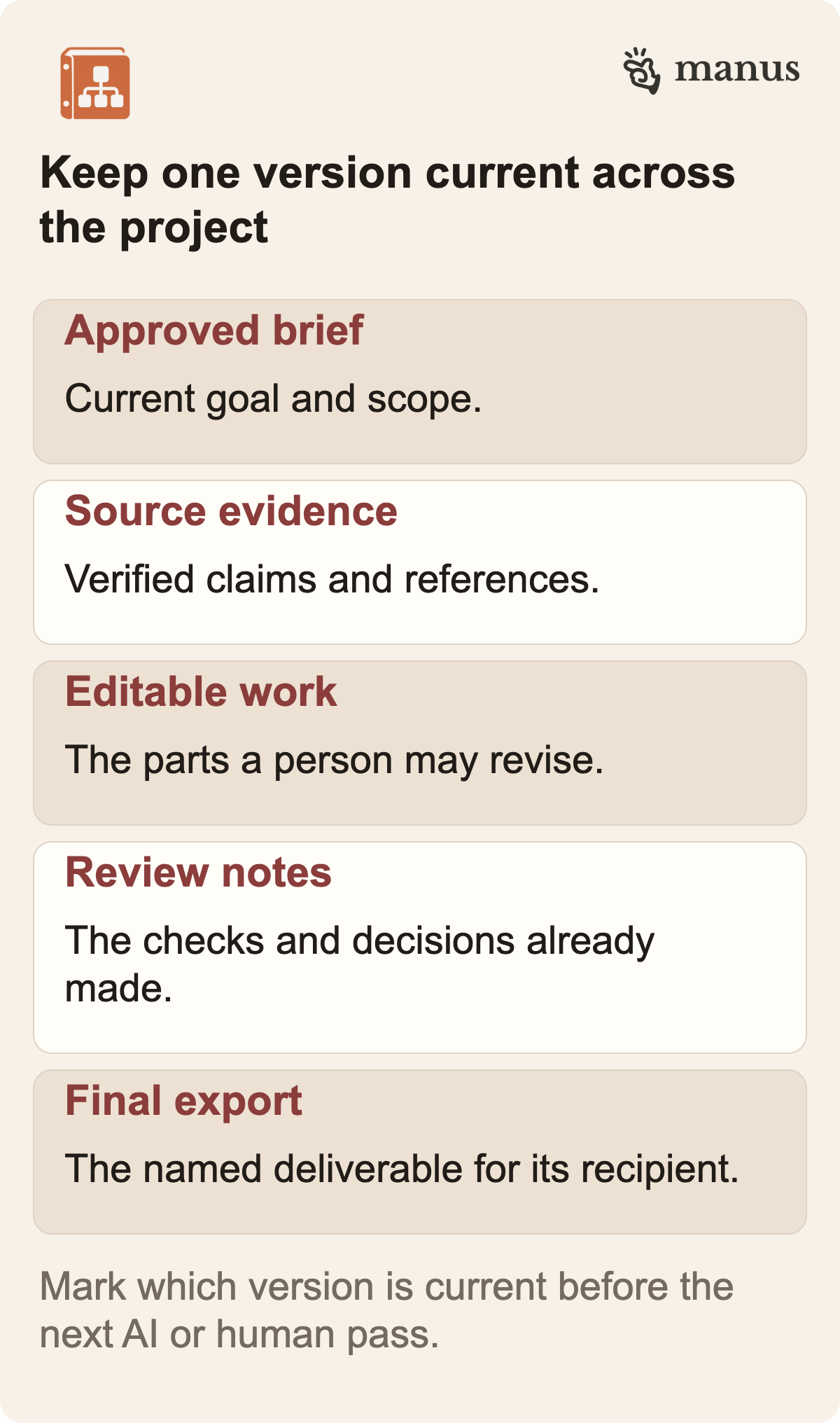
Shared project context helps only when a named person owns the current brief, approved assets, and accepted export.
Manus describes Studio as a shared workspace for people and AI, with project environments for work such as video and games. Connected context can help a team carry a brief and approved assets into later edits without restating every instruction. Its announcement also lists document, spreadsheet, slide, website, and coding work among supported project types, which is why teams may consider other editable artifacts in the same workflow.
That is useful if the project can retain the parts that actually change the next decision: approved sources, project constraints, brand assets, review comments, and the current deliverable. A shared project is not automatically a source of truth. The team still needs to know which brief is current, which claims were checked, what was merely proposed, which assets are approved, and which export is the final one.
Imagine a product video built around a landing-page claim that changes after legal review. If the workspace carries the old promise into a new edit, continuity can preserve stale information as easily as useful context. Name the current source, mark which assets and claims are approved, and repeat affected checks after a change.
 View image detail
Make the final file part of the test
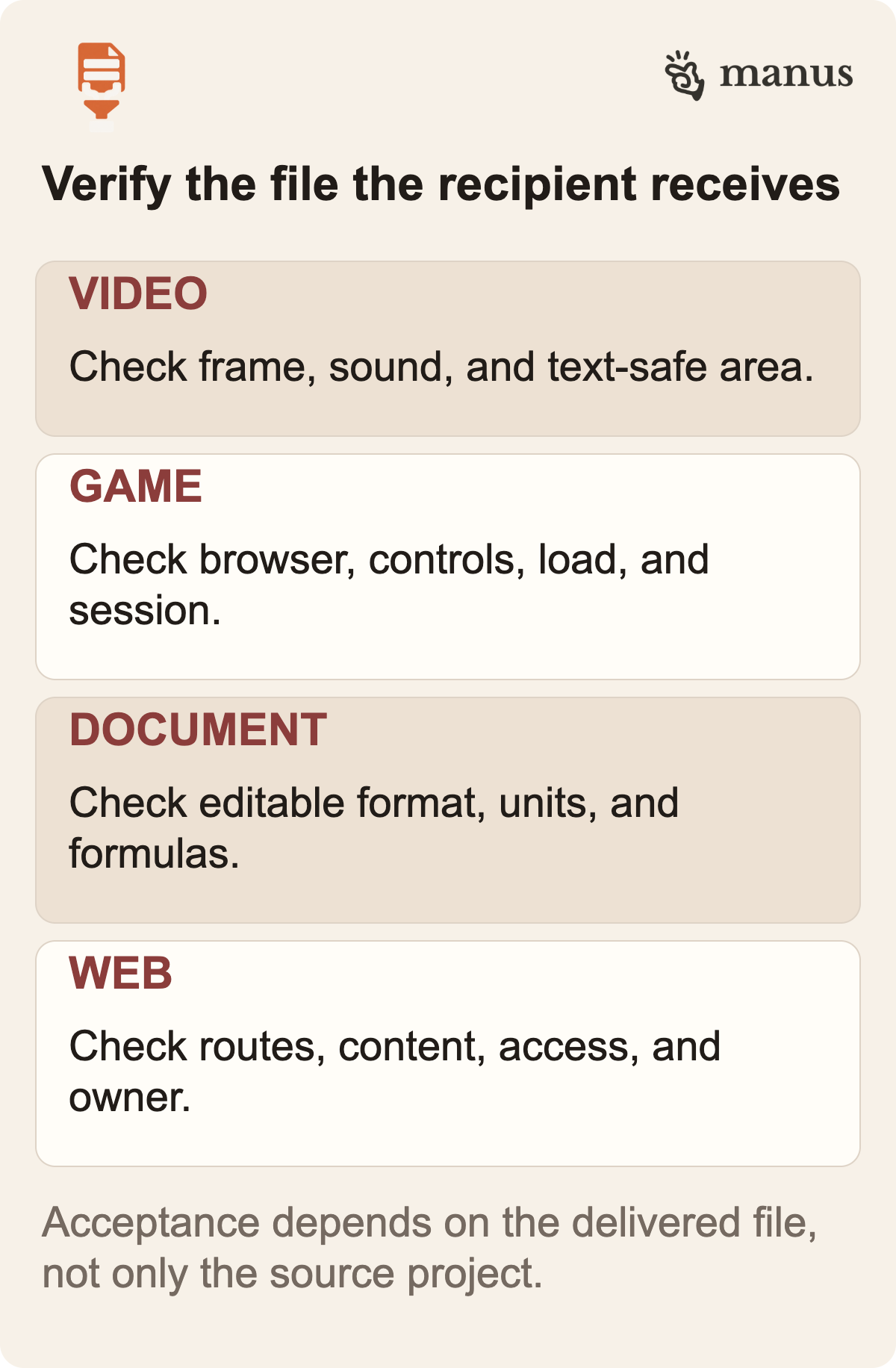
An editable project is only useful if the output it produces meets the intended destination. Every handoff test should follow a change through to the file a customer or colleague will actually receive.
For video, specify the aspect ratio, resolution, duration, text-safe margins, caption treatment, frame rate if relevant, audio level, and file type. Confirm which values the platform will transcode. Check a phone-size view when text or visual hierarchy matters. Preview the complete cut, not only a frame from the timeline. A correct source project can still export the wrong asset or create text too small to read.
For a game, define the target browser and device range, the first-load experience, the basic controls, expected performance, and what happens when a multiplayer session starts or ends. A hosted link is a publication mechanism, not an acceptance test. Decide whether the audience is a private group or the public. Check that the project does not expose personal information or use unlicensed art, sound, or names, and confirm the hosting terms for the project.
For documents and slides, check whether the output must remain editable in a format your colleagues can use. For a spreadsheet, preserve formulas, units, data range, and assumptions. For a website, make sure that the generated source, deployment, and content ownership are understood. Confirm that the specific format and workflow you need are supported before adopting them.
The final file test should be repeatable. A reviewer should be able to state the acceptance criteria, open the file from its handoff location, and confirm the outcome without relying on the prompt history alone. If the team cannot retrieve the asset or understand which version it is, the technically editable project may still fail as a collaboration system.
 View image detail
Manus Studio or final export: a comparison for small teams
- Expected revisions: Prefer an editable source project when…: Named changes are likely and should preserve other parts; A final export may be enough when…: The deliverable is approved and one-time
- Traceability: Prefer an editable source project when…: The next editor needs to inspect individual elements; A final export may be enough when…: The recipient only needs the rendered result
- Quality checks: Prefer an editable source project when…: The team can test the affected and preserved parts; A final export may be enough when…: The acceptance criteria apply only to the final file
- Risk: Prefer an editable source project when…: A change can be reviewed and reverted before release; A final export may be enough when…: A source project exposes more material than the recipient needs
- Cost: Prefer an editable source project when…: Revisions recur often enough to justify the project; A final export may be enough when…: Maintaining an editable workspace costs more than recreating a small deliverable
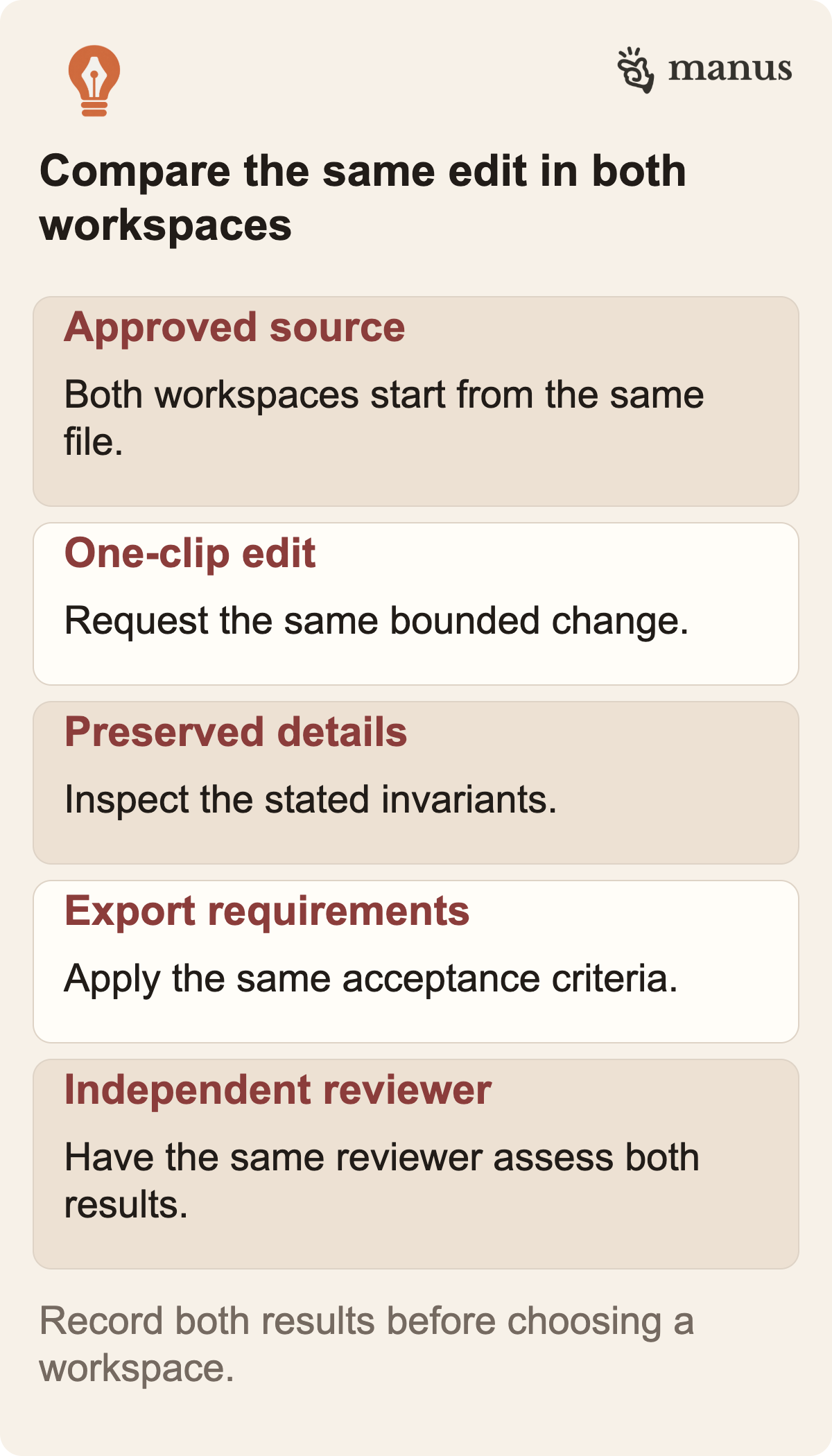
This article does not compare Studio's performance with a traditional editor or game engine. To make that decision, compare the same representative task in both tools and record correction effort, preserved elements, export quality, operating cost, and the work a person still owns. The cost guide explains why reviewer time and retries belong in that calculation.
A first Manus Studio edit test
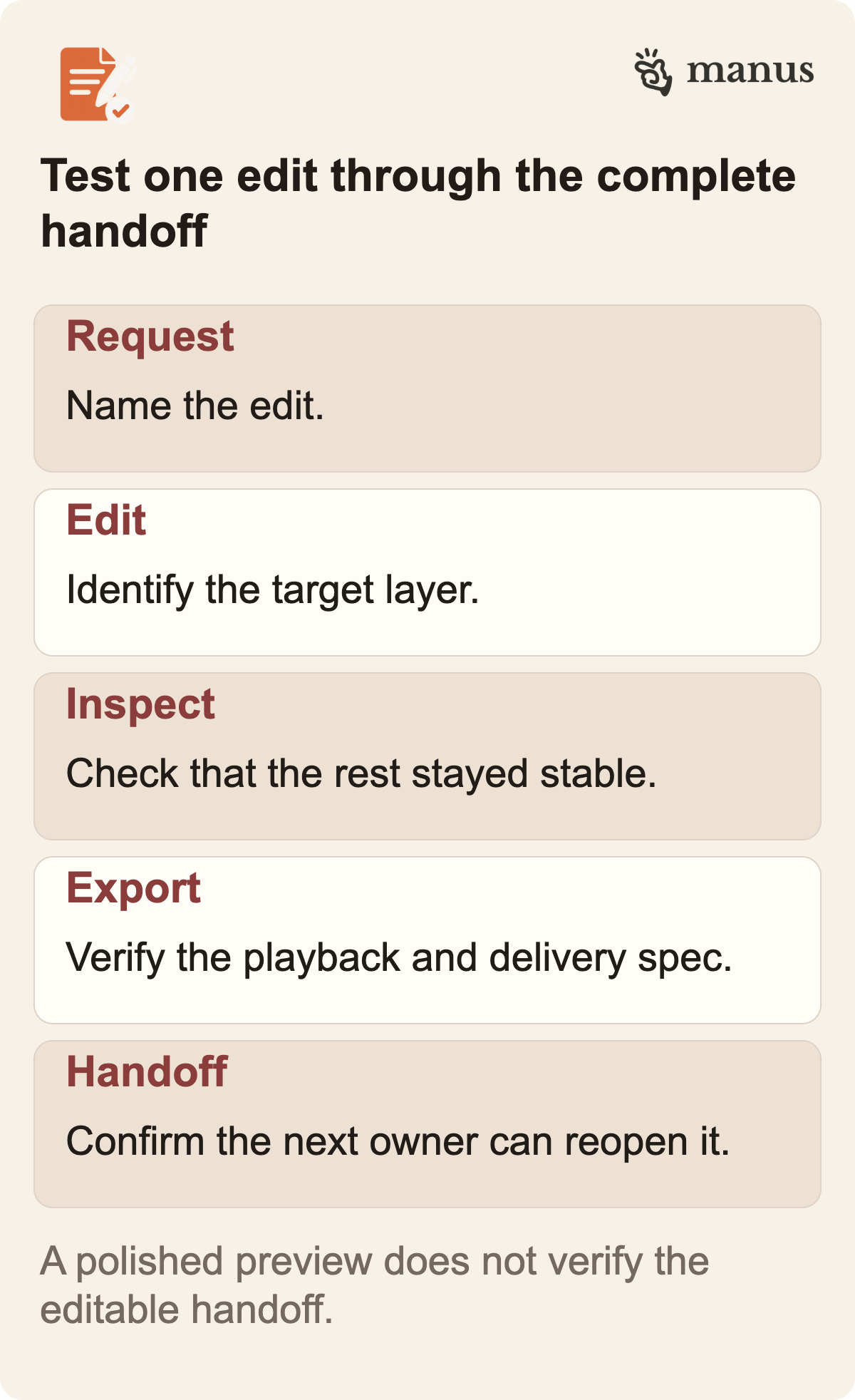
Choose one short project with written approval to use its assets. Capture the current source and export. Use one local change, such as replacing the outdated screen in the 45-second walkthrough above. Then inspect the editable project and exported file. Verify the change, preserved elements, asset rights, layout, playback, audio, and delivery format. Ask a second reviewer who did not write the prompt to check the result against the brief.
Record whether the editor could make the requested change directly, whether a new Manus pass was needed, how much manual correction remained, and which project state was handed to the next person. If you also test the existing production tool, use the same edit and acceptance conditions. Do not compare a polished generated result against an incomplete competitor draft or use one convenience example to claim that one system is generally faster.
If the test works, decide who owns future changes and where editable dependencies are stored. If it fails, record the failure mode and narrow the next test rather than expanding the entire workflow. One failed sound swap does not prove the product is useless. One successful scene adjustment does not prove every element is safely editable. The test can support only the task it actually exercised.
This approach is useful because it makes an attractive feature answer a concrete team question: will the next person receive enough control to make the revision they are likely to need? The result could be to adopt Studio for a narrow content type, keep the current editor, or use Manus only for a first cut. An evaluation that cannot end with “not for this job” is a product demo, not a decision.
 View image detail
Decide what leaves the workspace
Keep an editable source when a named person is likely to revise it and can maintain its assets and dependencies. Deliver a final file when the recipient only needs the accepted result. Keep both when one person must revise while another only needs to view. Recheck claims, footage, code, and instructions affected by each change.
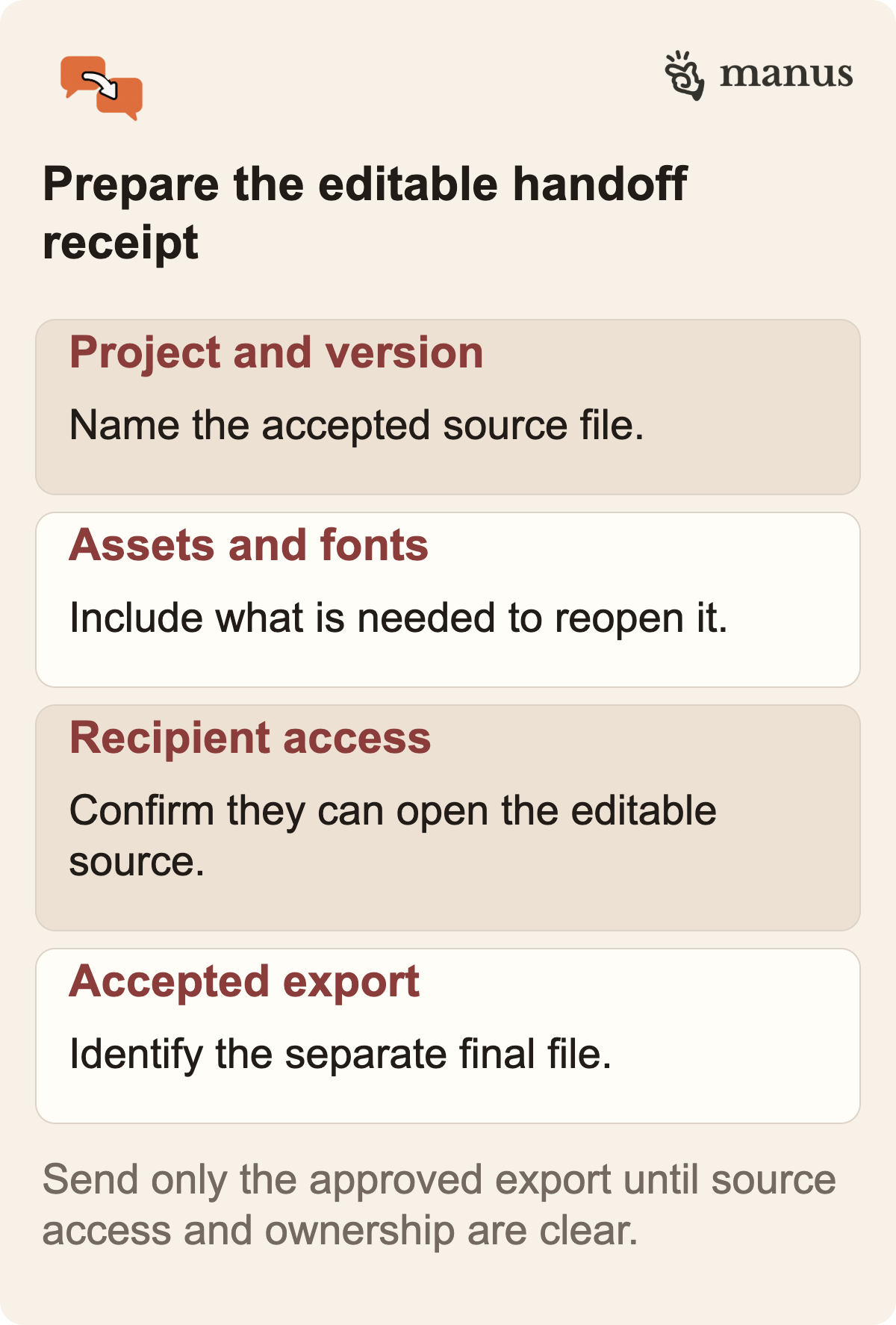
Use a four-item handoff receipt for any editable delivery: name the project file and version, include the assets and fonts needed to reopen it, confirm the recipient can open the source, and identify the accepted export. Keep the final file separate from the working project. Check current product access and account terms before choosing a workflow. If ownership or recipient permissions are unclear, send the approved export while the team resolves them.
 View image detail
Frequently asked questions
What is Manus Studio?
Manus Studio is a shared workspace in the desktop app. Its Video Editor lets users work with clips, images, text, motion graphics, and audio on a timeline; Game Dev lets users inspect assets and code and adjust a game's movement, art, and scenes. These are Manus's product descriptions, not hands-on results from Rise Productive.
Does an editable timeline guarantee that other parts remain unchanged?
No. State the elements that must stay fixed in the brief, then inspect the complete project and export after the change.
Should every recipient receive an editable project?
No. Keep a source project when the next owner needs to revise or inspect its parts. A final export may be enough when it has been accepted and the recipient only needs to use or view it.
How should a team test a new editing workspace?
Use the same source and one bounded edit in the current editor and the new workspace. Record manual corrections, preserved elements, export quality, rights and dependencies, and time to an accepted result.
Checked for this article
Sources
Keep going
Related notes.

AI in Practice
What to Check Before Putting Real Data into Tencent Octop
Octop is self-hosted, but a real deployment still connects accounts, providers, tools and people. Check each boundary before real data enters the workflow.
Read the article
AI in Practice
Claude Docs Sharing: What to Check Before You Send a Work Link
A pre-send checklist for Claude Docs links: verify recipient access, workspace policy, document version, export and mobile limits before sharing work.
Read the article
AI in Practice
Claude Docs and Slides: When Does One Conversation Help With a Report?
A practical pilot for deciding whether Claude Docs and Slides improves a report-to-presentation workflow, with source checks, baseline comparison and review criteria.
Read the article