
Automation and Agents
How to Choose a Workflow for Grok Team Bots
A shared AI coworker is only useful when the team has a clear job, shared reference material, a checkable result, and someone who will keep the context current.

On this page
- A Team Bot is a shared work surface, not a shared mind
- Start with a task the team already recognizes
- Score fit across five workflow tests
- Prefer a shared reference over a shared credential
- Three workflow patterns to consider, with disqualifiers
- An internal helpdesk answer from approved guidance
- A project handoff brief from shared records
- A customer account preparation note
- Work a hypothetical example before configuring a Bot
- Write the Bot's job card before setup
- Set a baseline that can tell you whether anything changed
- Use a two-week trial as a decision window, not a success promise
- Know when not to share a workflow
- The useful decision: start with a common job, then prove the fit
- Sources and further reading
Choose a first Grok Team Bot pilot around one recurring job that several people already handle in a similar way. Use a small set of shared references and produce an answer someone can check. Keep the job narrow enough for an owner to maintain its context and stop the Bot when a request falls outside the brief. A team Bot is a poor starting point for work that depends on private context, unrestricted customer records, or decisions no one has time to review.
At a glance: Choose a task that repeats, uses common references, has a checkable result, and has a named owner. Start with the smallest useful access set. Test a few real task types with approved data, then continue, narrow or stop based on what reviewers observe.
That is a workflow-selection rule, not a product endorsement. xAI announced Team Bots on September 28, 2026. Its launch page describes shared Bots with common context, plugins, credentials, skills and team memory. It also says each person's chat stays separate. The company shares internal and customer stories, but those are vendor-reported examples. AI Insiders' launch coverage also traces its product and outcome details to xAI. It is useful launch context, not independent validation. Rise has not created a Team Bot, tested an integration, measured time saved or inspected a customer's workspace. The useful question is what a team should test before assuming that a shared AI coworker will help.
About the author: Demetri Panici writes about useful AI use and productivity systems. This article is a source-based decision framework. It does not claim first-hand product testing.
A Team Bot is a shared work surface, not a shared mind
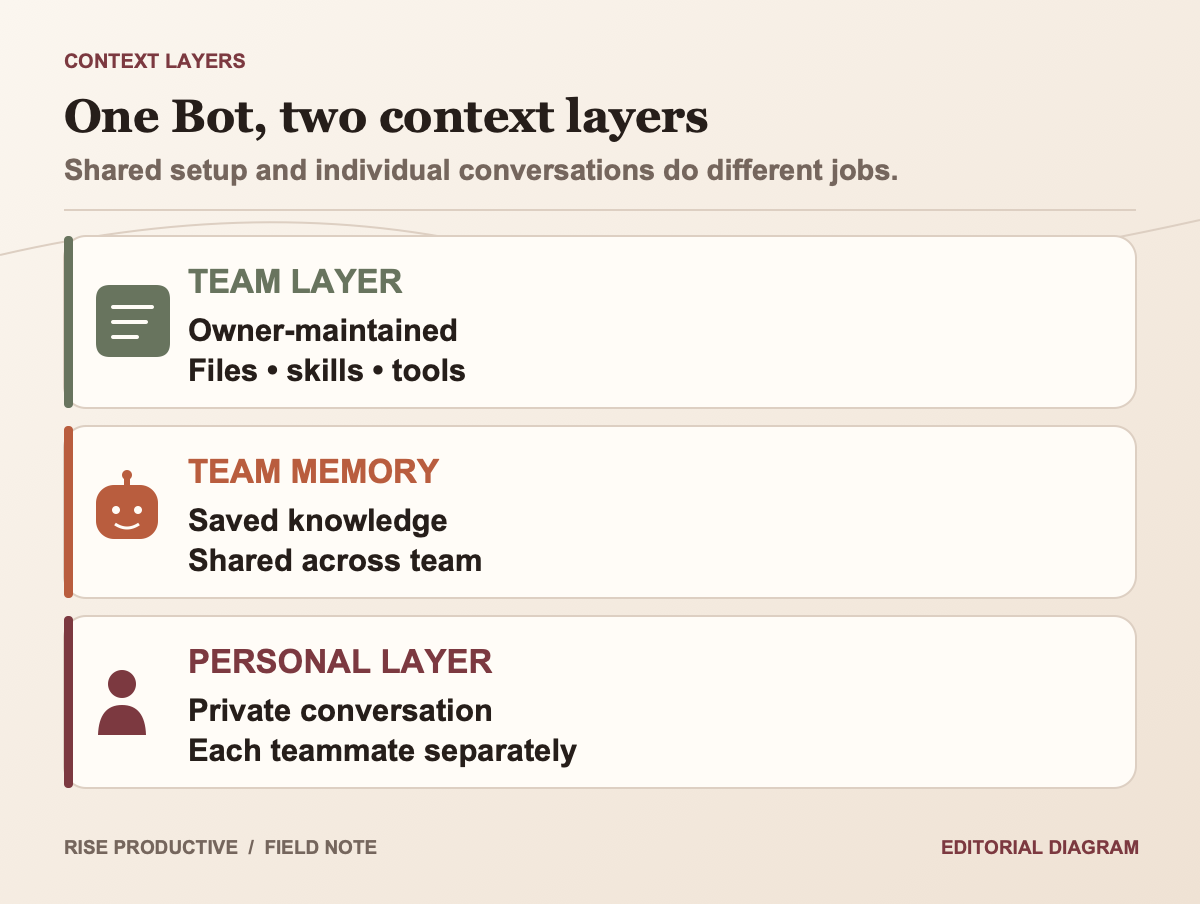
Grok Team Bot is xAI's shared assistant setup for a team. An owner configures shared files, skills, plugins and secrets, while members use their own chats. Shared context means the Bot's team-level references and memory that can shape multiple members' interactions. Private chat context means a person's own chat and personal memory, as described in xAI's current docs. These terms describe separate product layers, not a Rise security review.
The product name can make the feature sound like a group chat with a memory. Current docs describe a more specific arrangement. A Bot owner configures shared files, skills, plugins, and secrets, then publishes the Bot for teammates. Team memory is shared across the team's chats. At the same time, each teammate has a separate chat and private memory. xAI says an owner cannot read teammates' chats. These are statements in current product docs, not findings from a Rise privacy or security test. Team Bots guide explains the distinction, and the launch announcement frames the product around common context for shared work.
This separation matters because the word “shared” can hide more than one boundary. Shared expertise is useful when several people need one maintained process. Private chats are useful when a person asks for help that should not become a team memory. Shared files can establish a common vocabulary, yet a connected app may expose information under a person's account. A Bot can help one employee with their own task without sharing every detail of that chat with the rest of the team. Conversely, the shared instructions and credentials are not personal merely because each teammate chats with the Bot separately.
Think of it as a work surface with two layers: the Bot's shared operating kit, and each user's own interaction with it. The first layer needs an owner, a purpose, a review date, and a way to remove stale or private material. The second needs a clear explanation of what stays personal and what the owner can change. The design question is not whether one layer is good and the other bad. It is whether the job needs a team-maintained reference without requiring the team to see every user's private work.
 View image detail
Start with a task the team already recognizes
When a new agent arrives, people often start with a list of things it might do: summarize Slack, search a knowledge base, update a CRM, triage email, or prepare a report. Capability lists make a demo feel broad, but they do not establish that the team has a recurring job worth changing. Start with the work as it exists. Who does it today? What input arrives? What does “done” look like? Where does someone need judgment? What breaks if an answer is incomplete?
The Work Worth Doing test is a useful first filter: decide whether repeated work should be removed, simplified, automated with review, or kept human. That question prevents a shared Bot from becoming a new layer of maintenance on top of a process the team does not need. A team may discover that it does not need an AI teammate at all. It may need one current help article, a clearer intake form, or an owner who resolves conflicting policies.
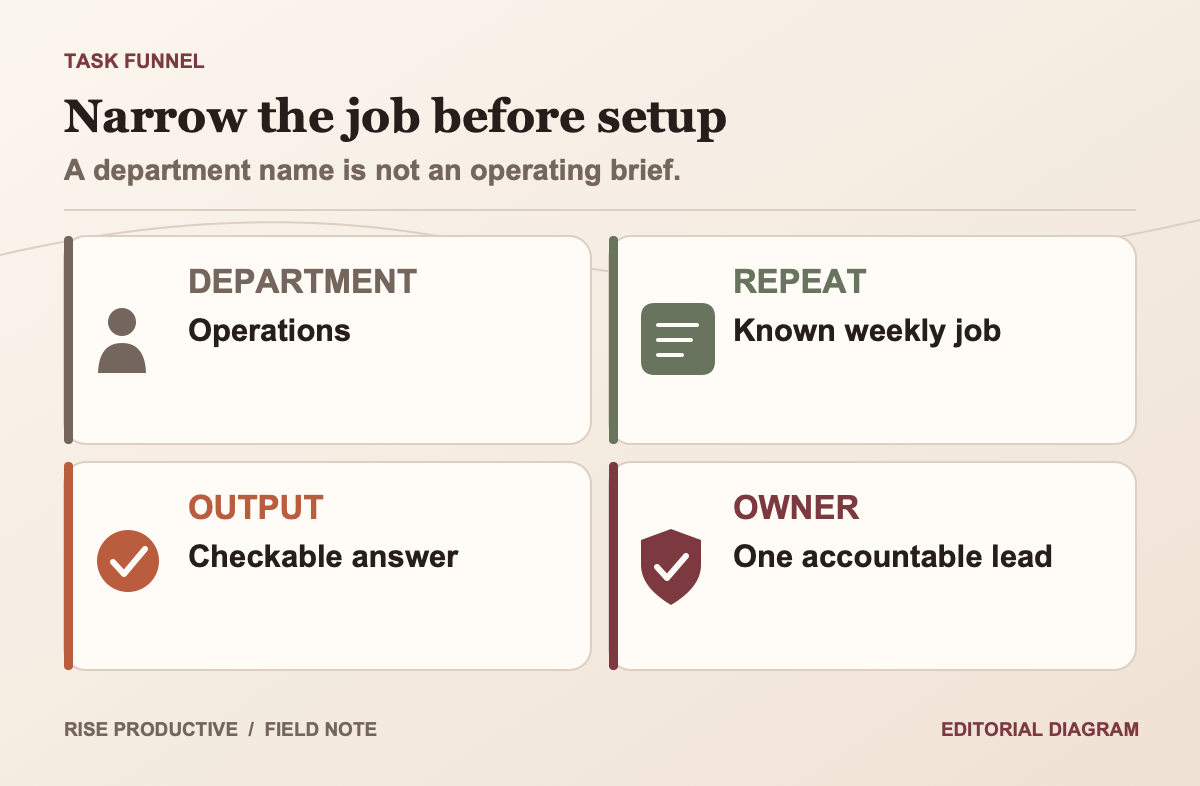
If the task survives that test, describe its present form in ordinary language. For example: “Each weekday, the operations lead answers three questions: what intake is approved, where the current template lives, and who handles exceptions.” This describes a repeated job, a shared reference and a human escalation. “Help everyone with operations” names none of those. A clear scope gives the Bot a boundary. It also gives the owner a way to judge whether the setup helps.
Treat each candidate as a workflow, not a department. Rise’s related GitHub Copilot shared-thread guide applies the same kind of task-boundary question to a different agent path. “Sales” is too broad. “Prepare a first-pass account brief from these five approved sources before the Monday customer meeting” is testable. The team can inspect whether the sources were correct, whether the brief omitted a material update, and how much editing remained. It can also stop the experiment without changing how sales operates.
 View image detail
Score fit across five workflow tests
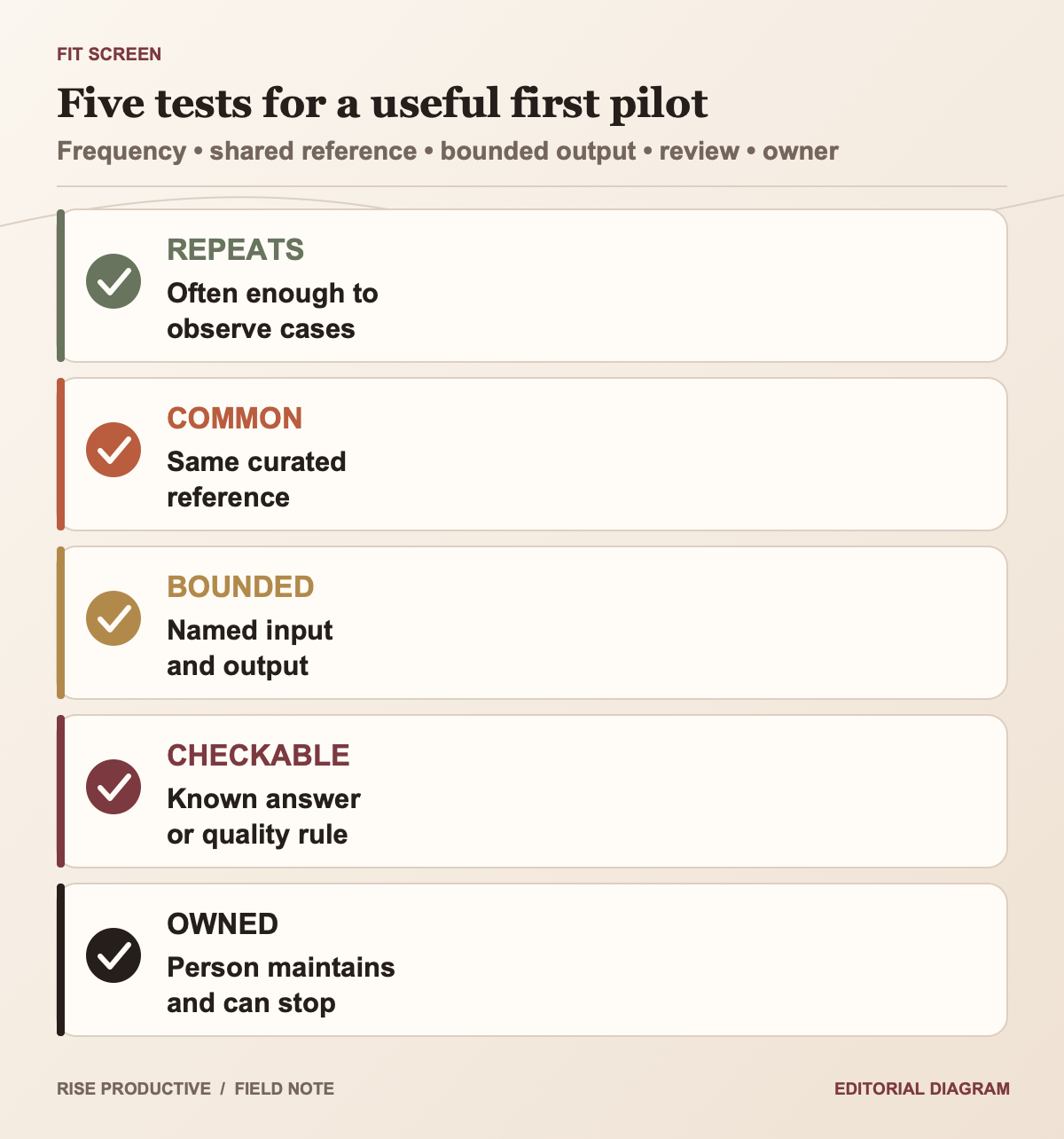
Use five questions to compare candidate workflows. This is a Rise planning aid, not a scorecard published or validated by xAI. A high total should not override a hard failure such as the absence of an accountable reviewer.
The tests work together. Frequency creates enough cases to review, but frequency alone does not make a good pilot. A stable shared reference helps only when the output has a clear boundary and a person can catch mistakes. Ownership ties those pieces together: someone maintains the sources, checks the result and can stop the trial. This is why the framework treats a missing owner as a stop condition rather than a low score to average away.
- Frequency: Strong first-pilot signal: The task repeats often enough to observe several cases; Weak signal: It is a rare, one-off judgment
- Shared reference: Strong first-pilot signal: Teammates need the same small set of current material; Weak signal: Each person needs different private context
- Output boundary: Strong first-pilot signal: The result can be described and checked; Weak signal: “Do whatever is needed” is the expected output
- Reviewability: Strong first-pilot signal: A named person can compare the answer with inputs; Weak signal: No one can tell whether the answer is correct
- Ownership: Strong first-pilot signal: Someone can update instructions and retire the Bot; Weak signal: Setup has no long-term owner
Start by writing the evidence for each signal, not just selecting “strong.” If the work repeats, list when and how often it occurs. If teammates share reference material, name the documents and who approves them. If the result is checkable, write down what counts as a correct answer and what should be left blank. This forces a vague product idea to become an operating hypothesis.
One disqualifier can be decisive. A workflow with sensitive information may still be suitable in some organizations, but it should not be the first experiment if the team cannot classify that data or check which controls the plan includes. A task with expensive or irreversible actions may also be a poor pilot when the team cannot confirm where human approval occurs. These are not blanket claims that Team Bots lack controls. They are reasons to choose an easier first job while admins answer the questions for a higher-impact use case.
 View image detail
Prefer a shared reference over a shared credential
The clearest first use cases usually share information before they share authority. A team might use an internal Bot to answer questions from a reviewed playbook, summarize a project decision log, or prepare a brief from approved documents. In each example, the Bot's value is the maintained context. Coworkers start from the same current reference instead of rebuilding it from scattered messages.
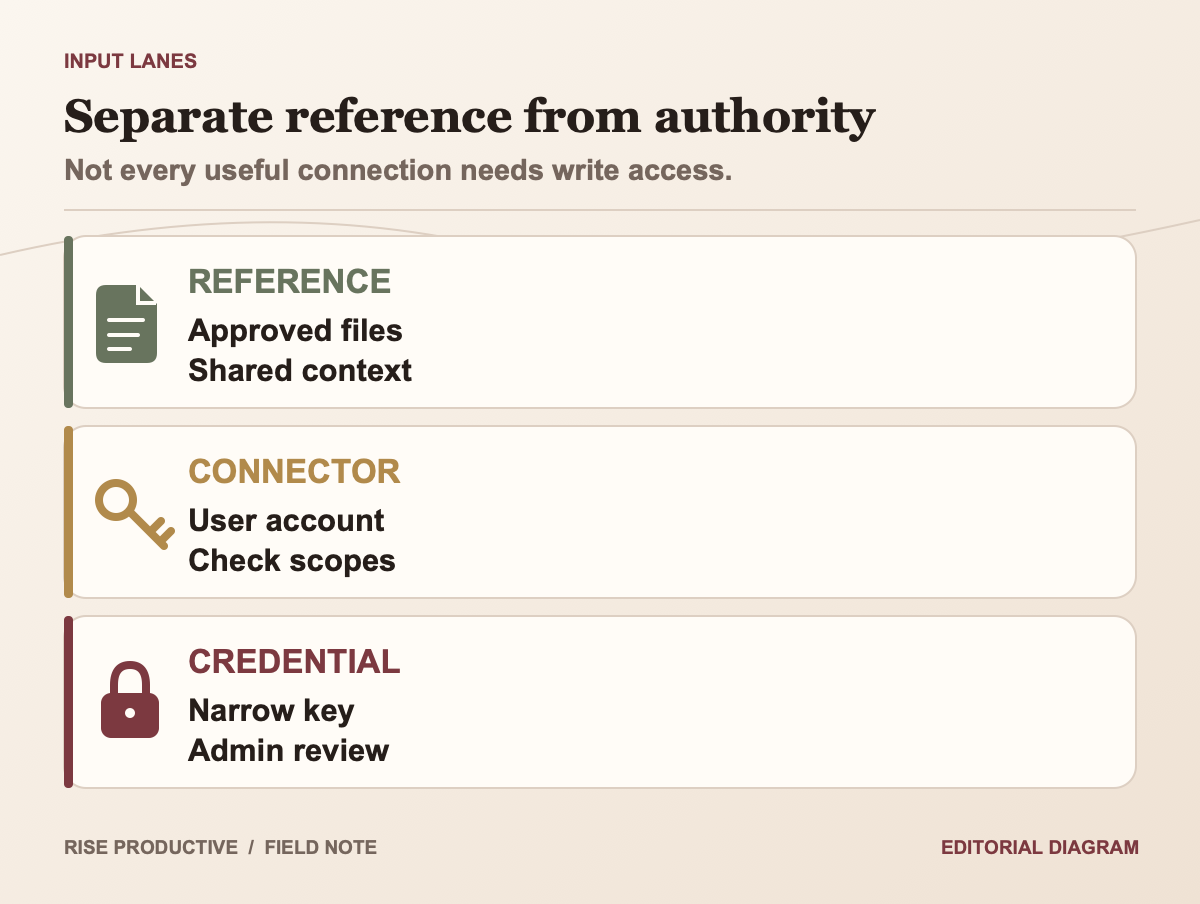
Connected apps and credentials can expand what a Bot can do, but they change the task's risk. xAI's docs say a Team Bot's shared plugins, files, skills, and secrets are shared across teammates' chats. It also recommends scoped, read-only service-account keys instead of personal credentials. That is a signal to keep the first context set as small as the task allows. It is not a reason to add every tool the team uses simply because a connector is available.
For the initial candidate list, sort each input into one of three groups: a reference the pilot team may use; a source that needs personal sign-in; or a credential or action that can change or expose data. The first group is often easier to evaluate. An admin should review the other two before they enter the Bot setup. The workflow owner may not have authority to approve a connected system. For related Slack app-scope and identity questions, see Rise’s Copilot in Slack and Teams admin checklist. Its controls are GitHub-specific, but its governance questions help make an admin review concrete.
The same applies to memory. A fact may be useful enough to retain, but that does not mean it should be retained forever or shared with every teammate. Decide which corrections belong in a durable team instruction, which belong in a user's private chat, and how an owner will remove an outdated team fact. Without that distinction, “learning” becomes an unbounded promise instead of a maintainable process.
 View image detail
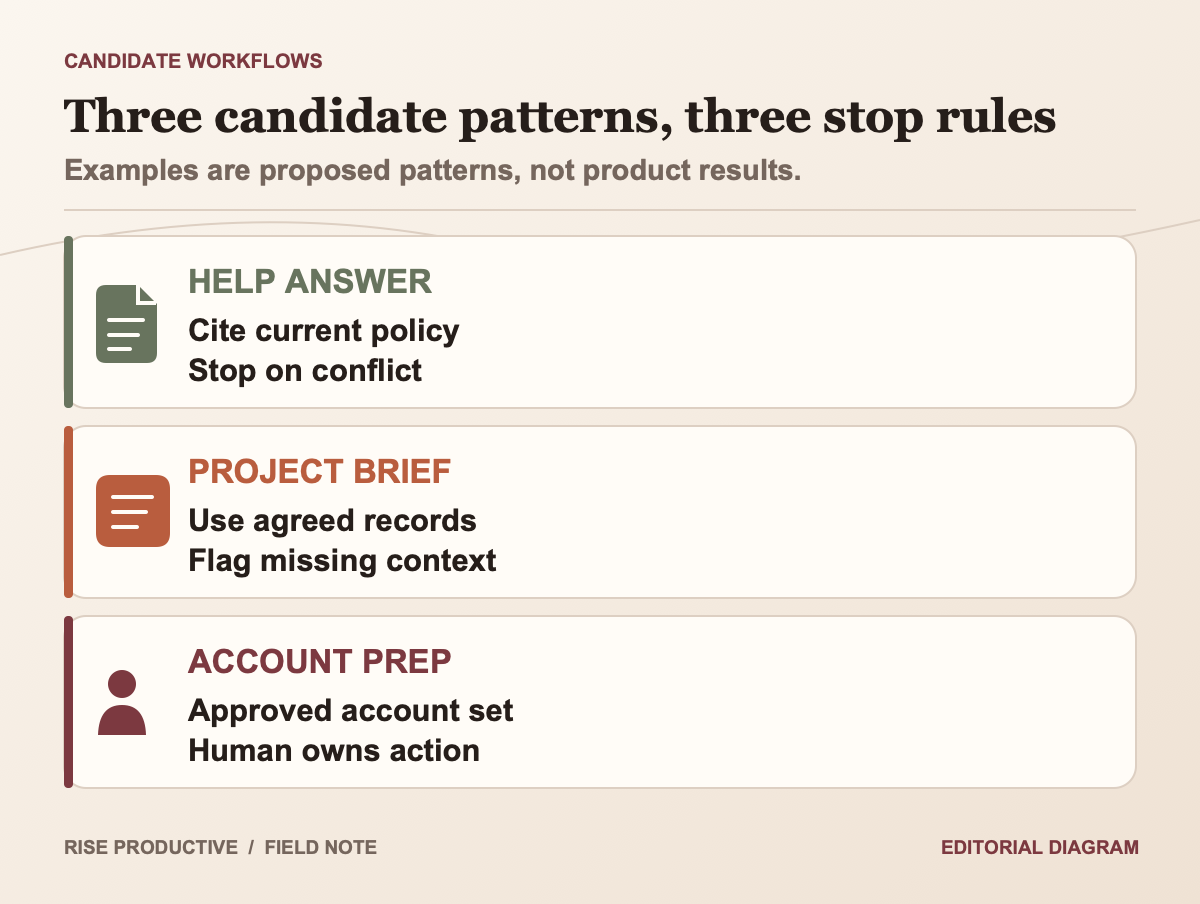
Three workflow patterns to consider, with disqualifiers
An internal helpdesk answer from approved guidance
A Bot could answer recurring internal questions from a controlled set of policies, onboarding documents, and templates. The result is easy to check if each response links to the exact source and labels exceptions it cannot resolve. A disqualifier: the team does not know which policy is current, or answers change materially across employees, jurisdictions, or customer agreements. Fix the source set before adding an agent.
A project handoff brief from shared records
A Bot might prepare a status brief from a small number of agreed project documents before a recurring meeting. The owner can compare dates, open questions, and next steps with those records. A disqualifier: the real decision depends on oral context or relationship judgment that is not in the files. The output should then surface that gap, not invent a confident status.
A customer account preparation note
A team might use a Bot to assemble a draft from sources already approved for that account. A customer-facing action should remain with the account owner until review roles are clear. A disqualifier: the connected data contains information the pilot group should not broadly access, or the team cannot tell whose credentials a plugin will use.
These examples are candidate patterns, not product demonstrations. xAI's announcement describes internal sales, engineering, marketing, and analytics examples, plus a customer story. Those accounts show what xAI says its users built. They do not establish that the same workload is available to every team, that the result quality transfers, or that a similar setup will create a financial return. Pick a job because its inputs and evaluation are understood, not because it resembles a vendor case study.
 View image detail
Work a hypothetical example before configuring a Bot
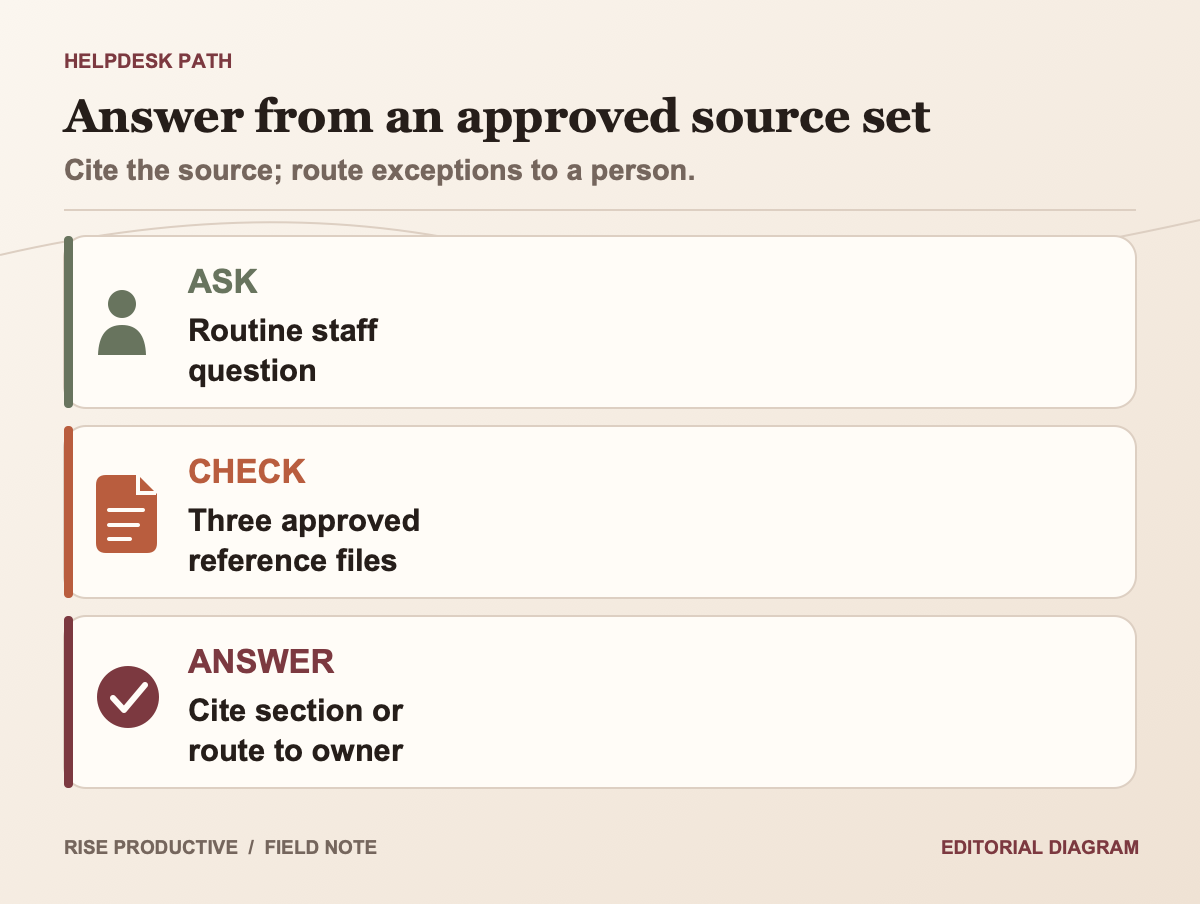
Suppose a 12-person agency repeatedly asks where its approved discovery template lives, what information a client must supply, and who handles an exception. Before building a Bot, the team would gather the current template, intake checklist, and named escalation owner. It would check that those materials agree. If two documents conflict, the owner would resolve the conflict before any model is asked to reconcile it.
The proposed Bot brief might say: “Answer only from these three approved documents. Cite the source heading. If the source does not answer the question, say what is missing and route the person to the operations owner. Do not send messages to clients or edit the CRM.” Each instruction is tied to a decision. The source list constrains context. Citations make the answer inspectable. The fallback reduces pressure to guess. The no-action limit keeps the first test at the preparation stage.
The trial could use ten recent, anonymized questions with an answer key made by the document owner. Reviewers would check source accuracy, missing exceptions, editing time, and whether a human had to reconstruct the answer anyway. The number ten is an example for a proposed evaluation, not a recommended statistical sample size. The team should select enough cases to cover the actual question types and record why the sample is useful.
If policy allows, the team could compare the Bot's draft with the existing human answer process. It should not send the drafts to clients or store personal data in an unapproved place. If no one can verify the answer key, the team has not designed a meaningful test. That finding is useful: the underlying knowledge base or ownership problem should be repaired first.
 View image detail
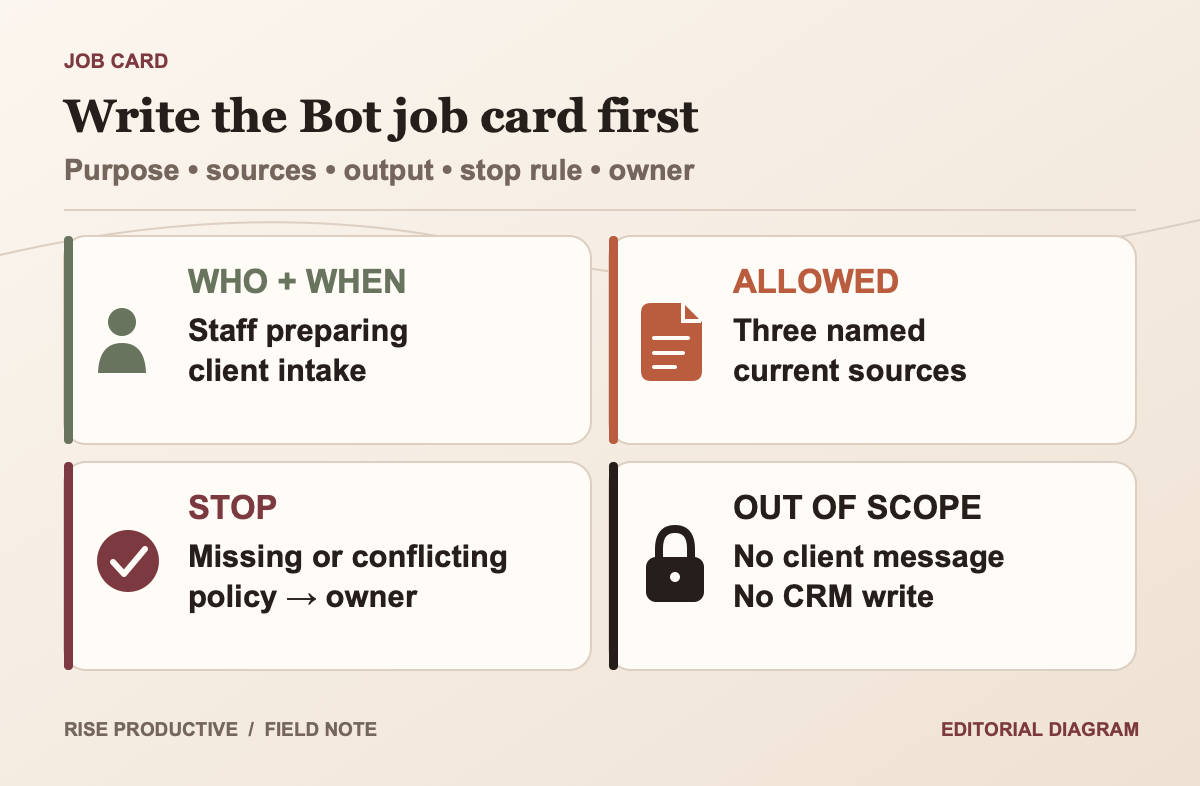
Write the Bot's job card before setup
A one-page job card turns a candidate into something the team can maintain. It should describe the work without relying on the Bot's name or on xAI's feature list.
- User and moment: Example for the hypothetical intake helper: Agency staff preparing a new client intake
- Repeated job: Example for the hypothetical intake helper: Find the approved template, checklist and escalation owner
- Allowed shared sources: Example for the hypothetical intake helper: The current template, intake checklist, exception guide
- Output: Example for the hypothetical intake helper: A short answer with the cited heading and next step
- Stop condition: Example for the hypothetical intake helper: Conflicting or missing policy; ask operations owner
- Prohibited action: Example for the hypothetical intake helper: Do not message a client or alter CRM records
- Human owner: Example for the hypothetical intake helper: Operations lead, with a named backup
- Review interval: Example for the hypothetical intake helper: Proposed review after two weeks and whenever a source changes
The job card also gives the owner a way to retire the experiment. If a process changes, update the source and the Bot's instructions together. If the owner leaves, the backup should know where the materials live and how to unpublish the Bot. If reviewers repeatedly correct one answer category, either improve the official guidance or remove that question from scope. The goal is not to make a Bot answer every question. It is to make the approved path easier to follow.
Do not write “learn from everything the team tells you” as the memory policy. Ask what knowledge should become shared, who confirms it, and how corrections are made. A Bot that captures unreviewed details may become less reliable precisely because people are using it. A small change process for common instructions is more useful than a vague promise of collective memory.
 View image detail
Set a baseline that can tell you whether anything changed
“People liked it” is not enough to establish that the workflow improved. Before the test, record how the task works now: approximate frequency, who does it, time spent finding the source, common errors or follow-up questions, and how the team knows an answer is complete. Keep the baseline proportionate to the task. You do not need a large analytics project to learn whether coworkers can find the right internal template.
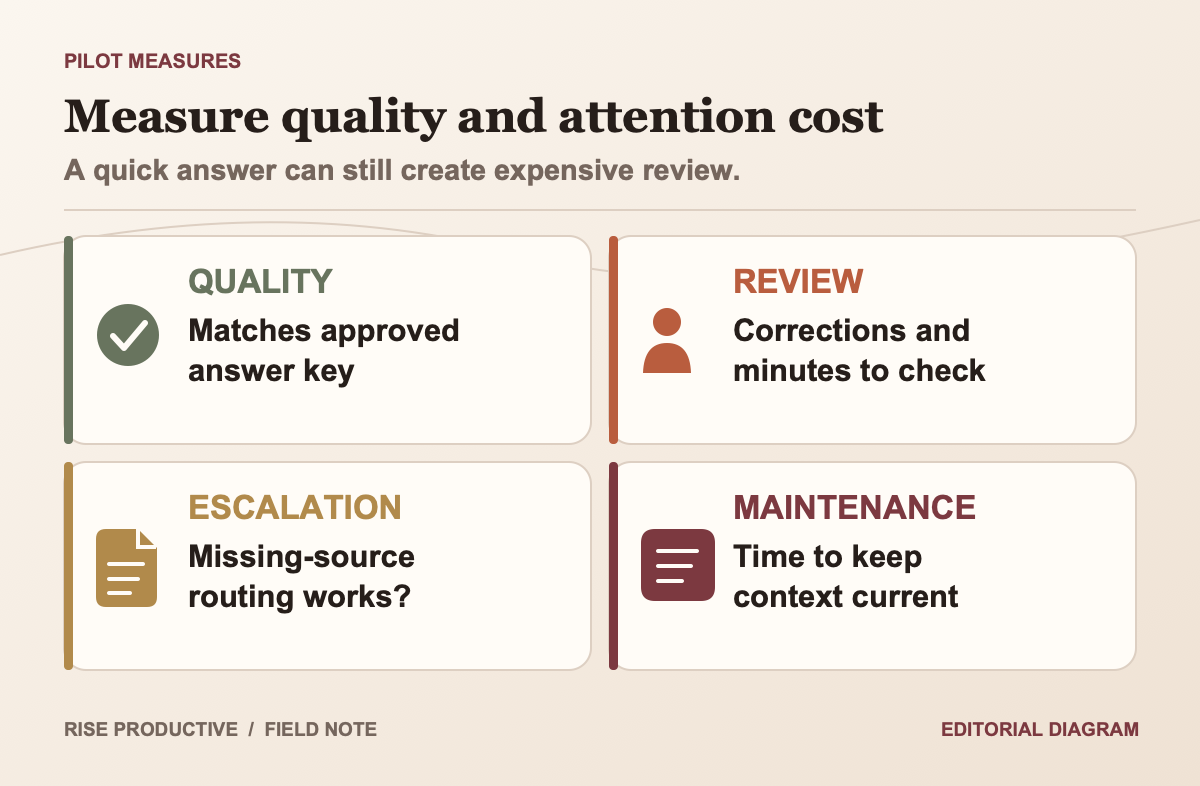
Then choose measures that match the hoped-for change. If the problem is repeated searching, track whether a person reaches the right source faster. If the problem is inconsistent answers, review accuracy against a documented key. If the problem is interruptions to a subject-matter expert, count which questions still require escalation and whether the escalation included enough context. If the proposed Bot only creates another draft that a person must rebuild, the workflow has not improved merely because the Bot produced text.
Keep output quality and attention cost separate. A short answer may be inaccurate; a long answer may demand more review than the human task it replaces. Note correction time, not only generation time. Identify who reads each draft and how long review takes. For a task involving external commitments, approvals, or customer data, time saved does not cancel the cost of a serious error.
Record the product plan, account path, connector, source set, and date of the trial. Product behavior and plan features can change. A result without those conditions is hard to reproduce. The xAI docs are a starting point for understanding the available controls; the affected account must confirm what is actually enabled.
 View image detail
Use a two-week trial as a decision window, not a success promise
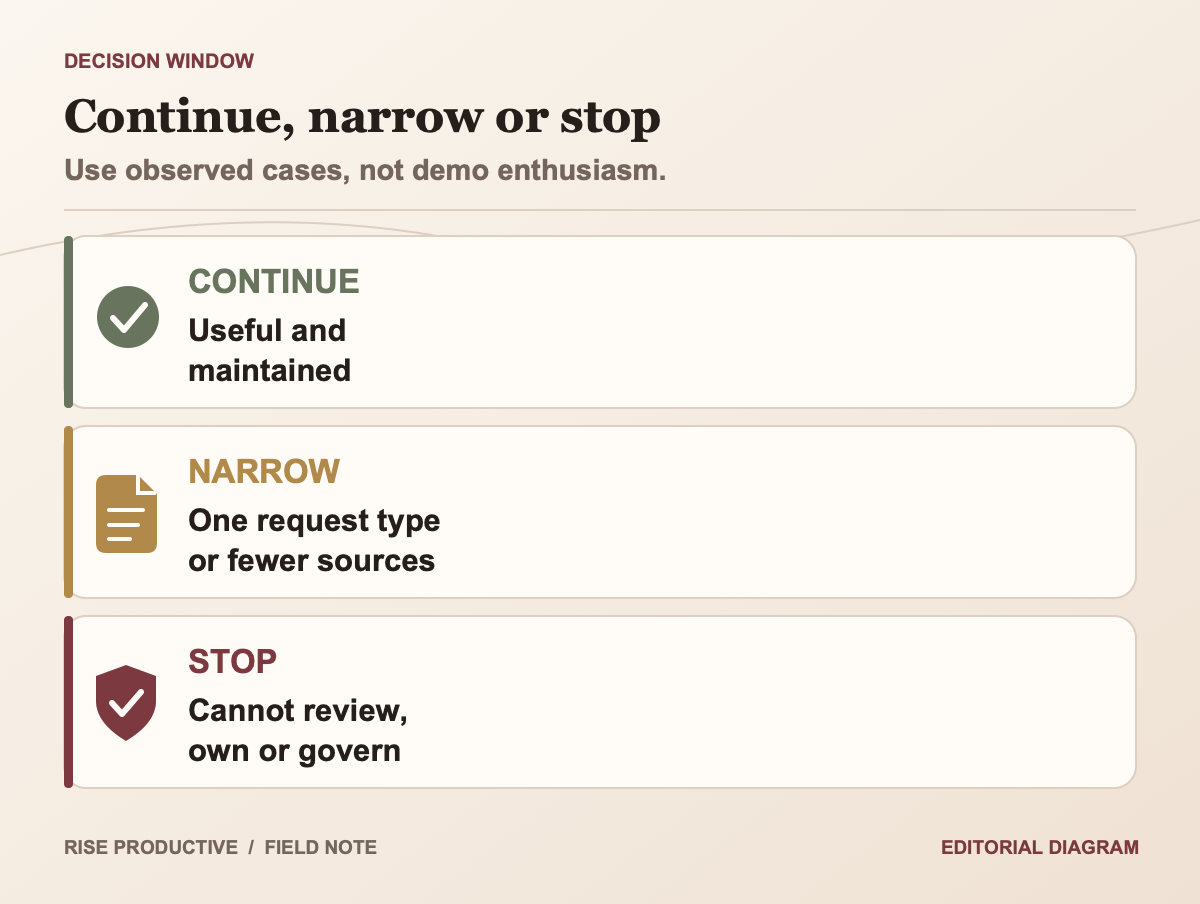
For a suitable candidate, a short trial could answer a few day-to-day questions: does the shared source set cover the routine cases? Can users recognize when they are outside scope? Does the output arrive in a useful format? Can an owner correct the shared materials? Does review take less attention than the current process? These questions can be answered without claiming that the product improves productivity at scale.
Set the end date before starting. At the end, choose one of three outcomes. Continue with the same scope if the evidence is useful and the source set has an owner. Narrow the task if a particular type of request creates confusion. Stop if the answers are hard to verify, if users keep bypassing the sources, if maintenance has no owner, or if the task is not frequent enough to matter.
The review should include people who do the work, the source owner, and the admin responsible for any connected system. An employee may judge answer usefulness; an admin may need to establish whether the intended connector or access path is allowed. One person's positive experience cannot answer both questions.
NIST's AI Risk Management Framework describes defining the scope of tasks and documenting human oversight as governance work. It does not certify any particular Bot. The useful application here is modest: write the task boundary and review role before the trial, then document what changed after observing actual cases. NIST's AI RMF core provides that broader governance context.
 View image detail
Know when not to share a workflow
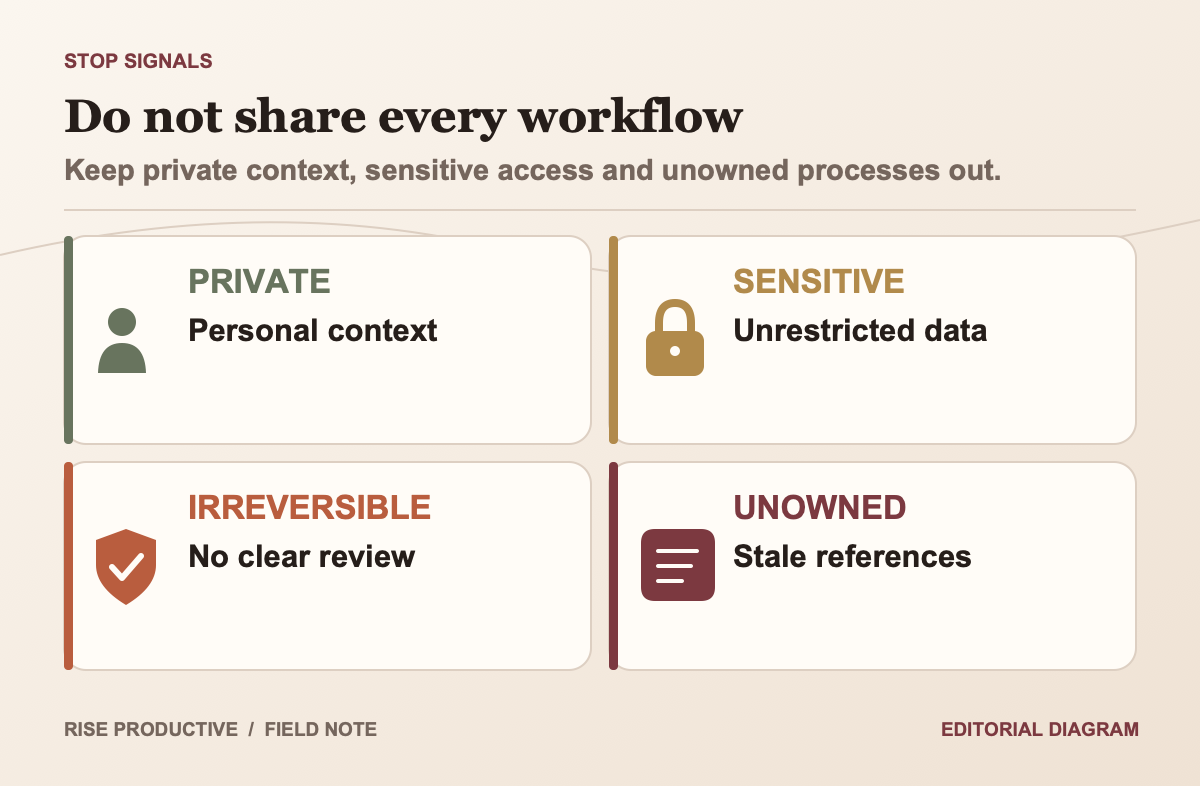
Do not make “shared” the default just because the product can be published to a team. A person might have a recurring task that depends on their account history, personal notes, or private decisions. It may be better handled with a personal Bot. The product docs distinguish team and personal Bots for a reason. A team-maintained assistant is most compelling when the task and the reference material are genuinely common.
Likewise, do not turn an ambiguous handoff into an agent task until the team agrees who owns the decision. If a request involves a customer promise, payment, legal acceptance, or a change to a live system, the output might be a draft or recommendation while a human handles the action. Whether a particular Team Bot setup can require review for that action depends on the current product controls, plan, chat path and account setup. The test should confirm the behavior, not assume that a setting available somewhere applies everywhere.
If the source material is unreliable, the Bot inherits that problem. If documents disagree about which template is current, adding a model could make the conflict harder to see. The owner should resolve authoritative-source questions before uploading files. If nobody can remove outdated context or maintain instructions, the shared Bot may become another neglected knowledge store.
For a low-frequency exception, route to the subject-matter owner instead of trying to force a confident answer. Good workflow design includes the cases the Bot should not take. A system that says “I don't have the approved answer” can be more useful than one that fills the gap with a plausible summary.
 View image detail
The useful decision: start with a common job, then prove the fit
Grok Team Bots introduce a useful possibility: one maintained Bot can give a team common instructions and references while each person retains a private chat. That architecture may make sense for recurring work where consistency matters. It also makes the quality of shared context, connector decisions, ownership, and review part of the workflow itself.
Before creating one, name a real repeated task and compare it with the five fit tests. Pick the smallest shared reference set. Write a job card that names inputs, output, owner, prohibited actions and a fallback when evidence is missing. Ask admins to check any connector, credential, Slack app or plan-specific control the task needs. Then run a bounded test against known cases and record reviewer effort alongside the answer quality.
If the result is useful, the next step is to expand one boundary at a time: more approved sources, a second workflow, or additional teammates. If the task is not shared, the evidence is difficult to check, or no one can maintain it, choose another form of support. A good AI coworker begins with work that deserves a clear owner and a fair test. The feature should not be asked to create that clarity on its own.
The key decision is not “Can the Bot do this?” Ask instead whether the team can define a small job, supply the right shared context, inspect the result and own changes. When the answer is yes, a bounded pilot can test the fit. When one of those parts is missing, fix that gap before adding another tool.
Sources and further reading
Source note: This article separates statements in xAI's announcement and documentation from external launch coverage, independent governance guidance and Rise's proposed workflow tests. The five fit tests are an editorial planning aid, not a validated tool. No live Bot was set up, and no product performance or customer outcome was measured. Recheck the official product sources before applying plan-specific details.
- Team Bots launch announcement (SpaceXAI/xAI, September 28, 2026; vendor descriptions and examples)
- Team Bots product docs (current product behavior; recheck account access)
- AI Insiders launch coverage (external reporting that attributes product and outcome claims to xAI; not independent validation)
- NIST AI Risk Management Framework Core (independent governance framework)
- What Is Work Worth Doing? (Rise Productive internal guide)
Checked for this article
Sources
Keep going
Related notes.
Automation and Agents
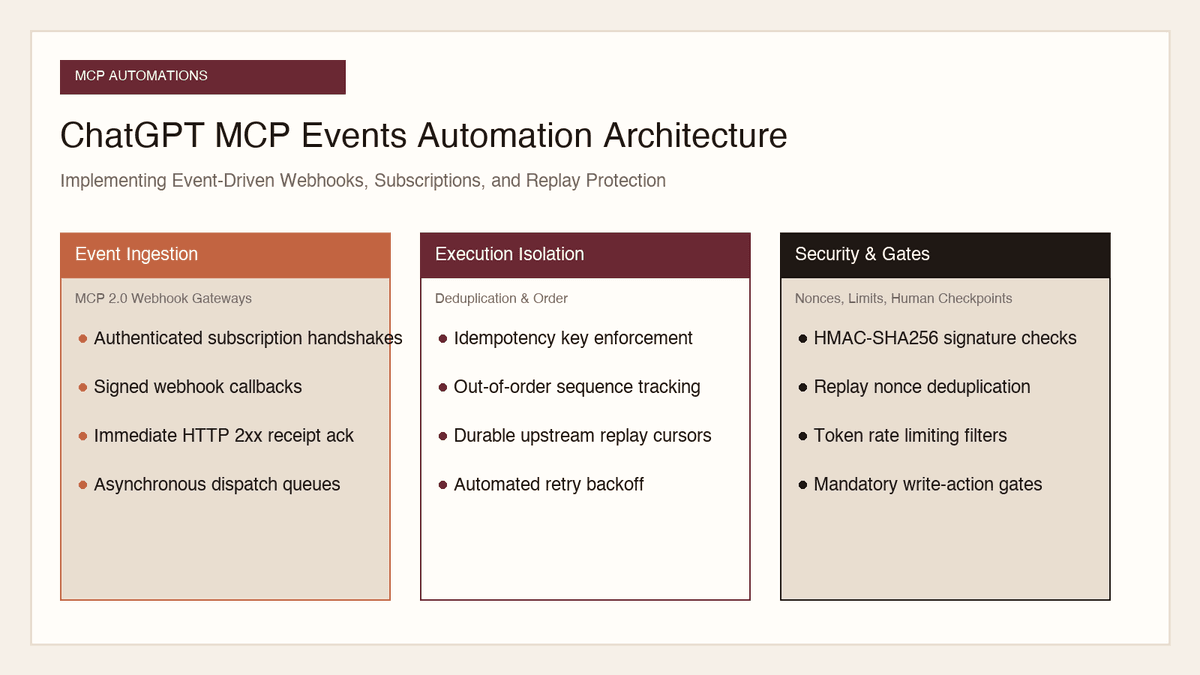
How to Implement MCP Events in ChatGPT: Event-Triggered Automations
Autonomous conversational agents no longer need to rely on wasteful polling loops. Here is how to implement event-triggered automations using ChatGPT MCP Events.
Read the article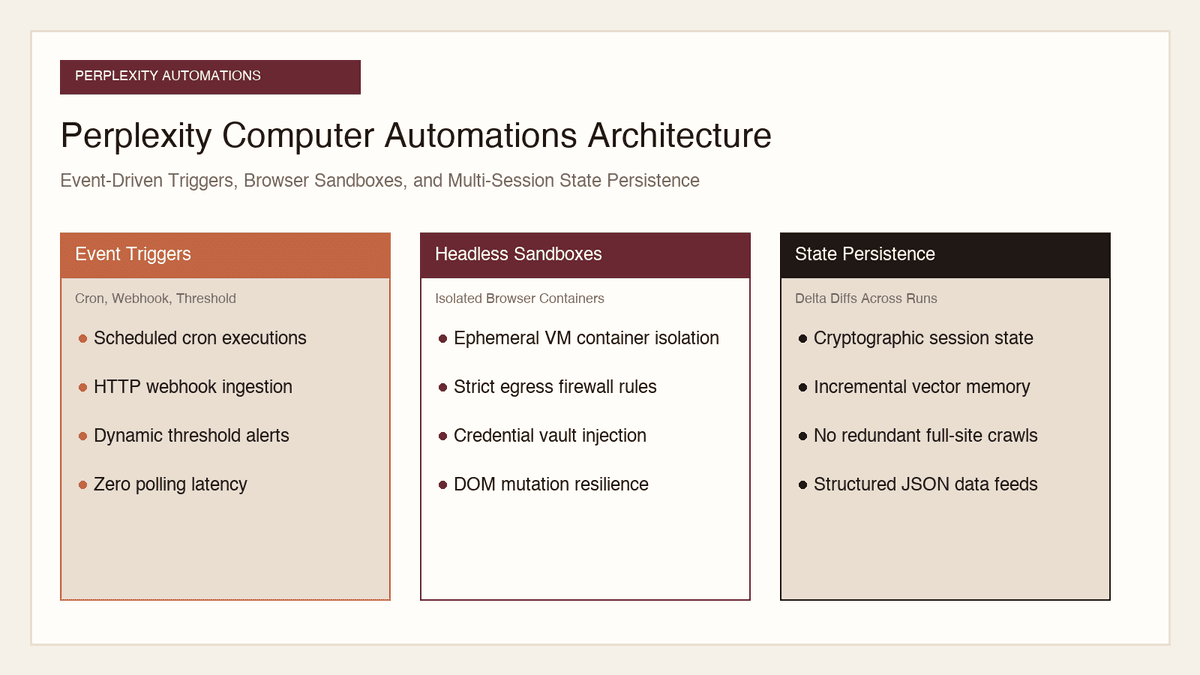
Automation and Agents
How to Build Recurring Web Automations with Perplexity Computer
Web scraping scripts break whenever a layout shifts. Here is how to build durable, recurring web automations using Perplexity Computer and persistent state.
Read the article
Automation and Agents
How to Benchmark Classifier Models: Latency, Cost, Determinism
Evaluating AI classifiers requires looking beyond static accuracy. Here is how to benchmark probability calibration, latency percentiles, and unit economics.
Read the article